Nice! I’m not a geologist and so won’t be able to glean as much as your wife. Nevertheless looking forward to following suit in Rheinhessen.
1 Like
As I understand it, the Roter Hang, or “Red Slope,” is Permian sandstone rather than Devonian slate.
Hey Paul,
Kevin has it correct (two points for Kevin!) - the old vine block was planted 1973. There are a couple of younger blocks of Riesling at Cole Ranch as well.
It’s a really cool vineyard (biased obviously) with head-trained vines planted on St. George rootstock and dry-farmed. I think it’s kind of a Goldilocks zone for Riesling that’s cold enough for a long growing season and that preserves acidity, but gets enough sun and warmth during the fall to ripen the fruit with really interesting and intense tropical fruit flavors. It’s one of our easiest, least stressful pick calls during harvest every year - the fruit just tastes right when it’s ready.
7 Likes
Cool! When do you usually pick?
In terms of sugar, we’re usually looking for 20.5-22 at most. Depending on conversion factor, finished ethanols are usually 12-low 13s, which is right in the zone for GG style.
In terms of calendar, in 2024 we picked Cole Ranch on October 2 and Wiley on October 1. They’re both late sites. 2023 was even later obviously being such a cold year, 10/24 and 10/19, but we’re generally somewhere around the first week of October.
3 Likes
Seems really late for California whites, but also sounds very Riesling!
Thanks for the close-up image of an 1897 map of Ohligsberg (courtesy of Max Kilburg). It shows the parcels and old site names, which match the current place-names on the cadastral map. The lower half is Ohligsberg (Am Ohligsberg); the upper half is Simonsberg. On the east side of Ohligsberg and halfway up Simonsberg is Auf der Mühl, spelled “auf der Muehle” on the 1897 map. Both Simonsberg, mostly colored dark red on Clotten’s map, and Auf der Mühl are in the present-day Wintricher Großer Herrgott.

Apollo’s Praise Dry Riesling. Chilled and pobega’ed.
Perfumed nose, slight petrol and herbaceous astringency on the nose, followed by white flesh stone fruits, white flowers leaning jasmine, some citrus. Intense fruit concentration of Myers lemon, yellow stone fruits, some hints of cherimoya and barely ripe papaya. Midpalate is decent, lacking some tension that can be found in The Knoll bottling. Medium plus acidity, medium-medium plus finish, lots of minerality of wet stone and slight powdery chalk if it makes sense.
Not your typical Riesling but it’s has insane QPR this might become my house riesling. @Kelby_James_Russell did it again 
3 Likes
Thanks for the kind words and a great rundown on our classic Dry Riesling! You’ve hit the nail on the head with the description, or at least what we are aiming for with the wine: it is intentionally a bit more open stitched and generous on the mid-palate than The Knoll or a Pentecostal Dry. This is largely due to the particular hill the fruit comes from, but is also what we want to capture for the ‘everyday’ style and what many folks will be looking for coming from a wide range of wine backgrounds (as opposed to the Riesling heads).
Taking a step back, for both this wine and our Kabinett, the other goal is to make wines that wildly over-deliver at the price. I think all of us in the wine world need to find ways to do exactly that if we want to get more people back into, and enthusiastic about, wine. Someone should be able to find a $20 bottle that they love and are excited by, that is a real path forward.
6 Likes
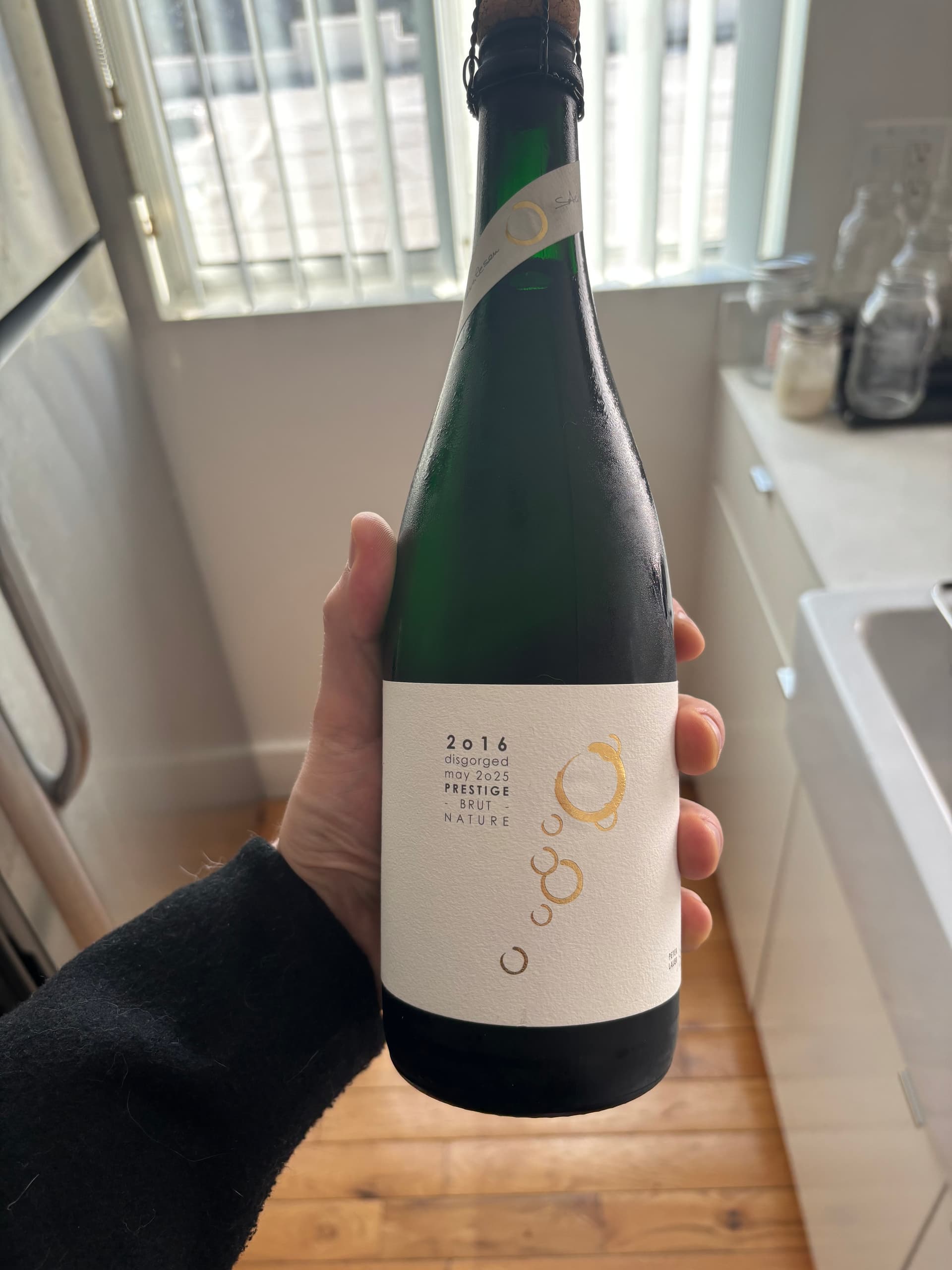
2016 Peter Lauer Sekt. Brut Nature. Disgorged May 2025
Seemingly a pretty unique bottle. I was browsing through Woodland Hills Wine Co. website, and saw they had a small allocation and I picked one up thinking I might never get another shot at getting to try something like this in the US.
Had all my favorite parts of Riesling and bubbles. Slightly bready but also had that signature petrol from the Riesling. Wine had tons of green floral and green vegetal notes, lemon peel, peach rings, and a touch of white pepper. What surprised me was how it didn’t really have a “bite” at all. I thought it might be given that it is Brut Nature. Very smooth and well balanced drinking experience.
We enjoyed this only slightly chilled where we found it to taste the best. One glass was served cold, but I found it to make the wine a little tight for my taste.
To be quite truthful it didn’t go that well with the classic fried chicken you would typically have with bubbles, but instead went much better with the oysters and the burger served on a brioche bun that we had as well.
If anyone has more insight on this offering I would love some!
2 Likes
Had a 2024 Peter Lauer Barrel X Riesling on Tuesday with gumbo (chicken & kielbasa) was a wonderful pairing, the wine was very easy drinking, need to get some more bottles
2 Likes
Something in Lyle Fass’s recent email has made me think. He describes Steinmetz as making wines of great “density.” I immediately felt I got the sense of his description, and agreed. It’s not just about body (I think) or alcohol content, but about low yield old vines, minerality, how “alive” the apricot is on the nose and palate, how much “information” the wine delivers per milliliter. Yes, all written in true Fass style. But I get the gist implicitly. Wondering, for one, if “density” in this sense is something particular to Riesling, or maybe more broadly to aromatic varieties.
Here’s a sampling from Fass’s email. The wine is Steinmetz 2024 Wintricher Geierslay GW.
“On the palate it is Steinmetz dialed up to eleven. The first impression is density. Old vine density. That feeling that the liquid has more information per milliliter than most wines manage in a bottle. The apricot is perfectly ripe but it is not jam and not syrup. It is an essence, a concentrate that feels molecularly bonded to the minerals. You taste fruit and stone at exactly the same time. There is also that bright, piercing acidity that is pure Steinmetz house style, but here it is so perfectly woven into the fruit and rock that you do not experience it as separate. The whole thing just moves in one piece.”
Density or palate weight definitely applies to many Steinmetz wines.
2021 Entelecheia Riesling Water Clock
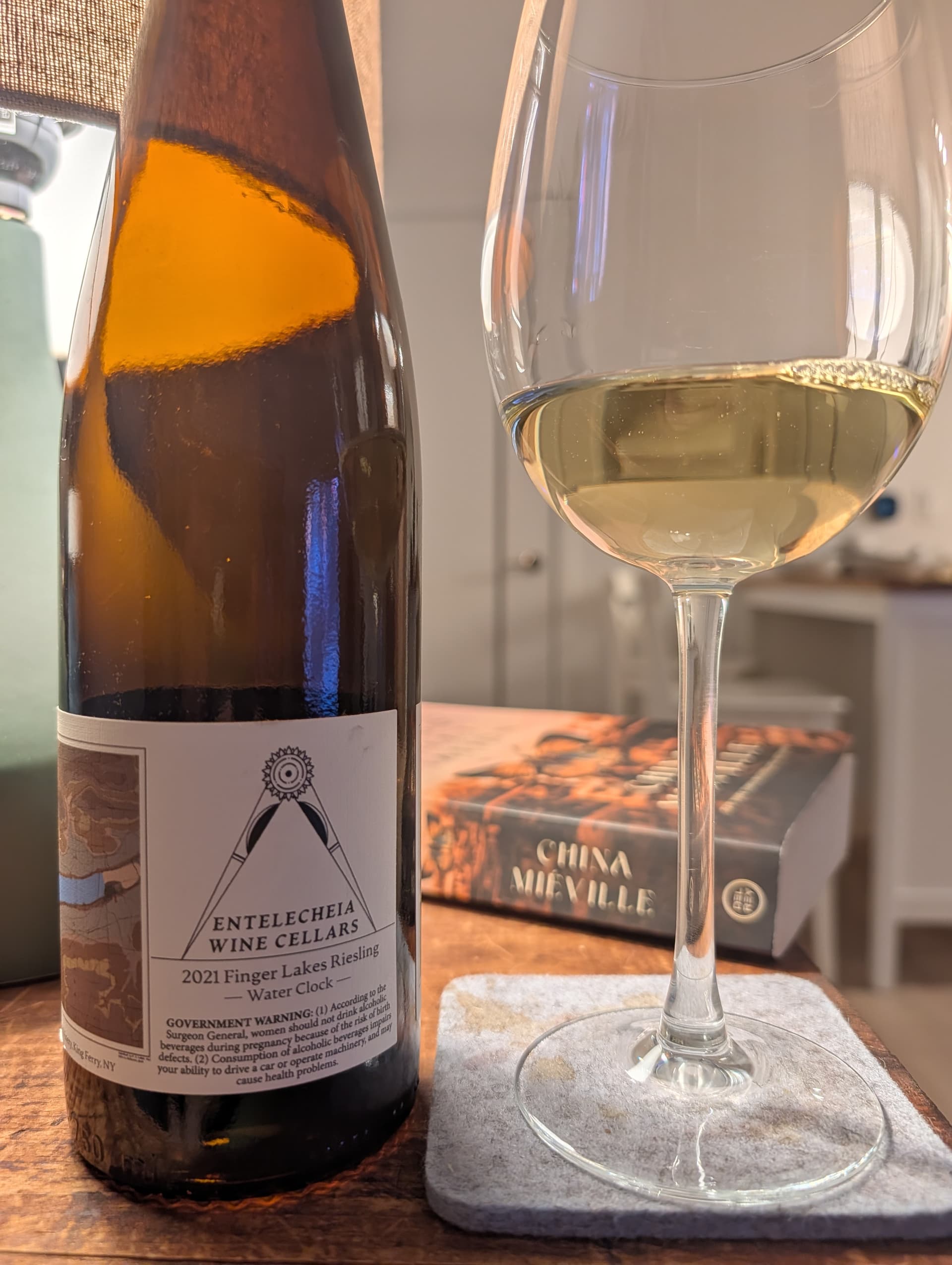
This is a real two-in-one wine, in several ways.
First off, it’s fully dry with just 5 g/L of RS, yet only 8.5% ABV! I was skeptical of it being underripe at first, but this is not the case.
First off, the label is a passion project of Matt Denci, who sources fruit from to various vineyard sites mostly on Senaca lake. He makes two wines per vintage, this Riesling and a sekt. The two are twins, as they are made from the same pick with the free run juice going to the sekt and the pressings to the still wine.
2021 is the current vintage for both. They received extended lees aging in barrel, which did what you’d expect for the sekt, but makes for an interesting still wine.
Popped and poured, it shows as a lemon-lime laser beam with racy acidity. Some tropical notes and petrol play a supporting role. After about an hour of air however, it turns into a completely different wine. The autolytic notes come out to play and the wine shows a waxy, toasty, and wooly side. The tropical notes, mainly pineapple, also come to the forefront. It’s like it changed costume from a young mosel riesling to a vouvray chenin.
Things kinda fall apart after that as it warms up, but quite a fun wine, and at 8.5% and dry I can chug these all night
4 Likes
Looks like the extra time in barrel dropped the alcohol %. Will try this during my annual NYC trip soon
1 Like
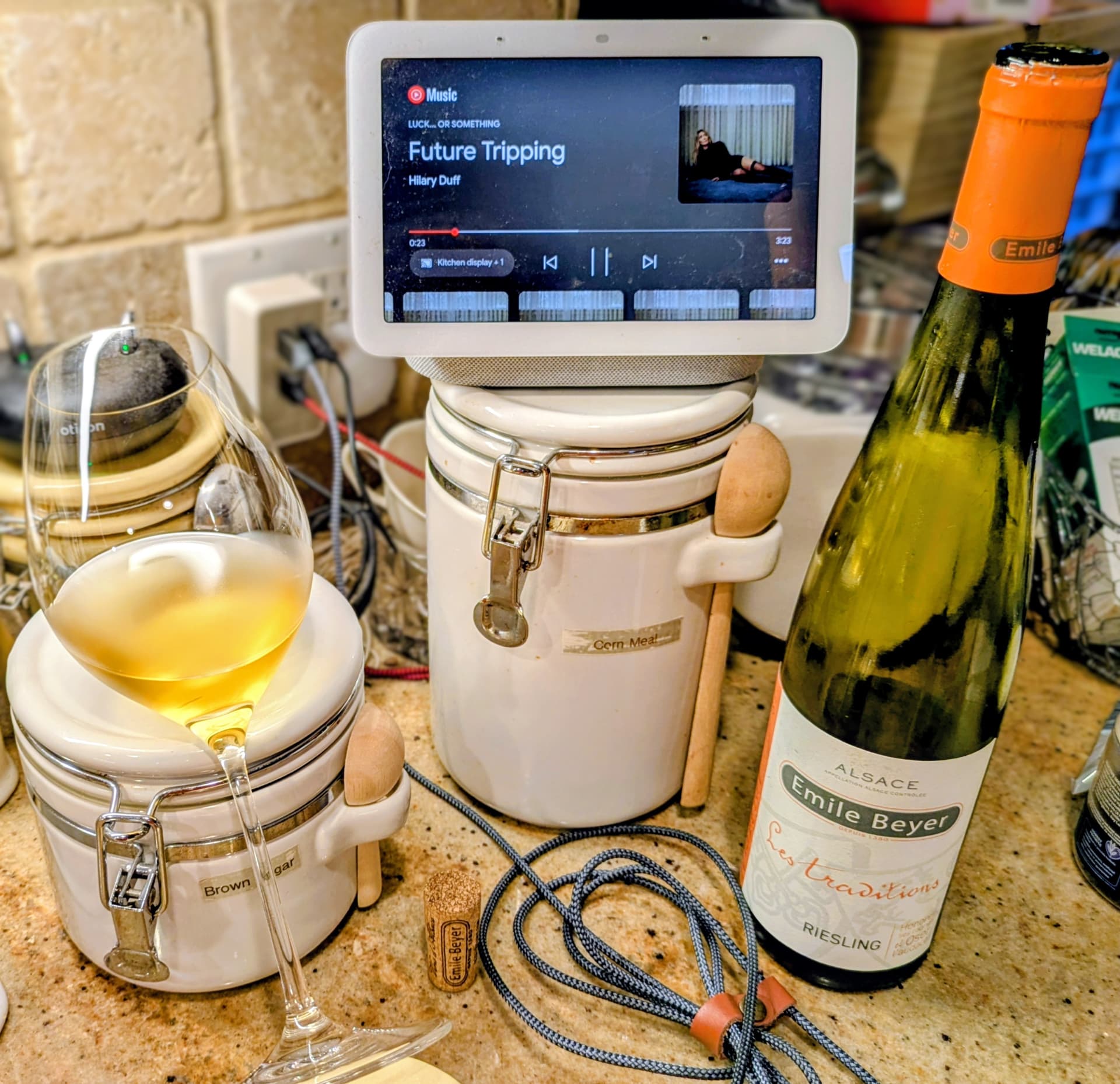
The 2020 Emile Beyer ‘Les Traditions’ Sec Riesling [Alsace] was midweek accompaniment to beef shank tacos, dim sum dumpling takeout, and pork chops with applesauce over three nights. I don’t love dry yet round riesling so was not enthused about this, although I suppose it drank the best on the 2nd night. At age six the color seems a bit darker than I would have assumed, but again, not very familiar with the region. If I was looking for Alsatian wines, gewurztraminers would match better with my preference for spicy Asian foods. This family has been making wines for some 400 years / 15 generations, which is pretty amazing by itself. I’d give this a B- on my card. 13% abv, medium body, agglomerated cork. A Michael Corso Selection.
2 Likes

This has opened and significantly increased in complexity since my last bottle two years ago. It’s not bone dry - must be near the legal residual sugar limit for a Grosses Gewachs - and it has some creamy lushness in the middle. There is fantastic cut and drive, spice, minerals, and wonderful myceliated soil complexity to contrast with the luscious apricot and pineapple fruit. Every bit as elegant as it is intense. Going to hold my remaining five bottles for another year, maybe two, as I think it will get slightly better before the law of diminishing returns kick in.
4 Likes
Been in New Zealand for the last two weeks and have had a number of very nice Rieslings, but the finest has been the 2024 The Bone Line Dry Riesling - their wines up and down the line were superb, but this was definitely a highlight. Pretty, precise, aromatically generous, savory and balanced on the finish. Around 6 g/L RS according to the winemaker. Their Hell Block off-dry Riesling was also very nice, but overshadowed by this one.
5 Likes
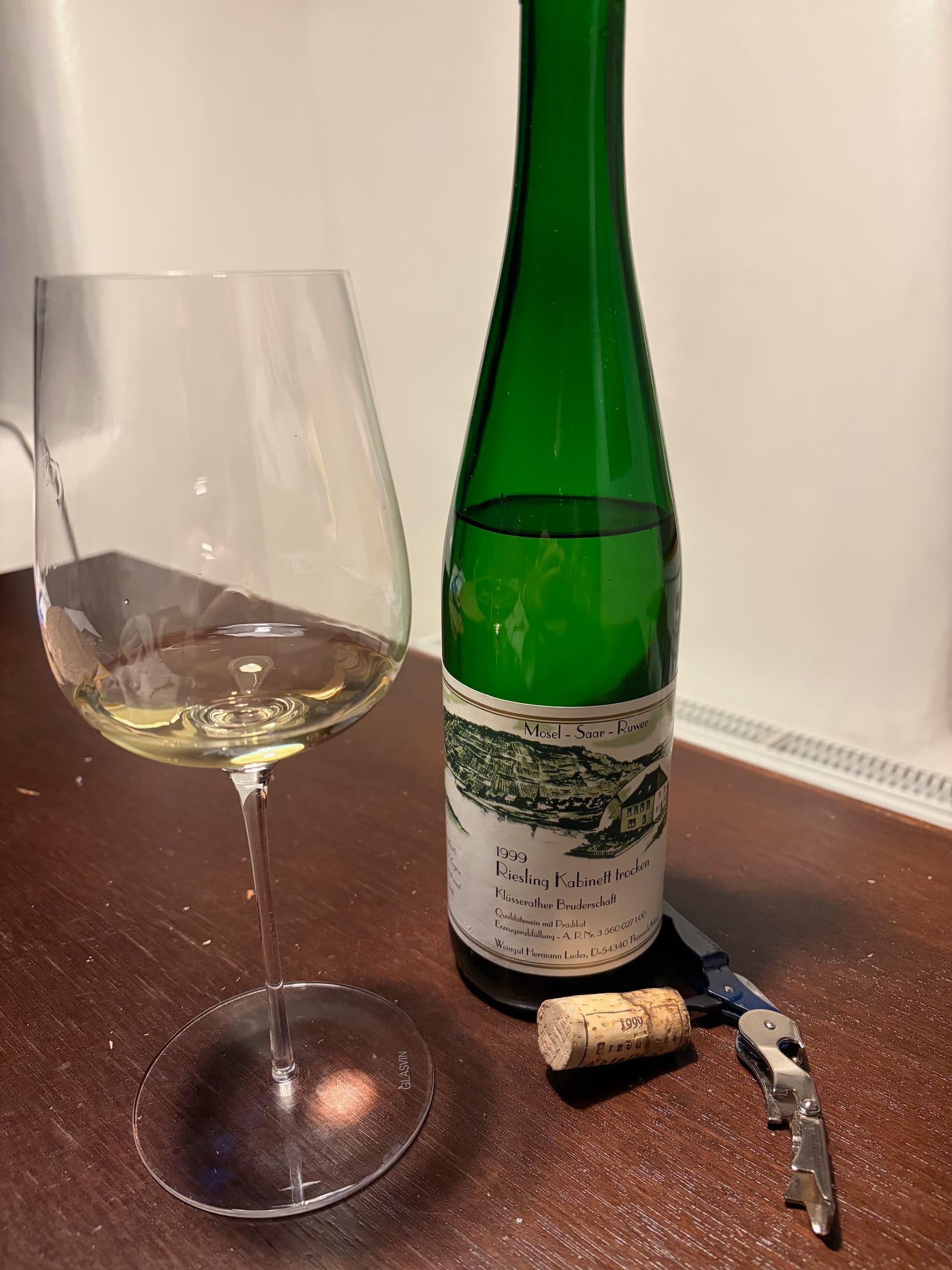
1999 Weingut Hermann Ludes Klüsserather Bruderschaft Riesling Kabinett trocken
A BD16 pick-up from @Jason_L 's Wine Explorers
First Riesling with anything close to this level of age on it. Immediate ripe tropical fruit (Guava/pineapple) on the nose. Had a petrol/gas note but it was “sweetened” by the fruit notes. I found some lemon/lime-soda grip and notes when drinking. Impressed by the balance and presence it retained over the hours. It slowly mellowed but retained the tropical fruits and beautiful balance, a wine I kept wanting to go back to.
A remarkable wine for me due to the exploration.
7 Likes
Nothing beats that first Ludes experience. 
1 Like