I got mad and bought zero bottles of Bordeaux between 2005 and 2012 because of their pricing decisions. I didn’t buy again in any meaningful amount until 2014, which they priced fairly.
7 Likes
Yeah well you’re not “en masse” you’re just Keith Levenberg 
2 Likes
I’ve written about this a few times but will write it here so you don’t have to look for it…
Yes, Bordeaux produces a lot more wine than Burgundy. It also remains the dominant market by volume when you are looking at secondary wine sales. I don’t think there is much debate about that. What is in debate is whether the trend away from Bordeaux will continue or reverse?
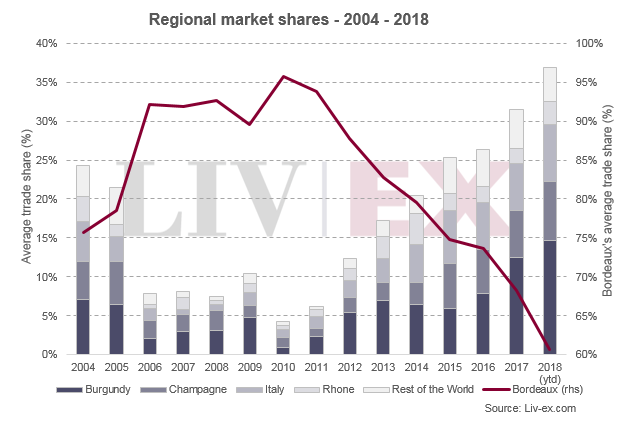
First, let’s look at market share. The chart below is sales of Bordeaux (rhs) vs all other regions on the Liv-Ex exchange. What you see is Bordeaux is far-and-away the deepest region accounting for up to 95% of all trade on Lix-Ex in 2010. Since that high it has fallen to 60%. What has taken over? All of the regions have grown in importance, but Burgundy is the clear upstart going from about 6% in 2004/2005 to almost 15% in 2018 (and that trend just continues from 2018 to today but I can’t find a good chart). I wouldn’t overlook the rise of Champagne and Italy either but Burgundy is the clear story.
The chart below is one perspective and I chose it because it was easy to find but you see similar things in the auction market.
To answer a conjecture above about what was so special about 2011, it was a confluence of a couple things:
- Demand was at an all-time high coming into 2010/20111 as Bordeaux was expanding into new markets, particularly China. In 2011 the Chinese instituted a gift ban, effectively killing a primary reason to buy Bordeaux
- Pricing was at an all-time high due to the high demand. The major producers kept pushing up prices, thereby alienating a lot of the previous customers leaving a lot of overhang when the Chinese demand suddenly fell
- There was a lot of speculative buying as speculators saw a large opportunity to make strong returns. When the real demand withdrew, these speculators lost a lot (see UK Bordeaux Ltd), had to dump, and never returned as buyers, thus the drawdown in demand was even more violent than just the real demand leaving
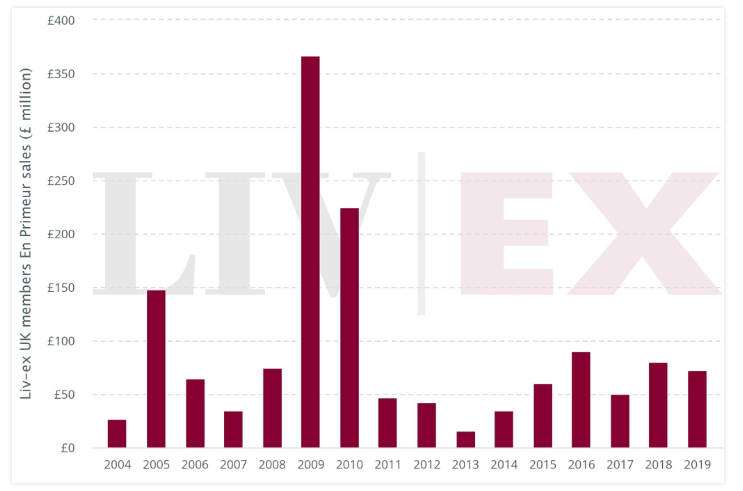
You can see here the Chateaus immediately pulled back pricing to try and recover but it was too late. People had already moved on, mostly to Burgundy which was both getting a lot of notoriety coming off the 2005 and 2010 vintages and gave those remaining new players what they thought they had in Bordeaux: cachet.
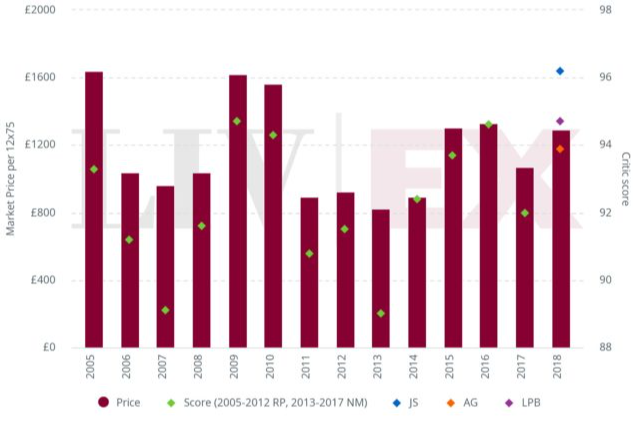
Now to pricing. Well, in the same period of time you see Bordeaux prices peak at the same time they hit peak trading and as the importance of Bordeaux has waned the prices have stagnated. At the same time, you don’t see Burgundy really surge as much as you see Bordeaux pricing fall. When you get to the 2015 vintage release then you see prices really start to move - Burgundy is now a star, people take notice, and the chase is on. From that moment, Burgundy leaves every other region in the dust.
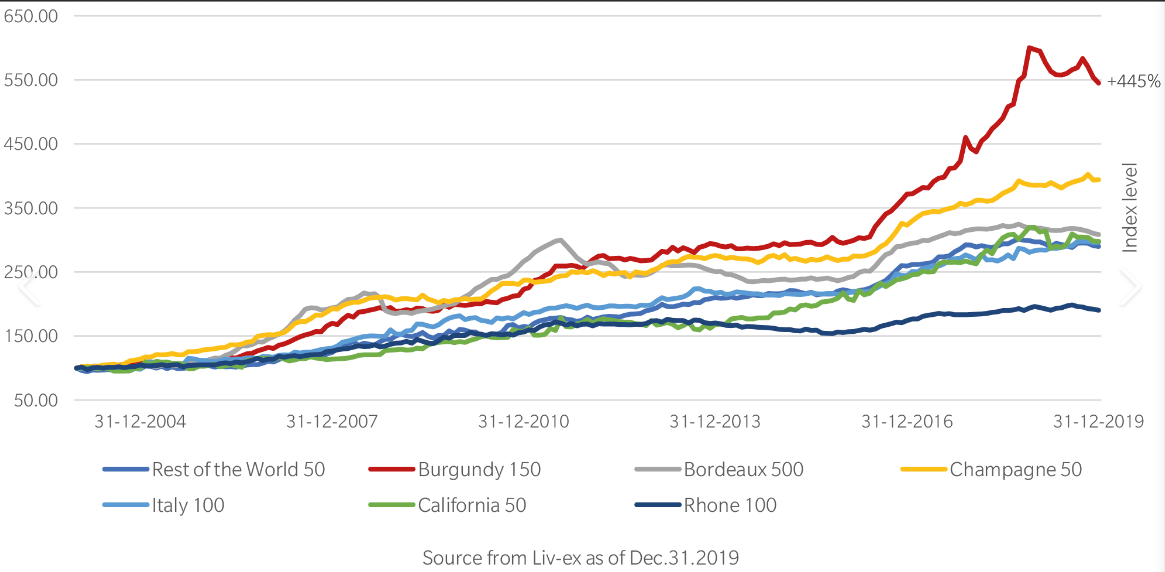
Here is another look. Depending on the index, Bordeaux pricing is either just getting back to 2010 levels or they haven’t hit it yet. Burgundy, on the other hand, is head and shoulders above all contenders.
(red = Burg, Blue = Bordeaux, Green = Champagne)
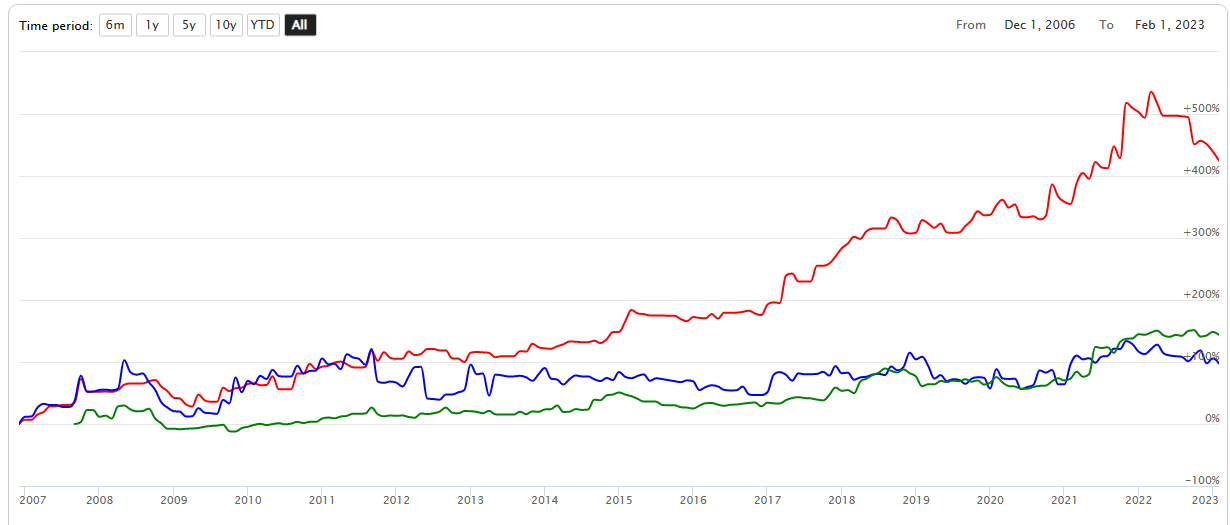
Now, is that dip in Burg real? Is Bdx considered “value” now? I think both are true: Burgundy was getting a little inflated as people were chasing and I think Bordeaux is now clearly undervalued. I think you will see a closing of the gap over the next 12-18m but I dont think Bordeaux is going to close the gap like before any time soon.
23 Likes
To be clear, i have always worn Brooks Brothers suits and Allen Edmond shoes. Always drunk Bordeaux and never the latest trend. I open the door for my wife, don’t wear white before the Masters, say “yes sir and yes mamn”, go to church on Sunday, basically never left Bordeaux!
8 Likes
Fantastic post by Alex Valdes as usual. Love how data-rich his posts always are.
What gets me about what might be called “price grievance” based explanations of why Bordeaux fell off after 2010 - explanations based on consumer resentment of price increases or whatever - is that Burgundy prices had already clearly exceeded Bordeaux prices by 2012 or so and the Burgundy-Bordeaux price gap only continued to grow through the last decade as Burgundy’s market share has expanded. If people resent price increases why don’t they resent Burgundy?
What happened is that speculators lost faith in high end Bordeaux because they realized that Bordeaux’s underlying demand could not support price increases for such a large supply base of high end wines. Speculative interest is crucial not only because it supports prices directly but because it contributes to cachet. Speculators had no problem with Burgundy price increases - they don’t give a shit if release prices go up so long as prices continue to rise in secondary markets so they can make a profit.
1 Like
Appreciate it!
I absolutely agree. They don’t care - they just want the return and, as you said, their involvement in the market exacerbates the upward trend (as they are grabbing cases real demanders want) and the downward trend (as they dump wines they don’t actually intend to drink)
I also think this is a cool chart. This is ex-chateau pricing vs market pricing at delivery. What you see is, for a long time, there was a good reason to buy ex-chateau: you got a good deal. When you look at this vs EP pricing, you see that as prices rose the supply chain profit fell. Now, many people consider that a good thing (how many times do we hear about Burg ex-chateau pricing at ridiculously low levels vs what you get it at) but look what happened when the chateaus, trying to take advantage of the booming market, tried to capitalize - the market turned over.
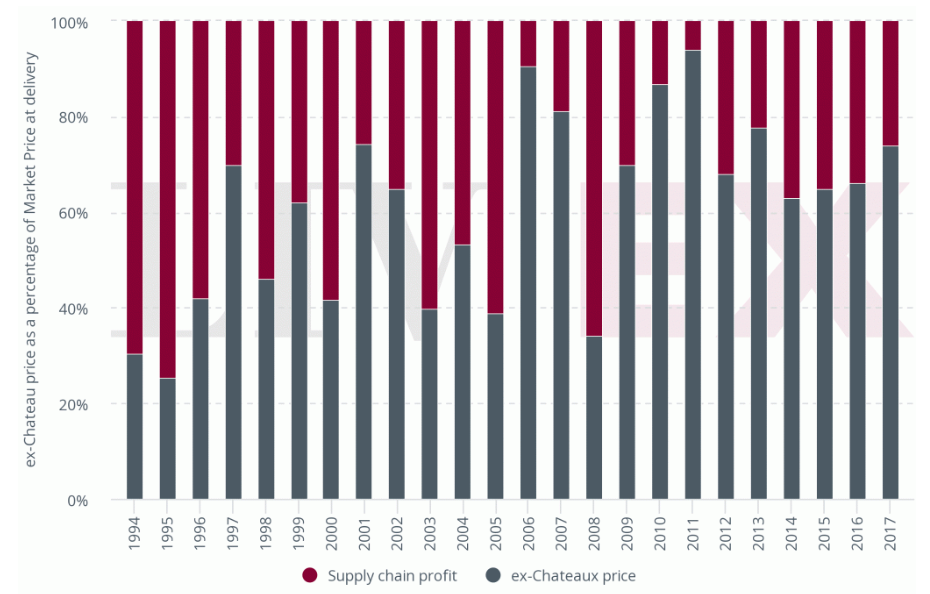
Commodity producers boom and bust for similar reasons (as do many people who act only when the market is really frothy like Jay Z asking to get paid in EUR right before the EUR collapsed or NFL players asking to be paid in BTC right before a collapse): they are acting without really understanding demand. I think the moves by people like Charles Lacheaux and others to try and capture all of the upside are setting very high floors for Burgundy and, if the market softens, it could be more painful than expected for producers. That said, at such low production, it doesn’t take many people to buy up a few hundred cases, but if the cachet isn’t there, people may shy away.
6 Likes
The Plague. The Horror.
1 Like
I think that in order to ‘flip’ things back, the First and Second Growths will have to ‘identify’ special vineyard blocks that are ever more exclusive and then build lovely little brick/stone walls around those special blocks.
A six pack of 2030 Mouton will come in a bespoke wood case, with the buyer’s name branded into the wood, and will contain one bottle each of their tiny vineyard blocks and one bottle of their ‘combined’ cuvée members only wine.
They will have Mouton Beckstoffer block, Mouton Louis XIV block, Mouton Hooper block, Marthe’s block, and The top of the heap….Aigle Criant block.
5 Likes
2008 was well priced.
7 Likes
Well, Angelus already offers Hommage a Elisabeth Brochet and Cos made the one-off (I think) Cos100, so arguably they are already drifting in that direction. I am sure there are other examples.
Aigle Criant. Beautiful.
Although for consistency, since the US got rid of George III, the Mouton would be Louis XVI rather than XIV.
2 Likes
Basically the ppl that are going to get screwed if any are like that guy buying random white burgundy because he thinks it will appreciate in price.
My general strategy is I look for good deals on wines I want to drink. If they appreciate a lot, great, maybe I’ll sell some. If not, then I’m happy to own them. I’m not trying to seek out a ton of the wines with huge price run-ups, not only because of price but also they’re not generally my favorites.
8 Likes
How much of the burgundy market do you think is speculators/flippers though? A fundamental issue is that the small amounts available make accumulating large positions very difficult.
For all the complaints I see about the state of the burgundy market (not from you, to be clear), Bordeaux has been much more of a funancialized commodity for vastly longer.
As to the OP’s actual question, I think the answer is when great Bordeaux is considered very drinkable young.
2 Likes
In Burgundy, I believe specs are a small share of the buyers, which is why I think the downward price movements in burgundy wont be big, especially when compared to Bordeaux. Are there more specs in the burgundy market than a decade ago? I think so. I think brokers tilted their books away from Bordeaux to acquire more Burgundy by buying cellars off collectors at high valuations hoping for a quick flip. I think that will bite them but, given the realities of Burgundy, they couldn’t amass very much.
2 Likes
Yeah, I strongly agree with you. It’s just not really possible to start buying cases of Rousseau Chambertin at attractive pricing because it’s almost impossible to source it in those amounts even at mediocre pricing. Whereas speculating in Bordeaux is fairly easy - you can buy just about as much Lafite as you want.
3 Likes
Agree. Which is why champagne is really interesting. 16,000 or so cases of Lafite are produced every year. 8,000 cases are produced of DRC across 10 wines so clearly there is a fundamental difference. The major champagne houses produce something like 100,000 - 200,000 cases a year (I’ve seen Krug estimated at 400,000+ cases annually) and yet champagne as a category, while not Burgundy, shows a lot strength. Now, the small growers, who are so hot right now, produce much more inline with Burgundy levels of production, but the major Champagne houses seem to be managing the rabid uptake well. Market pricing for the strong recent vintages has gone up and they seem to be cutting supply to keep price levels high.
2 Likes
I think it’s interesting in that there are a few prestige houses that do their own sales and distribution that constrain their releases and which also have a lot of different wines (Bordeaux might have 3?). I also think some will have watched Krug’s 2008 (and to a lesser extent Salon’ 2008) attempts to set a new very high price level and mostly fail - not so easy! I think the 2008 increase was as much a catching up to burgundy as anything else; Comtes at $100 for the 2004/2006 was too cheap given the quality.
2 Likes
Some interesting analysis here.
I think as long as the wine world continues to pretty much universally embrace the concept of “terroir”, as opposed to the once very strong concepts of grape variety and brand, all roads will continue to lead to Burgundy, that’s pretty much built into the discourse. You cannot really talk about “terroir” for any length of time without talking about Burgundy. As we have entered a new phase of more information-driven globalization, the reverse of what people anticipated has happened, and homogenization and anything “international” are out, whereas strongly individual, local products are in—one can see that trend in a number of fields—and this has also played into Burgundy’s hands.
But there is so much interesting stuff going on in Bordeaux today that I do think a ‘rehabilitation’ is due, and I am working on a long article about all the agronomic and technical evolutions over the last decade and a half that make Bordeaux an exciting place today. It’s an historical aberration that so many serious wine lovers don’t pay attention to Bordeaux, and so many wine lists don’t list Bordeaux, and I think it has somewhat unbalanced the fine wine market over the last ten years. The problem has been that a lot of the great work being done simply doesn’t get talked about: we get articles about the architect who designed the new barrel room, or the new Saint-Emilion classification, and the fundamentals, which are the details of farming and winemaking, get glossed over. So that is for us in the media to address.
18 Likes
There is an important question central to this discussion: why did the trend move away from Bordeaux and what would drive it back toward Bordeaux? @William_Kelley offered some of his thoughts:
I read the framing as terroir-driven scarce individuality is preferred: an individual producer, producing something only they can produce (because only 1 or a handful of people have access to that specific plot of land which produces a specific flavor profile), in quantities so small only a few will get the chance to taste (one person, small plot = small production). But what is the opposite of terroir-driven scarce individuality and is it Bordeaux? That is why I bring up champagne where natural scarcity, outside growers, isn’t as much the issue. Would Bordeaux change course if they put the wine maker more front and center and cut the number of cases offered in the market by 50%?
For me, I think there is something to this and something to what @Greg_K mentioned about when people feel like they can enjoy Bordeaux vs Burgundy. But, I think the issue is more at the core of how tastes evolve. The art world is a good example of this: why do certain styles of art dominate year in and year out? Because of what the collective of the art community believes is the most important art. It’s hard to find the start or the end of that train, and I think it is similar with Burgundy. I believe William is saying, at the core, it’s the terroir. He may be right, and I am sure that has something to do with it, but it feels more conceptual in nature than that - like Miles quips in Sideways “ Cabernets can be powerful and exalting, but they seem prosaic to me for some reason. By comparison.” You don’t want to drink wine that you feel is “prosaic” - that is where the zeitgeist is right now.
2 Likes
William, do you think any of the trend is driven by burgundy (especially at a high level) being more approachable younger? I don’t mean that young La Tache achieves the same apogee of experience as a bottle from the 70s, but producers like Mugnier, Gibourg, Liger-Belair and many others make wines that in many vintages can be drunk fairly young and provide fabulous experiences, which is harder with Bordeaux. The 2010 Mugnier Amoureuses is a spectacular wine today, whereas I wouldn’t expect a 2010 Lafite to be remotely as approachable.
3 Likes
I think that there are a couple of things going on.
First, most people (even people who like wine) don’t really know that much about wine. People got comfortable buying Bordeaux in the 1980s IMHO because of Robert Parker and the Wine Advocate. Easy to read and understand scores meant that anyone who liked Bordeaux could find good Bordeaux. Even if he should have rated a wine 92 when he rated it 95 or vice versa, one could know that one was getting a good Bordeaux rather than a crappy Bordeaux. And, in those days, there were a lot of crappy Bordeaux (it was not just traditional vs. modern, it was good vs. poor). Bordeaux soared and prices went up and up. Quality increased for a lot of the poorer Bordeaux.
Burgundy was different. Burgundy was even more difficult to understand and Parker did not help much. For many, many years Burgundy became the stomping ground for the cultist - the people who craved learning about one small producer after another. The great unwashed focused on whether a wine was a grand cru or a premier cru while the cultists searched out wines from Roumier, Mugneret-Gibourg, Bachelet, etc., which at that time really were not selling wines at a premium over the prices of wines from lesser producers.
That all changed with wine writers like Allen Meadows, John Gilman and, more recently, William Kelley who really understand Burgundy and told people which producers to buy. Those producers became extraordinarily hot and remain so today. Most of the top producers of Burgundy make wine in tiny quantities and so prices for these wines have soared to a level that might never happen in Bordeaux (other than maybe on the right bank) given the size of top estates in the Medoc.
At the same time, Bordeaux became more difficult because of tremendous stylistic differences among wines made at different estates. And, Bordeaux faced competition from Cabernets from other places like California in a way Burgundy does not, no matter how much lovers of Pinots from California and Oregon insist otherwise.
What will the future bring? Who knows. Burgundy’s #1 threat IMHO is climate change that could change the character of the wine. But prices are likely to continue rising for some time as there are lots of really rich people in the world and not that much wine. Buy wines from the Cote Chalonnaise and Chablis while you can (read William’s work on the Chalonnaise) or don’t complain when others beat you to it and the prices go up.
I think Bordeaux’s number 1 threat is that it really has become two markets. I think the prices for the better Bordeauxs will go up. The last few years (since about 2014) there have been some really good buys in top (but not really top) wines and at some point wineries like D’Issan for example are going to be discovered and prices will go up.
But, Bordeaux is a really huge region and there is a second Bordeaux where the wines are going to continue to sell for very little and die in the market until someone learns how to better brand and market these wines as a easy to buy, easy to drink, Kendall Jackson Chardonnay type of wine.
4 Likes