U.S. Surgeon General Calls for Cancer Warnings on Alcohol

There are cities in the US with no grocery stores. How are those people supposed to eat healthy? There’s a lot of structural issues leading to these problems that can’t be addressed simply through health care.

Comparing Japan to the US is potentially the worst possible example you could give; an ethnically and economically homogenous high income state with universal health care and the world’s largest focus on prevention.

3 Likes

Problem is that health policy and practice were and are created around bad science. Repeatedly. And affected many many many people’s lives negatively, even fatally. My 9th and 11th grade history teacher was fond of saying, “progress occurs when cocksure ignorance gives way to doubtful uncertainty.” Scientists should be more doubtful and less certain, given their history of being repeatedly wrong. Isn’t science observation, experimentation, and the testing of theories against the evidence obtained (paraphrased by the Oxford Dictionary)? There is so much that health scientists don’t know, haven’t proven beyond hypothesis, yet policy is created as a result of whatever is popular among them at the moment. No wonder people, even smart people, are skeptical of the scientific flavor of the month.

Proclamations like Murthy’s are suspect because policy is often built on the foundation of incomplete or flat wrong ‘science’. Which really isn’t science at all, is it? No more than alchemy was science.

The idea that science shows that alcohol MAY increase the likelihood of cancers adds little to the consensus that alcohol consumption is bad or worse for people. Cancer affects the person who has it; driving drunk kills innocent bystanders. Why is the possibility of increased rates of cancer more important in creating policy than the proven fact that drunk people behind the wheel of an automobile kill themselves and others at an alarming rate? Why is cancer the magic word? If it is to scare people into modifying behavior, that may be (is) a good idea, but don’t claim that it is wholly science based.

Health scientists have been so often wrong that their pronouncements should be viewed with a jaundiced eye. I believe that communicable disease science is much more reliable because the causes, effects, and treatments are more scientifically reliable than the health science mumbo jumbo that is often wrong.

This is pretty silly. We’ve known moderate alcohol use increases the risk of cancer for a very long time. The nurses study showed this 20+ years ago. The WHO released their consensus report 5+ years ago and Europe changed their labeling many years ago. This isn’t a rash decision based on recent data. It’s long overdue.

1 Like

Nonresponsive. Motion to strike.

So we are fucked
Buried in bureaucracy with cancer as the most radioactive topic
This is stupid
thread muted

3 Likes

I agree. This common juxtaposition of “one side is studies funded by industry and the other side is studies by government” as though obviously the government side is accurate, honest and unbiased is hilarious.

Corruption is one thing, but even aside from that, there are a lot of other motives and pressures that influence researchers in the government and public universities.

I’m not making a blanket statement that all governmental research is worthless by any means, just that skepticism and using your own eyes and brain are warranted there too.

1 Like

When I ship from France they have to add the US health label onto each bottle. Here is an example of a new add on that can be slapped on the wine before it leaves. It would probably do the same thing as what the surgeon general is suggesting.

1 Like

Sigh. Yes some people in the government are from industry, and some end up there later. That isn’t what people are necessarily complaining about, although it’s an important, albeit different issue.

What do you think is less likely to be biased? Studies paid for by the NIH, or studies sponsored by industry?

The research isn’t DONE by the government, just some studies are funded by the government.

As a researcher who has received funds both from private industry and the NIH, they aren’t the same thing.

1 Like

I am in favor of the government publicizing the results. I am not in favor of labeling. No doubt with rules on font size. With lawyers ready to sue for any discrepancies.

We label cigarettes and have subsidies for tobacco farmers.

We have had initiatives to lower fat consumption and government programs aimed at promoting cheese consumption at the same time.

Now we will add labels to wine and subsidize wineries if the government keeps true to form.

2 Likes

I generally appreciate the limited moderation here, but what’s with all the cursing? I don’t think it furthers your viewpoint.

Who knew that they agree with RFK? I think the vaccine issues varies between sects. I suppose herd immunity can’t cover everyone. Interesting that they do pursue medical care when they get sick and take advantage of most modern medical advances…a community of contradictions for sure. The crew who worked on my roof 2 years ago did a great job however!

The data is not new. It’s from Australian study published in Nature in 2020. What’s new is that the Surgeon General has chosen to highlight it, so it’s getting a lot of publicity.

It was a prospective study of 226,162 people age 45 or older, using reasonably sound methods for estimating alcohol consumption (2 interviews per participant) and cancer data (the New South Wales Cancer Registry). It focuses on cancers that have been designated as alcohol-related by the International Agency for Research on Cancer, not all cancers. No study is perfect, but this one’s pretty darn good. It’s subject to the usual limitations that the study population may be more health conscious than the general population (they signed up for a health study), the tendency for people to say they drink less than they actually do, and no way to determine past alcohol consumption from a survey of current drinking habits.

The actual numbers have been mentioned a lot in the press and several times in this thread. Sometimes they are exaggerated. If a risk increases from 10% to 11%, that’s a 1% increase in absolute risk. It’s not a 10% increase in risk as cited by some. Citing a percentage of a percentage as an increase in relative risk is a statistical technique that is often used to exaggerate the importance of findings and garner headlines. It’s cheating IMO, and I never let it pass when reviewing manuscripts for publication.

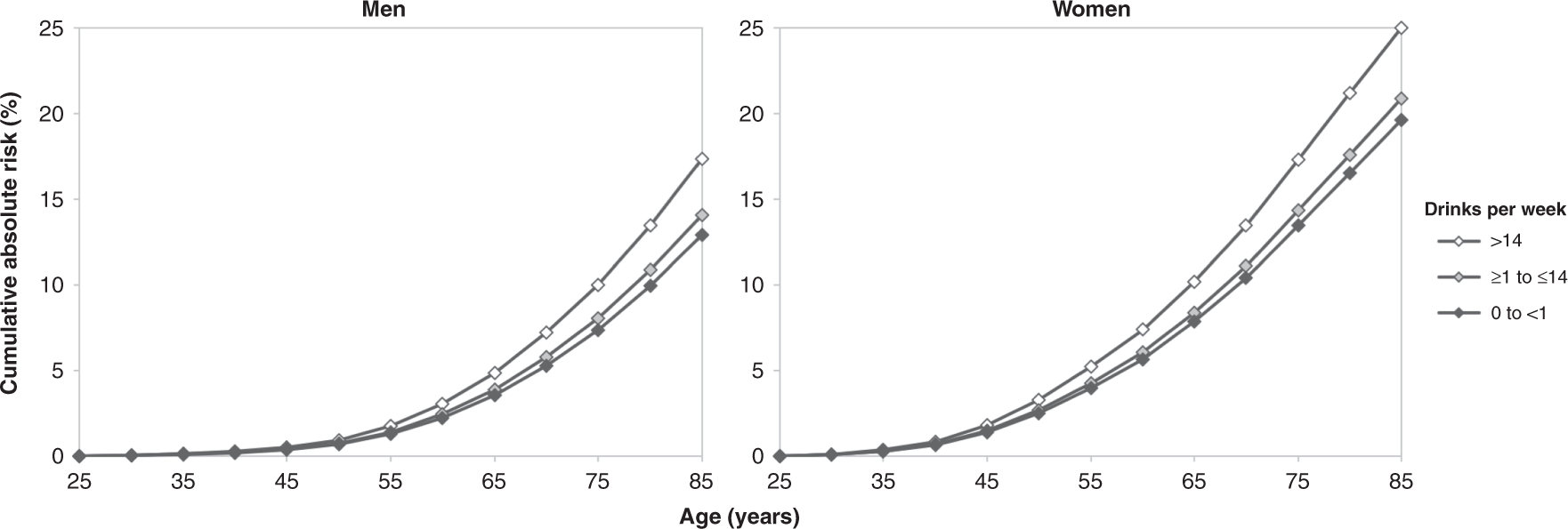
To their credit, the authors of the paper reported absolute, not relative risks. I think the following graphs showing cumulative absolute risk give a better representation of these risks than anything I’ve seen in the press.

Risk increases with age, even among the non-drinkers (bottom curves, 0 to <1 drink per week). It’s greater than 10% of male non-drinkers and 15% of female non-drinkers by age 85, a reminder that alcohol is not the only cause of cancer in these alcohol-related cancers.

The heaviest drinkers (>14 drinks/week, median 21/wk for men, 20/wk for women), represented by the top curves had an absolute increase in risk of developing an alcohol-related cancer of about 1% for men and 2% for women by age 65. That increased to about 3% (men) and 4% (women) by age 75 and about 4% (men) and 5-6% (women) by age 85.

In table form, simplified and rounding to the nearest percentage, I look at it like this:

Approximate Increase in Absolute Risk
(median 20-21 drinks/week vs. <1 drink/week)
Age….…Men………Women
45………<1%………<1%
55………<1%………~1%
65………~1%………~2%
75………~3%………~4%
85………~4%………~6%

As noted above and in the press, the greatest impact is on breast cancer in women.

From a public health perspective, I think the publicity is a good thing. Though I’d like to see the risk expressed only as an absolute increase, not as a relative increase. I also have no problem with putting a cancer risk label on alcohol.

11 Likes

While i agree regarding relative risk, as I said in my post above, baseline cancer risk per person isn’t the same, and what we’re talking about is modifiable cancer risk.

2 Likes

That’s a problem with any population study: population-based findings are not predictive of individual outcomes.

Was doing a quick literature search before seeing this and ran across https://pmc.ncbi.nlm.nih.gov/articles/PMC8271206/pdf/dyaa273.pdf which has a sort of inverted metric, “potential gain in life expectancy” from eliminating each of these. If I’m reading and inferring from it correctly it says that in Europe, the highest mortality for men has been due to smoking, whereas for women it is obesity. It was interesting to me how gender-specific the results were.

Well, if we are going to be consistent, when are we going to slap warning labels on guns? Longstanding research shows that gun ownership raises the risk of successful suicides, increased community violence, fatal accidents. The research is not disputable. Other countries have known this for years. Will these labels make much difference? People decreased smoking due to a variety of factors, but “scientific research” seems to have not made much of an impact until it gradually became socially frowned upon and the imposition of indoor breathing standards, they helped a great deal when non-smokers refused to be exposed willingly to indoor smoke.

this is a very helpful graph. When standing back and looking at this in relative risk terms, it isn’t really all that impressive an increase for the low/moderate group. At 85 I’m likely to get killed by something, cancer or other diseases. Getting numbers of over 200,000 gives it a pretty good sample for reliability. It would be really helpful if these kinds of studies could be correlated with family history of cancer incidence. Low risk family cohorts for cancer may not see any increased risk at all for low/moderate consumption vs high risk family cohorts. I suppose the larger numbers in the study could account for this but if I were a woman with a strong family history of breast cancer, it might well be a more significant factor in my drinking habits than if I came from a family with little to no genetic risk.

I think they should have warning labels on guns, although that likely won’t happen.

I think the impetus for the decrease in smoking was the surgeon general warning, as that eventually led to higher taxation which likely made at least as much if not a bigger difference.

2 Likes

As I said earlier, it isn’t a huge increase in risk, but it’s similar to that from eating a high percentage of your diet with ultraprocessed foods, exposure to second hand smoke, and living near a freeway. Everyone can make their own decisions but certainly having all the information is helpful in doing so.