The data is not new. It’s from Australian study published in Nature in 2020. What’s new is that the Surgeon General has chosen to highlight it, so it’s getting a lot of publicity.
It was a prospective study of 226,162 people age 45 or older, using reasonably sound methods for estimating alcohol consumption (2 interviews per participant) and cancer data (the New South Wales Cancer Registry). It focuses on cancers that have been designated as alcohol-related by the International Agency for Research on Cancer, not all cancers. No study is perfect, but this one’s pretty darn good. It’s subject to the usual limitations that the study population may be more health conscious than the general population (they signed up for a health study), the tendency for people to say they drink less than they actually do, and no way to determine past alcohol consumption from a survey of current drinking habits.
The actual numbers have been mentioned a lot in the press and several times in this thread. Sometimes they are exaggerated. If a risk increases from 10% to 11%, that’s a 1% increase in absolute risk. It’s not a 10% increase in risk as cited by some. Citing a percentage of a percentage as an increase in relative risk is a statistical technique that is often used to exaggerate the importance of findings and garner headlines. It’s cheating IMO, and I never let it pass when reviewing manuscripts for publication.
To their credit, the authors of the paper reported absolute, not relative risks. I think the following graphs showing cumulative absolute risk give a better representation of these risks than anything I’ve seen in the press.
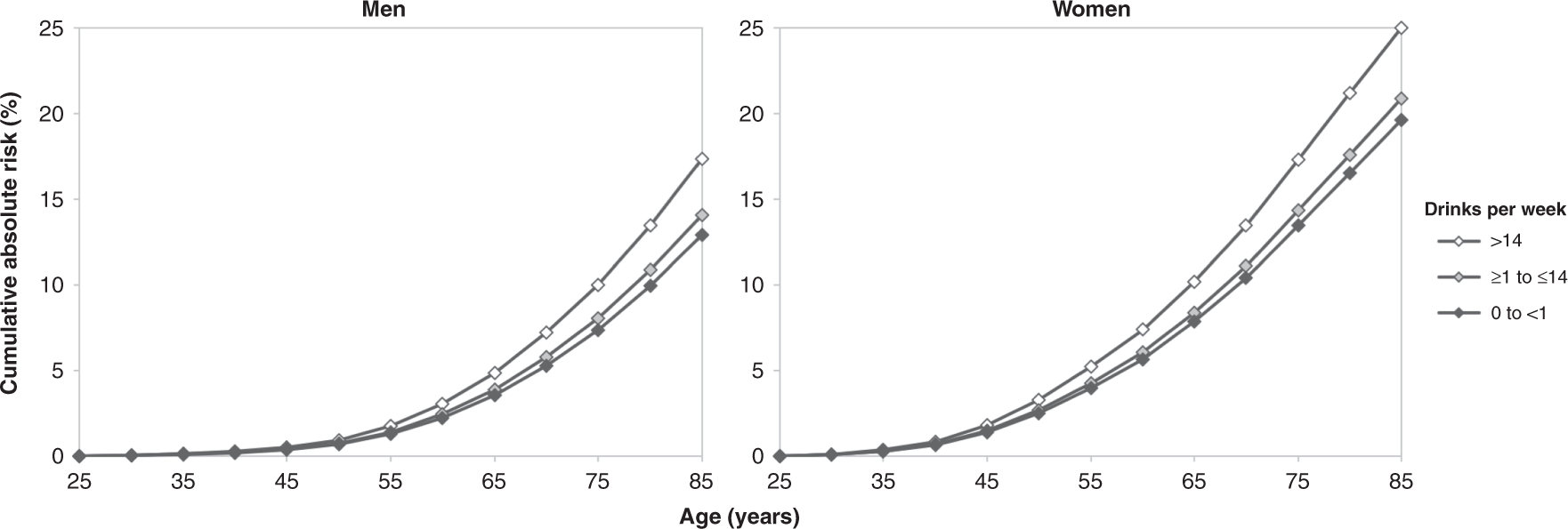
Risk increases with age, even among the non-drinkers (bottom curves, 0 to <1 drink per week). It’s greater than 10% of male non-drinkers and 15% of female non-drinkers by age 85, a reminder that alcohol is not the only cause of cancer in these alcohol-related cancers.
The heaviest drinkers (>14 drinks/week, median 21/wk for men, 20/wk for women), represented by the top curves had an absolute increase in risk of developing an alcohol-related cancer of about 1% for men and 2% for women by age 65. That increased to about 3% (men) and 4% (women) by age 75 and about 4% (men) and 5-6% (women) by age 85.
In table form, simplified and rounding to the nearest percentage, I look at it like this:
Approximate Increase in Absolute Risk
(median 20-21 drinks/week vs. <1 drink/week)
Age….…Men………Women
45………<1%………<1%
55………<1%………~1%
65………~1%………~2%
75………~3%………~4%
85………~4%………~6%
As noted above and in the press, the greatest impact is on breast cancer in women.
From a public health perspective, I think the publicity is a good thing. Though I’d like to see the risk expressed only as an absolute increase, not as a relative increase. I also have no problem with putting a cancer risk label on alcohol.