I did an experiment a few years back with purposefully storing some identical bottles in bad conditions like outside in the sun and next to a hot water heater. We coravined the bottles once a month and were surprised at how long it took to show perceptible differences. We’ve had wines notably lose flavor and aroma with heat damaging in shipping, so the time it too took for our experiment to degrade the wine was surprising.
The CamX deals inspired me to try a new more controlled iteration of this experiment. The general idea is to sous vide a case of CamX in varying temperatures and times to see where the damage kicks in. Using a sous vide will allow precise control of the temperature over a longer period of time.
I’ve done some initial experiments with a refilled wine bottle to see that a recorked bottle pops the cork at 125-130. I’m not sure how to segment the time and temperature on the final CamX case experiment and was planning on refilling 100ml wine sampler tubes to run initial experiments to plan exact temperature and timings.
If anyone has any ideas or input or testing the heat damage with the sous vide, let me know. @Cameron_Hughes@JesseG
I buy that differences might not be all that perceptible if the liquid inside the bottle hits 90-100 F for not all that long (minutes). But some combination of prolonged exposure (weeks or months), and even high temps I think would do some major damage.
Lots of variables you could play with here. You could include temperature variation. Another you could include is cellaring time after the “damage.” E.g., give two bottles the “damage” protocol and keep two controls. Put all four in the cellar after that and open one control and one damaged a week later to see what the differences are. Then open the other two five or ten years later to see if the differences have become more pronounced. If you’re willing to dedicate long-term cellar space to the experiment, I think those findings would be very interesting.
Perhaps this has been addressed here on the board before but I have wondered about storing wine at like 64-68 degrees to see if you can make it age/mature faster than if kept at 55-57?
A long time ago I did a two year experiment. I took three bottles each of three different, modest wines, two whites and a red, and subjected each set of three to different conditions for those two years. One set stayed in my 54°F cellar. One set stayed in my basement which ranged from also 54°F in the winter, slowly increasing to 70°F in the summer. The third set stayed in a closet in the main house (we had no central air at the time) that ranged from 60°F in winter up to 80°F at times in high summer. After the two years I held a blind tasting. To the group the cellar and basement wines were virtually indistinguishable. The upstairs closet wines were more advanced, but not in a negative way, just noticeably further along. I suspect another year upstairs would have been more negative for that set of wines. Since then I have been doing a longer term experiment between the wine cellar and the basement, using four different wines. At five years they were still quite similar. It’s only been since then that the condition differences have been notable, and then only with the more delicate whites. So far the Bordeaux and Syrah wines have remained consistent, and that’s after now almost 9 years.
Similar experience here with some ‘81-83 Bordeaux my dad and I bought together. Mine were stored in an actively cooled cellar at 55-57 degrees. He stored his passively in his basement which varied from 65-75 seasonally. I inherited them about 7 years later and put them in the cooled cellar. His bottles reached peak sooner and started to decline sooner, but in most cases they were very similar when on the plateau. Occasionally an actively cooled bottle would hit slightly higher highs when compared head to head, but it was subtle.
I never intentionally subjected a wine to 80+ degrees, but once inadvertently left a bottle in the car for about 3 hours on a hot 100-degree summer day. The cork was protruding, the label was stained, and the wine tasted dull and stewed that evening. But no pristine control.
@CFu poured us some gibourg nuits that he’d accidentally left in a car for a week in 90-100 degree weather and it tasted fine. @Sarah_Kirschbaum do you remember that? I think it might have been the grandes rondes?
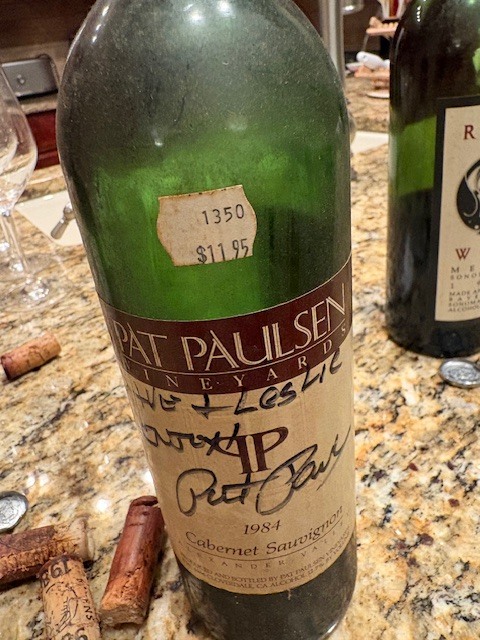
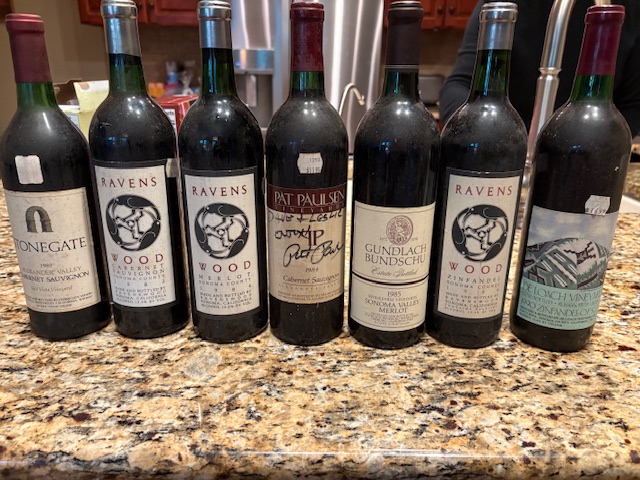
Here is a pic of a bottle of 1984 Pat Paulsen cabernet, purchased on release from Pat and stored in a series of passive cellars. For the last 3 years it sat on a table outside the cellar in the basement(temp around 68 year round). Popped and poured at our forgotten bottles tasting. It was excellent as was the 1980 Stonegate cabernet. Wine is much more resilient than people think.
As part of my master’s thesis, I stored a number of different wines - in screw cap lab glass - at different temperatures over a 10 month or so period post pressing to see how tannins, color molecules and other phenolics would evolve. I used 4 different temperature controlled rooms in the Pomology Dept at UCD - 5, 10, 20 and 28 degrees C. Overall results - the wines kept at 5 degrees C did not change much at all - tannins did not polymerize much at all; color molecules remained constant; very little polymeric pigment creation. On the opposite end, the wines stored at the elevated temps had increased polymeric pigment creation, leading to ‘less astringent’ tannins and greater creation of color stable molecules. We did not taste these wines - this was just looking at the ‘internal nuts and bolts’.