Day 2
Alright, so now five out of seven travelers were in Vienna. Me and our car’s driver needed to go to the nearby car rental office to pick up our minivan, and then pick up the last two guys - who were arriving only this morning to Vienna - from the airport. But first: breakfast!
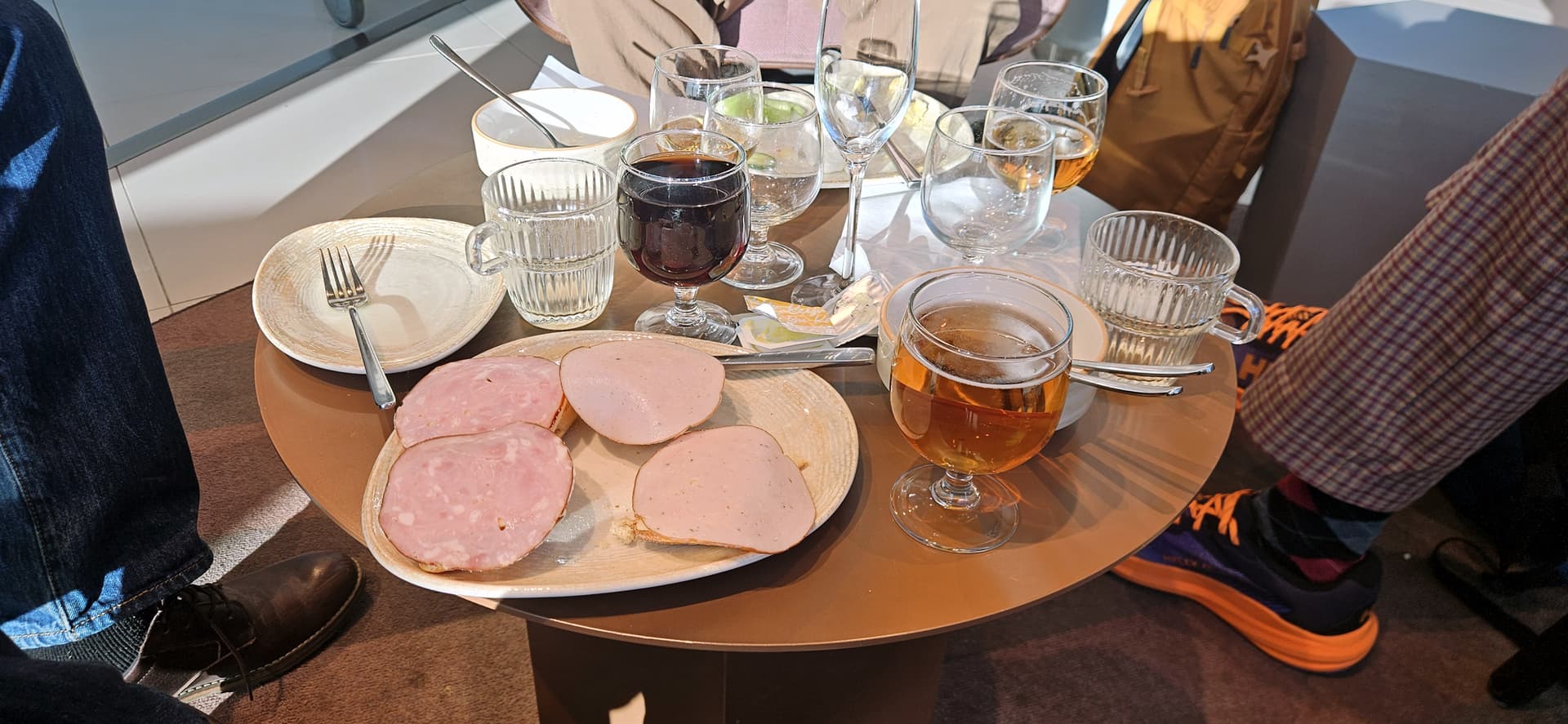
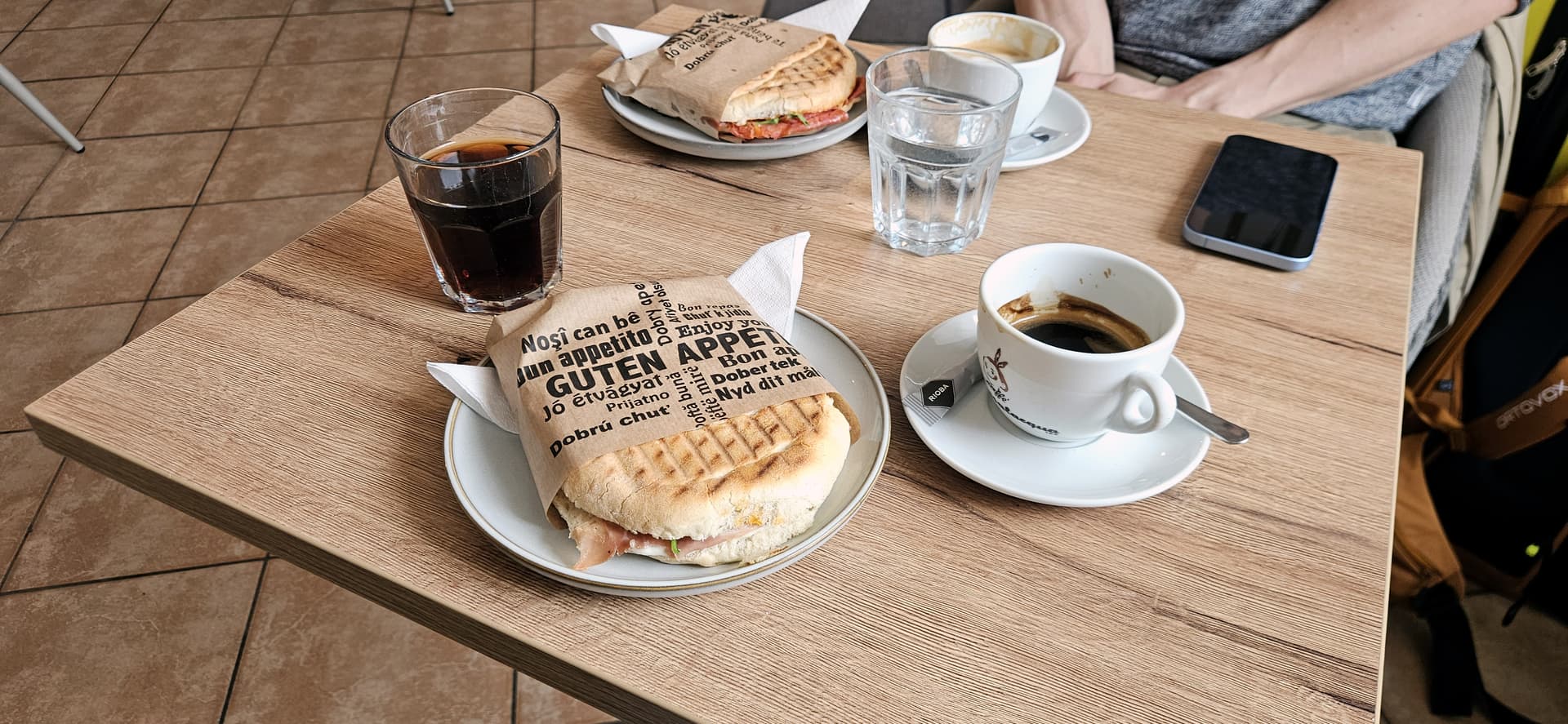
We found this nice little Italian café while making our way to the car rental. No better way to start a morning than a panino and a double espresso!
By the time we were ready with our breakfast, the other three guys who were also in Vienna with us had their car rented and packed, and apparently also the flight of the last two fellas was ahead of its schedule, so we had better get a move on!
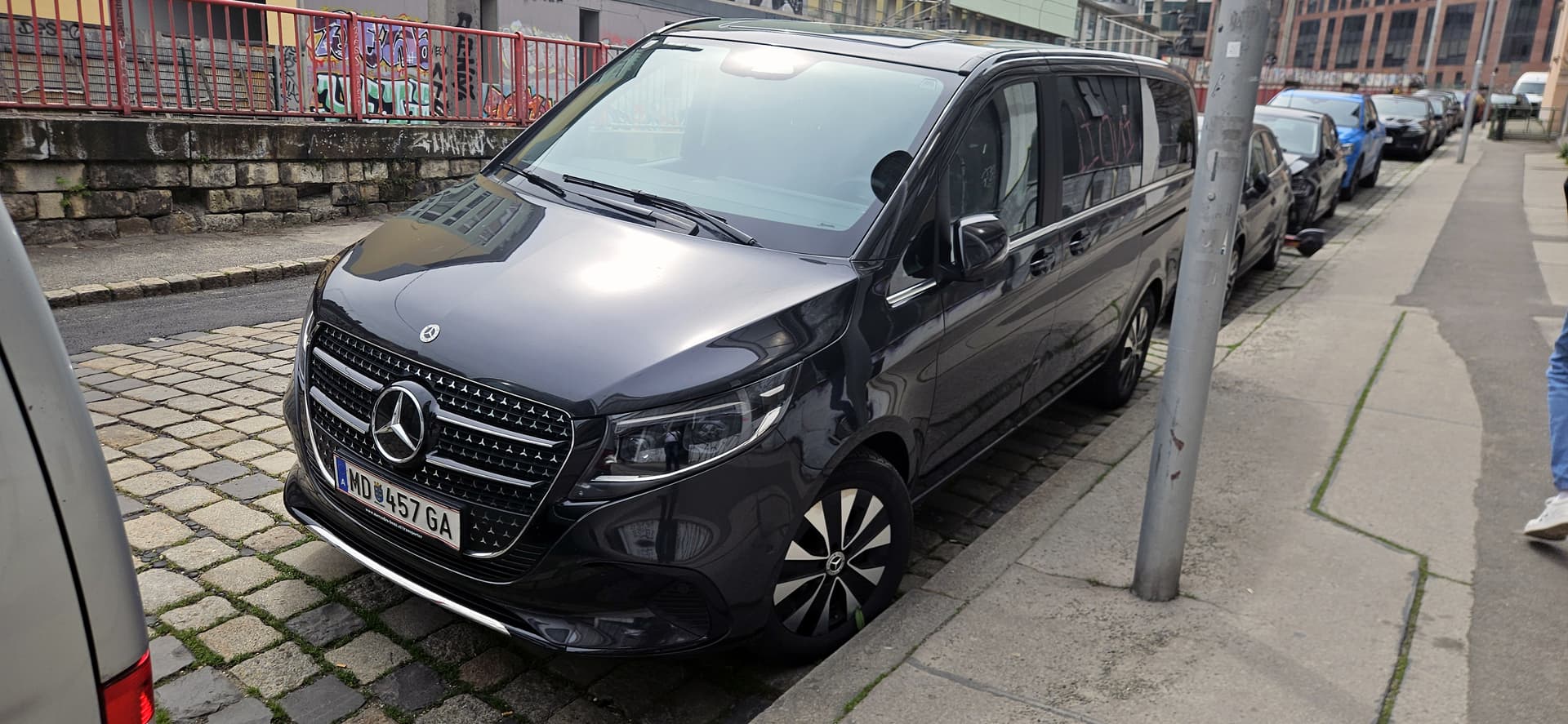
Fortunately getting our van didn’t take much time - it took us probably more time to inspect all the scratches in the car that were mentioned in the documents (we actually found one undocumented scratch!) and take down the extra chairs to make up enough room for our luggage than to go through the rental process and find the car from the garage.
Fast-forward 30 minutes and we had picked up our pals from the airport and now our group was full. We messaged the other car, asking about their location and they said they were going to have a lunch at Gasthaus Wild. Well, we put “Gasthaus Wild” into our navigator and after another 25 minutes, we were there. Except the other three guys weren’t.
After some confusion we realized that we were at Gasthaus Wild, while they were at Gausthaus Wild 1210, a completely different place on the other side of the city! Oh well. Since we needed to have a lunch anyway, we decided to stay and eat where we were at.
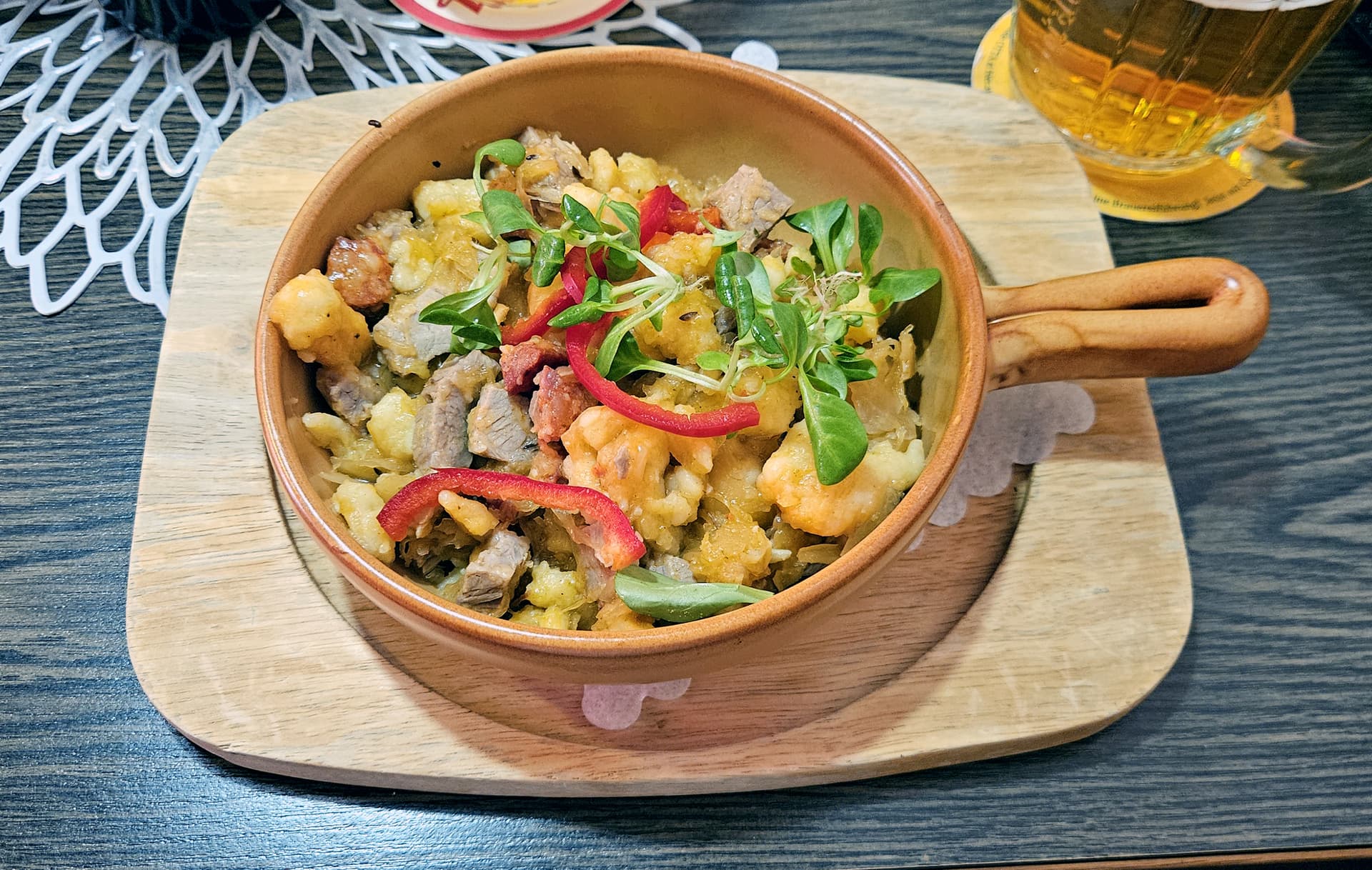
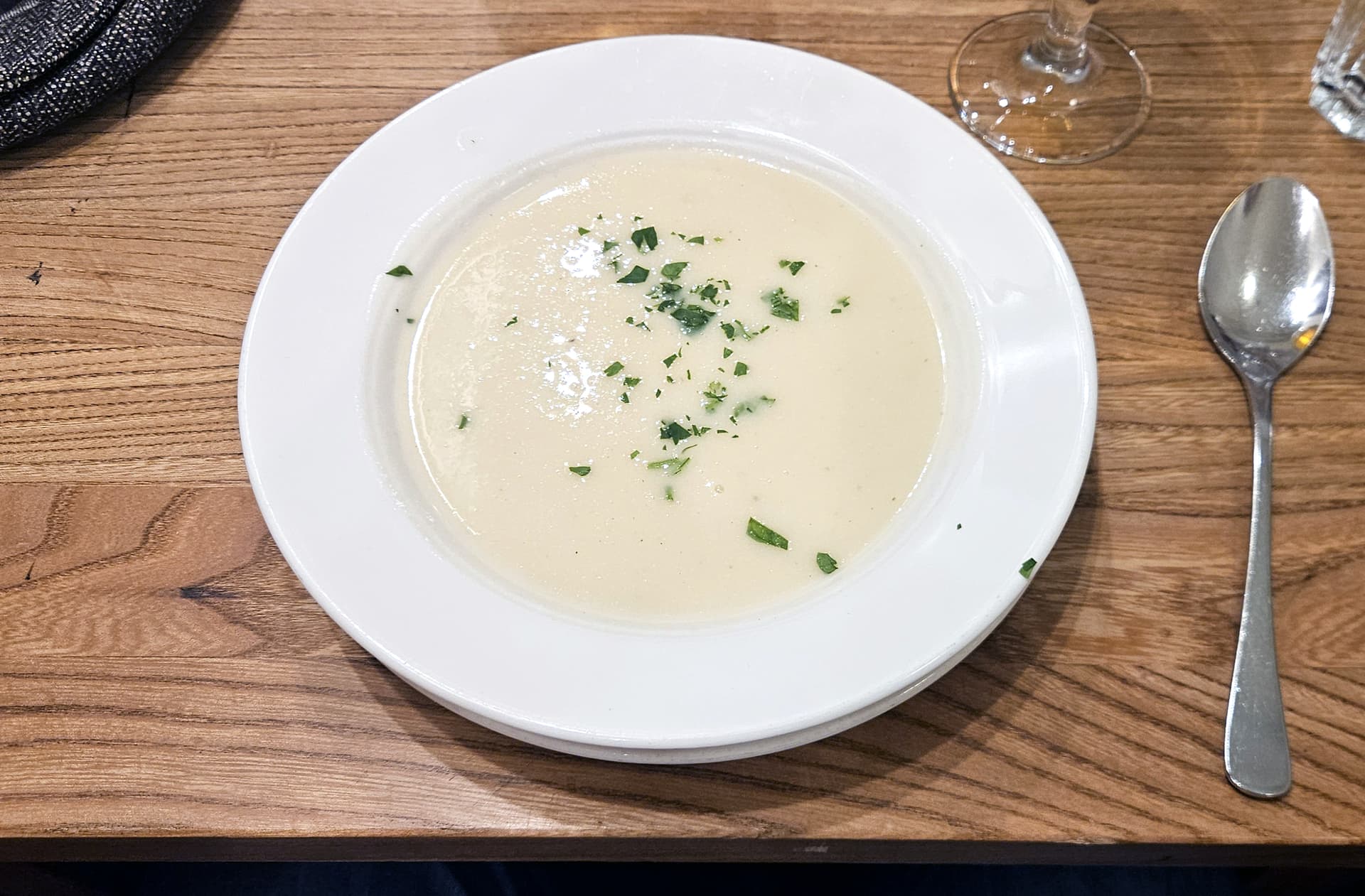
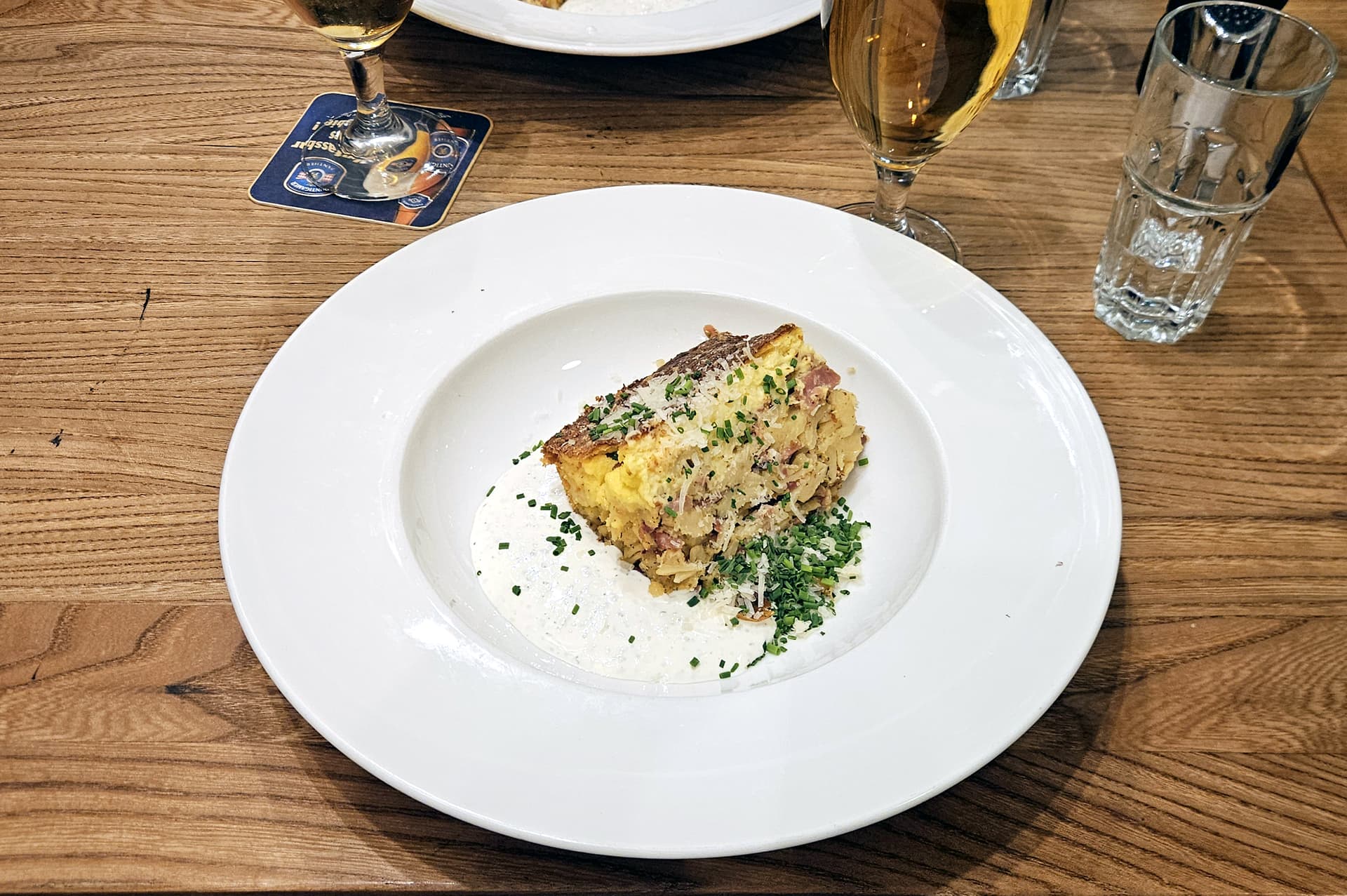
Cauliflower soup
Can’t remember the name of this stuff, but it was darn good!
After the lunch we had our first winery visit approaching fast, so we messaged the other group that we were leaving the lunch place now and we’d meet at Weingut Wieninger, located in the district of Stammersdorf, on the outskirts of Vienna and below the famous Bisamberg hill.
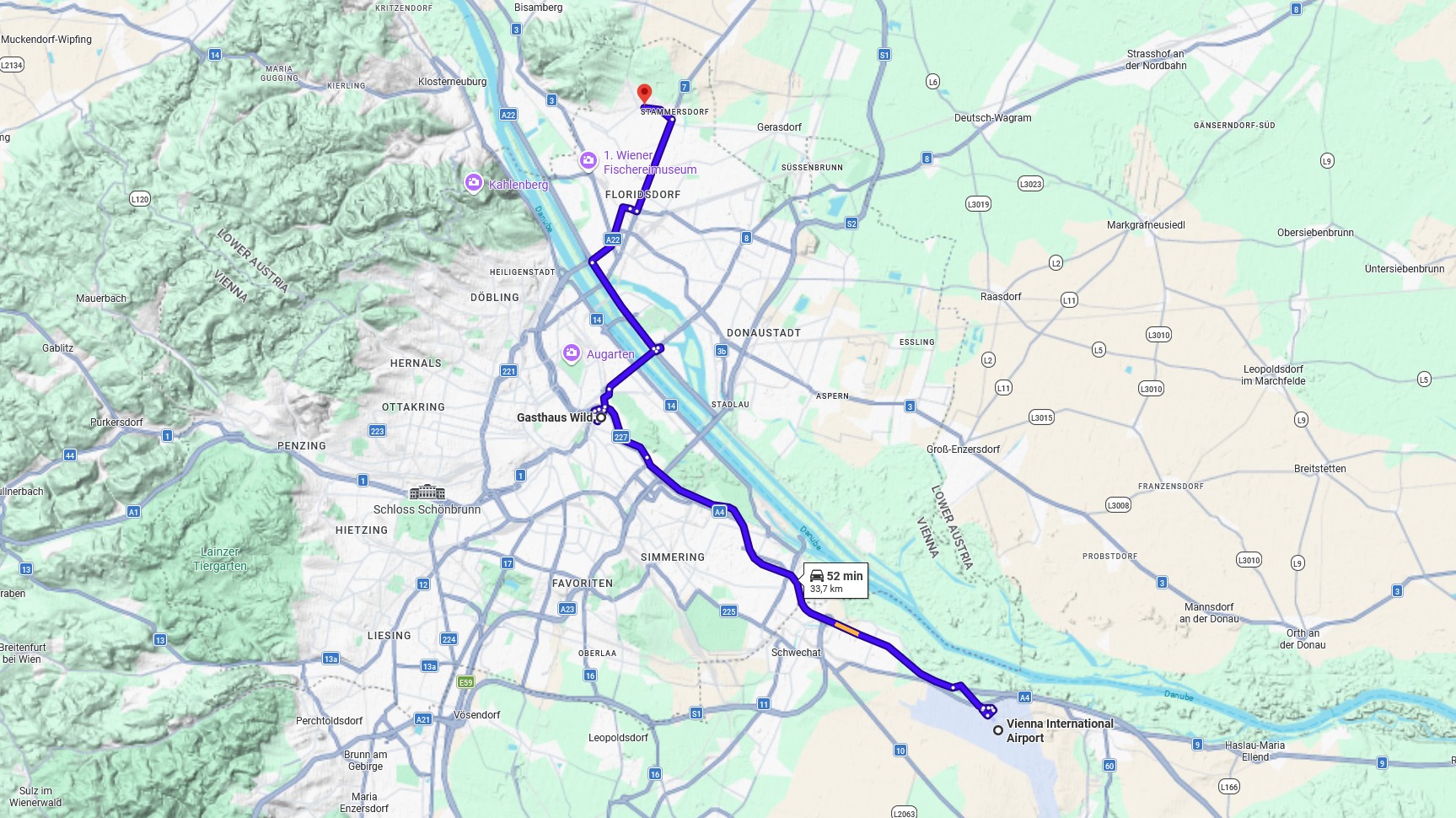
Our drive from the airport first to Gasthaus Wild, then to Weingut Wieninger. You can see Bisamberg hill immediately to the northwest from the winery, while the similarly famous
Nussberg hill is located on the other side of Danube, southwest from the winery.
And here we are.
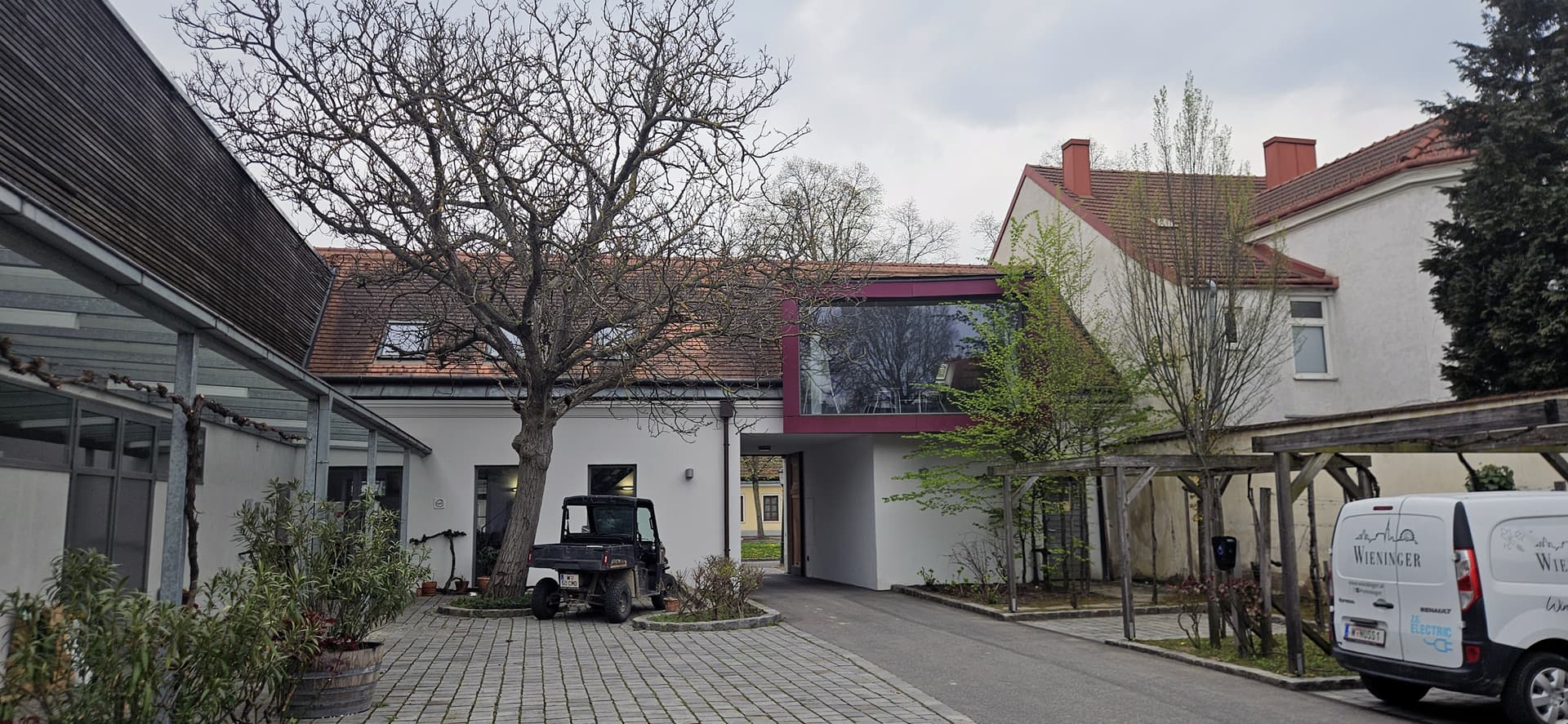
Standing in the winery’s courtyard.
Once inside, we were greeted and shown around by Benjamin, a very knowledgeable fellow. First we went to see the building where they receive and process the grapes come harvest time, while he explained to us some of the history and philosophy of the winery.
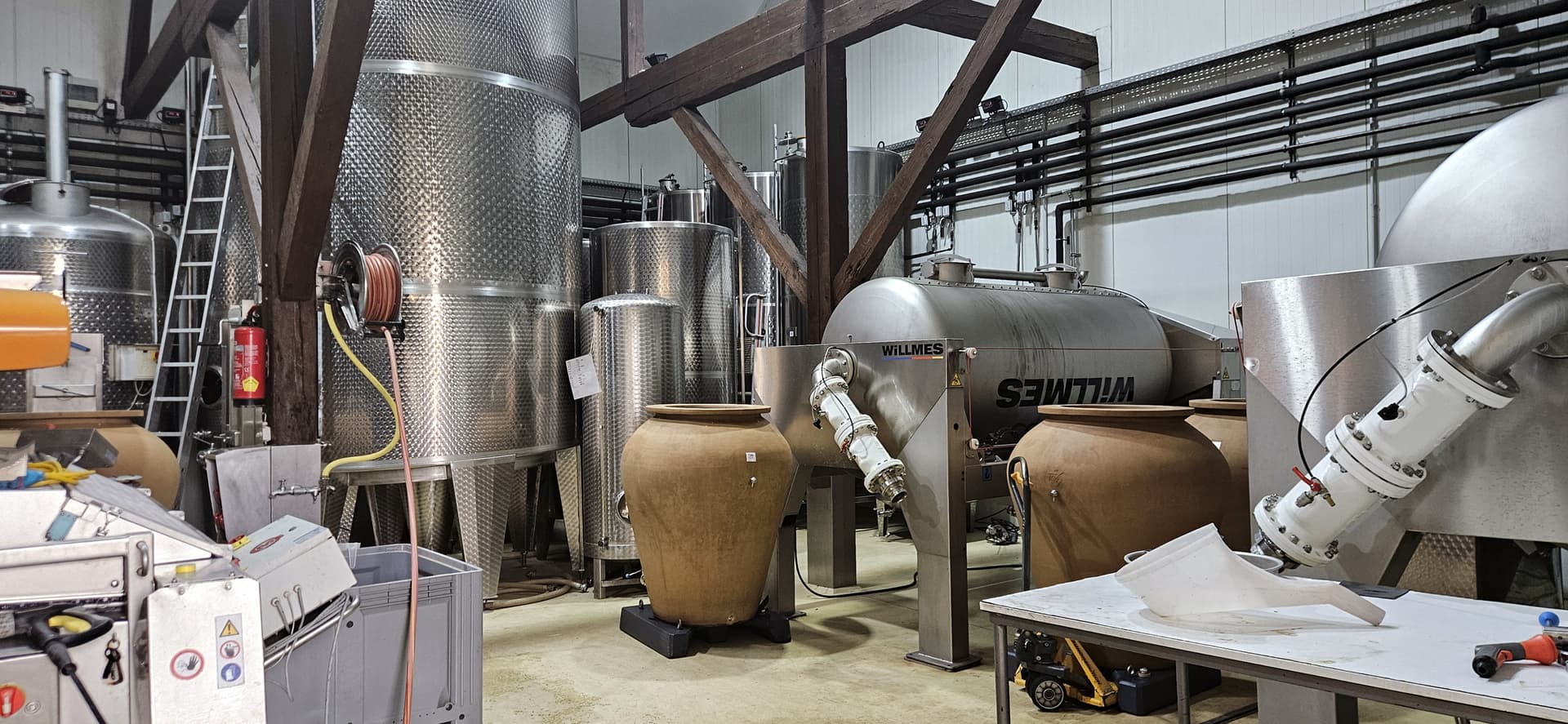
A view into the grape reception / fermentation hall, located on the ground level.
Some information on Weingut Wieninger:
- Fritz Wieninger’s family has been farming vines and making wines for generations in Vienna. However, they made and marketed their wine in the traditional Austrian way: their wines were sold at their own heurigen, ie. small taverns in which families could sell home-made food and their wines they had made.
- When Fritz Wieninger took over, he decided to do things differently: instead of making wine for their heurigen, he began improving the viticulture and the quality of their wines; bottling the wines he made; and marketing their wines, not just in Vienna but also in other parts of Austria and even abroad.
- In 2008 Wieninger started the conversion to biodynamics, and they became certified in 2011.
- Today their vineyards cover around 60 hectares, which is close to 10% of Vienna’s almost 700 hectares of vineyards - all located within the city limits of Austria’s capital! Of Wieninger’s holdings, approximately 40 ha are located East from Danube - where the winery is also located - whereas the remaining 20 ha are located on Danube’s western side (Danube runs through the middle of Vienna). The oldest estate vineyards are approximately 65 years old.
- 90% of the grapes are harvested by hand, only 10% - that goes into the entry-level wines - is machine-harvested. The average yields for the red wines hover around 3,500 kg per hectare and around 4,500 kg per hectare for the white wines.
- Parts of the winery building in which they operate today used to be an old monastery.
- All the wines are always fermented spontaneously. They are fermented and aged in a wide variety of different vessels, including stainless steel tanks, new and old barriques, demi-muids, 2500-liter foudres, egg-shaped concrete eggs and 750-liter earthenware tiñajas. Typically approximately 15 barrels are renewed annually - they are trying to keep the oak impact very low.
- 65-70% of the production is white and approximately 25% is red. The remaining 5-10% is sparkling wine, sweet wines etc.
- On the most basic level, Wieninger’s wines are split into four categories:
- The regional wines, which are blended from all the Viennese vineyards.
- The village wines, which either come from the parcels on the Nussberg hill on the western side of Vienna, or the parcels on the Bisamberg hill on the eastern side of Vienna.
- The single-vineyard wines.
- The others (reds, sparkling wines, sweet wines and Chardonnays), which can be made by blending fruit from both Nussberg and Bisamberg, but which are of higher quality than the regional wines.
- Wieninger has done considerable job in improving the overall quality of Gemischter Satz, the traditional field-blend white of Vienna. Typically Gemischter Satz is nothing more than an afterthought for many producers, but Wieninger makes several different Gemischter Satz bottlings with distinct identities.
- The style of the red wines is quite stern and structure-driven. Fritz Wieninger likes his wines to show some roughness and grip, so typically the wines are from the more tannic end of the spectrum - which also helps them to age gracefully for years.
- In 2014 Wieninger acquired another Viennese wine producer, Weingut Hajszan-Neumann, who also worked with biodynamics, but made wines in a more experimantal, non-interventionist and “natural” style. Although the owner of both, Wieninger has purposefully kept the two wineries separate and with distinct identities, respecting the original style of Hajszan-Neumann’s wines.
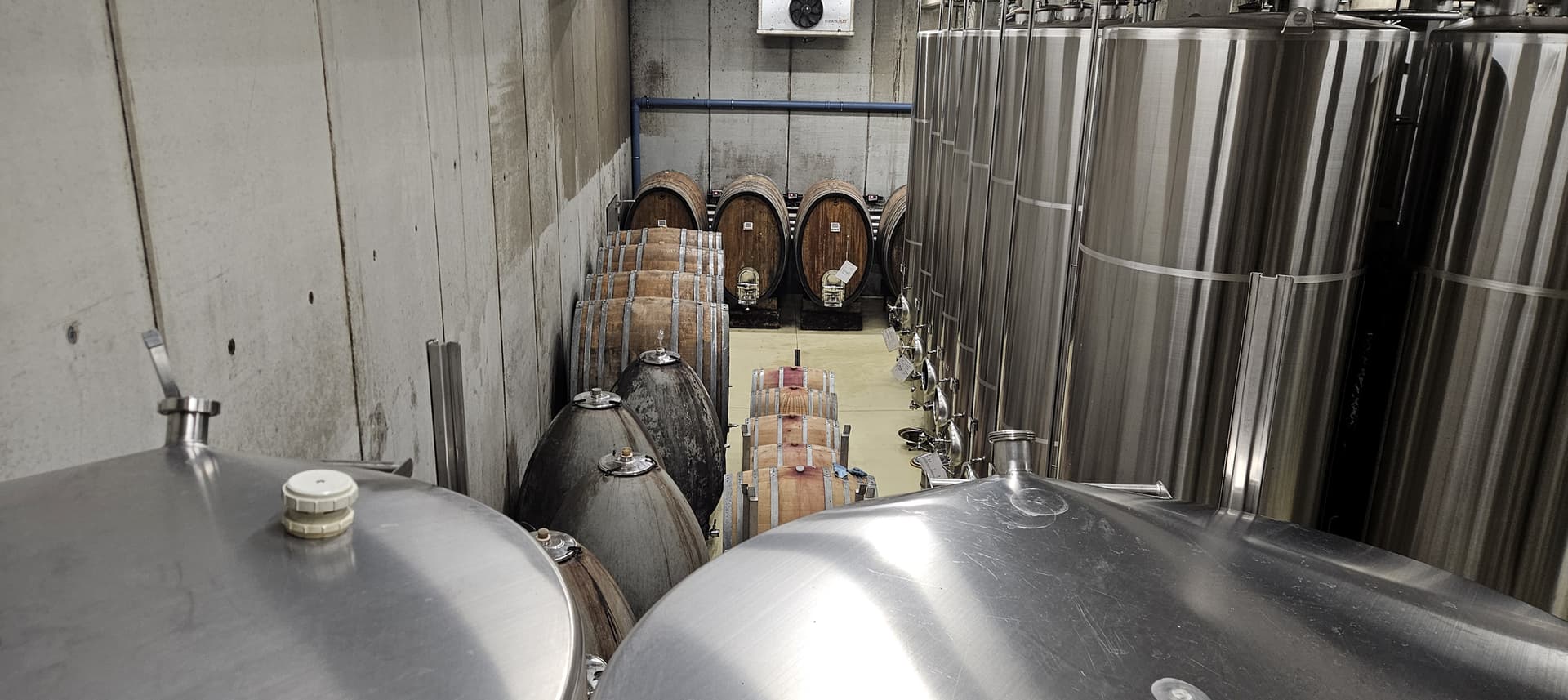
A view into the main aging hall, located underground, below the fermentation hall. Here you can see all kinds of different vessels for aging the wines.
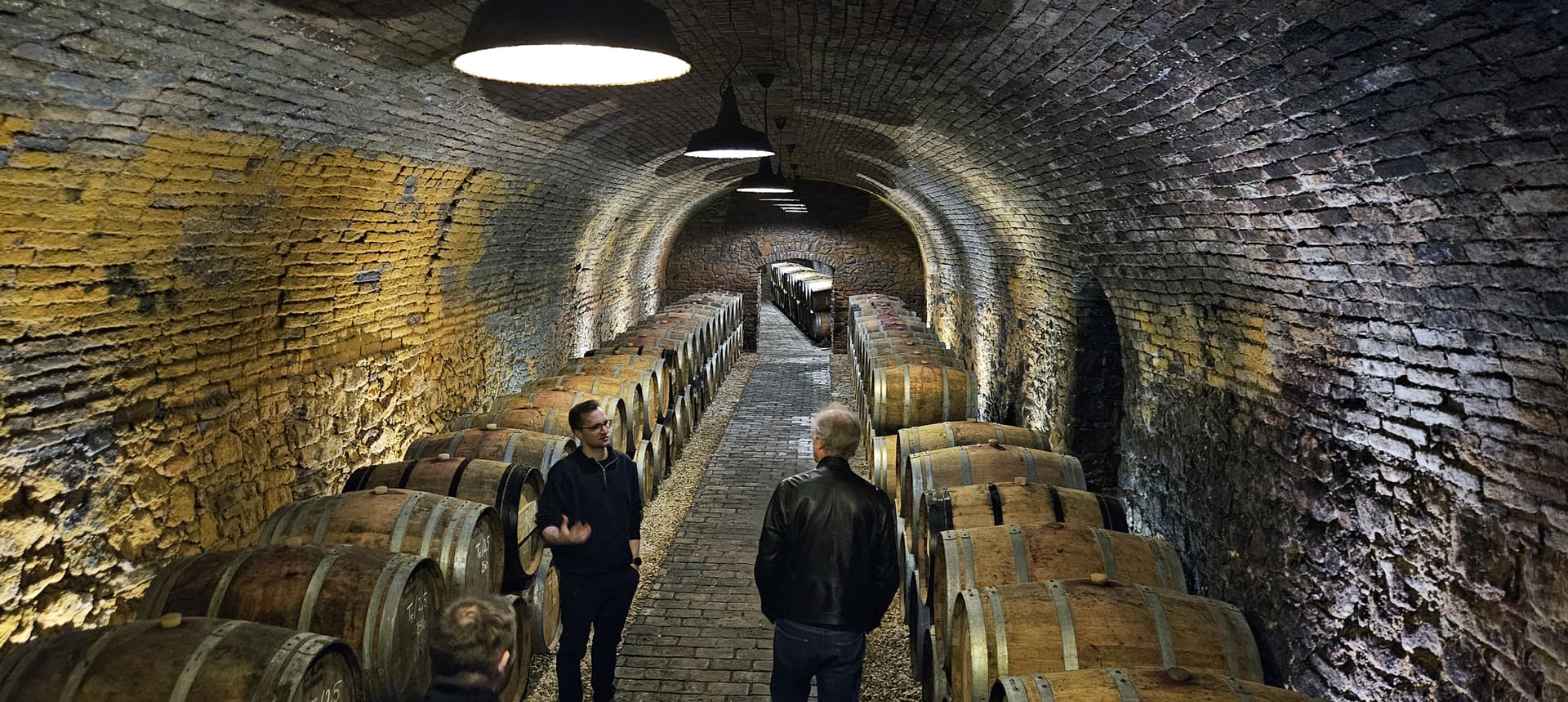
Benjamin showing us around in the old monastery cellars - the stone stairs here are deadly slippery!
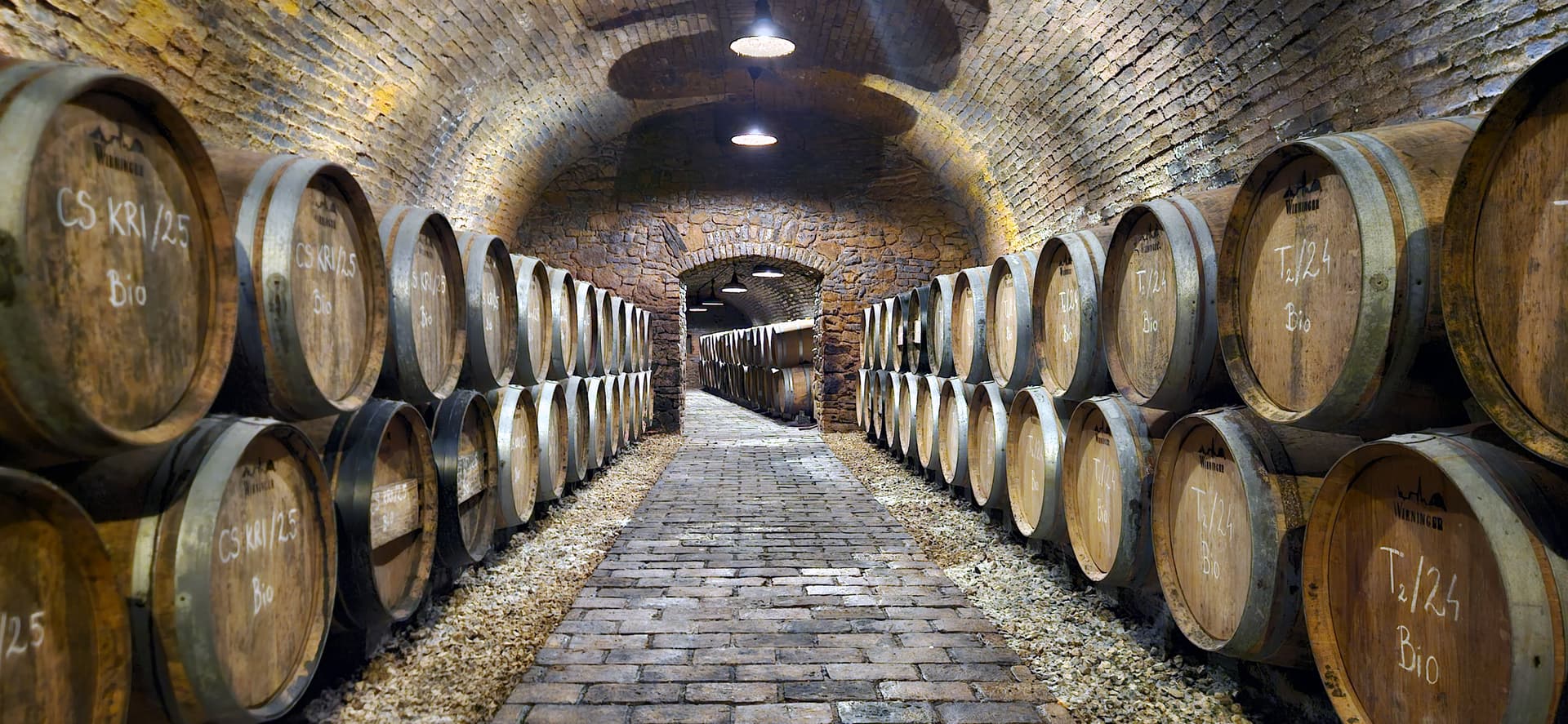
Here the old, well-seasoned barriques age in the coolness of the old cellar.
On the more recently-built side you can find also some new barriques along with some larger-format barrels.
After our tour around the winery buildings, it was time to sample some wines! While we were tasting the wines, Fritz Wieninger also popped by with a big grin to say hello and ask if everyone was doing fine.
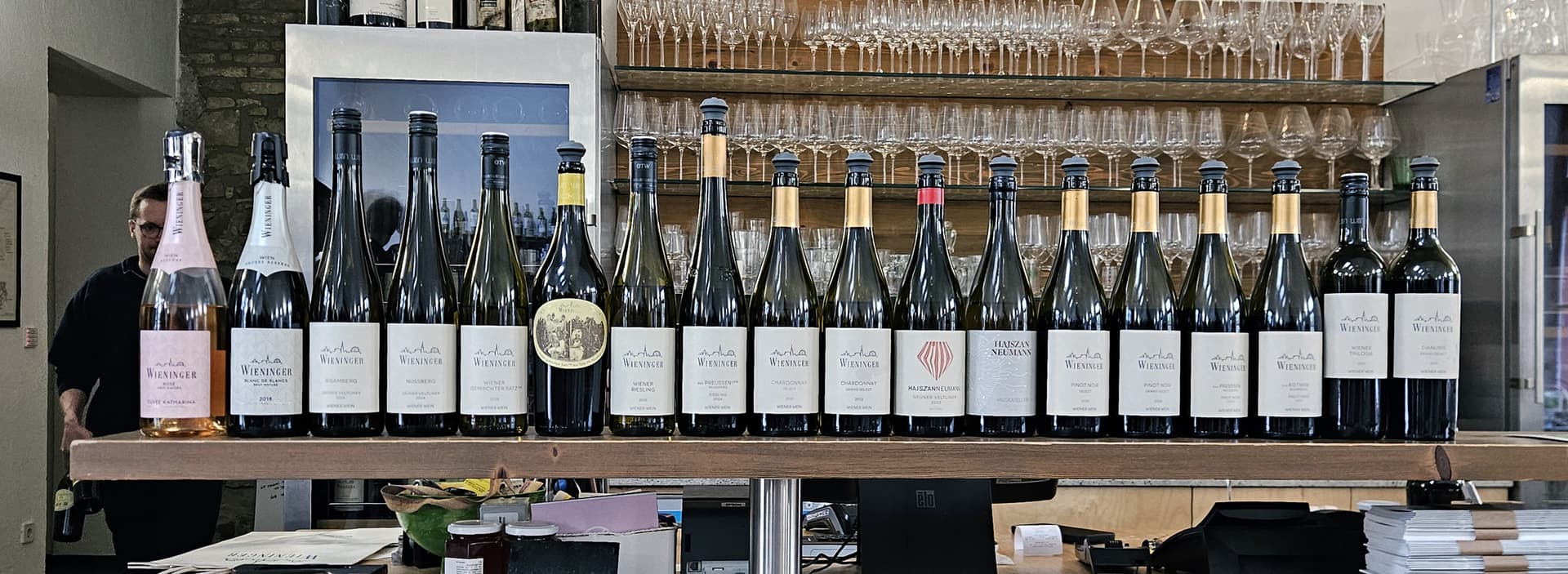
The impressive lineup.
- NV Wieninger Cuvée Katharina Brut Nature Reserve - Austria, Wien (13.4.2026)
A blend of biodynamically farmed Pinot Noir (80%) from Breiten, Hochfeld and Zwerchbreiteln, and Zweigelt (20%) from Gabrissen; all vineyards on the Bisamberg hill. The grapes are harvested early and whole-cluster pressed. Fermented and aged in stainless steel tanks. The final cuvée is typically a blend of 2-3 vintages. Bottled at the premises of another sparkling wine producer, then aged for at least 30 months on the lees. No dosage. 12% alcohol, 0-1 g/l residual sugar and approximately 7 g/l acidity.
Pale seared salmon color. The nose feels moderately ripe and fruit-forward with aromas of strawberries, some peachy tones, a little bit of apple and a hint of leesy autolysis. The wine feels dry and crisp on the palate with a medium body, a somewhat sparse and a bit short mousse and crunchy flavors of wild strawberries, some leesy tones, a little bit of stony minerality, light zesty citrus notes, a hint of fresh Fuji apple and a touch of salinity. Brisk, structured acidity. The finish is crisp, dry and quite long with zippy flavors of saline minerality and tart Granny Smith apple, some sweeter ripe red apple, light leesy notes of autolysis, a little bit of tart cranberry, a hint of lemony citrus fruit and a touch of wild strawberry.
A nice, fresh and zippy rosé bubbly. Enjoyably, but not particularly complex or memorable. Works nicely as a palate-refreshener with its brisk acidity and bright mineral core, but doesn't leave a lasting impression. A safe and well-made effort, priced somewhat according to its quality at 20€.
(87 points)
- 2018 Wieninger Blanc de Blancs Brut Nature Grosse Reserve - Austria, Wien (13.4.2026)
Made with biodynamically farmed grapes. Aged sur lattes for 5 years before disgorgement. 12,5% alcohol, no dosage.
Pale yellow-green color. The nose feels a bit understated with light aromas of sweet white peach, some leesy notes of autolysis, a little bit of sharp Granny Smith apple and a mineral hint of chalk dust. The wine feels crisp, bone-dry and a bit waxy on the palate with a medium body and brisk flavors of white peach, some floral tones, a little bit of vanilla custard, light saline mineral notes and a hint of grapefruit zest. The brisk, high acidity lends a good amount of freshness and structure to the wine. The finish is crisp, dry and lively with a rather long aftertaste of Granny Smith apple, some leesy creaminess, a little bit of tangy salinity, light floral notes and a hint of lemony citrus fruit.
A brisk and sophisticated Blanc de Blancs that shows relatively little nuance or toast despite the 5 years of aging sur lattes. The wine has also a curious, slightly waxy overtone, which makes it feel a bit off-piste as well. Fresh, stylish and thoroughly enjoyable, but nothing special to write home about. Starting to feel a bit pricey for the quality at 32,80€.
(89 points)
- 2024 Wieninger Grüner Veltliner Bisamberg - Austria, Wien (13.4.2026)
100% biodynamically farmed Grüner Veltliner from multiple vineyards on the Bisamberg hill - mainly from Ried Zwerchbreiteln, but also some from Ried Falkenberg and Ried Wiesthalen. The grapes are crushed slowly in a pneumatic press resulting in several hours of skin contact. Fermented spontaneously, aged on the lees in stainless steel tanks for 7 months. 12,5% alcohol.
Youthful pale green color. The nose feels fresh, herby and somewhat floral with aromas of ripe red apple, some zesty citrus fruits and a little bit of spice. The wine feels bright, zesty and balanced on the palate with a light-to-medium body and dry flavors of tart Granny Smith apple and herby spice, some floral notes of apple blossom, light primary notes of ripe grapey fruit, a little bit of stony minerality and a hint of spice. The high acidity lends good sense of freshness and structure to the wine. The finish is crisp, lively and somewhat linear with a clean, moderately long aftertaste of fresh appley fruit, some spicy tones, a little bit of stony minerality, light primary notes of grapey fruit and a hint of ripe citrus fruits.
A nice, fresh and clean Grüner Veltliner. Tasting this next to the more or less identically made Nussberg Grüner Veltliner, you can immediately identify the differences of these sites: this wine shows more precision and structure, but conversely comes across as more linear and less nuanced than the slightly richer Nussberg GV, which shows more depth and substance while packing a little bit less acidity. Both the wines are fine and lovely, but even though I love acidity and freshness, I think I prefer the Nussberg version of this variety by an inch. Both the wines are still very primary and benefit greatly from at least 2-4 years of additional aging, although I can see this wine evolving and improving for at least double of that. Solid value at 15€.
(90 points)
- 2024 Wieninger Grüner Veltliner Nußberg - Austria, Wien (13.4.2026)
100% biodynamically farmed Grüner Veltliner from two vineyards on the Nussberg hill: from Ried Serfellner and Ried Weisleiten. The grapes are crushed slowly in a pneumatic press resulting in several hours of skin contact. Fermented spontaneously, aged on the lees in stainless steel tanks for 7 months. 12,5% alcohol.
Youthful pale green color. The youthful nose feels quite expressive with a spicy streak of white pepper and fresh red apple, some ripe citrus fruits, a little bit of juicy white fruit and a primary hint of pear. The wine feels rather ripe and broad on the palate with a moderately full body and rich flavors of juicy Golden Delicious apple, some stony mineral notes, a little bit of tangy salinity, light spicy white pepper tones, a hint of steely minerality and a touch of chopped herbs. The overall feel is a bit round yet still sufficiently firm with the moderately high acidity and perhaps a tiniest suggestion of tannic tug on the gums. The finish is rather ripe and juicy yet still pretty crisp and perhaps even subtly grippy with a long aftertaste of sweet Golden Delicious apple, some steely mineral notes, a little bit of under-ripe pear, light spicy notes of white pepper and a hint of grapefruit.
A moderately ripe, round and textural village-level Grüner Veltliner that packs a bit more depth and substance than the lighter, zippier Bisamberg GV. Both the wines are vinified in the same way, so these two wines show nicely the main differences between these two hills; Nussberg seems to add some weight and texture to the wines at the expense of freshness and acidity. Even then, I feel the wine is enjoyably fresh and very balanced in overall feel, showing good potential for additional improvement with further aging. Although I also enjoyed the brisk freshness of the Bisamberg GV, I still preferred the textural feel and depth of flavor this Nussberg exhibited. A nice example of Viennese Grüner Veltliner and good value at 16€.
(91 points)
- 2025 Wieninger Wiener Gemischter Satz - Austria, Wien, Wiener Gemischter Satz (13.4.2026)
A blend of 12 different, biodynamically farmed grape varieties - mainly Grüner Veltliner, Pinot Blanc, Welschriesling, Riesling and Neuburger - from the Bisamberg and Nussberg hills. All the varieties are co-fermented spontaneously and aged in stainless steel tanks for 4 months. 12,5% alcohol, 2 g/l residual sugar and 5,7 acidity.
Pale, youthful whitish-green color. The nose feels fresh and very youthful with sweet-toned aromas of primary grapey fruit, some pear drops, light floral tones and a hint of apple. The wine feels fresh and youthful on the palate with a medium body with flavors of crunchy red apple, some primary notes of ripe grapey fruit and pear, light steely mineral notes, a little bit of crunchy white fruit, a floral hint of apple blossom and a touch of tangy salinity. The bright, high acidity lends a good amount of freshness and structure to the wine. The uncomplicated finish is youthful, fresh and somewhat linear with a medium-long aftertaste of fresh appley tones, some primary grapey tones, a little bit of stony minerality, light estery notes of pear drops and a hint of salinity.
A fresh and structured but also somewhat uncomplicated Gemischter Satz. Good sense of balance and focus, but the overall feel is quite simple and still dominated by the sweet, almost candied fermentation esters lending the wine a rather grapey and pear-driven overall feel. Most likely the wine will benefit from additional 2-4 years of aging, which is hopefully enough to make those candied primary notes disappear. At the moment the wine works fine as a simple weekday white, but offers relatively little beyond that. Maybe a bit pricey for the quality at 14,50€.
(86 points)
- 2024 Wieninger Nußberg Ried Ulm Wiener Gemischter Satz - Austria, Wien, Wiener Gemischter Satz (13.4.2026)
A field blend of biodynamically farmed Grüner Veltliner, Neuburger, Sylvaner, Riesling, Rotgipfler, Traminer, Weissburgunder, Welschriesling and Zierfandler, all sourced from Ried Ulm in the Nussberg hill. Co-fermented spontaneously and aged for 10-12 months in stainless steel tanks (2/3%) and old large oak casks (1/3%). 13% alcohol.
Pale yellow-green color. The nose feels a bit restrained but also wonderfully fragrant and nuanced with aromas of ripe Golden Delicious apple, some leesy creaminess, light notes of white peach, a little bit of stony minerality, a hint of chopped herbs and a tiniest touch of waxy funk. The wine feels broad, balanced and quite mineral on the palate with a rather full body and layered flavors of stony minerality, some fresh pear, light waxy tones, a little bit of tangy salinity, light herby nuances, a hint of ripe white peach and a touch of spicy red apple. Despite its somewhat sizeable overall feel, the wine manages to come across as quite harmonious and quite structured with its high acidity. The finish is ripe and quite rich yet still enjoyably crisp and lively with its long, quite acid-driven aftertaste of crunchy golden apple, some tangy salinity, light sweeter notes of ripe white fruits, a little bit of herby spice, a hint of waxy character and a touch of leesy creaminess.
A surprisingly serious, rich and nuanced Gemischter Satz - a considerable leap in quality from the simple and rather ho-hum entry-level Gemischter Satz. This is definitely where the money is at. Although the wine is still very youthful, it doesn't show any candied primary nuances anymore and it is perfectly enjoyable already now. However, I can imagine the wine is just a baby now and it will continue to evolve and improve for a good number of years more. Terrific stuff with lots of upside. Highly recommended. Great value at 29€.
(92 points)
- 2025 Wieninger Wiener Riesling - Austria, Wien (13.4.2026)
100% biodynamically farmed Riesling from multiple vineyards in Vienna. The grapes are crushed slowly in a pneumatic press resulting in approximately five hours of skin contact. Fermented spontaneously, aged on the lees in stainless steel tanks for 5 months. 12,5% alcohol.
Pale greenish color. The nose feels youthful, sweet and somewhat candied with aromas of ripe grapey fruit, some floral tones, a little bit of lemony citrus fruit and a hint of mineral spice. The wine feels youthful, open-knit and somewhat richly-fruited on the palate with a medium body and somewhat primary flavors of stony minerality, some pear, light grapey tones, a little bit of tangy salinity, a lemony hint of citrus fruits and a touch of floral spice. the moderately high acidity keeps the wine quite structured and enjoyably balanced. The finish is youthful, sweet-toned and precise with a somewhat primary aftertaste of ripe pear and lemony citrus fruit, some saline mineral tones, a little bit of grapey fruit, light floral notes of apple blossom, a hint of tart Granny Smith apple and a touch of wet rocks.
A youthful and still very primary but also enjoyably fresh and balanced Riesling with a good amount of fruit, focus and structure. From the entry-level range, I found this wine more nuanced and interesting than the somewhat simple Gemischter Satz. Although the wine is still way too youthful as it is so dominated by the candied primary fruit flavors, I can see this wine benefiting greatly from a few years of extra aging. A well-made example of entry-level Riesling, priced according to its quality at 14,50€.
(89 points)
- 2024 Wieninger Riesling Ried Preussen - Austria, Wien (13.4.2026)
100% biodynamically farmed Riesling from Ried Preussen on the Nussberg hill, a 40-yo vineyard Fritz Wieninger acquired from Mayer am Pfarrplatz in 2005. After the harvest, any botrytized grapes are removed, then the grapes are crushed slowly in a pneumatic press resulting in approximately 5 hours of skin contact. Fermented spontaneously, aged on the lees in stainless steel tanks for 12 months. 13,5% alcohol.
Pale greenish color with a faint lemon-yellow hue. The nose feels broad, fragrant and subtly funky with aromas of peachy stone fruit, some spicy red apple, light perfumed floral tones, a little bit of marzipan, a hint of waxy funk and a mineral touch of wet rocks. The wine feels surprisingly rich, broad and even subtly viscous for a Riesling with a quite full body and nuanced flavors of juicy Fuji apple, some nutty almond tones, a little bit of leesy richness, light saline mineral notes, a hint of waxy funk and a touch of ripe citrus fruits. The quite high acidity lends a good sense of freshness and structure to the wine. The finish is rich, long and characterful with a complex aftertaste of ripe peach, some juicy Golden Delicious apple, a little bit of leesy creaminess, light stony mineral notes, a hint of waxy funk and a touch of tangy salinity.
A characterful and quite idiosyncratic Riesling, showing more richness, substance and volume than seems typical for a Riesling. However, the wine never once comes across as heavy, weighty or clumsy - on the contrary, the overall feel is wonderfully fresh and structured despite the somewhat bigger-than-normal body of the wine. Furthermore, the wine exhibits a tiny bit of funky qualities that you don't normally see in Riesling - however, this quality only seems to add to the sense of depth and complexity. While still very youthful, I'd say the wine is quite approachable already now - although I'd let the wine wait for at least a few more years, just to develop some additional complexity. Most likely the wine will continue to age and evolve quite effortlessly at least a decade, if not even more. Great stuff, priced according to its quality at 34€.
(93 points)
- 2021 Wieninger Chardonnay Select - Austria, Wien (13.4.2026)
100% biodynamically farmed Chardonnay from multiple vineyards on the Bisamberg hill, ranging in age from 25 to 40 yo. The grapes are destemmed, then left to soak with the skins for 3 hours before they are pressed into oak barrels. Fermented spontaneously, full MLF, aged in oak barrels (40% new, 60% second and third use) for 15 months. 13,5% alcohol. Annual production approximately 10,000 bottles.
Quite intense yellow-green color. The nose feels ripe with aromas of zesty citrus fruits, some nutty wood, light pineapple tones, a little bit of floral lift, light smoky notes, a sweeter hint of cantaloupe and a touch of creamy oak. The wine feels quite ripe and moderately woody yet pretty balanced on the palate with a moderately full body and dry flavors of nutty wood and ripe citrus fruits, some stony mineral notes, a little bit of cantaloupe, light creamy oak tones, a hint of salinity and a touch of ripe peachy stone fruit. The high acidity lends a good amount of freshness, structure and focus to the wine. The finish is rich, long and quite acid-driven with flavors of creamy oak and grilled pineapple, some saline mineral notes, a little bit of ripe peach, light zesty notes of citrus fruits, a hint of nutty wood and a touch of smoke.
A fresh and structured but also still quite noticeably oaky Chardonnay that nevertheless shows good promise and future potential. Although I'm not the biggest fan of noticeably oaky wines, this wine never felt too oaky at any point, and I feel that the woodier nuances will integrate with the fruit just fine with additional age. A well-made and serious wine that just calls for time. Tasting this side-by-side with 2022 Chardonnay Grand Select, this wine felt more expressive and open for business, but qualitatively it was very hard to put any meaningful difference between the wines, since they were both so young. At 26€, this is a good buy - just let the wine get some additional age.
(91 points)
- 2022 Wieninger Chardonnay Grand Select - Austria, Wien (13.4.2026)
100% biodynamically farmed Chardonnay from multiple vineyards on the Bisamberg hill, ranging in age from 25 to 40 yo. The grapes are destemmed, then left to soak with the skins for 3 hours before they are pressed into oak barrels. Fermented spontaneously, full MLF, aged in oak barrels (40% new, 60% second and third use) for 15 months, after which the barrels showing the most promise are separated for a further year of aging; the remaining barrels are bottled as Chardonnay Select. Racked off the barrels after a total of 26 months of aging. 13,5% alcohol. Annual production approximately 2,000 bottles.
Quite intense yellow-green color. The nose feels dry, somewhat spicy and quite woody with a bit understated aromas of ripe citrus fruits, some nutty wood tones, a little bit of creamy oak, light sweeter notes of toasty oak spice and a touch of ripe pineapple. The wine feels firm, dry and somewhat concentrated on the palate with a full body and rather intense flavors of creamy oak and nutty wood, some ripe Golden Delicious apple tones, a little bit of honeyed richness, light stony mineral notes, a hint of ripe peach and a touch of vanilla. The overall feel is balanced and structured, thanks to the high acidity and cool mineral core of the wine. The finish is broad, quite rich and rather acid-driven with a long aftertaste of creamy oak, some pineapple, light buttery tones, a little bit of ripe Golden Delicious apple, a hint of nutty wood and a touch of apple peel bitterness.
A rather bold and impressive Chardonnay that feels quite similar to the 2021 Chardonnay Select we tasted - only with more with everything. Well, perhaps the level of acidity is more or less on the same level, but otherwise this wine shows a bit more body, more concentration, more minerality and definitely more oak. The only noticeable difference is that the 2021 Select felt more expressive, whereas this 2022 Grand Select seems to be still somewhat closed and holding back. It feels like there is a great wine in the waiting, but it is not ready yet. With this much oak, I'd say the wine would need a lot of time anyways, but as the wine still feels this closed, I recommend to let the wine age for some additional years just to open up. This is good, but at the moment it is obvious that the 2021 Select is much more ready for business compared to this wine. As a whole, this is Grand Select unarguably more impressive than the Chardonnay Select, but I'm not sure if the wine is still worth the extra tariff - this feels somewhat expensive for the quality at 72€.
(91 points)
- 2023 Weingut Hajszan-Neumann Grüner Veltliner Natural - Austria, Wien (13.4.2026)
100% biodynamically farmed Grüner Veltliner. Fermented spontaneously and macerated with the skins for four months. After racking the wine off the skins, it was aged on the lees for another 6 months. Bottled unfined and unfiltered with a 20 mg/l dose of SO2. 12% alcohol, 1,5 g/l residual sugar and 5,8 g/l acidity.
Hazy medium-deep yellow color. The nose feels wild and somewhat waxy with aromas of honeyed richness, some spicy tones, a little bit of peachy stone fruit, light funky nuances and a hint of crushed rocks. The wine feels dry, firm and somewhat wild yet not particularly funky on the palate with a medium body and fresh flavors of crunchy peach, some ripe Golden Delicious apple, light stony mineral notes, a little bit of leesy character, a hint of salinity and a touch of waxy funk. The wine is enjoyably high in acidity with a tiniest bit of tannic grip. The finish is long, dry and slightly grippy with a bit wild aftertaste of stony minerality, some citrus tones, a little bit of waxy funk, light peachy notes, a hint of salinity and a touch of leesy character.
A nice, sophisticated and enjoyably structured Grüner Veltliner that certainly looks more funky than it actually is. For an orange wine, this is a very well-behaved, accessible and balanced effort. Nothing too complex or memorable, but nothing bad, either. Fun, thoroughly enjoyable stuff. Priced according to its quality at 17€.
(90 points)
- 2024 Weingut Hajszan-Neumann Muskateller Natural - Austria, Wien (13.4.2026)
100% biodynamically farmed Muscat from Ried Neuberg on the Nussberg hill. Fermented spontaneously, first with semicarbonic fermentation on whole bunches, then on the skins for 3 months, after which the wine is racked off the skins and aged in concrete tanks until it is bottled unfined and unfiltered in the spring, with an addition of 20 mg/l SO2. 12% alcohol.
Slightly hazy yellow-green color. The nose feels very expressive and heavy with a very IPA-like bouquet of passion fruit, some floral tones, a little bit of ripe orange, light stony mineral notes, a hint of leesy character and a touch of grapefruit rind. The wine feels firm, fresh and floral with a medium body and nuanced flavors of passion fruit and ripe orange, some youthful grapey tones, a little bit of stony minerality, light leesy notes, a hint of crunchy Golden Delicious apple and a touch of rosewater. The high acidity lends good sense of freshness and energy to the wine. The finish is fresh, floral and very expressive with a long, dry aftertaste of IPA-like citrus fruit notes and passion fruit, some stony mineral notes, a little bit of leesy character, light floral nuances, a hint of zesty pink grapefruit and a touch of tangerine.
A fun, fresh and nuanced orange wine that should by all accounts be funky and weird, yet it is surprisingly clean and precise in overall feel. Add in some floral Muscat notes on almost IPA-like overdrive and you get this wine. Terrific stuff that might not be super serious, but is nevertheless super delicious. Very pure, fresh and vibrant effort for a naturalist orange wine. Highly recommended. Worth the price at 26€.
(91 points)
- 2023 Wieninger Pinot Noir Select - Austria, Wien (13.4.2026)
100% Pinot Noir from multiple parcels in the Bisamberg hill and one parcel in the Nussberg hill. Fully destemmed. Fermented spontaneously and macerated with the skins for approximately 10-14 days. Aged in oak barriques (20% new, 80% 2nd or 3rd use) for 18 months, then all the barrels are racked into a large oak fuder for bottling. Bottled unfined and unfiltered. 13% alcohol. Annual production 4000-5000 bottles.
Pale, fully translucent raspberry red color. The nose feels youthful and varietally correct with aromas of ripe cranberries, some spicy Pinosity, a little bit of brambly raspberry, light floral notes of violets, a hint of ripe cherry, a touch of gravelly minerality and a whiff of woody oak spice. The wine feels quite delicate, airy and light on its feel with a medium body and vibrant flavors of ripe cranberries, some woody oak tones, a little bit of spicy Pinosity, light cherry and raspberry notes, a hint of gravelly minerality and a touch of toasty oak spice. The overall feel is surprisingly structure-driven and sinewy for such a delicate Pinot Noir, not only thanks to the high acidity, but also to its somewhat rustic medium-plus tannins that pack quite a bit of grip for Pinot Noir. I like that! The finish is long, spicy and moderately grippy with a dry aftertaste of black raspberries and fresh cherries, some woody oak spice, a little bit of saline minerality, light brambly raspberry tones, a hint of gravelly earth and a sweeter touch of toasty oak.
A rather light and delicate yet also surprisingly stern and sinewy Pinot Noir that exhibits surprising intensity of flavor for such a lithe, pale-colored wine. The tannins are a bit on the rough side, so if you like silky smooth Burgundies, the wine might come across as somewhat rustic on that part. However, if you like old-school Pommard or are a fan of Nebbiolos and are not afraid of tannins, the wine really hits the spot. At the moment the wine could use some extra time sideways, just to integrate the (relatively modest) oaky notes better with the fruit and resolve those tannins a bit more, and I wouldn't be surprised if the wine could actually age quite a bit. A terrific little Pinot Noir that shows good promise; expect the score to go up as the wine ages. Good value at 27€.
(91 points)
- 2022 Wieninger Pinot Noir Grand Select - Austria, Wien (13.4.2026)
100% Pinot Noir from multiple parcels in the Bisamberg hill and one parcel in the Nussberg hill. Fully destemmed. Cold-soaked in open-top barrels for 6 days. Fermented spontaneously and macerated with the skins for approximately 10-14 days. Aged in oak barriques (50% new, 50% 2nd or 3rd use) for 22 months, then all the barrels are racked into a large oak fuder for bottling. Bottled unfined and unfiltered. 13% alcohol. Annual production 1500 bottles or less.
Quite deep, medium-dark and fully translucent ruby-red color. The nose feels dark-toned with aromas of black cherries, some dark-toned toasty oak, a little bit of dark forest fruits, light mocha tones, a sweeter hint of black raspberries, a touch of spicy Pinosity and a whiff of earth. The wine feels firm, spicy and a bit toasty on the palate with a medium body and intense flavors of juicy dark forest fruits, some peppery spice, a little bit of fresh black cherry, light woody tones, a toasty hint of mocha oak and a touch of brambly black raspberry. The overall feel is pretty stern and tightly-knit, thanks to the high acidity and ample, rather grippy tannins. The finish is dry, dark-toned and pretty tannic with a long aftertaste of brambly black raspberries and ripe black cherries, some peppery Pinosity, a little bit of toasty mocha oak, light earthy notes of forest floor, a woody hint of savory oak spice and a touch of juicy dark berries.
A surprisingly stern, robust and structure-driven Pinot Noir. The overall feel is dry, fresh and relatively airy, so the wine is definitely not too ripe or extracted in any way - I guess the limestone-heavy terroir of Bisamberg just results in rather tannic and relatively thick-skinned grapes, and if the best lots that show the most promise aging-wise are selected for this Grand Select, it comes as no surprise that the wine is rather muscular in style. Although the wine doesn't come across as too oaky, despite the 50% new barrels, the overall feel is still definitely more oak-heavy compared to the less woody 2023 Pinot Noir Select that we tasted at the same time. At the moment the wine is more about promise and future potential than immediate drinkability - I'd let the wine age for another 6-10 years, just to tone down the oak and tannins a bit more. Most likely the wine is going to age effortlessly for a lot longer than that, though. Fine stuff, but I'm not sure if this is worth the extra tariff (72€) compared to the more affordable Pinot Noir Select.
(92 points)
- 2022 Wieninger Pinot Noir Ried Preussen - Austria, Wien (13.4.2026)
100% Pinot Noir from Ried Preussen in the Nussberg hill. The vineyard is approximately 40 years old, but it was re-grafted to Burgundian Pinot Noir clone six years before the harvest. 60% destemmed, 40% vinified in whole bunches. The grapes are first cold-soaked for 5 days, then fermented spontaneously and macerated with the skins for approximately 10-14 days. Pressed into egg-shaped concrete tanks and aged for 16-20 months. Bottled unfined and unfiltered. 13% alcohol, 1 g/l residual sugar and 5,1 g/l acidity.
Rather translucent black cherry color. The expressive nose feels beautifully perfumed with youthful aromas of ripe raspberries, some fresh cherries, light fragrant spicy tones, a little bit of violet, a hint of wild strawberry and a touch of fresh blueberry. The wine feels firm, dry and focused on the palate with a medium body and intense flavors of sour cherries and brambly raspberries, some tart cranberries, light floral notes of violets, a little bit of spicy Pinosity, dark-toned hints of blueberries and black cherries and a savory touch of meaty umami. The wine is high in acidity with quite ample and moderately grippy yet not aggressive tannins. The finish is fresh, savory and quite grippy with a long, dry aftertaste of black raspberries and black cherries, some floral notes of violets, a little bit of fresh bilberry, light meaty notes, a hint of sour cherry bitterness and a touch of spicy Pinosity.
A beautiful, harmonious and immensely attractive Pinot Noir. Typical of Wieninger's Pinot Noir style, the wine packs quite a bit of tannic grip, but here the tannins feel a bit more powdery and less rustic than in some of their other Pinot Noirs bottlings. While stylistically a bit closer to a perfumed Burgundy than to a more spicy and robust Spätburgunder, the wine is still most of all quite Austrian in style - a fantastic combination of fragrant finesse that is still enjoyably unpolished and rough around the edges. Perhaps still in a bit awkward phase, but definitely going in the right direction. Probably the most impressive Austrian Pinot Noir I've tasted, but unfortunately also priced at such - the wine is available only in mixed cases of three bottles where the average price per bottle is well above 100€...
(94 points)
- 2022 Wieninger Pinot Noir Ried Rothen - Austria, Wien (13.4.2026)
100% Pinot Noir from Ried Rothern in the Bisamberg hill. 60% destemmed, 40% vinified in whole bunches. The grapes are first cold-soaked for 5 days, then fermented spontaneously and macerated with the skins for approximately 10-14 days. Pressed into used 450-liter demi-muids for 18-20 months. Bottled unfined and unfiltered. 13% alcohol, 1 g/l residual sugar and 5,1 g/l acidity.
Rather translucent black cherry color. The nose feels dark-toned, nuanced and quite attractive with aromas of meaty character and pronounced earthy spice, some crunchy black cherry tones, a little bit of brambly black raspberry, light dark plummy notes, a woody hint of old savory oak and a touch of forest floor. The wine feels dark-toned, meaty and somewhat chewy on the palate with a rather full body and intense flavors of black cherries and gravelly minerality, some meaty notes, a little bit of savor old oak, light saline nuances, a hint of spicy Pinosity and a touch of tart lingonberry. The wine comes across as pretty structure-driven with its high acidity and ample, moderately grippy yet still quite well-behaved tannins. The finish is long, savory and rather tannic with a dry, intensely-flavored aftertaste of ripe black cherries and tart lingonberries, some woody notes of savory oak spice, a little bit of tobacco, light mineral notes of crushed rocks and gravel, a hint of crunchy red plum and a touch of salinity.
An attractive and harmonious yet also pretty stern and tightly-knit Pinot Noir with great intensity of flavor and an impressive structure that really could use some additional aging. I love how the wine doesn't see any new oak, letting the vibrant - and surprisingly meaty - fruit profile take the lead. As is typical of Wieninger's red wines, the overall feel is quite tannic for a Pinot Noir, but like this wine's sibling, Pinot Noir Preusen, the tannins feel well-handled and not too tough or aggressive. I'd say the Preusen iteration shows more perfume and sense of finesse, whereas this Rothen version shows more body and intensity, yet structurally they both are on an equal level. From a quality point of view, I think the wines are on par with each other, but if I had to choose one wine over the other, I'd maybe go with Ried Preusen. A very impressive effort, but unfortunately also priced at such - the wine is available only in mixed cases of three bottles where the average price per bottle is well above 100€...
(94 points)
- 2021 Wieninger Wiener Trilogie - Austria, Wien (13.4.2026)
A blend of biodynamically farmed Zweigelt (65%), Cabernet Sauvignon (20%) and Merlot (15%) from multiple parcels on the Bisamberg hill. The grape varieties are vinified separately, all fermented spontaneously in predominantly old oak barriques and other oak casks (approximately 20% new oak). The barrels are racked and the final blend is gradually assembled over the approximately 2 years of aging. 13,5% alcohol.
Youthful, dark and somewhat translucent cherry-red color. The nose feels savory and even somewhat meaty with aromas of dark fruits, some old wood, light notes of tobacco, a little bit of smoke, a hint of ripe cherry, a touch of earth and a whiff of ripe blueberries. The wine feels firm and sinewy on the palate with a medium body and dry flavors of tart cranberries and lingonberries, some tobacco, light stony mineral notes, a little bit of ripe dark fruit, a hint of smoky meat and a woody touch of savory oak spice. The overall feel is pretty stern and structured with its high acidity and moderately grippy medium-plus tannins. the finish is long, savory and quite grippy with an intense aftertaste of tart cranberries, some tobacco, light earthy tones, a little bit of sour cherry bitterness, a hint of stony minerality and a woody touch of old oak.
A surprisingly structured and dead-serious effort for an entry-level red of the winery. The overall feel is very savory, quite earthy and also pretty mineral, but there is enough fruit to keep things interesting and vibrant. With this much structure, I feel the wine could really benefit from additional aging - for immediate consumption I heartily recommend pairing the wine with something hearty enough that can tone down the wine's rather tightly-knit structure. Although the fruit profile leans more on Zweigelt than on Cab or Merlot, I still feel this is a Bordeaux-lover's Austrian red. Good stuff that punches above its weight, terrific value at 16€.
(91 points)
- 2019 Wieninger Danubis Grand Select - Austria, Wien (13.4.2026)
A blend of Cabernet Sauvignon (50%) and Zweigelt (10%) from the Gabrissen and Jungberg vineyards planted in the early 1980's, and Merlot (40%) from the Breiten vineyard planted in the mid-1980's; all located on the Bisamberg hill. Only the best fruit from these old vineyards are selected for this cuvée. Fully destemmed, crushed, fermented spontaneously and macerated with the skins for 3 weeks in stainless steel tanks. After the fermentation, the wine is gently pressed and racked into new 500-liter demi-muids. Aged for 26 months. Bottled unfined and unfiltered. 13% alcohol.
Quite deep and moderately opaque blackish-red color with a faint youthful purplish hue. The nose feels dark-toned, smoky and somewhat toasty with aromas of game and tobacco, some woody notes of savory oak spice, a little bit of ripe dark fruit, light sweeter toasty oak notes, a hint of fresh blueberries and a touch of juicy black cherry. The wine feels rich, concentrated and silky on the palate with a full body and dark-toned flavors of ripe cherries and dark plummy fruit, some toasty mocha oak notes, light blueberry tones, a little bit of earth, a hint of peppery spice and a woody touch of savory oak. The overall feel is very firm and quite muscular, thanks to the rather high acidity and ample, assertive tannins that pack some grip. The finish is rich, savory and quite grippy with a long aftertaste of juicy dark fruits, some savory notes of game and meaty umami, a little bit of toasty mocha oak, light peppery notes, a hint of tobacco and a touch of fresh bilberries.
After so many red Wieninger wines that came across as rather classically styled - at times even a bit rustic - this wine was a rather different beast. It was more ripe, somewhat polished and noticeably more concentrated than any other red we tasted at the domaine; definitely a wine made in a somewhat modern style. However, even then, the wine is not all about ripe, concentrated fruit and glossy oak! The flavor profile is surprisingly dry and savory with a good emphasis on more meaty and earthy tones as well, and the tannins are - as it seems to be typical with all Wieninger reds - quite firm and prominent, lending quite a bit of structure to the overall feel. Even at 6½ years of age, the wine feels a bit too oaky and toasty for my preference, but there's no denying that the wine underneath is quite impressive with great sense of intensity, structure and depth of flavor. Perhaps after another 7-10 years of aging the oak has integrated a bit better with the fruit? At least the wine seems like it is built for the long haul. A fine and impressive wine made to cater for the fans of contemporary Bordeaux and the likes. Priced according to its quality at 41€.
(92 points)
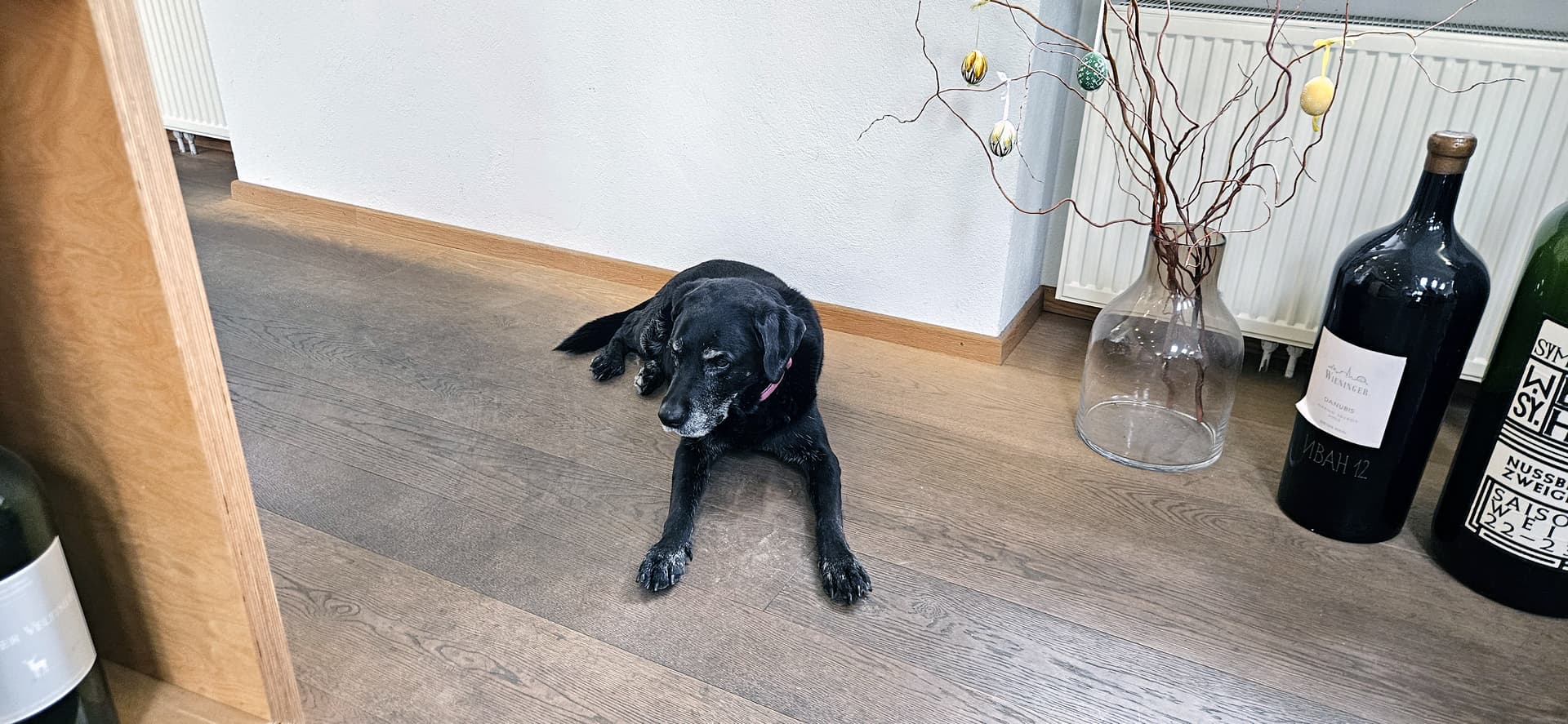
There was also an old, somewhat reserved winery dog (Blu? Blue?) hanging out nearby. This senior fellow didn’t seem to be particularly interested in getting pets or making new friends - yet it was absolutely necessary to remain there at all times, observing the guests!
After we had tasted the wines, we had an hour of time before our next winery visit - which was in Wachau, about 50 minutes drive away! To make it to the next winery in time, we quickly made our purchases, thanked for the amazing visit and were off on our way for the next visit.
The final view into the Wieninger winery as we are leaving.