Is it worth the wait? Cellaring old (2000 Cru Bourgeois Bdx) wine for 20 years

Executive Summary: choose wisely, because although some wines have become much more expensive to buy today, I can get the Cru Bougeois for an inflation-adjusted price equal to what I paid in 2001. However, I know the provenance and I don’t have to worry about whether someone is selling Katrina wine or wine that was stored under the staircase in the living room. The moral of the story is that, with a few exceptions, in Bordeaux at least, they got it right in 1855. Quality floats to the top and OK is just OK.

The long and boring version: In the summer of 2001, we were going on vacation to Costa Rica and I had just received a Bordeaux en primeur offering from Rochambeau wines (yes, the Steve Austin place :slight_smile: ) with copies of the RMP tasting notes. It was my reading material for the first leg of the flight. After having read articles about the wonders of the 2000 vintage in Bordeaux, I decides jump in with both feet, but having just spent most of my disposable income on plane tickets, I had no choice but to rein in my desire to buy high-level stuff. That, by the way, was a mistake, because I should have gotten the 200 Lafite, which has increased by a factor of ten.

I decided to buy inexpensive Cru bourgeois from each commune, based upon RMP’s highest rated wines that I could get for under $20. They have been lying quietly in my basement for more than two decades, with an occasional bottle opened just to check in on them. I am now in the midst of fixing my cellar inventory, so I decided to start opening these wines on a regular basis.

Yesterday, I opened a 2000 Ch. Fougas, which has the lowest current “value” on CT. $20 in 2001 is $38.05, I gave it a 90 minute decant and then followed it for 4 hours. It was solid and it had no flaws. Pleasant with resolved tannin and no bite. Light fruit but not a fruit driven wine. Did not have the complex flavors of RMP’s original TN, which as important in my selection process: The brilliant 2000 Fougas-Maldoror has a dense ruby/purple color and a nose of hot chocolate intermixed with black cherry jam, plums, and figs. The wine is dense, chewy, fat, and totally delicious. Some tannin in the finish is nearly obscured by relatively high levels of glycerin. Drink it over the next 10-12 years. A sleeper of the vintage. I did not find it dense and chewy at all after all of these years, with limited cherry jam, plums and figs.

Today the 2000 Fougas average price on Winesearcher is $43. Is it “worth” $43? It depends on what you like. I am not disappointed because it was reasonably pleasurable, but I can get wine for $43 that I find more pleasurable.

The others I have that I will open soon are Clos Rene, de Sales, d’Aiguilhe, La Fleur de Jague, Cantemerle, Cos Labory, Grand Mayne and d’Armailhac. An then there are my two splurges - 2000 Lacombes and d’Issan. The d’Issan, all of which I have open the bottle or to all of the years, it is excellent. I am partial to the Lascombes because I have had a lot of it because I used to buy it in the 1970s for almost pocket change, but I don’t believe it is as good as the d’Issan.

9 Likes

I would expect the Cantemerle to be quite good, and – yes – worth the wait. Possibly the Grand Mayne, too. Good luck with them!

In my experience, the Cantemerle is both overrated and underrated. It is unknown to most people, which makes it underrated, but to the cognoscenti, who know of it, it is never as good as they expect. I like both the Clos Rene and the de Sales, both o which, probably not coincidentally, are Pomerols.

3 Likes

in my experience, Cantemerle does best in “big” years, of which 2000 is one.

Are any of those Cru Bourgeois? Some are classified eg Cantemerle, others come from areas without classifications and so are really petit château.

1 Like

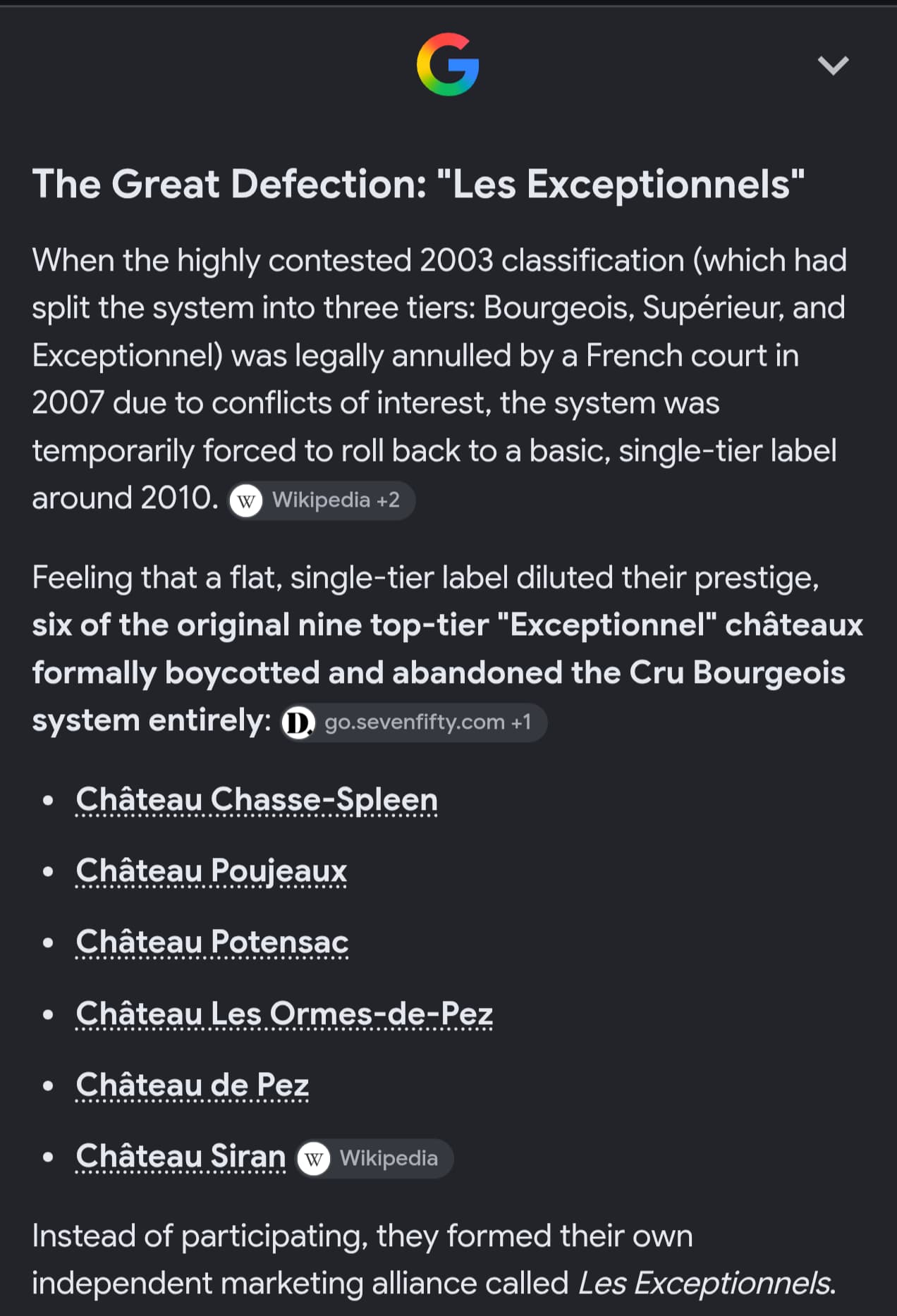
There was a 2020 revision:

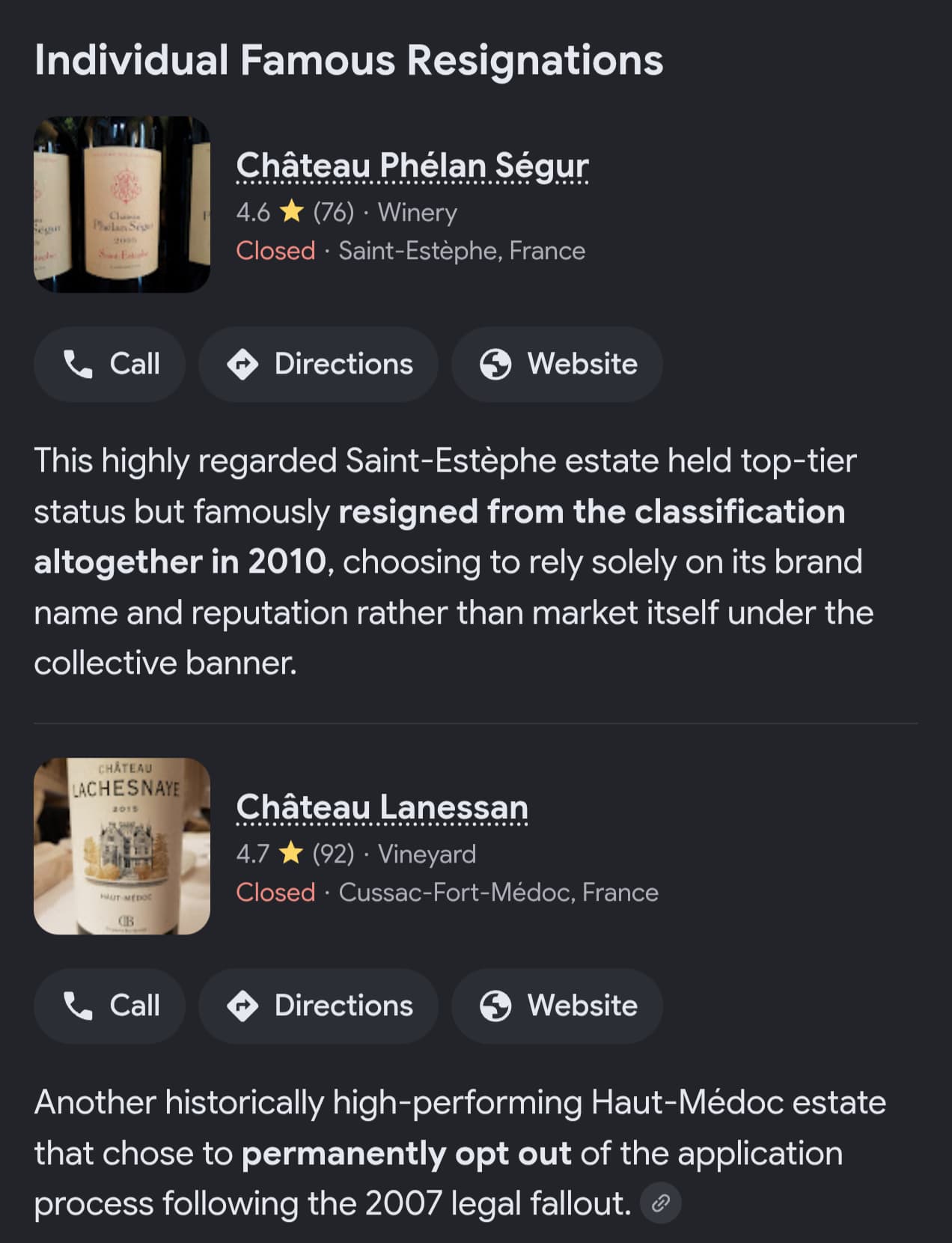
Examples of chateaux eschewing the classification:


I am old. I memorized the 1855 classification in high school French class in the 1960s. Other than the absurdity of under-classifying Mouton due to French antisemitism, I stick with the original definitions, If it was not classified, it was Cru Bourgeois. From there, you should buy, and drink, what you like. 2001 as just my 25 year experiment.

1 Like

Back then at Rochambeau it would have been Alan Marshok doing the Bordeaux offer, he was a great guy.
I also bought more at low end (just married, trying to buy a house, upcoming college bills). The modernista RBs were tasty young but aged poorly. Clos Rene is a solid Pomerol for lower tier. I’ve had good bottles of Caronne St Gemme (I think $9), Potensac, Cantemerle in last few years. For a bit more (but still cheap then) Haut-Bailly and Lagrange (StJ).

1 Like

Yes. I dealt with Alan. There were “issues” with their ability to deliver, IIRC it was the Lascombes and d’Issan, and everyone there pointed at everyone else. I made a fuss and they straightened it out. I think that Alan went to Post in Syosset and I had dealt with them for years before and after he got there. I have not spoken to him in a long time.

I’d be curious to hear how the d’Aiguilhe is holding up.

Over half a century of drinking these wines, I have concluded that any well-made Medoc or Haut-Medoc below the Classified level, harvested in a good or fine vintage (not too hot; not too cold) is a 20 year wine. Unless it’s Lanessan, in which case it’s a 50 year wine (I enjoyed and posted on a 1966 a few years back).
That’s just what you get from cold climate, Cabernet and gravel, assuming the wine is vinified, aged and bottled properly.
Of course ‘cold climate’ is looking like the past tense. I didn’t buy any 2003s.

4 Likes

Yes, absolutely. There are lots of wines that fit into the non-classified category that are neither CC nor CB. The passage from CB to this kind of No Man’s Land is one of the biggest tendencies of the last 40 years. I think the CB branding can be useful for some, but a glass ceiling for others, because when the average punter sees two CBs on a shelf, one costing 12€ and the other 30€, they won’t choose the more expensive of the two. Some have succeeded the transition better than others: Sociando-Mallet has done so successfully, whereas Citran, for example, hasn’t, still selling for the same price or thereabouts as before.

Of course there are some CCs that sell for less now than the non-CCs and in the process, can represent good value. Cantemerle is one - and I agree with Jay that it can be both over and underrated. Likewise Belgrave, whose 2000 cost me a mere 20€ only last year, and which is drinking beautifully. Fougas-Maldoror is a Côtes de Bourg and so a neither/nor anyway, and I’m not surprised that it aged so well for Jay.

As to whether or not it’s worth the wait, I think it depends on the size of one’s cellar. I’m happy to let some of mine age, because I can, but most people don’t have that possibility. Faced with choosing to age a good St.Julien for 20 years or a good CB/non CC, it’s tough to choose the latter, IMHO.

1 Like

Provenance is the whole game with bottles like these. A modest wine with perfect storage can be genuinely charming at 25 years — not profound, just honest and fully mature, which is its own reward. The ones that disappoint are usually the bottles with an unknown past, not the humble label. Looking forward to hearing how the Cantemerle shows.

I have bought and cellared several cru bourgeois wines for years. Really had good luck with them Some of them have changed, and if I were collecting now I would avoid them.

But generally I would go with the higher end
Meyney
Sociando Mallet
Potensac

If you are trawling for older vintages you in the secondary market
Poujeaux
Lanessan

1 Like

I never heard that underclassifying Mouton was do to antisemitism, not that that was unlikely in 19th century France. But then why didn’t they also underclassify Lafite, which is also a Rothschild wine (they did get around).

Yes, hard to square with Lafite being a first growth.

Circle squared: the Rothschilds didn’t buy Lafite until 10-15 years after the 1855 classification.

1 Like

Umm, I don’t think the Rothschilds owned Mouton in 1855.

1 Like

I think more winners than losers in that group. I would expect to enjoy de Sales, d’Aiguilhe, Cantemerle, d’Armailhac, Lascombes, and d’Issan. Not OMG magical moments, but enjoyable and worthy of the initial price. Curious to hear what you think when you open them.

They (English branch) purchased Mouton in 1853.