This won’t do anything to boost wine sales going forward.
https://www.telegraph.co.uk/health-fitness/diet/alcohol/alcohol-women/
This won’t do anything to boost wine sales going forward.
https://www.telegraph.co.uk/health-fitness/diet/alcohol/alcohol-women/
Paywalled. The readable portion sounds like clickbait. What scientific study, if any, did they misinterpret to come up with that headline?
That’s like liquor before beer, you’re in the clear.
This is so stupid.
Women who drink two bottles of wine a week are at a 27 per cent greater risk of developing breast cancer than women who don’t drink, says Dr Rumgay.
According to Alcohol Change UK, just one drink per day (1.25 units) can increase your breast cancer risk by 7 per cent.
Women who drink a small glass of wine every day, equivalent to around 10 units a week, are at a 15 per cent greater risk of developing breast cancer than women who don’t drink, says Dr Rumgay.
Women who have one drink three times a week are at a 9 per cent greater risk of developing breast cancer than women who don’t drink, says Dr Rumgay.
Women who have one drink once a week are at a 3 per cent greater risk of developing breast cancer than women who don’t drink, says Dr Rumgay.
Women who have fewer than six drinks over the course of a whole year are 0.3 per cent more likely to develop breast cancer than women who don’t drink.
As I thought. For a more realistic interpretation of the data, look here:
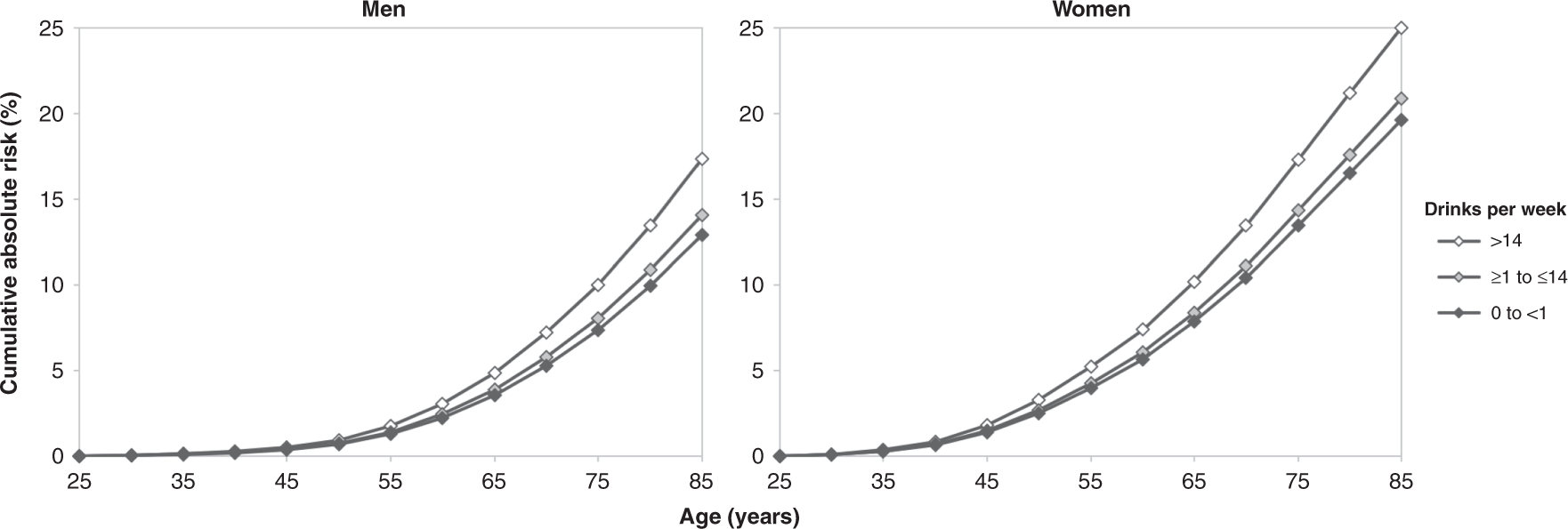
I think the following graphs showing cumulative absolute risk give a better representation of these risks than anything I’ve seen in the press.
Risk increases with age, even among the non-drinkers (bottom curves, 0 to <1 drink per week). It’s greater than 10% of male non-drinkers and 15% of female non-drinkers by age 85, a reminder that alcohol is not the only cause of cancer in these alcohol-related cancers.
The heaviest drinkers (>14 drinks/week, median 21/wk for men, 20/wk for women), represented by the top curves had an absolute increase in risk of developing an alcohol-related cancer of about 1% for men and 2% for women by age 65. That increased to about 3% (men) and 4% (women) by age 75 and about 4% (men) and 5-6% (women) by age 85.
In table form, simplified and rounding to the nearest percentage, I look at it like this:
Approximate Increase in Absolute Risk
(median 20-21 drinks/week vs. <1 drink/week)
Age….…Men………Women
45………<1%………<1%
55………<1%………~1%
65………~1%………~2%
75………~3%………~4%
85………~4%………~6%
The issue is that breast cancer risk is heterogeneous. Tyrer-Cuzick doesn’t explicitly factor alcohol into the risk calculation but probably more research in this area will be coming down the line.
My point in posting that article was less about the science than about how common these articles are becoming. I suspect that very few people have ever read a scientific article on the risks and dangers of smoking. And yet pretty much everyone will claim to know that smoking is bad for your health, even the people who keep smoking. As these articles continue to be published by the mainstream/popular press, the belief that drinking alcohol is bad for you will become common knowledge among the general population regardless of the science behind it. And that
No argument there Chris. Just trying to present a more rational view for anyone who reads the linked article.
Unless the study eliminates genetic variation it is fairly useless. We already know that women with some , typically inherited, dna markers are more prone to breast cancer than others. Does this study adjust for that?
It’s a population study, so it should account for genetic variation in aggregate.
Gordon, “restaurateur,” asking the hard, medical questions here. 
As Michael points out, genetic variability becomes irrelevant in a large population study like this.
It should also be noted that results of population studies describe population risks, not individual risks. So from the perspective of individual utility, one does need to also consider individual risk factors as you imply.
I didn’t know where else to post this. These two wineries, plus Crowley? If I was local, I’d definitely go to this party!
Some of the Valley’s best Pinot Noirs paired with Matt’s legendary BBQ—come on down to Evesham Wood for a Barn Party featuring Crowley, Haden Fig, Evesham Wood, Matt’s BBQ, and it’s free!
Saturday, June 21, join us for an afternoon of wine tasting, barbecue, good vibes, and friendly faces in the rustic charm of our hilltop barn overlooking the beautiful Le Puits Sec Vineyard.
Hang out with the winemakers—Erin Nuccio of Evesham Wood and Haden Fig, and Tyson Crowley of Crowley Wines—while they open their best bottles. Experience how perfectly these complex Pinot Noirs pair with Matt’s expertly smoked brisket, turkey, pork sausages, and mushrooms.
Get your free tickets now to let us know you’re coming out. We can’t wait to see you!


I’m glad you did - registered! Thanks!
Executives from Jack Daniel’s parent company, Brown-Forman Corp., warned that the business is seeing pressure from cannabis, weight-loss drugs and lackluster demand from Generation Z.
Brown-Forman CEO Lawson Whiting told analysts on an earnings call that the “same big three” is the reason that there has been lower demand for liquor.
This was way too short and lacking in evidence that those things are true.
I think the excuse machine is alive and well. Companies like Brown Forman are not looking at the massive boom in American Whiskey competition. There are way too many brands. That to me is more about what is undercutting their sales than Ozempic. Prices of the premium whiskies got out of control on retail shelves and the secondary market. And while the secondary market has come down, I’m seeing an awful lot of overpriced whiskey sitting on retail shelves, waiting for “that guy” to come along.
The marijuana argument is cute. I think the same number of people were doing it the day after it was legal (still only 21 states) as the day before it was legal. You might see some people experimenting with infused products, but I don’t think that there is going to be a huge boom beyond the same audience of marijuana users as before it was legal. Companies like Brown Forman are already down the marijuana path anyway, so there’s that too.
I think I’ll take it for what its worth. Doesn’t have to be a formal study to have some merit. These are trends that are happening all around us and we are aware that they will take some kind of a bite out of the traditional wine/beer/spirits market. BF heading into the drinkable THC market makes sense for these reasons. Whiskey has its own issues and there will be lots of shakeout there as so many have jumped in during the time it was skyrocketing. Buffalo Trace doubling capacity will ripple through the industry
The lifetime odds of dying in a car crash are approximately 1 in 95. I have a much greater risk of dying every day driving home than developing a cancer from wine.
Moreover, studies have shown a 21% increased risk of lymphoma among tattooed individuals compared to those without tattoos. The risk appears to be higher for certain types of lymphoma, like diffuse large B-cell lymphoma and follicular lymphoma.
Also, some studies indicate a higher incidence of skin cancer (excluding basal cell carcinoma) among tattooed individuals, with a hazard ratio of 1.62.
Sooo, maybe the younger generation should drive back roads home and take the money they spend on tattoos and spend it on wine 
Day one? Yes. Over time, no.
Plus, there’s a difference between only having access thru scoring a dime bag behind the Circle K and going to a licensed, safe dispensary, or, in some states, the Total Wine for a hemp drink.
(Disclosure: ITCB (in the cannabis business))
I agree with you, and should have been more clear that my comment was about the current state of affairs and in response to the ridiculous snippet sized article.
Cannabis is too new to be the boogey man. To your point about gaining traction, it’s whether clients will stick with it.