He sold “Founding Memberships” that entitle certain benefits to the buyer. One of those benefits is a gift card worth $$$$
Why hasn’t anyone asked ChatGPT?
Question: I signed a non compete when I sold my wine company. The terms of the non compete say I can’t sell wine direct to consumers for 24 months. On month 21, I launched a new wine company, very similar to my old one, and sold $1000 founding memberships which allows the buyer to use the $1000 on future wine purchases as well as other perks like riding on my private yacht and having tastings. I have not sold any wine or offered any wine to any consumers. I am getting sued by the person who I sold my company to for breaking the terms of my non compete. Who is right?
Answer:
This sounds like a complex situation with significant legal implications, but I’ll break it down into key points based on the information you’ve provided.
Key Details:
- Non-Compete Agreement: You signed a non-compete agreement that prohibits you from selling wine directly to consumers for 24 months.
- Your New Venture: You launched a new wine company on month 21 of the 24-month restriction period, selling $1,000 founding memberships, which can be redeemed for future wine purchases but do not involve directly selling wine yet.
- Legal Action: The buyer of your previous wine company is suing you for allegedly breaching the non-compete terms.
Key Points to Consider:
- Interpretation of “Selling Wine Direct to Consumers”:
- The terms of the non-compete explicitly restrict selling wine directly to consumers. Whether you’ve violated this depends on how the contract defines “selling wine.” If the contract language is strict about the direct sale of wine (and your membership model isn’t considered a “sale” of wine yet), you might have a technical argument. However, if the membership allows the purchase of wine in the future, it could be seen as a form of indirect sale or an intention to bypass the non-compete.
- Some non-competes are written broadly, covering anything that could reasonably be seen as competing in the same market or industry, even indirectly. Given that your membership essentially serves as a precursor to wine sales, the other party might argue that you’re “setting up” for future sales, which could be considered a violation of the spirit of the non-compete agreement.
- Does Selling Memberships Count as “Selling Wine”?
- This is a grey area, and courts often look at the substance of the activity over its form. While technically, you haven’t yet sold wine, you’ve sold something (a membership) that is closely tied to future wine sales and could be interpreted as an attempt to bypass the non-compete. Depending on the legal interpretation, it could be seen as a “violation in advance” because the membership is contingent on future wine sales.
- Additionally, offering perks like private yacht rides and tastings, while not directly selling wine, still ties into the wine business and could be construed as part of the package.
- The Timing (Month 21):
- You launched the business just 3 months before the non-compete expires. If your non-compete was meant to protect the buyer’s ability to build their own customer base in your previous market, launching a similar business so close to the expiration date might look suspicious to a court. The buyer could argue that your actions are a breach of the non-compete’s purpose, even if you haven’t technically sold any wine yet.
- Non-Compete Enforcement:
- Non-competes can be difficult to enforce, depending on the jurisdiction, the language of the agreement, and the industry. Courts generally want to enforce non-competes that are clear and reasonable in scope (in terms of geography, time, and what activities are restricted). A 24-month restriction in a wine business might be considered enforceable if it’s deemed necessary to protect the buyer’s business interest.
- However, some jurisdictions have laws that limit the enforceability of non-compete clauses, especially if they are overly broad or restrictive.
Who Is Likely “Right”?
- You: If the non-compete is narrowly defined to only cover actual wine sales, and your memberships haven’t yet resulted in any wine sales, you could argue that you haven’t technically violated the terms.
- The Buyer: If the non-compete is broadly written to prevent you from engaging in any activities that could be seen as competitive to the business you sold (even if you’re not directly selling wine yet), the buyer might have a strong case. Selling memberships tied to future wine purchases, particularly when you are still operating in a very similar niche, might be enough to trigger the non-compete.
Legal Advice:
Ultimately, this is a question of interpretation that can only be definitively answered by a court. You should consult with a lawyer who specializes in contract law, specifically non-compete agreements, to help evaluate your position. They can provide specific guidance based on the language of your contract, the jurisdiction you’re in, and how similar cases have been decided in your area.
The key things your lawyer will focus on are:
- The exact language of your non-compete.
- Whether the membership model you’ve launched is considered a violation of the intent of the non-compete (even if you haven’t yet sold wine).
- How courts in your jurisdiction have interpreted similar clauses in similar cases.
This situation seems like one where the court would likely look at both the letter of the agreement and the broader context of your actions. You might not have technically violated the non-compete, but the buyer could argue that your activities are strategically positioning you to do so in the near future.
3 Likes
Oh hey Matt. Welcome to the thread. 
1 Like
I’m a drunk you think I remember what someone posted before?
2 Likes
If I was Cam, I would be shying away from the yacht rides. On the wholesale level, there’s something known as “ Assists” Simply stated you cannot provide some thing for free that would induce the sale of your product in the alcohol beverage business in California
The following is not the specific language that I’m looking for, but it’s within the theme
Section 25600 of the ABC Act prohibits generally the giving of any “premium, gift, or free goods” in connection with the sale of any alcohol beverage. The ABC, however, several years ago adopted Rule 106(j) which allows a premium or gift “cross-merchandising” promotion with a non-alcoholic beverage product if the value of the premium or gift does not exceeds $0.25 if it is cross-merchandised with beer, $1.00 with wine, or $5.00 with distilled spirits.
The ABC’s policies interpreting these provisions have evolved since it adopted Rule 106(j), particularly in response to a court case in 2002, Department Of Alcoholic Beverage Control v. Miller Brewing Company. In that case, a court of appeals held that giving consumers cash rebates or refunds on the purchase of beer when they bought certain non-alcohol products was lawful. The court distinguished a “rebate” from a “premium, gift, or free good.” Since that case the ABC has expanded its policy to allow any amount of rebate on either the alcohol beverage or the other item purchased in conjunction with the alcohol beverage unless the rebate results in the giving of something free. The rebate therefore may not equal or exceed the cost of the product for which it’s offered. Rebates may be given either at the time of purchase or by mail-in to the manufacturer or importer. The ABC continues to prohibit the actual give-away of a non-alcohol beverage item itself (as opposed to a rebate or refund) when the value exceeds the dollar limits mentioned above.
Specifically:
Cam isn’t selling wholesale. He’s selling DTC. This is the same as a winery having a wine party for it’s members, or free shipping.
1 Like
I’d start with cleaning up the shit.
1 Like
The Négociant added this as a ‘popup’ on their website for possible SMS text offers:
An incredible lineup is on the way!
$100+ quality Oakville, Rutherford, Yountville,
Coombsville, and Atlas Peak Cabernet’s
for prices too low to print.
World-class Sonoma Coast Chardonnay, Pinot Noir and many more!
11 Likes
When?
1 Like
When the case settles.
3 Likes
Will be well aged.
2 Likes
I am hoping for a N.00 secret offer to those of us who are founding members!
6 Likes
100%. I’m looking for a ‘back up the yacht’ $200 wine for $12. 
6 Likes
Think big!
Maybe 3 super special extra secret awesome offers?
- N. #0
- N. #00
- N. #000
- et cetera……?

1 Like
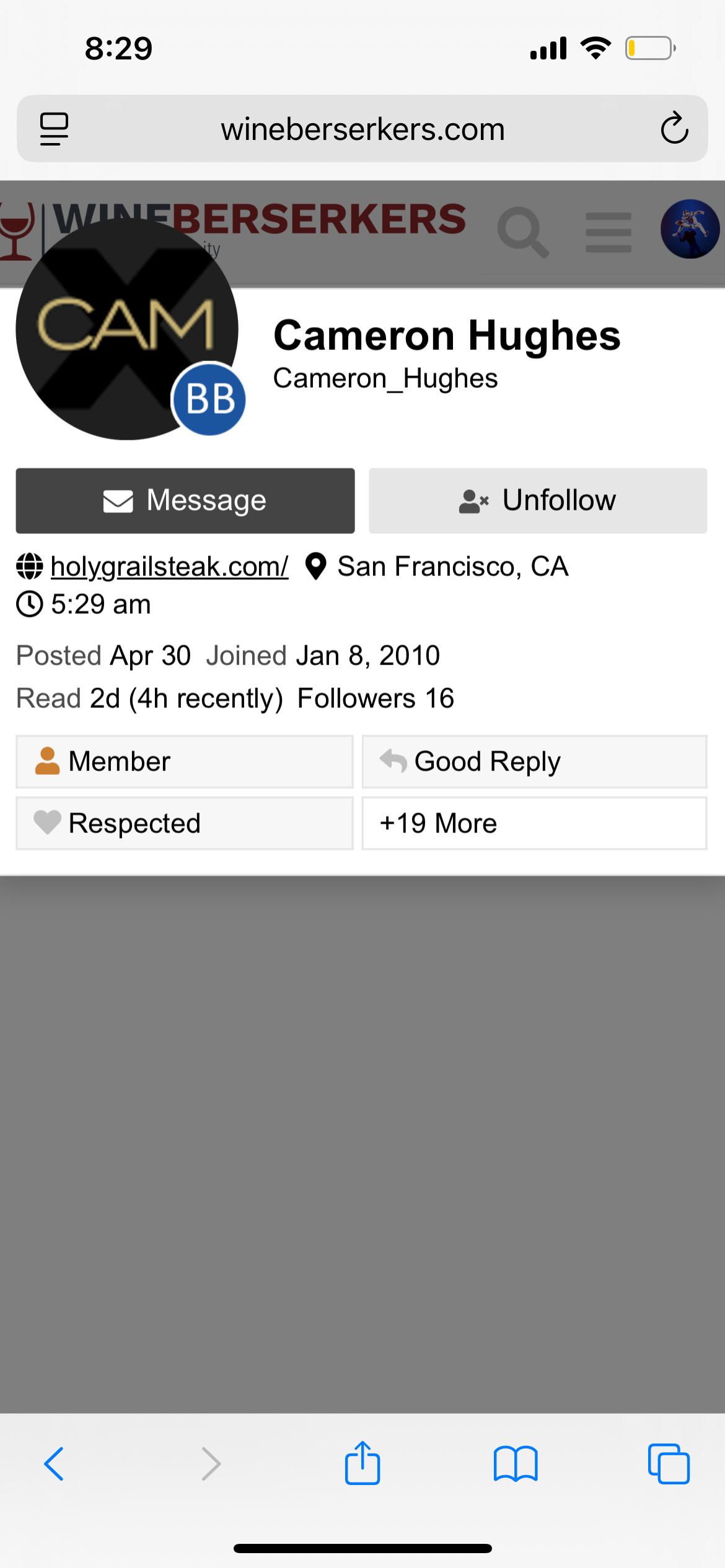
Website also appears scrubbed of any references to “The Negociant”, bottle labels or pictures, as well as the specifics about business model (eg restocking fee).
Will Cam rebrand to Intergalactic wine? Which honestly is a cooler name anyway.
4 Likes
BUTT Wines
(back up the truck)
8 Likes
“The silence is deafening, butt, the aroma is incredible?”
3 Likes
Hmm. those changes are interesting, and makes it seem he is not interested in fighting the legal issues if he can avoid them with a simple name change.
1 Like