How do you all rate your wines? Asking both about scale (e.g., 100 point, A-F, like/dislike) and about how you build your score (i.e., do you score components of the wine and see what the result is, or do you gut-feel where on the trash - mind-blowing scale a wine fits in)?
I want to begin scoring on CT but don’t really have much to go off other than picking a wine critic and mimicking their methodology - so curious to hear from you all.
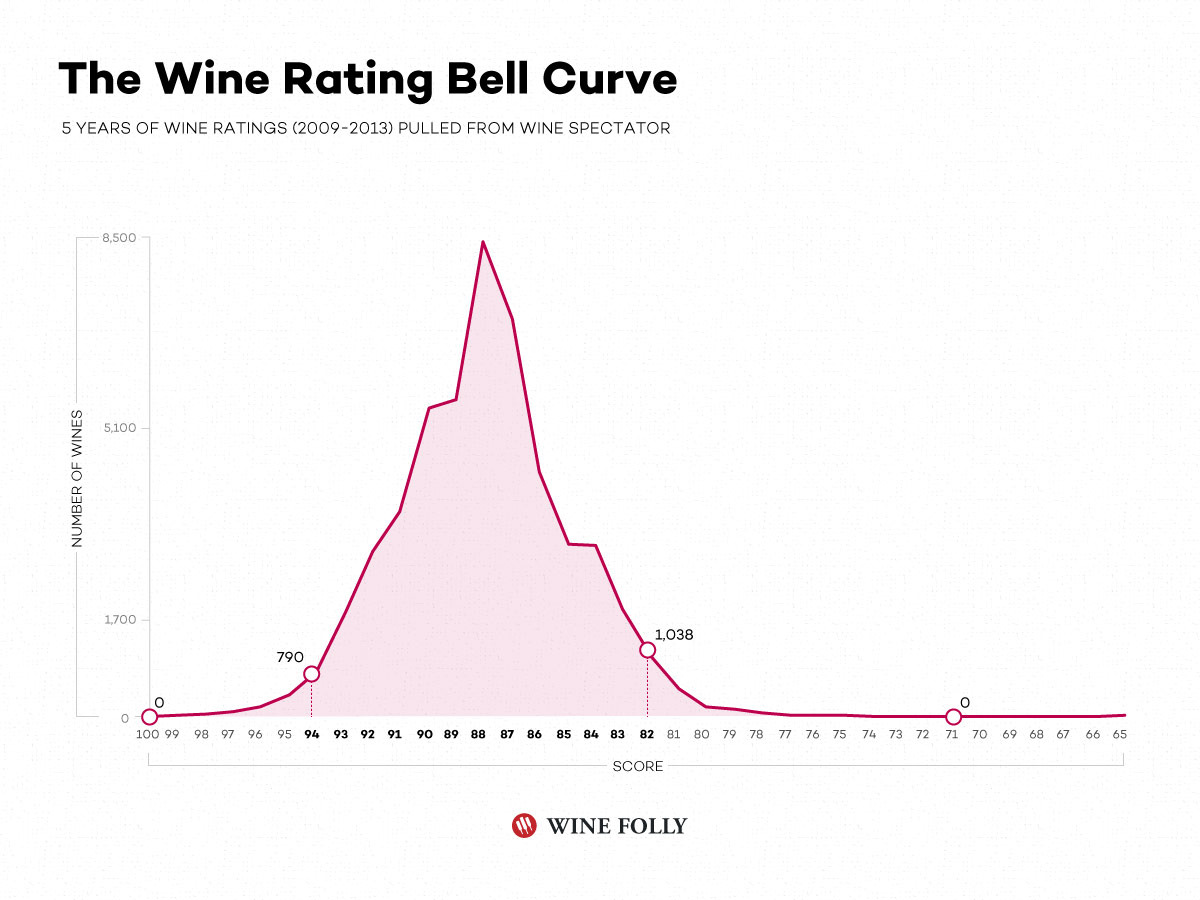
Somewhat related, saw this scoring distribution list on WineFolly, found it interesting that the vast majority are “above average” to “good.”
These curves aren’t really useful. People don’t randomly sample across the pool of wine made in the world, there is a selection process that by definition skews this towards the higher points…
Personally, I rate wines because it gives me an additional dimension in my tasting notes without having to use a bunch of words to describe how much I liked this vs another wine. But it’s mostly a gut feel, definitely not an analytic process.
Ignacio, perhaps think about David’s suggestion and ignore the score. I’ve been writing up wines for 2 decades now and I’ve never used a score either. The value lies squarely for me in what you say not what you have it scored. All the best with whatever you decide and look forward to seeing your notes. What is your handle in Cellartracker?
Personally, I take notes and usually write my views on when I should open the next bottle, how much air, etc, and whether/under what conditions I should buy more/buy in other vintages etc. Those are the most practical pieces of information I need when looking back on my notes to inform future me.
I use a ridiculously convoluted scoring system that I created. It works for me.
AFAIK nobody else uses it, which is fine, because it works for me.
It has 32 gradations, which I think most wine-lovers can understand.
Rating meaning # of gradations
under 80 - undrinkable, potentially lethal 1
80 – 84 - it’s in front of me, OK, I’ll drink it 5
85 – 89.5 - I’m enjoying this 10
90 – 94.5 - Drinking, enjoying and paying attention 10
95 – 99 - Everything else is in the background 5
100 - GO AWAY! DON’T BOTHER ME!!! 1
My method is easy. I look at a Suckling score and reverse the figures. 98 becomes 89 93, a 39.etc
I run into problems with double digits, but fortunately he only publishes one, the 99, so I just add a 1, so it becomes 100. And with anything scored 100, I just remove a zero.
I use the 100 point scale sometimes for personal reference and when talking with others, but my most common rating system is a shorthand that I’ve found works well for me and lends itself well to being jotted down without attracting too much attention, which can be helpful in a professional setting.
A minus sign (-) means I don’t like it
O means it’s fine
A plus sign (+) means it’s nice
++ it’s good
+++ it’s impressive
! I really like this!
We can feel pressured into applying scores, because that’s what the wine critics do, but they do it for the column inches, for the shelf talkers, and to sell books / magazines to those too scared to trust their own palates.
If scoring helps, fine do it, but use a scale that’s useful to you. Other scales include:
Hugh Johnson’s one sniff, two sniffs, taste, etc. scale that’s nicely descriptive
The simple scale that was popular in Italy e.g 0-3 grapes, 0-4 glasses, recognising how difficult it is to be in any way precise
The $ (or € or £) scale. Simply at what price would you think this ‘fair value’ (e.g. $30), so if you see it much cheaper, buy it! This is also a super (and humbling) scale to use when blind tasting.
I hope that the “average” score reflects above average wine. Most critics, and amateurs who bother to post scores, do not bother drinking, let alone scoring, below average wines> Remember that there’s Blue Nun, Mateus and Two Buck Chuck out there.
Here is my lowest CT-rated wine. I do not remember exactly why I drank it, but it had something to do with a WB event or contest. Maybe it was a FMIII charity event.
NV Richards Wine Company Concord Wild Irish Rose - USA, New York, Finger Lakes, Cayuga Lake (9/1/2014)
Light red, almost rose. acetone and red cherry on the nose. Sweet red Catawaba flavor, similar to dilute Manischewitz Concord Grape. Produced in Canandaigua, New York. Definite Finger Lakes red wine terroir. There is a bit of popcorn flavor but no butter on it. Finish lasts way too long. Still have that Smith Brothers Cough Drop flavor well after I hoped the finish would be gone. I swallowed in it the name of science, so it gets 60 points, which is my minimum for a wine that your reflexes did not force you to spit out. (60 points)
And here’s my lowest ever rating for a Bordeaux, which may give you an idea of why most “rated” wines are at least “good.” I think this was a magnum that was brought by Gary Vaynerchuck. The Fontalloro he brought was much better.
2003 Château Marquis d'Alesme - France, Bordeaux, Médoc, Margaux (1/1/2007)
At the Jets/Raiders Tailgate OL. Earlier this year, I had lunch with Francois Mauss. I suggested in jest, after a half bottle of Pax, that maybe the BB denizens should take one step beyond buying wine at the Hospice de Beaune auction and actually buy an existing winery. He told me that a classified Bordeaux Chateau, D'Alesme Becker, was for sale (it has since been sold). At first I insisted there was no such Chateau, because while in French class in high school I had once memorized the 1855 classification and I did not recognize the name. But knowing who I was talking to, I realized that creeping alzheimers was probably amplified by the high octane Pax. I looked it up when I got home, and sure enough, there it was. I didn't give it much thought until yesterday morning, when someone (name withheld to protect the innocent) showed up at our tailgate at the Meadowlands with a bottle of the 2003. First of all, the label is ugly. You would never guess it to be a Bdx by the label, except for the words "Margaux" in big white letters on a black background. It is the exact opposite (white on black) as the label shown on Cellartracker. I tasted the wine in the parking lot at about 11:30 am, again at home at about 10:00 pm, and again this morning a 11:30. The color of the wine is cloudy. I assume it is unfiltered, and this morining I can see some sediment stuck to one side of the bottle. Otherwine, the color was about right. There is just nothing going on with this wine. It smells like an ordinary red wine you buy in a jug. The flavor is not affirmatively bad, but it's not good either. I can't give you much of a tasting note because there's not a lot of taste other than generic red wine. I think that 79 points is the perfect score. It does not warrant 80, which is defined as "good" but there's nothing obnoxious, rancid musty or rotten about it. If you take into account how much really bad wine there is in this world, the high end of average seems about right. (79 points)
I don’t use points and I don’t believe in scoring wines for others to relate to. My palate and my preferences are not calibrated to any universal standard.
I use outstanding, excellent, very good, good, fair, and poor as a memory aid. I don’t expect my rankings to have any meaning for anyone else.
Excellent and outstanding are for wines I want more of, ignoring for rating purposes their cost and how much is already in the cellar. They are simply wines that I would be enthusiastic about drinking again. The outstanding ones are few and far between, best described as a “Triple curly with an extra woo, woo, woo!”
Very good and good are for wines I enjoy but would not bother drinking again. I’d rather spend whatever remaining drinking days I have left with excellent or outstanding wines.
Fair is for wines I don’t enjoy but are not specifically flawed. I wouldn’t finish a glass of a fair wine unless etiquette demanded it.
The first thing to consider, IMHO, is why are you taking notes and scoring wines? For most of us, it’s just for ourselves
to remember what we liked and why
was the bottle ready (for you)
what kind of preparation worked, or not
do you think you’d like it more in the future, I.e. as it aged
or, the reverse - it’s aged plenty, or perhaps too much
Was it worth the price
Should you buy more (of the wine, the producer, the grape, the region)
All of those reasons for taking a note in CT are hard to encapsulate with a single number.
Or, you might be taking notes for others - to record an event for friends, perhaps. Or you might remember that CT is a community that benefits from all our notes, so perhaps you add some details that the community might care about.
Still, a single numerical score might have some use. For me, I try to capture some of these questions I’ve outlined, but I also add a score. That helps me remember how much I liked the wine, relative to other bottles (as hideously inexact as such a subjective comparison might be). I might write fairly similar notes on two bottles, but give one a score of 90 and the other a 94. This would remind my fallible memory about my subjective preferences.
The most important part of my notes are the words. But I do score. I use a roughly 10 point scale. Below 88 are terrible wines to be avoided. Otherwise I score from 88 to 96, with 88 being a barely drinkable, acceptable basic wine, and 96 verges on nectar of the gods. I have given a few 97s, 98s, and 99s, but how are they different? I couldn’t possibly tell you.
I guess I will be the contrarian opinion and actually encourage you to give a numerical rating on a 100 point score. CT gives parameters and you should use that as a guideline. Your scores can certainly have merit and are best if not in a vacuum. There certainly is score inflation but I personally believe some of that is attributable to better wine making in general as well as hopefully you are only drinking better wines. Most importantly if you can define specific attributes to the wine that influenced your score it can be valuable. The truth is even pundits are quirky - Gilman gives ridiculously low scores just because he hates the style of a wine - and that’s ok as long as he says why. Finally it is hard to write good thoughtful notes and good scores - even so as the years go by you often will find that when you revisit a wine you had 10 or 15 or 20 years prior that a thoughtful note and score will help you understand how the wine evolved. Or for all that matters, how your palate has evolved.
Always good to hear both sides of an argument! Definitely is some utility as a “wrapper” for the notes overall, and definitely agree that there is a lot of variance across how different folks score. And as you mention time is the ultimate test - definitely see a lot of evolution in my taste since beginning my “serious” wine journey a bit over a year ago, let alone over a decade or two!
I’m OK with the 100 point system, if only because (as Parker noted) it relates to any American kid’s childhood.
Just as long as we all realize that nobody uses a 100 point scale.
“I rated that a 23.”
“You idiot, I gave it a 38 and was tempted to go to 39!”
or, further down the scale:
5: I had to go to the hospital and have my stomach pumped.
4: I had to go to the hospital and was in intensive care overnight.
3: I had to go to the hospital and was in intensive care for a week.
2: I had to go to the hospital and came home with permanent damage.
1: I had to go to the hospital and I died there.