Who knows Maury?

Another recent trip to France, and another new region I was exposed to and taken an interest in. This time it’s Maury.

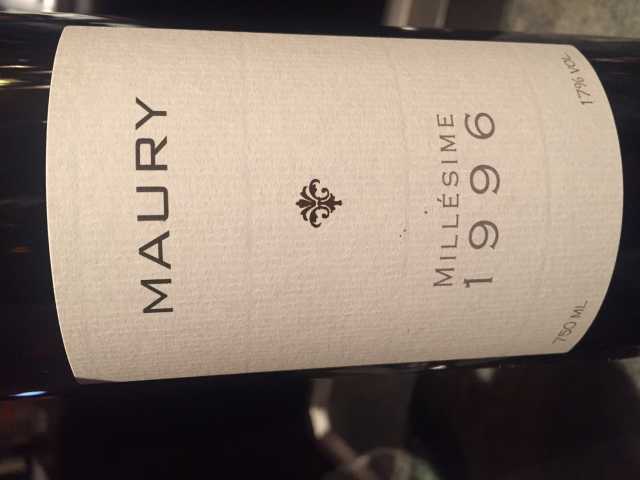
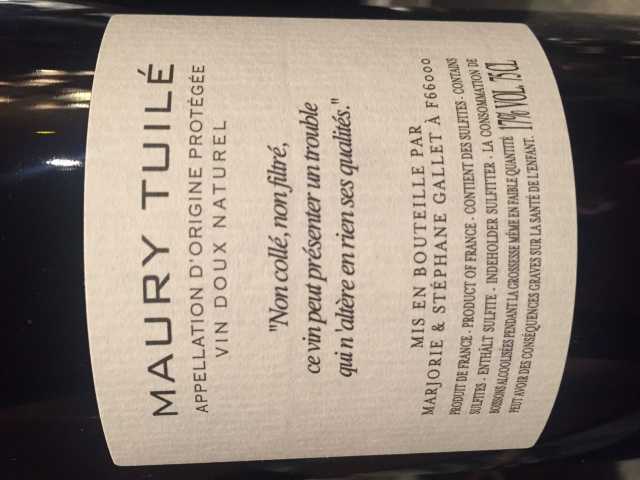
I first had a 2014 from Domaine Pouderoux that was tasty and interesting, and later a 1996 Maury Tuile from Marjorie and Stephane Gallet (Roc des Anges) that was so phenomenal I went back to the same wine bar the next night to have another glass. I can’t stop thinking about that wine, though I can’t seem to find much on CT or W-S. Even their website doesn’t show the bottling I had.

Other than being a Grenache-based fortified wine from the Roussillon and reading a bit on Wikipedia, I don’t know much about Maury at all. Can any of our resident experts here add any color? Maybe a list of top producers I can find that are imported in the U.S.?

Thanks in advance…
IMG_2981.JPG
IMG_2982.JPG

I’ve had a few of it over the years. Its very much like Banyuls, both Vin Doux Naturel. When young, I find they are the best dessert wines with chocolate.

Unfortunately, I don’t know that producer.

I know Maury quite well.
It´s a fortified wine - but moreover it is aged in big glass baloons stocked up in the summer sun … so a wine that survives this is literally immortal [wow.gif]

  • similar to Banyuls, but slightly less powerful, less tannic, often a bit creamier and sweeter … (splitting hairs)

We just had one 10 days ago with 7 friends … no vintage but late 70ies … and from a small cooperative … outstanding, very nicely aged … and the rest in the bottle was still drinking fine yesterday …

I once (90ies) found a Maury bottle at a flee market, standing in the full bright sun … I bought it for a song (might have been 4-5 $ then) … produced certainly before 1960 … really great wine …

The best (known) producer is usually Mas Amiel - they make a vintage and several “aged” wines (10 years, 15 years, 20 years …) - and also dry Roussillon …
Mas de Mas is another one …

Aside from Mas Amiel I don´t buy special producers, just what I find and looks good, but usually 20+ years old … I don´t like and drink them young … there are a lot of good makers and cooperatives …

BTW: a young good Maury (and Roussillion) producer is Paul Meunier, son of Alan Meunier (Domaine JJ Confuron, Burgundy) … no idea if he´s available …

1 Like

Another vote for Mas Amiel which I usually find when visiting London. I too also enjoy Banyuls.

Please look up Dan Kravitz (Hand picked Selections) he has a few producers that he brings in. He also has his own vineyard in the area. His own wine is excellent.

I know Maury reasonably well, although I didn’t know there was such a thing as Maury Tuilé.

Mas Amiel is the most well known and makes good versions but is pretty expensive compared to the competition.

Other producers I know who make good sweet Maury are

Domaine Pouderoux
Domaine Fontanelle
Clos des Vins d’Amour
Domaine Soulanes
Mas Mudigliza

But don’t dismiss the wines from the Cave de Maury, which can offer fabulous value.

1 Like

I read a book recently that covered them a little. Review is here

1 Like

Loved his “Fifteen” bottling drank cases of
The stuff about 10 years ago. I’ve not seen it in years, I wonder if it is still made?

That was going to be my suggestion as well. We have visited Maury quite a few times. A stop at Cave de Maury for a taste & spit can be helpful before the vertigo drive to Château de Quéribus. [cheers.gif]

@Gerhard–I have always found Maury to be a bit more rustic than Banyuls. Perhaps it’s the distance from the cooling influence of the sea?

Well, rustic or not depends on the producer … when well aged I don´t find it rustic … it tastes slightly “hotter” than a Banyuls I´d say … but I´m not totally sure I could distinguish a Maury from a Banyuls blind in every case …

I have had the chance to drink several Maury of various years and as I have the records, here is what I have drunk:

1880 (4), 1925 (23), 1928 (2), 1929 (2), 1930, 1932 (6), 1937 (3), 1939 (3), 1945, 1947 (3), 1948 (2), 1954, 1959 (6), 1965, 1969 (5), 1974, 1975, 1980 (4), 1983 (5), 1985 (4), 1997, 1998 (4), 2005 (2), 2007 (2), Total (87)

If I have drunk so many 1925 it is because I had the chance to receive an incredible proposal from a winemaker whom I know who was short of money. As he was responsible for what he proposed, that I knew by drinking from the casks, I bought a lot.

Maury is as Gerhard says an immortal wine because it has suffered temperatures above 50° Celsius when the sun shines on the huge dame-jeanne in glass which are spread on meadows and not far from 0° in winter.

Maury was long considered as the poor brother of Port wine but it is different. Sweet but rather lighter than Port, it is absolutely charming. Goes perfectly with chocolate but also with other desserts.
It could go with sweeetbread but it must be the last wine of a meal as it is strong and penetrating.

The prices are still cheap.
I recommand :

  • Chabert de Barbeira, les Vignerons de Maury
  • Maury cooperative des vignerons de Maury
  • La Coume du Roy domaine de Volontat Bachelet

And also Mas Amiel but for old vintages.
I am never dissatisfied by Maury.

1 Like

I appreciate what Gerhard says.
I would say that Banyuls is probably more diverse than Maury and sometimes more complex.
Old Banyuls are incredible.
Banyuls of Docteur Parcé are among the very best.

+1
And from another Parcé, I am also a fan of Dom. de la Rectorie. In addition to the fortified wines, Pierre’s Rosé is spectacular.

Thanks for all the input. I’ll definitely check in with Handpicked and see what they’re carrying these days.

I’ll be back over in France next month and see what else I can come up with on Maury…

Word of advice, don’t go there in summer months. It was hot as Hades. I was even there in March and it was pretty unbearable.

The Calvet Thunevin wines are made there, and if you like that big style, they are great.

Not in Maury, but of the same cloth/style and being from Roussillon, Puig Parahy makes a great dessert wine called Rancio.

Another vote for Mas Amiel, the style is just very balanced. Soulanes is quite nice too.

Nope, that was a one off project. Check out Cabirau though, that’s Dan’s project, and the wine is even better.

Slight drift, but Roc des Agnes wasn’t established until 2001. Assuming this Maury was already in barrel, possibly in bottles. Was it a part of the terms of purchase for the old vineyards that they take what was barreled off their hands? They haven’t actively produced one since afaik, preferring to do a passerille as their sweet wine. Any other info from anyone?

More than likely. I know Saint Roch (one of the Lafage properities) was bought around 2007 or 2008, and they had back stocks they took on.

Kind of telling that, from vines and back inventory of a Maury good enough to inspire the initial post, new owners immediately converted over to making completely different wines the first chance they got. Perhaps once the region’s regular winemaking infrastructure is more developed there might be some more Maury produced, but it definitely isn’t a wine that can lead their economy any more. Probably best that they’ve developed more mixed usage.

Commercial post: As already noted, I own a vineyard in this village.

Thanks to all for the kind words and the interest.

First of all, the Appellation ‘Maury’ is for dessert wines. Dry red wines from the village now have a new (since 2011) Appellation of Maury Sec. Dry red wines that do not qualify for the Appellation Maury Sec (or qualify, but the producer chooses not to use it) can be Cotes du Roussillon - Villages or Cotes du Roussillon. I produce only dry wines, Maury Sec at the higher level and Cotes du Roussillon for the entry level.

I am far from an expert on the dessert wines, but in my limited tastings I find Maury both more earthy and more mineral than Banyuls, but less fruity. Maury comes in a variety of styles, from young and pungent purple to aged, very aged and ancient, increasingly aromatic and with colors fading to ‘tuile’ (which means ‘tile’ in French, referring to the orangey color you see on roofs).

Dessert wines in general and the Vins Doux Naturel of Roussillon in particular have definitely lost much of their markets over the past few generations. In Roussillon, the generic Appellation for these lightly fortified wines is Rivesaltes. The specific, higher quality Appellations are Banyuls and Maury. I think that for wine, their reputations are about equal, but Banyuls is in a much stronger commercial position, being a gorgeous oceanfront village. Maury can be beautiful, but it is neither seaside nor mountains, so will never get the tourist traffic of Banyuls.

Within Maury, AFAIK the only producer to still use the classic ‘bonbon’ method is Mas Amiel. Their aged wines spend a year in 20 gallon glass jars (bonbons) sitting outside in a courtyard, exposed to full sun and temperatures that in fahrenheit range from lows of about 20 in the winter to highs that approach 110 in the summer. They make some of the greatest dessert Maury.

The Cooperative of Maury does excellent work with their dessert wines and I believe has older vintages for sale at very reasonable prices.

Not within Maury, but making Rivesaltes from a very similar terroir is Domaine Mounie in the adjoining village of Tautavel. I haven’t been there in a decade, but I doubt that things change quickly and they would probably have quite a selection of older vintages, again at reasonable prices.

Production in Maury is inevitably moving towards dry red wines, in accord with the changing tastes of consumers both in France and abroad. I do not want to hijack this thread, which is about the dessert wines, but interested board members can find lots of press and lots of verbiage about the dry red wines of Maury Sec, both here and in a lot of other places.

Dan Kravitz
1 Like

Dan,
Thank you for your message.
It is true that the landscapes of vines of Banyuls along the sea are fantastic.
But Maury is a lovely town and if I am not wrong you see the Canigou with the almost permanent snow.
From the place of Mas Amiel, you have a wonderful view on the Pyrénées.

Old Maury, old Banyuls, old Rivesaltes have very affordable prices and give a lot of pleasure. It is a pity to see the evolution of consumption, which is the same for Sauternes : they transform their production to make more dry wines.

1 Like