Did not intend on opening this, but I was in a rush and my hand landed here. Have a few, so figured I’d check-in. Wouldn’t call it a waste, but close. Just too soon for what I want from this wine. There’s a ton of material here that needs to relax a bit.

4 Likes
Oh Dennis. Shame on you… 
3 Likes
Should i say three Hail Marys or something like that 
And ask forgiveness from the Nahe gods.
4 Likes
I have a mag of the 2020 Halenburg…I guess I should wait 40 years to open it?
2 Likes

We opened these two last night at a restaurant with Peking Duck - what a fun comparison! The 1990 showed a little dull at first, good, but not nearly as lively as other bottles we’ve had. The 2019 was out of the gates as pretty a young kabi as I have had, super delicious, delicately strucured with tons of flirty appeal. We finished the 2019 at the restaurant and brought the second half of the 1990 home with us to finish a couple of hours later - Damn! I’m so glad we waited. By the time we got back to it, the wine had firmed and brightened, doing a 180 textually to something much more spritely and effortlessly expressive. Bottles like this show why auslese with age can be a true sipping wine. Loved them both.
12 Likes
And your experience with the 1990 demonstrates why wines with a decent amount of age need time open to wake up and reveal their greatness. I am so tired of people (especially those who pop and pour) giving up on aged wine too soon.
7 Likes
I still have a few Von Simmerns. 76 BA, and 88 Spats and Ausleses. Had one of the spats about 3 years ago and in great shape. Baroness Andrea von Simmern used to come to Ann Arbor annually on a sales tour. I not only enjoyed the wines, but I had a little innocent crush on her. She would attend our after event parties where all the German winery owners on the tour would bring wines from their Schatzkammer and we would do the same.
Great year, great vineyard, Terry Theise Selection. A recipe for quality.
I visited with the Trimbachs a couple times recently. Too many of the current vintages are anathema to the Trimbach style. They are doing their best, but they can only harvest so early in hot years to try to make their wines in the Trimbach way.
1 Like
Just had, Sunday, two 2020 Emrich Schönleber Halenbergs at a blind Nahe tasting I hosted. One was opened the night before, the other at the tasting. The wines were quite different and none of us identified it as the same bottling (I checked the AP#). Both had great potential and were excellent wines. The first wine was more open, the second wine was tighter and larger, more intense. We had a good laugh how none of us IDed as the same wine.
3 Likes
What do folks think of the Eva Fricke wines? Sitting on a couple Krone '20’s that I’m reluctant to open anytime soon; don’t hear about her much on WB.
I enjoy them, especially the dry ones. I have some from 2019-2021. Kind of hard to find
1 Like

This was very much in the zone & drinking surprisingly young. The photo makes the color look darker than it really was, On opening, it was not terribly forthcoming, mostly about the acid. After a couple of hours, it was absolutely singing. Notes of tangerine, lime zest, just a hint of petrol. I was a fan of the '04s in the Mosel on release and am happy that I have a few more bottles of this, another example of how terribly under-appreciated JJ Prüm’s wines are.
8 Likes
?? Lovely wines and all. But Prüm is the reference for Mosel off-dry wine and the name you always see, alongside Egon Müller when people want high prices, and Keller for dry riesling.
Under-appreciated was a poor choice of words.
The point I was trying to make is that, despite being among the very best wines made in Germany (along with Ego Müller & Keller, as you point out), they are priced significantly lower. So, at least according to the market, they are under-valued.
2 Likes
Probably a function of public demand for off-dry wines in general? With Müller being the exception, and also a smaller estate with those severe yields.
Although, FWIW, I personally wouldn’t put Prüm ahead of all their other peers in the region. I think they get name recognition because they have consistently produced good age-worthy wines over decades (whereas other historic producers had ‘dips’), so they have become an easy reference point that certain consumers expect. But for me, if their prices went into the stratosphere while their peers remained much lower, that would be over-valued.
4 Likes

Michigan riesling is hit or miss for me, with way more misses than hits. They are often overly tropical, lacking acidity, and/or contain too much RS for me. But this 2020 stone house riesling from the old mission peninsula is fantastic. Flinty, racy, just a hint of fruit.
3 Likes
Joh. Jos. Prüm has about 22 hectares, and Egon Müller, with Le Gallais, has about 16 hectares. As I understand it, Egon Müller has taken over the von Hövel holdings in Scharzhofberg and is leasing them. This means that Egon Müller now has nearly 19 hectares.
I should add that the “severe yields” are in the 2.1-hectare block in Scharzhofberg with the old, ungrafted vines.
3 Likes
Last weekend opened the first of a case of Carl Loewen 1896 Riesling 2018.
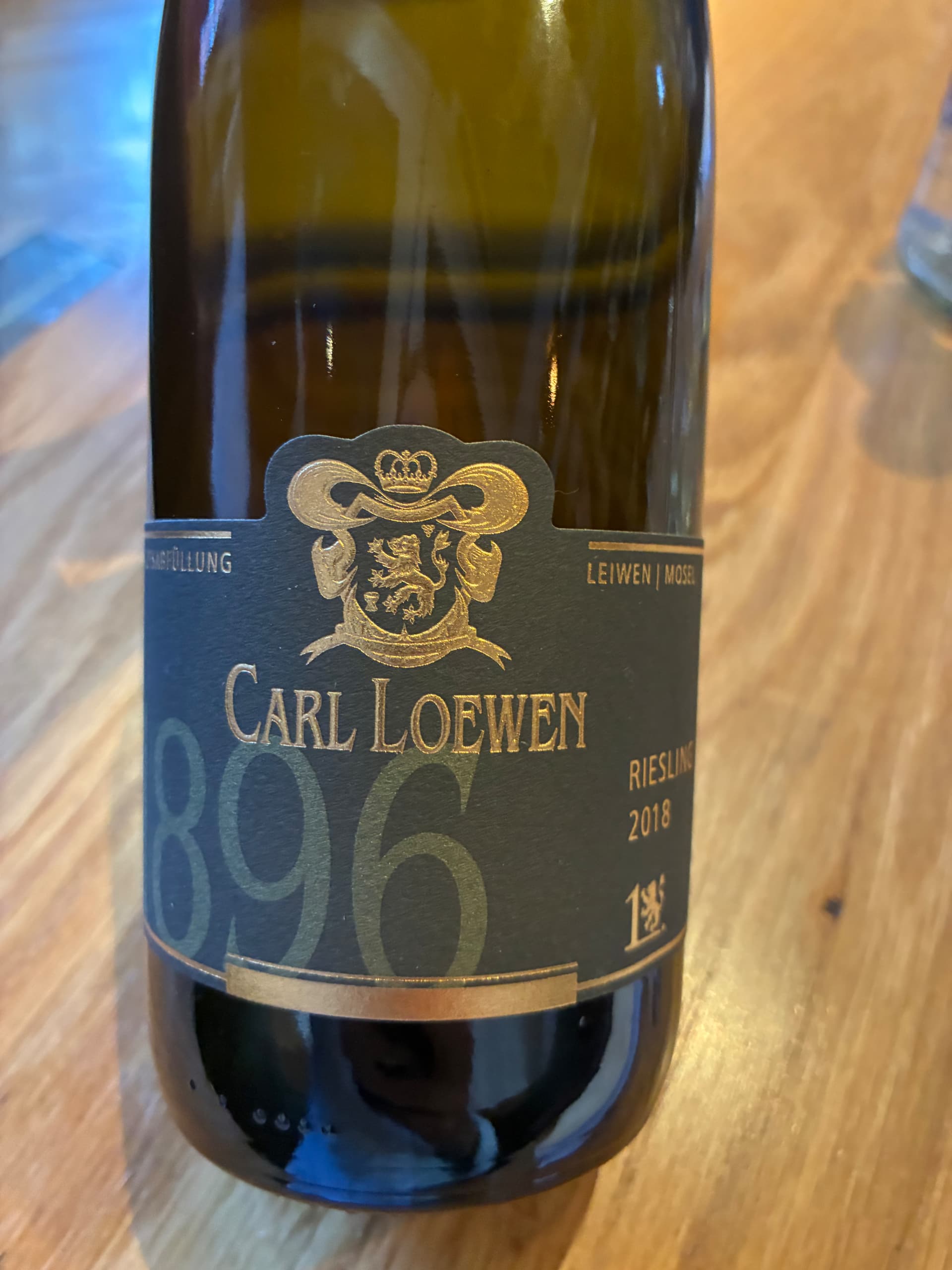
There’s a couple of Loewen 1896 cuvées, this is the top tier grey label. One fuder made, foot stamped, basket press etc. I’ve had ‘16, ‘20 and ‘21 (‘16 was the only one in the right drinking zone) so interested to see how this would drink.
Gorgeous, rippling intensity, long length but also somehow light and mineral driven. Beautifully balanced, this is thoroughly in the drinking zone now. No rush with the rest, but the fruit is there and interplays with the minerality in a way that keeps the wine shape shifting and hard to pin down. Great food wine. Lovin’ it.
6 Likes