While trying to dig up some information for the “Contra Costa Wine Heritage” thread, I stumbled across a 2016 email reply from Shauna Rosenblum of Rock Wall Wine Company.
Please keep in mind that her comments are in response to my past search for any historical links between the ancient Mataro grapevines found in Antioch and Oakley in Contra Costa County and those located in San Benito County.
"…I am very familiar with the ‘old-school’ plantings of Mataro grapes in Contra Costa County, but I am not as familiar with the Mourvedre Vineyards of San Benito County.
"Mataro is interplanted throughout California in centenarian vineyards. My story behind that choice of our ancestors is that they weren’t concerned with bringing the fruit in, making wine and then blending it. Blending came first…in the field. Blending happened in their choice of what to plant. The tiny Mataro berries along with the red fleshed Alicante Bouschet and intense Carignane are present in almost every vineyard that is around 100 years old. These three varietals seem to be the most consistent 'back-up singers’ to Zinfandel plantings throughout California, and particularly in Contra Costa County. I have a source of 88-year old Mourvedre in Oakley that is the best I have ever worked with and it’s in a dude’s front yard.
"I think Mataro adds complexity to Zinfandel. Zin is awesome on it’s own, but it can often run the gamut of being one-dimensional if there isn’t a couple % Petite, Mataro, Carignane or AB in it.
"Anyway, I don’t know if that was helpful or not, but good luck on your quest…sounds fun!
“Let me know if you are ever in our area, I’d be happy to taste you on my wines that have Mataro in them.
Cheers!!!
Shauna Rosenblum
Winemaker
Rock Wall Wine Co.”

Rock Wall Wine Company Homepage
I have sent an email to the folks at Ridge Vineyards in hopes of gaining an understanding of the winery’s intermittent relationship with the grape known as Mataro/Mourvèdre.
From the Ridge website, the following wines include Mourvèdre (or “Mataro”, in the parlance of the winery’s literature) either as a varietally-bottled wine or as a large component in a blend:
• 1990 “Evangelo Vineyard” Mataro (90% Mataro, 5% Zinfandel, 5% Alicante Bouschet)*
• 1993 “Evangelo Vineyard” Mataro (100% Mataro)*
• 1995 “Pagani Ranch” Mataro (75% Mataro, 25% Zinfandel)
• 1996 “Pagani Ranch” Mataro (75% Mataro, 25% Zinfandel)
• 1997 “Pagani Ranch” Mataro (77% Mataro, 23% Zinfandel)
• 2003 “Pato Vineyard” Mataro
(95% Mataro, 5% Petite Sirah)
• 2013 “Lytton Estate” Grenache/Mataro (40% Grenache, 40% Mataro, 15% Zinfandel, 5% Carignane)
• 2014 “Lytton Springs” Syrah/Grenache/Mataro (47% Syrah, 27% Grenache, 26% Mataro)
• 2015 “Lytton Springs” Syrah/Grenache/Mataro (35% Syrah, 23% Grenache, 42% Mataro)
zcz2jPGU9rA
\
- For unknown reasons, the Ridge 1990 & '93 Mourvèdre wines were labelled as “Evangelo Vineyard”, while the proper spelling of the property is “Evangelo”.
Mr Alex Russan of Metrick Wines has responded to my email interview questions. Metrick Wines produces a single-vineyard El Dorado Mourvedre from the “Futurnick Vineyard”.
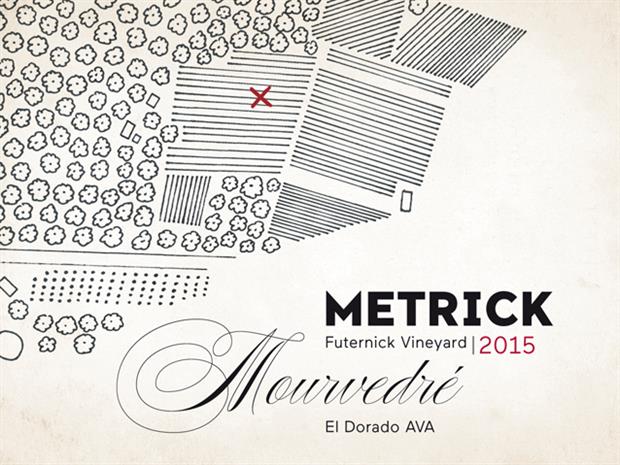
• What Mourvedre Clone/selection is used for your vineyard source, and why have you chosen that particular one?
AR: “It is Tablas Clone C or D. I chose the vineyard and manager over the clone (buying grapes, rather than land I own), but was happy to find out that they are the tables clones, as many of the older clones I’ve tasted in CA seem to be less complex. If it were my own vineyard, I would do a Tablas clone, or a Spanish clone.”
• Have you worked with different Mourvedre sites? What insights have you developed towards the ideal location for desirable Mourvedre grapes?
AR: “I have only worked with the Futernick Mourvedre. Unique things about this site are, the wines are particularly aromatic and particularly low in tannin. 2017 I did an extended maceration to try and pull some tannin out, and others have tried various degrees of stem inclusion. Still, the resulting wines are light and aromatic—not a bad thing at all, but I think if you wanted more tannin structure, you would have to blend. Luckily, Mourvedre is a particularly age worthy grape—perhaps owing to other antioxidants present in the skins—so the wines should be longer lived than other wines of such light structure. Mourvedre’s pH also goes quickly once the berries are nearly fully colored, so, to keep the wine in a microbial safe pH range (3.9 or lower), acidulating or blending is necessary.”
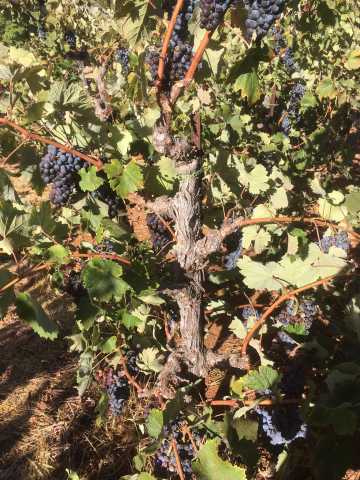
• What thoughts do you have regarding the relationship between Grenache, Syrah, and Mourvedre; what makes these three so complementary?
AR: " I don’t do GSM’s, and am by no means an expert on these types of wines. My interest in Mourvedre came from my work importing them from Spain for my Alexander Jules Import Company (http://www.alexander-jules), the Casa Los Frailes wines that I import, as well as the Primitivo Quiles wines of Alicante (which I do not) inspired me. Syrah aside, I think it it is difficult to have a ‘complete’ wine with a Mourvedre or Grenache, and I think they can often temper each others aggressive components, or fill in each other’s potential blanks, to make a complete and, at least, accessible, at most, magnificent, wine."
• Why do you think so many winegrowers have had success growing Grenache and Syrah, whereas Mourvedre has proven more challenging in getting mature fruit?
AR: “I think a lot has to do with marketability and demand. I’m seeing more and more growers plant Mourvedre, and more and more winemakers creating single vineyard bottlings. Prior to phylloxera, Mourvedre was a widely planted grape in Spain and southern France, it’s fall from grace was due to it’s difficult grafting onto early rootstocks, which is what lead to Grenache’s rise in popularity. So, I don’t think there is necessarily anything inherently less valuable about Mourvedre vs S and G, although I do think it is probably the most difficult to make a complete and exceptional wine from, at least for what the market overall market is looking for.”
• What special considerations do you think are necessary to produce a 100% (or Mourvedre-dominant) wine from this grape in the winemaking process?
AR: “Planting in a site where the grapes will better retain acidity into ripening, unless you do not mind acidulating—I prefer not to, but do when the wine is at a microbially unsafe level. A good amount of oxygen during fermentation and shortly after (as it’s prone to reduction). Not a whole lot else, I think people are more scared of this grape than it warrants.”
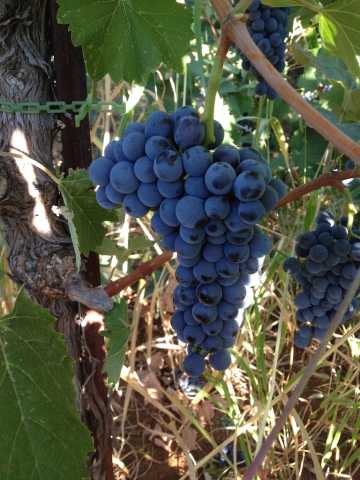
Metrick Wines website:
http://www.metrickwines.com/
Metrick Wines Facebook Page: Metrick Wines
California Garagistes Interview with Metrick Wines’ Alex Russan
Alex from Metrick Wines sent me a little extra information on the Mourvèdre vines of the winery’s El Dorado AVA vineyard source:
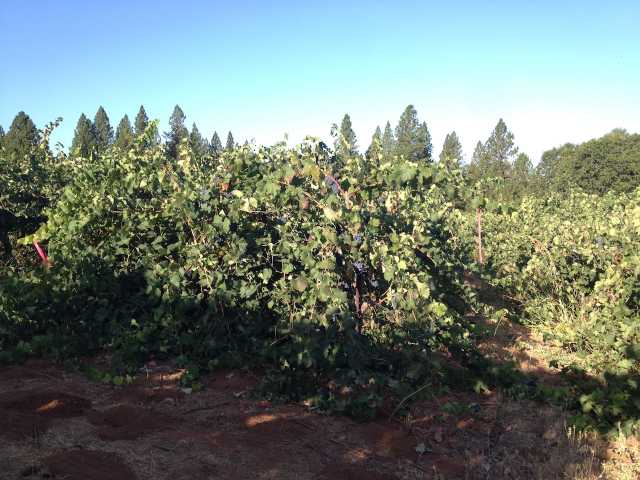
“Ron Mansfield, who manages the vineyard, has a really unique ‘vertical cordon’ system, which gives really nice dappled sunlight, and lots of air, to the clusters (looks like a mess, but is very organized)—VSP would give a lot more sun exposure, and at 2800 feet, you’d lose a lot of delicacy in the grapes, as well as acid, a lot quicker. I’m actually not a fan of VSP from a quality perspective for California in general, too much light intensity relative to more northern areas.”
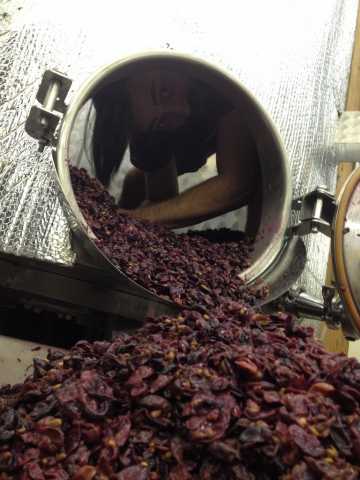
Mourvèdre Fruit from the tank:
From the California Garagistes interview with Alex of Metrick Wines:
Q: “What vineyards do you source from? Why?”
AR: “My Mourvedre comes from the Futernick vineyard in El Dorado (just up slope from the better known Fennaughty Vineyard). I initially wanted to work with Gamay (I’m still on the waiting list!), but really liked Ron Mansfield, “the man” for grapes in El Dorado, and the area itself. Deep volcanic soils that they’re able to dry farm in most years, Tablas clones, north facing slope (to mitigate the warm climate some), all sounded great to me.”
Sacramento Bee
“Dunne on Wine: Farmer Ron Mansfield’s at the Root of El Dorado’s Wine Success”
by Mike Dunne
March 18, 2014
"…Let’s catch up with Ron Mansfield, who farms 300 acres of wine grapes on and about Apple Hill in El Dorado County.
"Most of the vineyards Mansfield tends are owned by people who under management agreements relinquish their long-term care to his stewardship.
"His relationship with property owners has been especially successful in his development and care of Fenaughty Vineyard, close by Mansfield’s own vineyard and orchards, Goldbud Farms.
"Grapes from Fenaughty Vineyard are grabbed each harvest by more than a dozen winemakers near and far, many of whom recognize the growing stature of the plot by including its name on their labels. Wineries that receive steady recognition for wines from Fenaughty Vineyard include Edmunds St. John and Donkey & Goat in Berkeley, Keplinger in Napa Valley, Lavender Ridge and Hatcher in Calaveras County, and David Girard, Holly’s Hill, Windwalker and Skinner in El Dorado County.
"… More and more, his attention is devoted to wine grapes, including the 30 acres of Fenaughty Vineyard, planted almost entirely to such Rhone Valley grape varieties as syrah, grenache and mourvedre.
"…Three principal natural factors help account for the popularity of the grapes grown at Fenaughty, Mansfield explains. By facing north, and by being below the ridgetop, the vineyard is relatively cool even during the summer, allowing grapes to mature slowly and evenly, intensifying their flavor.
"Secondly, the patch is given over entirely to well-drained soils that capture enough moisture so that vines rarely need to be irrigated. ‘This is really nice soil to farm,’ says Mansfield of its mix of Aiken clay loam, volcanic debris and traces of granite. ‘It has a high water-holding capacity, but at the same time it’s well-drained. That allows the vine to carry its crop load without any stress during the (growing) season,’ he notes.
"And at 2,850 feet above the American River, the vineyard is caressed by gentle, steady breezes cooling grapes and helping them dry out after rain.
"Also contributing to the vineyard’s stature is Mansfield’s labor-intensive cultural practices, which involve such painstaking tasks as multiple pruning and crop-thinning.
"…Berkeley winemaker Steve Edmunds, however, tasted some of the syrah Mansfield had cultivated and liked it so much he urged him to concentrate on developing more plots of Rhone Valley grape varieties.
"Meanwhile, Mansfield’s own taste for Rhone Valley wines was growing. In 2002, he, Edmunds and fellow El Dorado County vintner David Girard toured the Rhone Valley. ‘That trip gave me more confidence for growing Rhones in this area.’
“Mansfield and his son Chuck already have launched their own nascent label, Four Fields, and plan to build a winery within the next couple of years…”
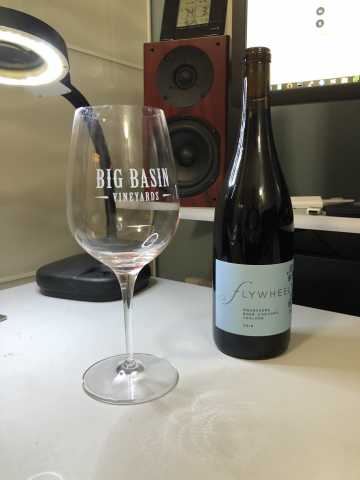
Something new and exciting in the space. Was tasting mighty fine this mornin…
'16 Flywheel Mourvedre. Boer Vineyard, Chalone, AVA.
Thanks for the information, Sean!!! 
I received an email response from Scott about the winery’s prior work with Mourvèdre in January.
I am not able to get any of the Flywheel Mourvèdre where I live, but I am always excited about the growth of the variety’s presence in California and beyond!
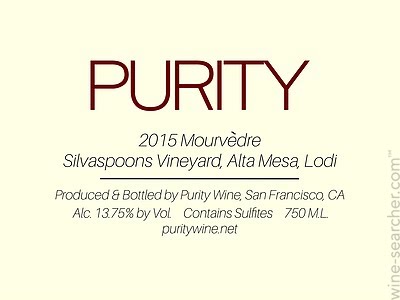
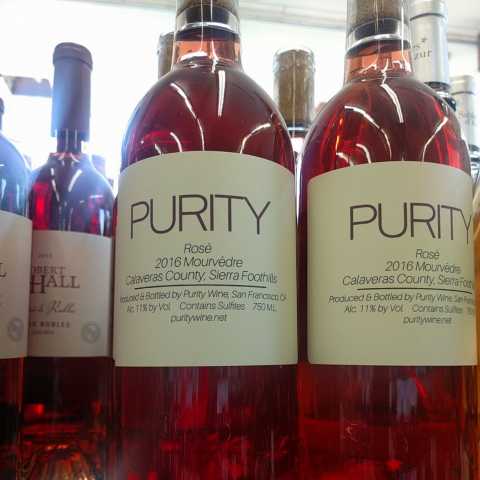
I received an email from Mr Noel Diaz at Purity Wine, who has bottled a diverse range of wines from all over California! Here are some of his thoughts on Mourvèdre…
• What Mourvèdre Clones/selections have you worked with, and have you observed any particular strengths or weaknesses among them?
ND: "Mourvèdre is a part of the oeuvre, my oeuvre, I hope that doesn’t sound pompous.
"I don’t know what the clones are that I work with, and I don’t really care because I have what I have. Since I’ve never had the luxury of picking out the clones, I haven’t really been very interested in the splitting of hairs of the particular differentiations, or subtleties thereof. This can get a little too esoteric for me, there are so many combinations of things that lead to the end result. Also, when you talk to growers, they rarely seem to know much about the clones.
"Now when you talk to Pinot growers, you get more information, they seem to know a lot about the different nuances of the different clones. Also, my understanding of clones is that over the long haul differences begin to loose their obviousness. Do you ever buy Pinot with the intention of ‘let’s see who produces the best triple 7 or let’s see the difference between Dijon 115 and 114’? At this point, it’s mental masturbation in esoterica. I hope I’m not losing you here, and honestly I’m not trying to offend you, but I think this question, unless you’re looking to plant Mourvèdre, overlooks the big picture. But I could be wrong, please continue reading…
“Now, along with the second part of the question, yes. I have made wine from Mourvèdre from 3 different locations and each wine has been different, quite different, but they have also been different vintage to vintage, and I have seen the same thing happen with the Syrahs I’ve worked with. I worked with a Santa Ynez Syrah that made a spectacular wine, far from perfect, but distinctive as could be, and I’ve only seen glimpses of that wine from other sources. It really does get complicated. I’m sure you’ve heard about the butterfly in Costa Rica that sets off a hurricane in New York… We understand specific processes, but understanding the myriad influences and relationships under spontaneous other reactions is unfathomable, that is why we will likely never be able to truly understand exactly how any give wine comes to be. Do you think a lottery number is truly arbitrary? Is anything truly arbitrary, or just beyond our understanding….”[/i][/b]
•On average, how old are the vines that you source your Mourvèdre fruit? Have you any thoughts on whether there exist advantages of working with older vineyards vs younger ones?
ND: “Regarding vine age, I guess 15-20 years is average, I think that once a vine gets to 7 or so years, there’s perhaps more reliability in what it can produce. I like old vines, old vineyards, but more for aesthetic reasons. I’m a romantic. Just as, much as I’m dubious of the superiority of own rooted vines, it would be my preference to work with them, all else being equal. No, old or young, most important is the person who’s caring for the vineyard. I haven’t worked with much in the way of young vines, so can’t really comment on that, but I don’t think I would hesitate to work with young vines.”
• What special factors in geology, climate, etc, do you find help make Mourvèdre a viable grape for your many recent fruit sources: “Coufos Vineyard” (Nevada County), “Joshua’s Starry Night Vineyard” (Calaveras), and the “Silvaspoons Vineyard” (Lodi)?
ND: "Geology, my preference is for mountain fruit, I like elevation, I like granite.
"Calaveras has a very interesting geology, it’s very mixed with clay soil, which is very common, on top of schist, quartz, granite, limestone, slate; it’s referred to as the ‘Calaveras Complex’ on the USGS website. I like that it is peculiar, dynamic. When you stand on one of the ridges leading up to the vineyard, you can see how the land has been churned up and around, that dynamic geologic mix is very compelling.
"As for Granite in Nevada County, I do believe that granite has this electric influence, think Beaujolais, very alive acidity. Every wine I make from the Nevada County vineyard I work with has crazy acidity.
“As for Lodi, I probably wouldn’t have worked with that fruit had I not lucked into it. I got some fruit by accident from a friend who over bought. It was Cinsault, and it was beautiful, but the pH was crazy high so it went into a blend, I wouldn’t do that again, it was so pretty. Anyway, the Barbera I made from there was super popular and I liked it a lot, the Mourvèdre also was very popular. It’s a Lodi Rules sustainable vineyard, and I’m trying to get the grower to cut some rows for me and not use glyphosate, I’m offering him 25% more plus the hopes that he sees he can work organically, and it can be commercially viable. The wines from there have proven themselves to me, I don’t really understand the geology enough to know why, I know it’s sedimentary, but I really don’t know what that means for the vine.”
• What thoughts do you have regarding the relationship between Grenache, Syrah, and Mourvèdre; what makes these three varieties so complementary?
ND: “Any time you see field blend, they usually have historical context. And that context is usually related to how and when the fruit ripens, and there should be harmony. But I don’t see why Tempranillo couldn’t be in the mix if it was handy and provided something the others didn’t. I generally prefer varieties as stand alones, varietals. This is philosophical. I have made lovely blends, but blending can get very complex, and I don’t necessarily believe it gets to an obviously superior end result.”
• Why do you think so many winegrowers have had success growing Grenache and Syrah, whereas Mourvèdre often has proven more challenging in getting mature fruit?
ND: “Yeah, Mourvèdre is finicky to grow, that’s one reason you don’t see it all over. Also, it’s known for making a very muscular wine, like Tannat, Petite Sirah, and Malbec. Syrah is popular because it’s considered noble, and it grows like crazy. Grenache can get ripe, it’s a bit of an oddball, but it too comes from a well regarded place, CNDP. It can build a high alc wine without a lot of tannin.”
• What special considerations do you think are necessary to produce a 100% (or Mourvèdre-dominant) wine from this grape in the winemaking process?
ND: “I haven’t produced a style of Mourvèdre different from lower alc and not super extracted, so that’s a difficult question to answer. My guess is that what people usually do, even in Bandol, is get the fruit ripe and extract the heck out of it, I’ve had aged Bandols that I didn’t really find very interesting, they get kind of a rubber tire reduction and tobacco-y, but not much delicacy like an aged Syrah or Nebbiolo. I hope I’m headed in the direction of making a Mourvèdre with more nuance as it ages. But I don’t know. I definitely like the wines I’ve produced from the grape. I find it rewarding to work with.”
Purity Wine’s website: https://www.puritywine.net
WineMC² Profile: “Noel Diaz of Purity Wine”: http://www.winemc2.com/portfolio/noel-diaz-purity-wine
Grape-Nutz Wine Journal: “Open House at Kendric Vineyards, April 2016” (Includes brief on Noel and 5 Purity Wine TN’s)[/u]: Open House at Kendric Vineyards April 2016
Grape-Nutz Wine Review: “Brumaire – 1st Annual Grand Tasting, March 13, 2016” (Includes Purity Wine TN’s): Brumaire - 1st Grand Tasting - March 2016
Grape-Nutz Wine Review: “Brumaire – Second Annual Grand Tasting, March 12, 2017” (Includes Purity Wine TN’s): Brumaire – 2nd Annual Grand TastingMarch 2017
Grape-Nutz Wine Review: “Brumaire – Third Annual Grand Tasting, March 11, 2018” (Includes Purity Wine TN’s): Brumaire – 3rd Annual Grand Tasting, March 2018
From the Ridge Vineyards blog:
4488: A Ridge Blog
“Announcing Our First Ever Grenache-Mataro”
by Kurt DeLashmet, Retail Sales & Hospitality Lead
May 18, 2015
_"…If you don’t recognize ‘Mataro’ from other Ridge bottlings (Lytton Springs, Geyserville, etc.), this is the same grape as Mourvedre and Monastrell, as it is otherwise known in France and Spain. Here Paul Draper talks a bit about the grape and its history…
\
Wcl_k2dfqgU
“…Ridge has been involved with the production of Mataro since our first vintage of Geyserville in 1966, which has a small amount planted amongst its field blended vines. The varietal pops up in many of the field blend vineyards that we currently work with, adding a layer of earthy complexity to the wines. In our history, we have even produced several varietal Mataros from various vineyards including Pagani Ranch (Sonoma Valley), Bridgehead (Contra Costa), Pato (Contra Costa), Evangelho (Contra Costa) our very own Lytton Estate. Here is a humorous take on one of our early Mataro releases from winemaker Daryl Groom and the folks over at Jordan Winery…”_
\
17Ulr9Y0jo8
I received a reply from Scott at Flywheel Wines about the single-vineyard, 100% Mourvèdre from his winery:
"We did indeed just bottle our 2016 ‘Boer’ Mourvedre – fun that it got a post already!
Right now our current release is the 2014, but we way over-vintaged our 2016’s to try to get them more ready for action a little earlier. Some of our earlier vintages were so tight early on that our 2013 ‘Brosseau’ Pinot is our current release on that one (tasting great now, though).
"I’d be happy to answer your e-mail interview questions, and to talk about both the 2014 and 2016 if you like. How does it all work? I have to admit I’m just coming out of my bottling haze, and getting my bearings straight, so thanks for your patience!
"All the best,
Scott Shapley
Flywheel Wines
415-515-2081
scott@flywheelwines.com "
Needless to say, I am most excited to hear about this trend of bottling a straight Mourvèdre from Flywheel!!!
Saw this on FB, and it seems relevant to this thread. It turns out California growers who thought they were planting the Monastrell clone of Mourvedre, actually have Graciano vines.
-Al
Thanks for the heads-up on the article, Al. Matt Kettmann is a good writer and he seems to have covered all the bases well on this. The mix-up has been known for awhile, but this might be the first time the info has gotten out to the wider public.
Agreed - and a letter is currently being prepped to send to all of those involved. This should be interesting . . . 
I helped bottle this wine with Scott and got a taste of it just before it went into bottle - agree with Sean that it’s really good stuff!

Thanks, Al!!!
I am definitely tempted to ask winemakers, “What’s in your bottle?” 
Someone’s going to be p*ssed.
Ken, I am always fascinated by your close interactions with such a broad group of wine folks! Thanks for the info!
I am sharing this information from a separate thread. Who knows, in light of the recent news, the Spanish resources herein may prove useful to someone…
iMiDRA is an acronym for “Instituto Madrileño de Investigación y Desarrollo Rural, Agrario y Alimentario” (more or less, “Madrid Institute of Research and Rural Development, Agriculture and Nutrition” in English). I really must say that the Database is very broad in its scope, and I wish I had discovered its existence sooner! 
The Collection: “The Collection of Grape Varieties of El Encín (El Encín’s Vine Varieties Collection) is the biggest in Spain; it consists of 3,532 accesions. The aim of this collection is to research, preserve, identify and evaluate the genus ‘Vitis’.”
History: “Its origin dates back to 1893, at the Haro Viticulture and Enology Station (the Viti-culture and Oenology Center in Haro) .In 1950 the collection was moved to the El Encín Estate (Alcalá de Henares) and since 1984 it has come under Madrid’s regional government.”
The Data Base: “The database has information about the different vine varieties in the collection. It includes 207 bundles of paper from 1914, 670 descriptions made in 1956 and more than 3,000 accessions described and photo- graphed since 2000, including microsatellites.”
• iMiDRA website’s Grape Data Base results for “Monastrell”
2220_foto2000.pdf (73.8 KB)
• iMiDRA website’s Grape Data Base results for “Graciano”
Wine Enthusiastic
“Embracing the Graciano Goof: Central Coast vintners who thought they were planting the ‘Monastrell clone’ of Mourvèdre just learned that they were instead harvesting an obscure grape from Rioja”
by Matt Kettmann
July 16, 2018
"…Like dozens of vineyard owners across the Central Coast, [Saxum/‘James Berry Vineyard’s’ Justin] Smith purchased the ‘Monastrell clone’ of Mourvèdre from Sunridge Nurseries a few years ago. Catalogued at UC-Davis Foundation Plant Services (FPS) as ‘Mourvèdre clone #571’ until last week when the listing was changed to ‘Graciano Clone #8’, the vines were first identified and imported by Plansel, a Portuguese company.
"…The clone became 99% of the nursery’s Mourvèdre vine sales in a short period of time, says [Sunridge Farms’ Andrew] Jones. He explained that one grower planted it next to another type of Graciano, which looked quite different. Sunridge plans to send a letter to the growers who purchased the vines to let them know that they’re growing Graciano, not Mourvèdre.
"There’s concern that the mix-up could lead to lawsuits, especially for wineries that bank on Mourvèdre. But there doesn’t seem to be many angry vintners, not even in Ryan Pease, whose Paix Sur Terre label is based on Mourvèdre. He’s labeled one wine as Monastrell since 2015, but he will call it Graciano going forward.
"‘I do remember when I fermented my first “Monastrell”,’ he says. ‘During punch downs, I was thinking to myself, “There is no way this is Mourvèdre, but either way, it’s really good stuff.” Graciano is very well suited to our climate, and it seems to be a pretty good mistake.’

"Pease also plans to plant more of the variety.
"How did this initial goof occur? Justin Smith of Saxum ran through a number of possibilities. One is grammatical: the Spanish word for Mourvèdre is ‘Monastrell’, while the French word for Graciano is ‘Morrastel.’
“Smith says it’s likely that the cause lies more in Old World practices, where multiple varieties are interplanted. Some villages have different names for the same grapes and, more problematic, the same name for different grapes…”[/i]
In other news, this thread will henceforth be known as “What, No Graciano Appreciation Delegation?” 
I still am reaching out to wineries and winemakers the West Coast of America in my pursuit of information on Mourvèdre/Monastrell/Mataro, but I have also been trying to assemble a list of international producers to email as well.
Any recommendations are most welcome!!
As I mentioned in a separate thread, Agapito Rico was a, if not the, pivotal figure in putting the Jumilla DO and, in turn, Spanish Monastrell, on the international market. Here is a little bit more information about the man and the movement…
Wine Spectator
“Jumilla’s Visionaries: In Southeastern Spain, Pioneering Winemakers are Producing Robust Reds”
by Bruce Schoenfeld
December 15, 2006
"…On the hillsides and in the valleys of this largely vacant countryside that gets less than a foot of rain annually, vines of ungrafted Monastrell planted in stone-covered soil produce wines the color of a moonless night. They have rich, meaty flavors and plenty of alcohol to match, but also, somewhat surprisingly, enough acidity to be refreshing when drunk young.
"…Just a decade ago, Jumilla was known almost exclusively for bulk wine. A decade before that, it scuttled more than 20 percent of its vines when a European governing board looking to alleviate a wine glut offered farmers more money to remove vines than they could earn selling grapes.
"The change has come because of a new appreciation for Monastrell. Grown everywhere from Provence and the Rhône Valley to California and Australia, and known as Mourvèdre, Mataro and Balzac, its origins have been traced to the grapegrowing areas around the coastal city of Valencia. In Jumilla, this thick-skinned grape, which thrives on heat and sunshine, disdains water and postpones its full maturity until the autumn, makes wines that are dense and compelling.
"…Bodega owner Agapito Rico, who started the movement toward export-friendly wines in the late 1980s, makes a varietal Syrah as lush and fragrant as any in Spain. In all, there are now 100,000 acres of vines in Jumilla today.
"Taken together, this combination of an area on the edge of viticultural cultivation and of varieties carefully fine-tuned to function under harsh conditions has created an appellation on the rise. ‘It’s all scrub and rock, nothing more,’ Rico says. ‘But for wines meant to be drunk young, at least, we’ve proven that it works.’
"Rico, 59, is a taciturn man who looks like he stepped out of a Wyoming general store. He has the stubborn, solitary mindset of a Western rancher to match. When he insisted on also giving his son the unusual name of Agapito, his wife had to later change it to the more innocuous Pedro. He seems an unlikely father of an appellation, but even those who aren’t enamored of his quirks and complaints give him credit.
"After years spent in Madrid selling and distributing wine, Rico returned to his native Jumilla in 1985 with the idea of planting grapes. ‘He saw what Alejandro Fernández had done in Ribera del Duero, and he decided to do the same with Jumilla,’ says his friend Pedro Martínez, owner of Casa de la Ermita. At the time, subsistence grains and a few olive trees outnumbered the vines along the parched landscape. Rico found an abnormally fertile mountainside called El Carcho, a dot of green on a canvas of brown, and planted Cabernet Sauvignon, Merlot and, a decade later, Syrah. Mostly, though, he planted Monastrell there and elsewhere on his property.
"Rico believed that the appellation should be making fruity wines meant to be consumed young, when the freshness of the fruit is most evident. Beginning in 1990, he hired a winemaker and started putting his theories into practice. Much of that involved picking later, giving the Monastrell a chance to gain in strength and color as October loomed. Since the summer drought invariably continued through harvest, rain wasn’t a risk. A long maceration period distanced the wines even further from the pale bulk product.
"…Now his bottlings have fruit that jumps from the glass, and they sell in some two dozen countries around the world. If you’ve tasted a Jumilla wine in Singapore or Sweden, it may well have been Rico’s.
"Nevertheless, Rico believes that his efforts to create a worldwide brand are being undermined by the millions of liters of bulk wine made for local and regional consumption by the handful of large producers and dozens of small ones that still dominate Jumilla’s output. Accordingly, he is tempted to remove the appellation name from his labels. He has also partnered with José Luis López de Lacalle of Rioja’s Artadi to create El Seque, a successful bodega in neighboring Alicante.
"‘He was the first to have the concept to bottle wines of high quality. He tried to change the image of the appellation, to fight for the name of Jumilla,’ says Marcial Martínez. ‘Now he thinks he failed. But I’m not at all in agreement with him. I think he succeeded.’
“‘About eight of us are changing things little by little, but it has cost us a lot,’ Rico says. 'Before the ‘90s, our image was like that of the Priorat—rough, bulk wines—but what happened? Priorat renovated nearly all of its production. In Jumilla, we make 60 to 70 million liters, and we’ve renovated only 10 percent. In the end, the word “Jumilla” turns out to be a negative. And it isn’t going to change.’…”
The article continues, focusing on several other personalities of the area who have helped in spreading a higher quality product across the world. Needless to say, none of the remaining figures (Jorge Ordoñez, Pedro Martínez, Miguel Gil, & José María Vicente) agree with Rico’s dejected pronouncements.
The very fact that shelves in many American stores feature at least one Monastrell from the Region of Murcia (Bullas, Yecla, & Jumilla) testifies to the success of Agapito Rico’s ground-breaking work.
Bodegas Agapito Rico Carchelo home page
• Learn More
• Wines
• Vineyards
Denver Post
“Spanish Wines Getting Note”
by Tara Q. Thomas
November 3, 2008
TrendHunter
“The Agapito Rico Bottle is Covered in the Earth’s Soil”
by Vittoria Natarelli
September 2, 2010
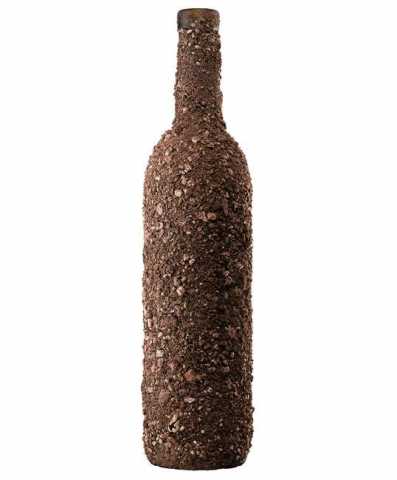
"The Agapito Rico Bottle was designed to honor Agapito Rico. Rico was an important figure in the DO of Jumilla Spain because he was a pioneer in achieving quality wines in this region. Considering how the bottle is covered in dirt and soil, the piece emits a naturalistic feel.
“Designer Eduardo del Fraile obviously wanted Agapito Rico to be honored as a nature-loving winemaker because the Agapito Rico Bottle is definitely ‘down to earth’.”
El Mundo do Vino / The World of Wine
“Agapito Rico”
"There are those who travel a lot and, in discovering new lands and new people, forget their little country. For Jumilla, fortunately, this has not been the case with Agapito Rico, a Jumillano who has dedicated many years of work selling wines - predominantly to his country, but also…all over the world.
"Therefore, he did not lack knowledge…when he decided to start a wine project a decade ago…that he would collide with the prevailing mentality of his hometown.
"To begin with, he focused his efforts in his own vineyards - the ‘Carche’ and ‘Fuente de Perdices’ -, which were planted at that time with some 20 hectares of old vines from Monastrell - the emblematic grape of the area…adding, since 1986, Tempranillo, Cabernet, and Merlot, completing the current plantation of 90 Ha.
"After the 1989 harvest, the first wines were bottled, with Agapito counting on the advice and opinions of experts and friends who reassured the success of his chosen path. Of course, the foreign varieties that were incorporated in the wines were not authorized at that time, which prevented them from displaying the DO on labels.
“Several years later, the wines of Agapito Rico now enjoy the official approval of the Regulatory Council. However, this is not the most important thing; instead it is that they enjoy…the applause of the international public, where 80% of the production [is exported].”