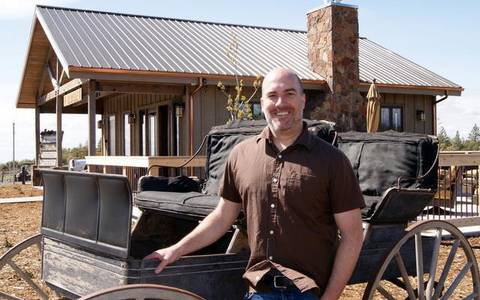
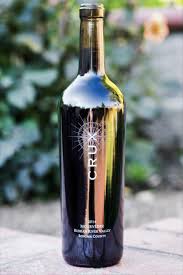
I received a reply to my interview request from winemaker and forum contributor Mr Ian Brand of I. Brand & Family, La Marea, and Le P’tit Paysan!
• Question: What Mourvedre Clone/selection you have worked with, and why you have chosen that particular one?
• Answer: “I’m not entirely sure. I haven’t planted any Mourvedre/Mataro myself. The three vineyards we’ve worked with were already in the ground, although we’ve grafted two other vineyards to feed our rose program. We’ve used cuttings from the Enz vineyard to graft those two. The Enz Mataro represents a distinct genetic line supposed brought over by a Frenchman who planted the first vineyard in the Lime Kiln Valley in the late 1850s. Totally uncorroborated, although there is some funny stuff growing back there. I believe the other vineyards have had Tablas clone and another ‘Mataro’ heritage clone, but I haven’t thought to track that info down.”
• Q: What special factors in geology, climate, etc, do you find help make Mourvedre a viable grape for your fruit source?
• A: “Most Mourvedre vineyards you look at are rose vineyards at best. Some don’t carry enough acid to do even that. Mourvedre is super finicky. It really needs a fortuitous match of climate and soil. The best two I’ve seen are the Enz vineyard and the Antle/Rodnick Farm vineyard. Both have a calcareous element, both have a granitic element, both have warm to hot days with little cloud cover, and both have cool nights. We’ve gotten some good, but generally inconsistent vintages off the heavily calcareous gypsum soils on Spur Ranch, but the drought has really put the hurt on those vines and they’re struggling to rose ripeness these days. Other vineyards we’ve seen that lack the calcareous element, the sun exposure, or the cool to cold nights have lacked the texture, ripeness, or acid/tannin balance to make a red wine. Another part is canopy management. Like Grenache, it needs a head trained or reasonable facsimile thereof so there’s space around clusters, filtered sunlight, etc. I haven’t seen it perform well on a classic, manicured VSP. As such, drier weather is helpful.”
• Q: What thoughts do you have regarding the relationship between Grenache, Syrah, and Mourvedre; what makes these three so complementary?
• A: “I think Mourvedre and Grenache, especially, are complimentary to a wide variety of grapes. There’s wisdom in conventions of blending, and there’s convention, too. Grenache and Pinot can be pretty complimentary, or Grenache and Tempranillo, or Grenache and Touriga Nacional… Depending on the Syrah, it can be pretty dominant no matter what you put it in. Certain Syrah vineyards are just not for blending.”
• Q: Why do you think so many winegrowers have had success growing Grenache and Syrah, whereas Mourvedre has proven more challenging in getting mature fruit?
• A: "I think Mourvedre is very finicky in its siting. It’s tough for me to put my finger on it in a wider context as I specialize in such a limited geographic area, and because the Mourvedre vineyards I’ve seen that work fall into a very individual niche. I can tell you places locally I think Mourvedre would work, but that’s about the reach. Mourvedre grapes that aren’t in that sweet spot can have such skin/juice and acid/tannin/ripeness imbalances as to be unworkable without diving deep into the toolbox in the winery, which means something in the winemaking plan is off base – likely the plan itself.
“As far as Grenache and Syrah go, Grenache is very hearty/forgiving in the vineyard if difficult to get a compelling wine from in the winery, and Syrah has it’s foibles in the vineyard (especially around its relationship to water) but it’s about the easiest thing to pull an interesting wine from in the winery if decent grapes, sort of the three-chord truth of the grape world. Always a good place for young winemakers to start out”.
Ian Brand
http://lppwines.com
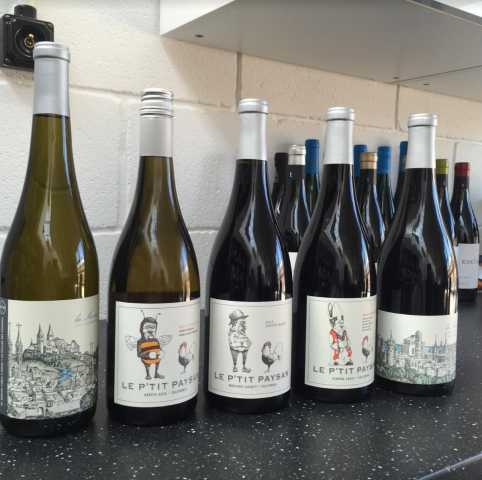
Mr Brand’s bottlings include the La Marea Spur Ranch Mourvedre San Benito County and I. Brand & Family “Old Vines” Enz Vineyard Mourvedre Lime Kiln AVA, as well as Le P’tit Paysan “Pierre’s Pirouette” Rosé (Mourvedre, Grenache, Cinsault) Central Coast & Le P’tit Paysan “Le P’tit Pape” (Grenache, Syrah, Mourvedre, Counoise) San Benito County.
For more information:

![[wow.gif]](/uploads/db3686/original/2X/7/7d450e9830889c8943b674446a21b7254cad657e.gif "wow")
![[cheers.gif]](/uploads/db3686/original/2X/0/0ff9bfcdb0964982cd3240b6159868fbdf215b1a.gif "cheers")