Do you look on an ullage of fresh bottes? I often encounter a scenario when all or some of new bottles that arrived to store shelfs have relatively low ullage. How could it happen and should you worry about?
Some examples, although it is not the lowest level I have encountered:
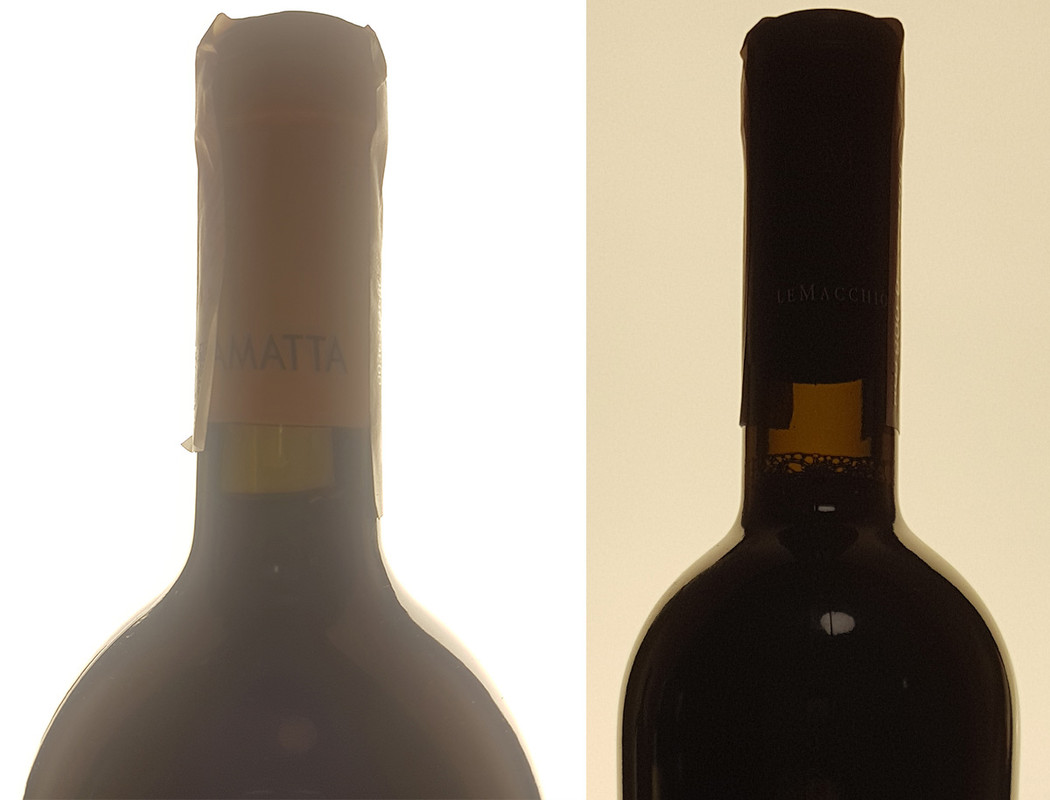
Bibi Graetz Testamatta 2018
Le Macchiole Paleo 2017 (Bubbles after a shaky transportation)
For Testamatta it was the highest level in a store. Other bottles had even lower level.
Looks like it has a long cork. I bet if you pour it out there’s 750ml of wine in the bottle. That’s all that really matters.
If he pours it out, wouldn’t there be no wine in the bottle?
![[scratch.gif]](/uploads/db3686/original/2X/4/42a16863a8714da3c1604419e3eb9206bb87aa50.gif "scratch")
2 Likes
Depends on bottle shape. Some of the bigger bottles seem to be designed to be filled lower.
The Heisenberg uncertainty principle of wine.
1 Like
Typical ullage on a standard bottle (750ml) is around 14-18 mm. Bottles are designed to utilize a standard sized cork/inserted closure. If the bottle is designed to use a 54 mm cork at 16 mm ullage but a 45 mm cork is used instead, it could add as much as 9 mm of ullage. There is also temperature effects, related to the thermal expansion of the wine - smaller but can be significantly impactful at high temperatures or low initial ullage levels.
1 Like
Those look pretty normal to my eye. I will have a look at my Testamatta to see how the fills appear. Which vintage(s) are you seeing this in? I have experienced variable fill levels from smaller production wineries that use manual filling techniques. I don’t think Testamatta would fall into that category. Machine calibration can be factor if the fill levels are consistently lower than expected but all the same.
To the question I thought you were asking…if I have a bottle that has ullage down into the shoulder, I’d either exchange it if possible or drink it as soon as practical. What you show would not catch my attention.
Thanks,
fred
Could also just be a “low fill” every once in a while the bottling line does not always get the perfect fill level. This one looks within range to me. Temperatue of the wine at time of bottling is a bigger effect but that would effect a whole run, unless temperatures swing enough in a given day of bottling.
Winemakers also have different ideas of what the proper fill height is, some prefer more some prefer less. I dont know of anyone who actually does a perfect 750ml every time, and again at what temperature? Glass is not perfect either, weight 12 empty bottles, there not all the same in grams.
![[blink.gif]](/uploads/db3686/original/2X/1/10e99773136c8c7c26d8a4f3ea716e27704e295a.gif "blink")