Over the weekend I had some old friends over for a late celebration of my birthday. These folks are in the “non-geek but like wine, go to wine country, etc.” category. As usual when I have this gang over for wine, the deal was that I supply the wine, and in return they have to listen to me yammer about it. Good trade!
I put together four side-by-side flights based on categories of wine I’ve been exploring, with the hope that each pair would provide an interesting contrast. I think three of the four flights achieved that goal pretty well.
As usual the group was game for the exercise and there was a good mix of wine and non-wine chatter as we worked our way through. Most of the detail in my notes below is from a quick run back through the wines the following day, as we were having too much fun for me to split my focus and keep contemporaneous notes.
Flight 1 - New World / Old World blancs de noir
Goodfellow Tsai BdN 2022/Laherte Autrefois 2019
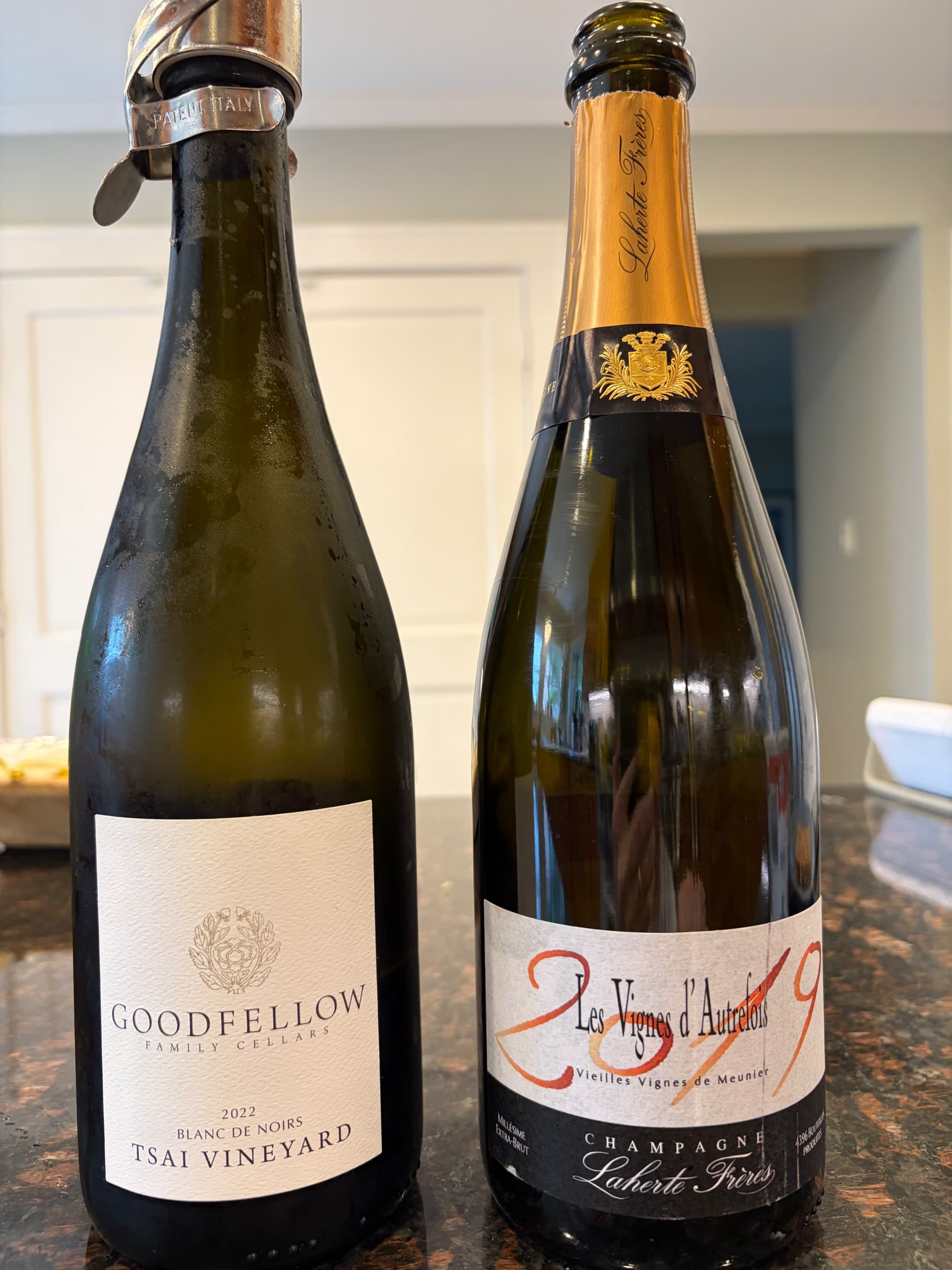
Two blancs de noir from producers who operate in the lean/precise idiom. Of course different grapes - the Goodfellow is all PN and the Laherte all Meuniere - but they still made for a good duo.
The Goodfellow continues to show delicious honey drizzled golden apple and florals over a mineral, high acid, taut structure.
The Laherte is the more complete sparkler with a nutty, doughy nose on top of crisp apple driven fruits and a chalky, grippy palate. As at our last Berserker offline, the layered depth of this champagne (albeit a younger vintage this time) stands out and it does an impressive job of balancing its array of almost indulgent bakery flavors with a taut and focused palate presentation.
Vote went to the Laherte but all commented positively on the Goodfellow, which was for most of the table the first New World sparkler that got their attention.
Flight 2 - 2022 Koosah Vineyard Chardonnay Horizontal
2022 Martin Woods Koosah Chard/2022 Walter Scott Koosah Chard
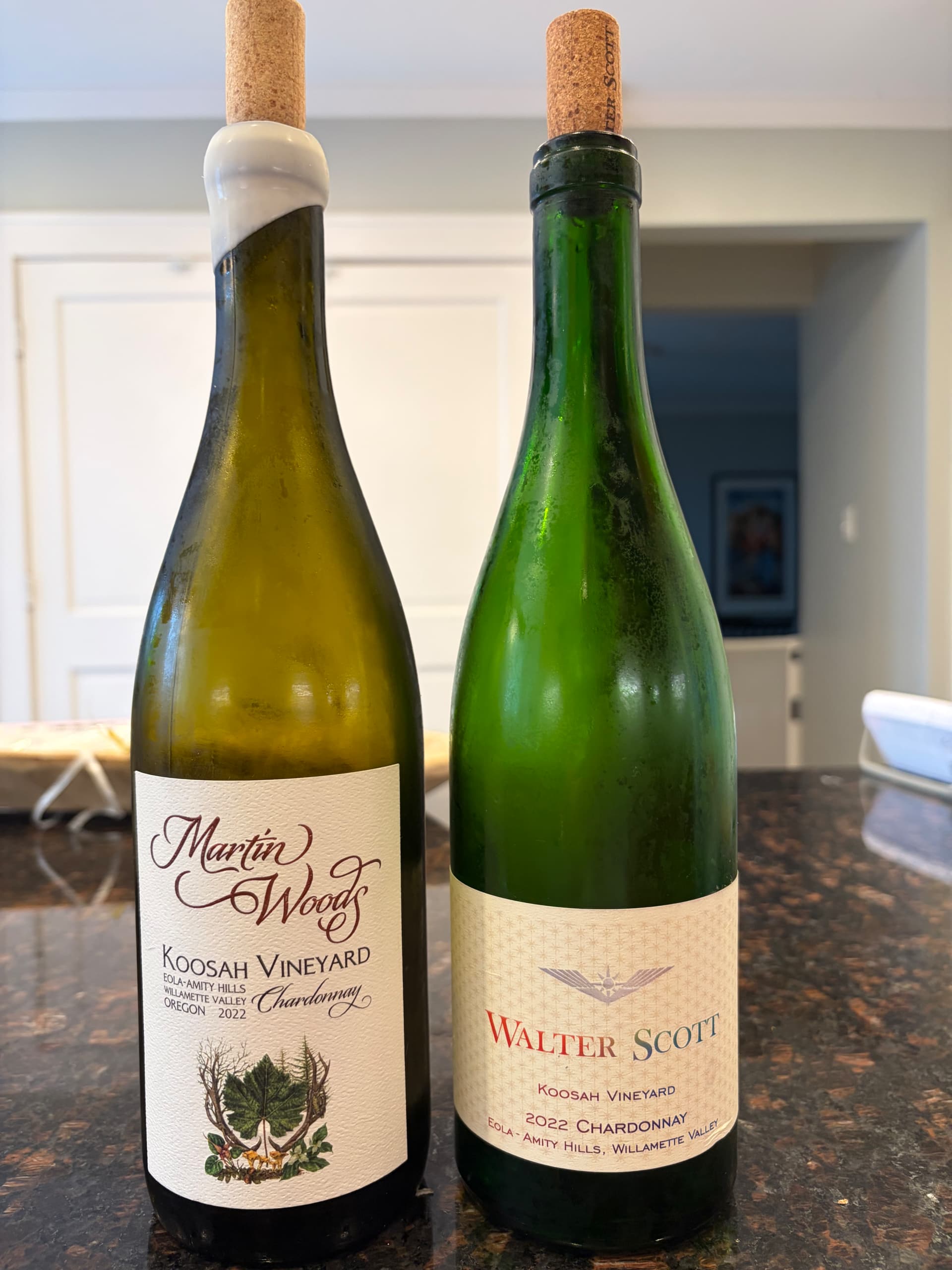
This flight was designed to show the impact of winemaking decisions on ~basically the same fruit, and it did a great job. I did the Martin Woods a little dirty by opening the Walter Scott a few hours in advance and doing some pouring back and forth between bottle and a decanter to wake it up a bit, having experienced too many surly WS bottles on pop and pour. Turns out the MW would have liked the same treatment as it was a bit reticent on the nose at first. However with some swirling it woke up and the wines nailed the contrast I was hoping for.
The Martin Woods is made with almost no new oak and while the cellar work is generally on the reductive side they do not specifically chase reductive flavors or aromas. By contrast the Walter Scott saw a whopping 65% new oak, albeit 350L puncheon, and of course they are among the standard bearers for intentional reductive aromatic and flavor impact in the valley.
The Martin Woods showed a pear, pear drop, apple, quince, and white peach fruit profile. The wine is cool toned and strikingly pure, and is texturally quite impressive with a silky glide that fans out across the palate. The wine is calm cool and collected and there is an impressive sense of gravitas.
By contrast the Walter Scott is all high wire thrill. The nose is classic W-S with steel and popcorn reduction, plus fresh bread, hazelnut, and explosive tropical toned fruit with barely ripe pineapple in the lead. On the palate the wine is tense and feels only a little bit coiled, I’d say this is still young obviously but not criminally so. The oak lends a textural gloss. A small but welcome touch of cold butter on top of the piercingly acidic fruit profile. The wine finishes long. As ever at Walter Scott the wine eats the new oak quite impressively and there isn’t a vanilla/spice signature here.
Walter Scott the table favorite. Just has an extra gear over its flightmate.
I would be curious to know the pick dates on the two wines. I would guess that the Martin Woods grapes hung just a little longer, as the fruit tones shifted a bit more toward pear/apple… if I remember correctly, those pear/apple tones come later in the ripening process than the pineapple-ish tones of the W-S. (Counterintuitive, and maybe I’m making things up.) In any case both very nice wines and would be happy to have either on the table.
Flight 3: Mature Napa Merlots
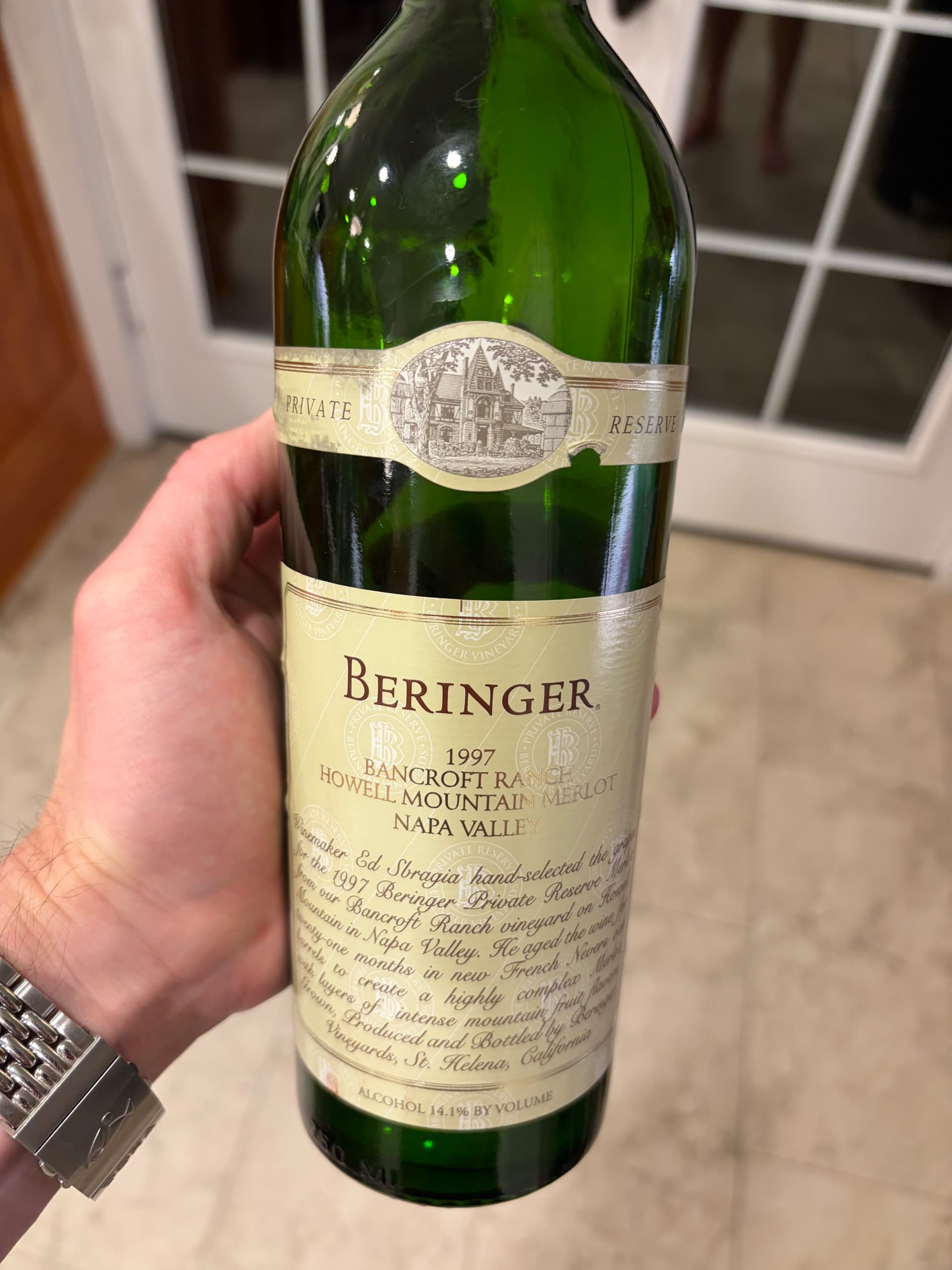
1989 Duckhorn Three Palms/1997 Beringer Bancroft Private Reserve.
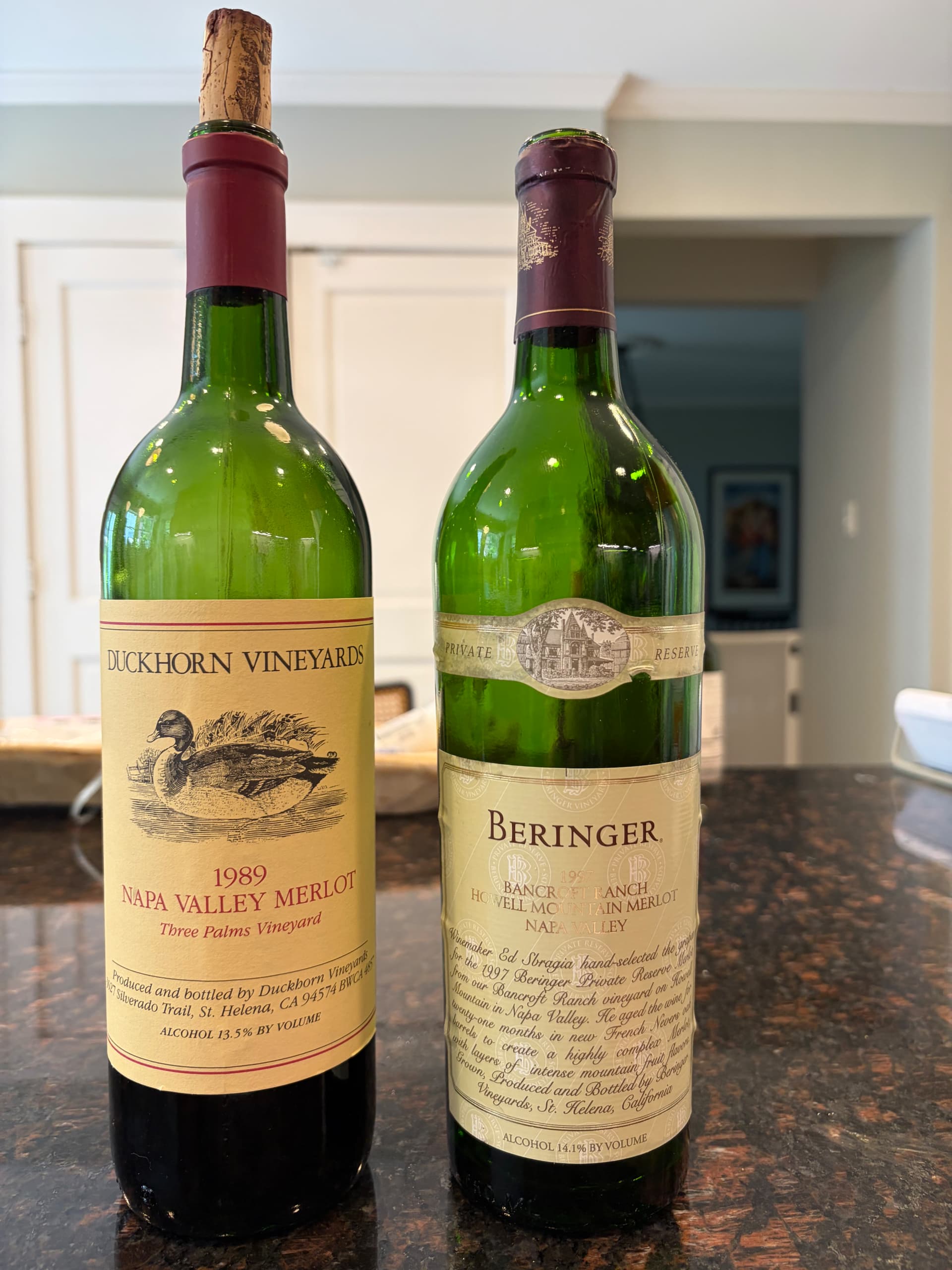
This was perhaps a less focused comparison than the first two, and was driven mostly by my desire to toss a birth year wine into the mix. But yeah why not, both tip top Napa Merlots, one valley floor fruit from a “meh” vintage and one mountain fruit from “the vintage of the century ™”.
The birth-year Duckhorn was probably a bit past peak but not egregiously so (chorus: “are you talking about you or the wine?”). In the glass garnet red and quite clear. On the nose it showed a pretty solidly tertiary array of leaves, dirt, leather, tobacco, menthol, sweet spices, a touch of balsamic, plus some plummy dark fruit. On the palate surprisingly vigorous with plenty of fresh acidity, bottle sweetness abounds, and there is a core of red and plum fruit that fans out and stains the palate, followed by some savory brothy tones. There is a bit of firm, fine grained, but decidedly old school tannin left (ie not the velvety tannin one sees in modern Bdx). Acidity is solidly medium. Fine to good finish. While nothing to really write home about I thought this was a charming wine, and I bet it would’ve shone a bit brighter on its own with dinner vs. in a lineup.
The Beringer didn’t knock me over but a few others were higher on it. I don’t have a great sense for when they did or didn’t make Private Reserve versions of the Bancroft Merlot but I think this is the first I’ve had that was labeled as such?
The wine showed surprisingly young to my mind, if you were so inclined I’d bet this would still be in fine fettle 10 years hence. On the nose it showed a pleasant array of plush Merlot aromas, featuring cocoa powder, black cherry, plum, and florals, plus some incipient aged leafy and tobacco tones.
On the palate the wine still has a great deal of moderately grainy tannin - oak tannin? - which is a bit drying and saliva sucking, nowhere near as bad as e.g. some Parker era St Ems but it did knock a notch off my enjoyment. It has a sumptuously silky texture and a fresh-but-rich fruit and cocoa flavor profile. This was a step behind the early 90s non-PR bottlings I’ve had over the past year or two, which had better freshness and more resolved tannin structures.
The group preferred the (what other word but) hedonism of the '97 Beringer.
Flight 4: 2004 Left Bank/Right Bank Bordeaux
2004 Ch. Montrose/2004 Vieux Chateau Certan
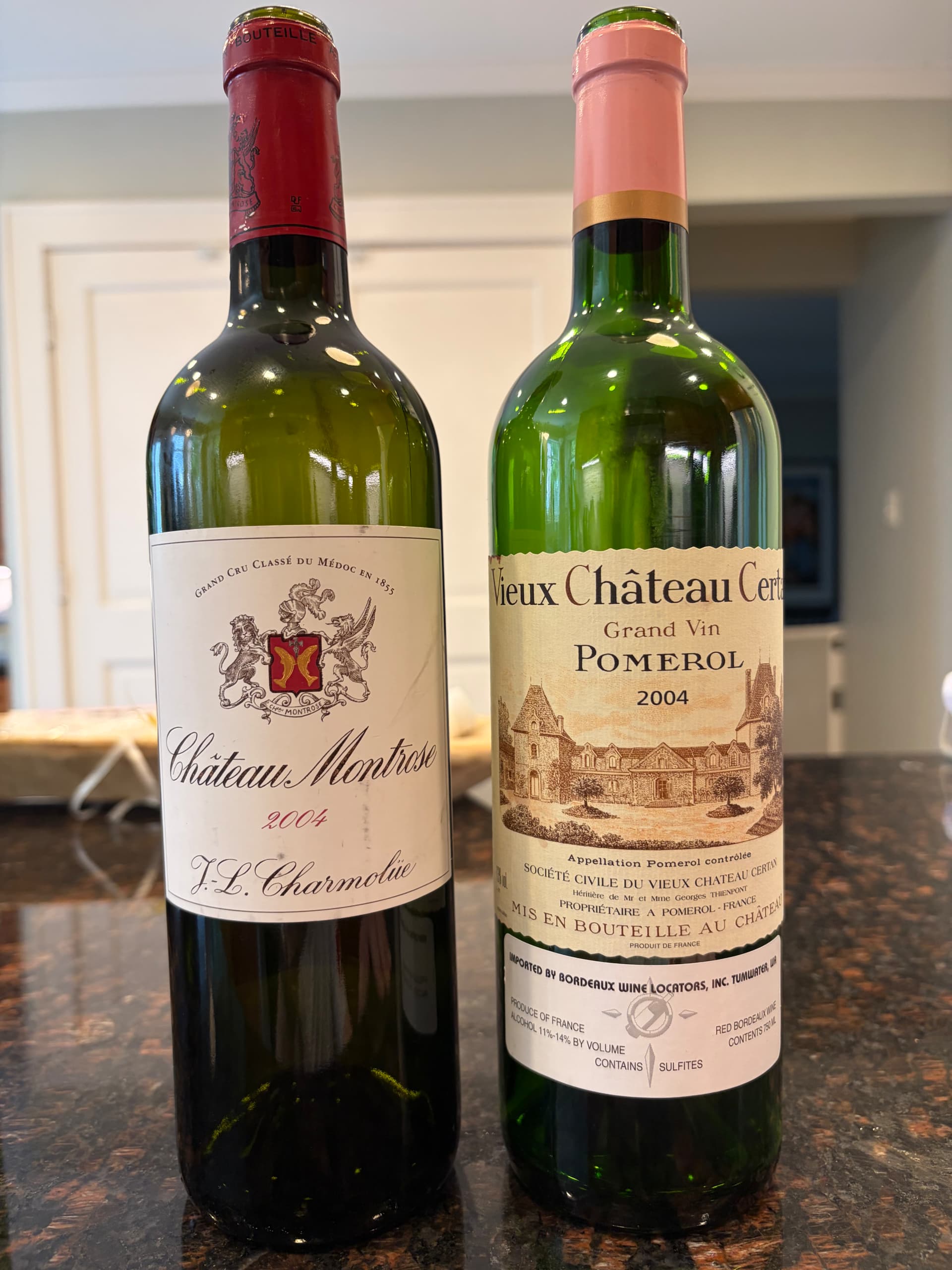
I am a fan of the 2004 vintage in Bordeaux, which seems to have produced many good to very good wines in a savory, leafy, elegant register. The vintage is broadly available at auction and through brokers, in my experience is drinking very well now, and it trades at a very significant discount to the critical hits around it like 00/05.
I haven’t tasted enough to say, but from my reading the Montrose is well regarded among the left bankers and I’ve seen claims the VCC is among the top handful for WOTV.
These were decanted for about 2.5hrs then poured back into the bottle, and were served around 4.5 hours after opening.
The Montrose was almost painfully tannic and surly on opening and I was concerned it wouldn’t come around, but in a pleasant surprise it evened out and behaved itself by the time we poured it. On the nose the wine is resolutely classic with a blast of tobacco, dirt, leather, blackcurrant, dark berries, and an excellent pyrazine edge of green pepper and herbs. On the palate the wine is deep, earthy, and savory; a touch rustic. This is a Loire CF drinker’s Bordeaux, and that is intended as a compliment. This was my only bottle, and I now regret not having opened it next to an 04 Sociando-Mallet… from memory there are some interesting similarities between the wines though no surprise the Montrose has the dials turned to the right.
The VCC was a perfect contrast to the fierce Cabernet profile of the Montrose. On the nose the wine was everything you could ask of a Pomerol in early maturity, exploding from the glass with an exotic melange of truffle, musk, nag champa, powdery rose, suede, and raspberry dominant red berry fruit. On the palate the wine contrasts a sumptuous and silky texture with immense freshness from the very large cut of Franc in this vintage (30% IIRC?), and the finish is very long. The only gripe for me, as @Otto_Forsberg has noted in a couple of his great notes on this wine, is that this bottle (unlike my last ) showed a touch of diacetyl. This is something I’m fairly sensitive to in red wines and it modestly detracted from an otherwise stellar experience with this bottle. Only a minor issue in the scheme of things and very glad to have some more in the cellar.
While the Montrose was solidly quite good it did not quite reach the level of the VCC in terms of layered complexity, and the vote was lopsidedly in favor of the right banker. However, this nailed the left bank/right bank comparison, with both wines screaming regional and varietal typicity.
//
We finished the night with dessert (an excellent tarte tatin courtesy of my wife) and a birth-year sticky: 1989 Ch. Suduiraut.
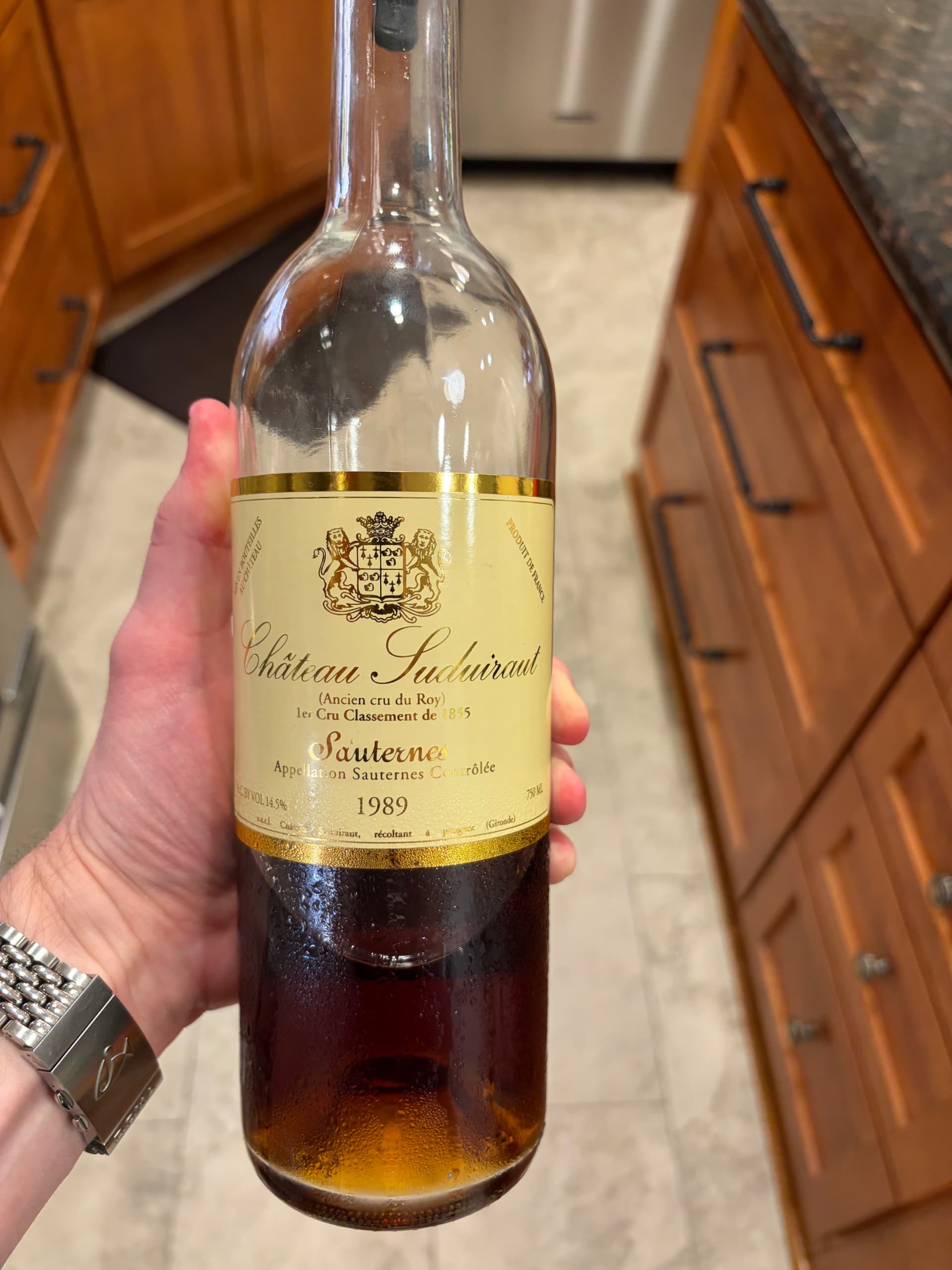
This Sauternes poured a deep amber, not the best color I’ve seen on an '89 to be sure. However the nose promptly confirmed that one cannot get too bent out of shape about the color of a botrytized wine, bursting forth as it did with ginger, apricot, honey, sweet spices, grilled pineapple, and bananas foster(?!). On the palate it is surprisingly lithe, no ponderousness here, with zingy acidity that keeps the sweetness quite well in check. The wine glides across the palate with tones of caramelized tropical and pit fruit, and the impression is really quite light and elegant. The finish loses a step, not impressive for a sweet wine.
//
A wonderful evening. Fantastic company and delicious wines.