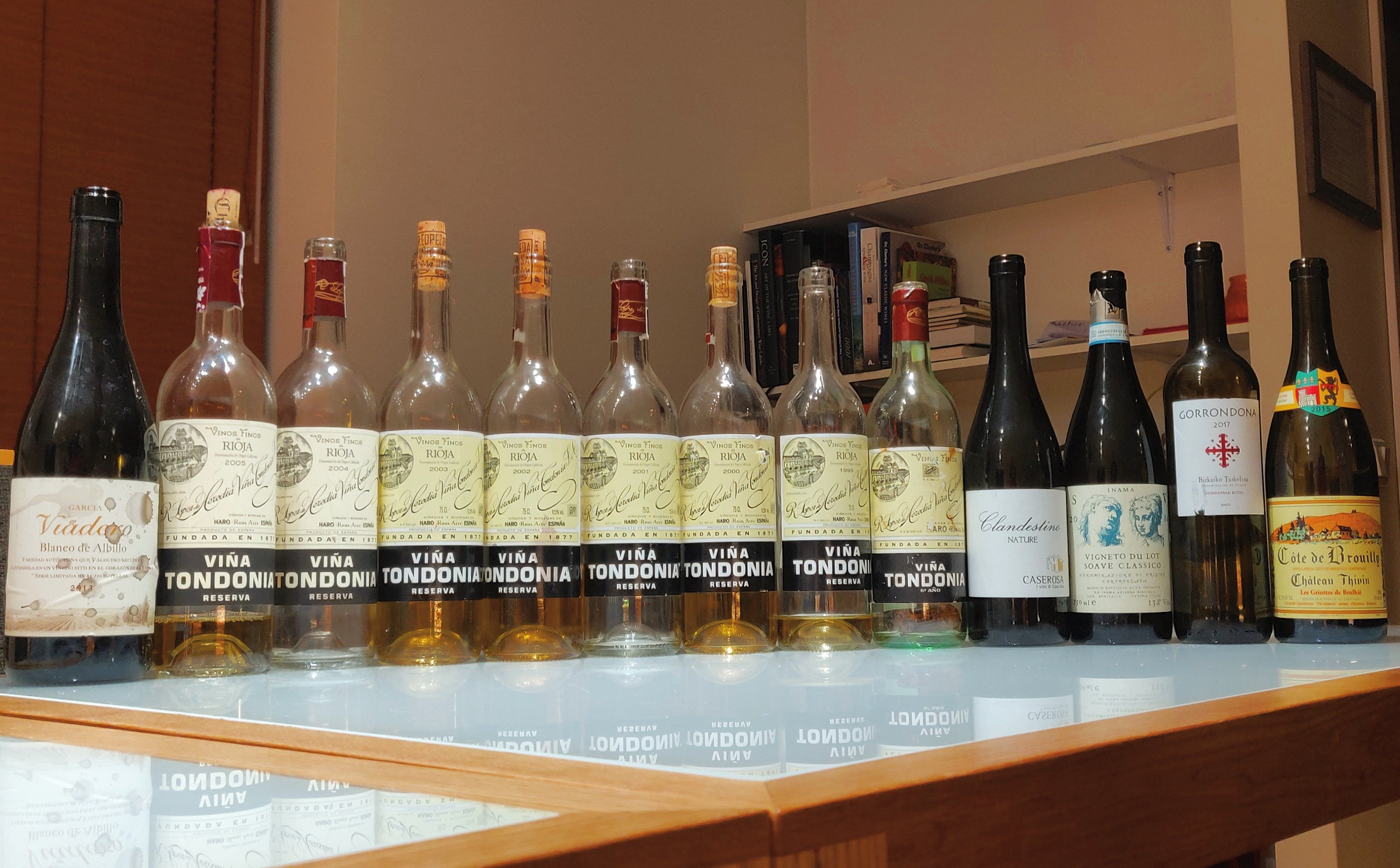
The first tasting of this year was one the attendees had been awaiting for some time! A sort-of follow-up to the Viña Gravonia vertical we had a few years ago.
I guess R. Lopéz de Heredia doesn’t need any introductions, seeing how their wines have magically turned from overlooked gems into some of the most revered and sought-after old-school Rioja wines in just a span of a handful of years, and how the winery is discussed on an almost daily basis here.
So, in short, we had a vertical of recent vintages of Heredia’s mid-tier white, Viña Tondonia Reserva (sandwiched between the “entry-level” Viña Gravonia and the exceptional Viña Tondonia Gran Reserva, which is made only in select vintages and which is basically unicorn-level unobtainium by now).
I was familiar with most of the vintages here, but it was very educational tasting them in a succession - the differences between the vintages became so obvious now, when one needn’t rely on their memory how the vintages tasted like, but just jump between the glasses! For some reason the even vintages seemed a bit lesser in comparison to the odd vintages. Especially the 2001 vintage - which I’ve always considered to be an exceptional vintage - really showed its colors here, turning out to be even more impressive than I remembered when I could compare it to the surrounding vintages and not just rely on my memory! Also 2003 really surprised me - I expected it to show some hot vintage qualities, but just as 2003 Bosconia and the red Tondonia, this was simply exceptional stuff despite the dry and solar vintage!
And, like almost always, we also had an introductory blind to prepare our tastebuds, and some random follow-up blinds, because no-one ever wants to call it quits after the main event is over!
.
.
-
2013 Viticultor Goyo Garcia Viadero Blanco de Albillo - Spain, Castilla y León, Vino de la Tierra de Castilla y León (15.1.2022)
100% Albillo from vineyards in Ribera del Duero located at the level of 870 m above sea level. 12,5% alcohol. Total production 34210 bottles. Tasted blind.
Luminous and quite deep lemon-yellow color. Somewhat restrained and slightly evolved, waxy nose with aromas of honeydew melon, some candle wax, light floral notes, a little bit of leesy character, oaky hints of creaminess and savory wood and - especially with some air - a tropical touch of banana. The wine is ripe, broad and textural but at the same time rather dry and restrained on the palate with a quite full body and slightly reticent flavors of evolved waxy character, some phenolic bitterness, a little bit of ripe peach, light stony mineral notes, a hint of cantaloupe and a touch of leesy creaminess. The medium-to-moderately high acidity doesn’t lend much freshness or zip to the wine, but keeps it quite nicely in balance. The finish is ripe and dry with quite understated fruit character. There are medium-long flavors of leesy creaminess, some peachy tones, a little bit of phenolic bitterness, light evolved waxy tones and a hint of banana.
A nice, quite rich and relatively reticent Spanish white that shows some sense of evolved complexity. It was really hard to guess what wine this was, although I was pretty sure it was a Spanish white. The overall style reminded me a lot of Galician Albariño with some age - thanks to its understated fruit and somewhat noticeable phenolic bitterness that is quite common in many Albariños - but I recognized this can’t be an Albariño since it lacked the piercing acidity and pronounced minerality typical of the variety. Seeing how I’ve never had a varietal Albillo before, it wasn’t really a surprise I didn’t manage to guess the wine correctly! All in all a nice enough wine, but it could really use a bit more fruit and acidity - now it was a bit lacking in depth, flavor expression and freshness. (89 pts.)
.
-
1999 R. López de Heredia Rioja Blanco Reserva Viña Tondonia - Spain, La Rioja, La Rioja Alta, Rioja (15.1.2022)
A blend of Viura aka. Macabeo (90%) and Malvasia Riojana aka. Alarije (10%). After the spontaneous fermentation, the wine is aged for 6 years in predominantly old American oak barrels, bottled unfiltered and aged for a further 5-6 years in the bottles before release. 12,5% alcohol. Tasted in Tondonia Blanco 1999-2005 vertical.
Somewhat evolved and quite deep golden yellow color with a pale bronze core. Rich, expressive and moderately evolved nose full of classic Heredia aromas: creaminess, some bruised apple tones, a little bit of savory wood character, light notes of rosin, evolved hints of caramel and dried yellow fruits and an oxidative touch of nutty complexity. This just phenomenal. The wine feels dry, somewhat concentrated and moderately intense on the palate with bold, complex flavors of evolved creaminess, some stony minerality, light tart notes of lemony citrus fruits and Granny Smith apple, a little bit of savory wood spice, evolved hints of hay and browned butter and a touch of tangy salinity. Despite its full body and somewhat concentrated feel, the wine is wonderfully high in acidity, lending it great sense of freshness and intensity. The finish is ripe, complex and wonderfully acid-driven with persistent flavors of lemony citrus fruits, some tart green apple tones, a little bit of savory wood spice and nuttiness, light mineral notes of tangy salinity, evolved hints of bruised apple and browned butter and a touch of smoke.
An outstanding, wonderfully complex and exceptionally balanced vintage of Viña Tondonia Blanco that is just singing now, yet still holding tons of promise for the future. At first this seemed like the best of the bunch, but with some air other vintages seemed to blossom whereas this vintage seemed to fire on all cylinders after just pop’n’pour, developing surprisingly little in the glass. However, none of the vintages seemed to deteriorate even with extended airtime, speaking volumes of the aging potential here. Although not the best vintage out there, this is one remarkable vintage of this label that offers tons of pleasure right now but will continue to reward any patient fans of traditionalist, subtly oxidative Rioja Blanco that are willing to let this wine age for another decade or two. Highly recommended. (95 pts.)
.
-
2000 R. López de Heredia Rioja Blanco Reserva Viña Tondonia - Spain, La Rioja, La Rioja Alta, Rioja (15.1.2022)
A blend of Viura aka. Macabeo (90%) and Malvasia Riojana aka. Alarije (10%). After the spontaneous fermentation, the wine is aged for 6 years in predominantly old American oak barrels, bottled unfiltered and aged for a further 5-6 years in the bottles before release. 12,5% alcohol. Tasted in Tondonia Blanco 1999-2005 vertical.
Somewhat deep, luminous burnished golden color - looks similar to the 2001 vintage and more youthful than the darker 1999 and 2002 vintages. The nose feels a bit low-key for a Tondonia Blanco with a bit restrained aromas of evolved waxy character, some wizened golden apples, a little bit of dusty soil, light nutty tones, hints of ripe citrus fruits and lemon zest, a touch of creamy richness and a whiff of dried flowers. The wine is very intense and slightly concentrated on the palate with a full body and fresh flavors that show relatively little evolution. There are notes of ripe golden apples, some nutty complexity, a little bit of slivered almonds, light notes of hay, a hint of chalky minerality and a creamy touch of panna cotta. The high acidity lends great sense of structure and freshness to the wine. The finish is long, dry and somewhat acid-driven with bright, tangy flavors of saline minerality, some wizened green apple tones, a little bit of oxidative nuttiness, light nuances of hay, a hint of rosin and a touch of lemon zest.
A wonderfully fresh and precise vintage of white Tondonia Reserva that seemed a bit restrained and understated in comparison to the other vintages we had. I wonder if this is just a lesser vintage compared to the outstanding 1999 and 2001 vintages, or if this was just caught in a slump. However, the wine was also surprisingly youthful for its age, showing less sense of development compared to the surrounding vintages and, conversely, great potential of future development. Although an excellent Rioja white - like Tondonia Reserva almost invariably is, every time - this seemed a bit lesser in quality compared to most of the other vintages we had. However, I wouldn’t be surprised if this wine blossomed into something extraordinary with further aging, seeing how ridiculously youthful the wine seemed now, at the tender age of 21½ years. (92 pts.)
.
-
2001 R. López de Heredia Rioja Blanco Reserva Viña Tondonia - Spain, La Rioja, La Rioja Alta, Rioja (15.1.2022)
A blend of Viura aka. Macabeo (90%) and Malvasia Riojana aka. Alarije (10%). After the spontaneous fermentation, the wine is aged for 6 years in predominantly old American oak barrels, bottled unfiltered and aged for a further 5-6 years in the bottles before release. 12,5% alcohol. Tasted in Tondonia Blanco 1999-2005 vertical.
Luminous burnished golden color - very similar to the 2000 vintage and more youthful than the darker 1999 and 2002 vintages. The nose feels complex, slightly evolved and quite powerful with somewhat concentrated aromas of slivered almonds, some resinous tones, a little bit of hay, light creamy oak nuances, a sweet evolved hint of wizened peach, a touch of smoke and a toasty whiff of brioche. The wine feels remarkably concentrated, moderately full-bodied and even slightly oily on the palate with intense and remarkably dry, layered flavors of ripe red apple and tart lemony citrus fruits, tangy salinity, some savory wood spice, a little bit of oxidative nutty complexity, light creamy nuances, a sweet hint of dried yellow fruits and a touch of chalky mineral bitterness. Although the wine shows some sense of concentration and weight, the prominent, remarkably high acidity makes the wine feel very balanced and structure-driven. The finish is long, complex and tangy with bright, dry flavors of lemony citrus fruits, sharp saline mineral notes, some crisp Granny Smith apple, a little bit of chalky minerality, light evolved nuances of hay and chopped nuts, a developed hint of creamy oak and a touch of bruised or baked apple.
This has been consistently an outstanding vintage of Tondonia Blanco Reserva, but as I’ve tasted the wine previously only soon after release, I really haven’t been able to glimpse the full potential of the wine. Now, in a vertical tasting, the wine really stood head and shoulders above the surrounding vintages, showing some evolved complexity, yet coming across as remarkably youthful, focused and structure-driven, even for a Tondonia Reserva. I really wish I would’ve purchased more of this upon release - at 20,95€ this was a screaming bargain. A very singular wine that is offering tons of complexity already now, yet still manages to show some additional potential for future evolution. I’d say this was my WotN in out Tondonia Blanco vertical and probably my favorite vintage of the Heredia Reservas vintages from the past 25 years - it is really difficult to make a white Rioja any better than this. (97 pts.)
.
-
2002 R. López de Heredia Rioja Blanco Reserva Viña Tondonia - Spain, La Rioja, La Rioja Alta, Rioja (15.1.2022)
A blend of Viura aka. Macabeo (90%) and Malvasia Riojana aka. Alarije (10%). After the spontaneous fermentation, the wine is aged for 6 years in predominantly old American oak barrels, bottled unfiltered and aged for a further 5-6 years in the bottles before release. 12,5% alcohol. Tasted in Tondonia Blanco 1999-2005 vertical.
Evolved and moderately deep golden yellow color with a subtly coppery core - this looks slightly darker than the vintages 2000 and 2001, but very similar to the vintage 1999. The nose is relatively cool and restrained for a Tondonia Blanco with slightly evolved aromas of ripe citrus fruits, some oxidative nutty tones, a little bit of savory wood spice, light crunchy notes of red apple, mature hints of caramel and browned butter and a touch of honeyed richness. The wine is dry, evolved and silky smooth on the palate with complex yet slightly understated flavors of slightly bruised apple, some oxidative notes of chopped nuts, light caramel tones, a little bit of woolly lanolin, a sweeter hint of dried fruits and a touch of tangy salinity. Although the acidity feels relatively high, lending nice, balanced structure to the wine, the overall feel is still somewhat softer and milder compared to the surrounding vintages. The finish is long and complex but a bit on the mellow side with layered flavors of nuttiness and, tangy salinity, some creamy tones, a little bit of ripe lemony citrus fruit, light nuances of hay, a toasty hint of smoke and a touch of browned butter.
A very nice but also noticeably lighter and somewhat mellower vintage of Tondonia Blanco that feels a bit understated compared to the other vintages in a vertical setting. As the wine is a bit lacking in the concentration that seems to be the hallmark of Tondonia Blanco, this vintage feels more similar to Viña Gravonia - although in many vintages Gravonia feels more brisk and precise than this vintage. While this is a lovely and intellectually engaging white Rioja an sich, it is a bit lagging behind when compared to the other vintages on Tondonia Blanco we had in the tasting. Although I expect the wine to at least hold, if not develop, for years - even decades - more, I doubt this will become much more impressive even with age. I’d love to be proven wrong, though. (91 pts.)
.
-
2003 R. López de Heredia Rioja Blanco Reserva Viña Tondonia - Spain, La Rioja, La Rioja Alta, Rioja (15.1.2022)
A blend of Viura aka. Macabeo (90%) and Malvasia Riojana aka. Alarije (10%). After the spontaneous fermentation, the wine is aged for 6 years in predominantly old American oak barrels, bottled unfiltered and aged for a further 5-6 years in the bottles before release. 12,5% alcohol. Tasted in Tondonia Blanco 1999-2005 vertical.
Somewhat evolved, clear lemon-yellow color. The overall appearance is slightly lighter compared to the other vintages in this tasting. The nose is rich, open and expressive with remarkably intense and slightly evolved aromas of wizened lemons, some dusty wood spice, a little bit of tropical peachy fruit, light developed nuances of browned butter and roasted nuts, a sweet hint of caramel and a touch of fried mushrooms. The overall impression is very complex, seemingly full of everything. The wine is rich, full-bodied and somewhat evolved yet not tertiary on the palate with complex flavors of stony minerality, crunchy fresh apples, some browner butter and fried mushrooms, light creamy notes, a little bit of ripe citrus fruit, oxidative hints of nuttiness, caramel and chopped nuts and a touch of coconut. The acidity feels high even for a Tondonia Blanco and actually remarkably high for the hot 2003 vintage. The finish is ripe, rich and very acid-driven with persistent flavors of lemony citrus fruits and bruised apple, some roasted nuts, a little bit of chalky mineral bitterness, light evolved notes of browned butter and fried mushrooms, a hint of coconut and a touch of tangy salinity.
This is an astounding vintage of Tondonia Blanco. I expected this vintage to stand apart from the other vintages due to the hot year, but instead of being weightier and softer, this turned out to be remarkably powerful and concentrated yet fresh and precise. Actually it feels as though the wine has lost some of its weight since my last taste of the wine (5 years ago), letting the acidity to come even more to the fore. The overall style was relatively youthful for Tondonia, the wine showing quite little evolution despite its 18 years of age, making it feel this will continue to improve for years, decades even. At 20,95€ this has been a screaming bargain. (96 pts.)
.
-
2004 R. López de Heredia Rioja Blanco Reserva Viña Tondonia - Spain, La Rioja, La Rioja Alta, Rioja (15.1.2022)
A blend of Viura (90%) and Malvasía Riojana aka. Alarije (10%) from Viña Tondonia vineyard harvested in mid-October. After the spontaneous fermentation, the wine is aged for 6 years in predominantly old American oak barrels and bottled unfiltered in 2011, then aged for another 5-6 years in bottles. 12,5% alcohol, 6,5 g/l acidity. Total production 35,000 bottles. Tasted in Tondonia Blanco 1999-2005 vertical.
Somewhat deep, luminous burnished golden color - looks identical to the 2000 vintage. The nose feels dull, dusty and somewhat understated with distant notes of earth, some mildew, a little bit of caramel and a hint of peachy fruit. The wine is medium-bodied, concentrated and acid-driven on the palate with dull, reticent flavors of dusty earth, some mildew, a little bit of developed waxy character and a hint of evolved nuttiness. The impressive high acidity lends great freshness and sense of structure to the wine. The finish is dull, short and acid-driven with flavors of tangy salinity, some dusty earthy, a little bit of mildew, a hint of some cheesy funk and a touch of sharp, acid-driven lemony character.
A corked bottle. Shucks. NR (flawed)
.
-
2005 R. López de Heredia Rioja Blanco Reserva Viña Tondonia - Spain, La Rioja, La Rioja Alta, Rioja (15.1.2022)
A blend of Viura aka. Macabeo (90%) and Malvasia Riojana aka. Alarije (10%). After the spontaneous fermentation, the wine is aged for 6 years in predominantly old American oak barrels, bottled unfiltered and aged for a further 5-6 years in the bottles before release. 12,5% alcohol. Tasted in Tondonia Blanco 1999-2005 vertical.
Deep, luminous and somewhat evolved dark lemon-yellow color. Ripe, intense and expressive nose with complex aromas of juicy lemon-driven citrus fruits, some developed notes of creaminess and melted butter, light floral nuances of honeysuckle, a little bit of fresh, crunchy apple, a faintest hint of sharp, perhaps slightly aldehydic salinity and a touch of mushroomy funk. The wine is very intense, concentrated and even slightly oily on the palate with a full body that feels slightly weightier to the preceding vintages - including the hot 2003 vintage. There are complex flavors of lemony citrus fruits and juicy golden apples, some evolved creamy tones, a little bit of tangy salinity, light stony mineral nuances, a hint of mushroomy funk and a touch of roasted nuts. The wine is remarkably high in acidity despite its ripeness and full body, making the overall feel very firm and structured. The finish is firm, crisp and lengthy with a rather concentrated aftertaste of saline minerality, evolved creamy tones, some sharp lemony citrus fruit, a little bit of ripe red apple, light sweeter nuances of juicy yellow fruits, a hint of mushroomy funk and a touch of beeswax.
A remarkably fresh, precise and focused vintage of Tondonia Blanco that combines tons of ripe, concentrated fruit with almost surprising acid zip and a bright mineral core. Although there were some more developed nuances in the flavors, the overall impression was remarkably youthful for a Tondonia and in our vertical, this was not only the youngest wine, but also noticeably more youthful than the other vintages. Although the wine didn’t manage to reach the heights of the best vintages in the vertical, it is nevertheless brimming with potential and I wouldn’t be surprised if this not only would match the level of quality seen in the best vintages, but even surpassed it. A superb vintage that will reward those with enough patience to let the wine reach its apogee. (94 pts.)
.
-
NV R. López de Heredia Rioja Blanco 6º Año Viña Tondonia - Spain, La Rioja, La Rioja Alta, Rioja (15.1.2022)
No age designation, the lot number says “GG 10 83”, which could suggest the wine is based on probably vintage 1976 or 1977. Tasted after the Viña Tondonia Reserva 1999-2005 vertical.
Moderately evolved golden yellow color with a slightly coppery core. Evolved, brooding and quite dark-toned nose with very concentrated aromas of browned butter, smoke and roasted nuts, some cooked cream, a little bit of bruised apple, light meaty notes, a hint of smoke and a touch of dried stone fruits. The wine is very developed and light-to-medium-bodied on the palate with very brisk and intense flavors of chopped nuts and cooked cream, some lemony citrus notes, a little bit of tart green apple and apple skin bitterness, light metallic nuances of brett, a hint of stony minerality and a faint touch of something leafy and slightly green. The very high acidity lends an almost electric feel to the wine. The mouthfeel almost slightly oily and concentrated by the age, even if the mouthfeel is on the light side and the piercing acidity keeps the wine very lively. The finish is very long and complex with quite evolved flavors of roasted nuts and bruised apple, some lemony citrus fruit notes, a little bit of tangy salinity, light pithy bitter nuances, a hint of crème brûlée and a faint green touch of something leafy.
An outstanding and remarkably complex Rioja Blanco that is still fully alive and kicking, even though the wine is about 45 years old. Although the wine was simply exceptional and easily one of the best wines we had that evening, this bottle didn’t match the one we had a few years ago - while very similar in style, this wine had these faint nuances of leafy greenness and something metallic, which really didn’t have that much of an impact on the larger picture, but if one is trying to put two wines in order of quality, I can easily say I preferred the wine that didn’t exhibit these characteristics. Nevertheless, a fantastic wine that really stands as a testament to the aging capability of Viña Tondonia Reserva. These wines really need decades, not years, to show their best. (96 pts.)
.
-
2019 Azienda Agricola Tenuta San Francesco Caserosa Clandestino Nature - Italy, Campania, Costa d’Amalfi Tramonti (15.1.2022)
Well this was a curiosity: a natural wine, which is made - according to the producer - from a blend of fruit sourced from very old (70-150 yo) own-rooted Biancatenera and Biancazita vineyards, which in turn are - according to Robinson et al. - both synonyms for a white Campanian variety better known as Ginestra. However, the true identity of these varieties was a quite recent publication, so probably the producer didn’t get the memo yet. Anyway, the wine is fermented naturally and macerated with the skins for 3 days. Fermented and aged for 6 months in stainless steel. Bottled unfined and unfiltered. 12% alcohol. Tasted blind.
Hazy, pale straw yellow color. Very classic lambic nose: funky and even slightly reductive aromas of bretty barnyard and latrine, some sharp lemony notes, a little bit of salty sea breeze, light skunky notes of hard-boiled egg and a hint of leathery funk. The wine is wild, funky and lively on the palate with quite light body and fresh, crunchy flavors of bretty funk and barnyard, some stony mineral notes, a little bit of Band-Aid, light peachy tones, fruity hints of lemon and whitecurrant and a touch of slightly bitter and subtly resinous phenolic character. The high acidity lends great sense of freshness and electric zip to the wine and there are no tannins to speak of. The rather long finish is lively but also rather wild and funky with sauvage flavors of phenolic spice, some leathery funk, a little bit of Band-Aid, light appley notes, a hint of tangy salinity and a touch of crunchy whitecurrant.
I commented that this must be the most vinous lambic I’ve tasted! I mean, honestly, even if one gets to drink some rather wild and funky naturalist white wines every now and then, very few wines are dead ringers for a classic, funky lambic. Sure, you can taste that this is made from grapes, not from malt and wheat, but that’s about it. But even if this is a very funky and not that “traditional” example of white wine, this is surprisingly pleasant, refreshing and thoroughly drinkable all the same. All that funk seems to be a character of this wine, not a flaw. So perhaps not the most typical of white wines, but an enjoyably naturalist beverage all the same. (88 pts.)
.
-
2016 Inama Soave Classico Vigneto du Lot - Italy, Veneto, Soave Classico (15.1.2022)
This is a special bottling of Inama’s Soave Foscarino - the Garganega grapes for this wine are sourced from a single vineyard on Monte Foscarino that produces exceptionally concentrated grapes. The wine is fermented and aged for 6 months in low-toast French oak barriques (25-30% new) followed by another 6 months of aging sur lie in stainless steel. 13% alcohol. Tasted blind.
Pale lemon-yellow color with faint lime-green highlights. The nose feels rich and heady with powerful and very expressive aromas of mirabelle plums, some poached pear, light floral notes, a little bit of creamy oak, a sweet hint of apple jam and a vague touch of sweet oak spice. The wine is broad, ripe and concentrated on the palate with a full body and rich flavors of juicy mirabelle plums and apricots, some sweet notes of apple jam, light creamy notes of oak, a little bit of almost green banana, floral hints of apple blossom and chamomile and a touch of stony minerality. The mouthfeel is oily and slightly viscous, but the moderately high acidity keeps the wine quite nicely in balance. The finish is ripe, juicy and concentrated with long and subtly sweetish flavors of mirabelle plums and apricots, some notes of plantain, a little bit of creamy oak, light sweet nuances of apple jam, a hint of woody spice and a floral touch of apple blossom.
A rather huge and concentrated powerhouse of Soave, made in a style that is very impressive in its own right, but feeling a bit too weighty and clumsy for my preference. The wine never comes across as too ripe, the alcohol remains at quite modest levels and the wine shows balanced acidity, yet the overall feel is somehow a bit overdone. I guess the main culprit is oak; even though the wine isn’t obviously oaky - at first I wasn’t even sure if the wine had seen any new oak and noticed only the creamy notes suggesting oak aging on a more general level - I feel the oak tones only emphasize the concentrated, almost oily mouthfeel of the wine and accentuate the sweetness in the ripe fruit flavors. The overall impression is that there’s an eminently high-quality wine underneath, but the oak influence takes it in a sort of bad direction - I feel if this wine was made in the same style as Foscarino, this would be so much better. This is a balanced and enjoyable Soave Classico in any case, but I feel there is potential for this wine to be even better than how it is now. I really hope the wine loses some of its baby fat as it ages. (89 pts.)
.
-
2017 Doniene Gorrondona Bizkaiko Txakolina Gorrondona - Spain, País Vasco, Bizkaiko Txakolina (15.1.2022)
100% Hondarrabi Beltza, first cold-soaked, then fermented, followed by spontaneous MLF. Bottled with minimal SO2. Tasted blind.
Slightly evolved, subtly maroon-hued pomegranate red color. Dry, crunchy and moderately herbaceous nose with cool yet very attractive aromas of roasted bell pepper, some peppery spice, a little bit of crunchy crowberries, light ripe-fruited notes of juicy blackberries and blackcurrants, a hint of pink peppercorn and a touch of fresh bilberry. The wine is dry, cool and crunchy on the palate with a light-to-medium body and lively, acid-driven flavors of blackcurrants, some herbaceous notes of bell pepper, a little bit of crowberry and blueberry, light inky tones, a hint of grassy herbal greenness and a touch of tart red plums. The tannins are grippy but quite sparse and easy, so most of the structure relies on the high and wonderfully brisk acidity. The finish is dry and crunchy with a little bit of tannic grip and a lively, somewhat herbaceous aftertaste of red bell pepper, some leafy greenness, a little bit of fresh blackcurrant, light crowberry tones, a hint of fresh red plum and a touch of peppery spice.
A wonderfully fresh, clean and herbaceous little red. Everybody was instantly guessing Cabernet Franc and virtually all the guesses focused on different parts of Loire. Although we were not anywhere near the correct place with this wine, everybody loved it for what it was - a wine with a very Cab Franc-like herbaceous overall character that didn’t feel aggressively green or unripe, but instead wonderfully in balance with the fresh, acid-driven fruit. Terrific stuff. The overall feel is slightly evolved, so I wouldn’t age the wine much longer - this really feels like a wine that is showing its best with its youthful vibrancy. (90 pts.)
.
-
2015 Château Thivin Côte de Brouilly Les Griottes de Brulhié - France, Burgundy, Beaujolais, Côte de Brouilly (15.1.2022)
A blend of organically farmed Gamay (98-99%) and Chardonnay (1-2%) from a solar 5-hectare vineyard in Côte de Brouilly. Vinified partly in whole bunches. Aged in old oak tuns for 7-9 months. 13% alcohol. PnP’d into a decanted and served blind to unsuspecting wine enthusiasts.
Deep, very dark and slightly translucent ruby red color with a youthful blueish hue. The nose feels rich and sweet-toned with bold aromas of ripe dark berries and strawberries, licorice, some marmaladey blackberry tones, a little bit of raspberry jam, light nuances of savory spices, a hint of earth and a touch of dried dark fruits. The wine is dark-toned, chewy and quite noticeably concentrated on the palate yet still relatively fresh for the style with a medium body and dry flavors of licorice, very ripe blackberries and chokeberries, some savory spices, a little bit of blueberry, light inky tones, a hint of dried dark fruits and a touch of strawberry. The overall feel is quite stern and structured, thanks to the high acidity and quite assertive medium-plus tannins. The finish is long, chewy and moderately tannic with intense flavors of fresh blackberries, some meaty tones, a little bit of ripe bilberry, light bitter notes of sour cherries and roasted spices, a hint of earth and a touch of gravelly minerality.
A very stern, dark-toned and tightly-knit Cru Bojo that is more powerful and muscular than what one would normally expect from Côte de Brouilly, known more for their lighter and more red-toned style of Gamay. I guess it says something of the style when the first guesses were “perhaps something from the Balkans?” and “a lighter style of Madiran?” - it really took some time for people to arrive at Beaujolais and even then the guesses went to Morgon and Moulin-à-Vent. What I think is that if this was a Côtes-du-Rhône or some other GSM, this would be a wonderfully fresh, firm and structure-driven effort. However, for a Gamay, this is just too stern, dark-toned and humorless, at least for my preference - I like my Gamays (and especially Côte de Brouillys) lighter in body, brighter in taste and more red-fruited in character. However, I have to admit I enjoyed the stern, sinewy structure here and it went really well together with the chewy dark fruit. Fortunately this wasn’t one of those jammy, soft, too sweetly-fruited and excessively alcoholic hot-vintage Bojos, but instead a surprisingly well-executed effort for the difficult vintage. This is a quite nice wine, if one remembers to approach it not as Gamay but instead more like a stern GSM wine. Perhaps a bit atypical, but nevertheless balanced and quite impressive in its own right - at 15€ this was a good purchase. (88 pts.)
Posted from CellarTracker
![[cheers.gif]](/uploads/db3686/original/2X/0/0ff9bfcdb0964982cd3240b6159868fbdf215b1a.gif "cheers")
![[bow.gif]](/uploads/db3686/original/2X/3/34fe6dfbb5b9ca18529c11cea0b49f72cb1f17d5.gif "bow")
![[wink.gif]](/uploads/db3686/original/2X/0/04707e6a7bbb03e0153e349d8a9270d30e1e9525.gif "wink")

 - 2001 R. López de Heredia Rioja Blanco Gran Reserva Viña Tondonia