TN: Bunch of Italian whites from Alto Adige

Based on the posts from the past year or so, it seems that the Italian white wines are finally getting some traction among the forumites. This is why I thought people might be interested to read about my latest forage into the wines of Alto Adige.

While some of the greatest Italian whites come from Alto Adige, I’m not entirely convinced all the whites made there are particularly interesting. The biggest problem with Alto Adige is that it is one of the sunniest and - surprisingly - warmest spots in Italy. It benefits from the same phenomenon as Alsace: the valley is protected from clouds, rains and cold winds by the surrounding mountains.

In the past this has made it possible to grow varieties that normally couldn’t thrive at those latitudes and altitudes, but nowadays the valley can be likened to a hot cauldron where many growers struggle with soaring sugars and sinking levels of acidity in the grapes. In hottest vintages it is a battle whether to pick the grapes overripe or all too early when they have reasonable levels of acidity and not too much sugar, but no flavor precursors whatsoever. Especially red grapes, Gewurztraminer and Pinot Grigios seem to suffer the most, often clocking at +15% ABV is fermented dry.

Some of the best vineyards have been situated historically in places where the vineyards are situated at an angle so that they get the maximum amount of sunshine, but currently it seems possible that in the future these vineyards aren’t capable of producing top-class wines anymore. Many producers have noticed that it’s not feasible to plant at higher (and cooler) elevations since at some point arable land changes to mountainside. Other producers have started to replant their vineyards: some grow red varieties - counter-intuitively - at higher elevations than white varieties. This is because when the vineyards at higher elevations get more sunshine and the lower ones stay more time in the shade during the day, and when the air stands still, the hot air rises and replaces the cooler air, which streams to the valley floor.

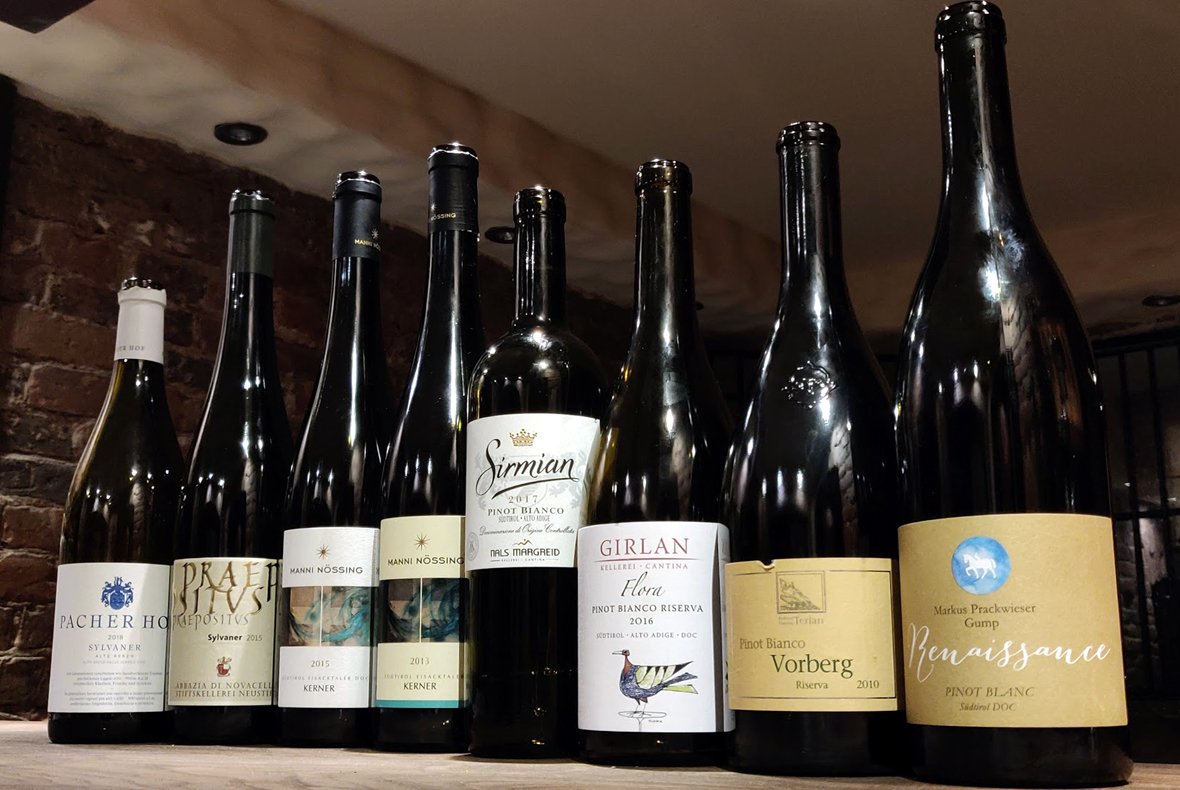
In this tasting we had two Sylvaners and two Kerners from DOC Valle Isarco / Eisacktal (if you think of Alto Adige as an “Y”-shaped valley, it’s the northeastern part) and four Pinot Biancos from the greater DOC Alto Adige, which encompasses the whole Y (but, to my understanding, these wines mainly came from the northwestern part and the central part of the “Y”). I’m always interested in tasting Sylvaners and Kerners, but I have my own reservations: finding a solid Sylvaner/Silvaner outside Franken is ridiculously hard (I’ve had some, but these wines are very few and very far between) and while Kerner can make some very enjoyable wines, they always feel like second-class Rieslings - i.e. stylistically very similar to a Riesling, but all too often lacking the thrill and finesse of a good Riesling. Alto Adige Pinot Biancos, on the other hand, are my weak spot. I think Pinot Blanc is the least interesting variety in the Pinot family - except for wines that come from two regions: Alto Adige and Champagne. Especially in Alto Adige this variety seems to express qualities and characteristics which simply cannot be realized somewhere else. I don’t know what is happening here, but it seems like the same thing as Assyrtiko + Santorini, Nebbiolo + Northwestern Italy, Juhfark + Sómlo or Nerello Mascalese + Etna.

Here are the wines, in the next post I’ll publish my notes.
altoadige.jpg

Pale and rather neutral yellow-green color. Youthful, aromatic and very primary nose with aromas of sweet pear and pear drops, some ripe white fruits, a little bit of herbal grassy character, light notes of hay and a hint of cantaloupe. The wine is broad, rich and quite round on the palate with intense flavors of spicy red apple, some herbal grassy character, a little bit of steely minerality, light notes of hay and perhaps a slightest autolytic touch of something bready. The acidity feels rather modest, not contributing much to the structure or to the sense freshness. The finish is spicy, slightly warm and quite round with ripe flavors of zesty lemon, some crunchy quince, a little bit of sweet cantaloupe, light herbal grassy tones and a hint of hay.

An intensely fruity but otherwise somewhat round and mellow Sylvaner that feels a bit too ripe for its own good. There’s quite a lot of everything, except for the acidity - which is exactly what a wine like this would need. With fresh acidity this would be a wonderfully fresh and lively effort, but now it feels a bit too soft and round, lacking the verve and zip necessary to make this wine feel truly balanced. Now it is a nice, lush and pretty drinkable Northern Italian white, but very little beyond that. (85 pts.)

Concentrated, deep neon-yellow color with subtly greenish overtones. Very big, sweet and concentrated nose with ripe aromas of quince, papaya, some honeydew melon, a little bit of marmalade candies, light grapey tones, a floral hint of honeysuckle and a touch of hay. The wine is medium-to-moderately full-bodied, broad and quite oily on the palate with intense and rather concentrated flavors of exotic spices, quince, some robust spicy red apple tones, a little bit of steely minerality, light floral tones, a hint of honeycomb and a touch of dried spicy herbs. The acidity feels moderately high, keeping the wine from tasting flabby or soft despite the viscous, oily mouthfeel. The high alcohol lends some obvious warmth to the mouthfeel. The finish is spicy, robust and somewhat warm with concentrated flavors of exotic spices, buckwheat honey and honeycomb, some stony mineral tones, a little bit of spicy red apples, light herbal notes and hints of fragrant floral spices.

A robust and wonderfully complex, but also very big, concentrated and warm Sylvaner which might be impressive in its own right, but lacks drinkability and freshness. The wine is noticeably spicy, rather extracted and a bit too high in alcohol. Very hard to get much varietal flavor or sense of place out of this wine and even hard to get excited about it. Although not a heavy or ponderous wine, it lacks all fun and liveliness. (87 pts.)

Medium-deep yellow-green color. Rather chemical and rubbery nose with slightly restrained aromas of swimming pool and chlorine, rubbery swimming toys, some red apples, light zesty citrus fruit tones, light notes of petrol and a hint of quince. Overall quite odd and not particularly attractive nose. The wine is dry, medium-to-moderately full-bodied and fruity on the palate with flavors of ripe citrus fruits, honeydew melon, some stony mineral tones, a little bit of white peach, light quince notes and a rubbery hint of pool toy. The high acidity keeps the wine fresh and the rather full body nicely in check, but the high alcohol cuts through quite a bit. The finish is warm and rather restrained in fruit with more emphasis on the flavors of stony minerality, some steely character, a little bit of rubber and chlorine and a hint of crunchy quince.

An otherwise quite decent Kerner, but the rubbery note takes some toll on the enjoyment and the high alcohol a bit more. Feels somewhat awkward and clumsy. Not bad, but nothing I’d recommend either. I wonder if this was an off bottle or if there was something else wrong with the wine. (86 pts.)

Medium-deep lemon-yellow color. Ripe, rather sweet-toned and somewhat developed nose with aromas of honeydew melon, some beeswax, light lemon marmalade tones, a hint of developed spicy character and a touch of dried herbs. The wine is dry, medium-bodied and fresh on the palate with precise flavors of steely minerality and wet stones, some bright and crunchy notes of white fruits, light apple tones, a little bit of honeycomb, a hint of ripe grapey fruit and an evolved touch of wizened citrus fruits and lemon curd. The high acidity keeps the wine balanced and well-structured. The finish is ripe, long and slightly sweet-toned with fresh flavors of tart green apples, some ripe white peach, light stony mineral tones, a hint of beeswax and a touch of dried herbs.

A nice, balanced and pleasantly evolved Kerner. Not a wine to challenge a fine Riesling, but nevertheless works as a good substitute in a pinch, coming across something not unlike a well-made lower-tier Riesling with some age. I often find it hard to get interested on a Kerner, but this is such a well-made wine I just might. (90 pts.)

Luminous and rather youthful yellow-green color. Still very youthful and borderline primary nose of ripe golden apples, some white peach, a little bit of crunchy golden currant, light cantaloupe tones, a hint of cool steely minerality and a slightest herbal touch of Pilsner-like noble hops character. The wine is lively, medium-bodied and very fresh on the palate with wonderfully precise, transparent flavors of crunchy red apples, ripe white peach, some spicy herbal tones, a little bit of stony minerality, light cantaloupe tones, a hint of apple peel bitterness and a tactile touch of rich, concentrated stone fruit character. The wine is very high in acidity, which lends it terrific sense of freshness, focus and structure. The finish is quite powerful, acid-driven and rather concentrated with intense flavors of red apples, some stony minerality, a little bit of herbal spice, light apple peel bitterness, a hint of sweet white peach and a touch of crunchy star fruit.

A consistently very impressive, concentrated and structured Pinot Bianco that shows perfectly why Alto Adige is the optimum region for making world-class Pinot Blanc. This variety thrives in many places, but it getting more and more convinced that this cultivar reaches its best expression here. This wine is all too young and primary to be showing its best now, but it is obvious for anyone with a working nose and mouth that this will become something remarkable if given enough age. With Pinot Bianco Vorberg Riserva this seems to be some of the greatest Pinot Blancs in the world. Highly recommended. (93 pts.)

  • 2016 Girlan Pinot Bianco Alto Adige - Südtirol Flora Riserva - Italy, Trentino-Alto Adige, Alto Adige, Alto Adige - Südtirol (6.2.2020)
    Fermented and aged for 12 months in casks of 1200-1500 liters. Partly MLF. Blended together after 12 months, left to marry in stainless steel for 6 months, bottled and aged for another 6 months before release. 14,5% alcohol.

Youthful lime-green color with subtle lemon-yellow overtones. Ripe and somewhat restrained nose with subtly Northern Rhône-ish aromas of sweet white fruits, some honeydew melon, light gummi bear tones, a herbal and slightly lager-like note that reminds me of Roussanne, and a hint of floral spice. The wine is dry, firm and enjoyably acid-driven on the palate with flavors of citrus fruits, fresh nectarine, some stony minerality, a little bit of white pepper, light golden apple notes, a hint of dried aromatic herbs and a Roussanne-ish touch of floral spice. The high acidity keeps the wine fresh and structured, but the high alcohol lends some obvious heat to the mouthfeel. The finish is fresh, quite warm and pretty ripe with lengthy flavors of ripe red apples, some white peach, a little bit of stony minerality, light crunchy notes of star fruit and a hint of fresh nectarine.

A clean, structured and fresh Pinot Bianco with a lot of stuffing and potential for further development. The overall feel is slightly atypical for the variety, since the wine reminds me more of very concentrated Northern Rhône white with its distinctive herbal and floral tones, and less of Alto Adige Pinot Bianco. Nevertheless, this is a very enjoyable and well-made effort. The only thing that bugs me some is the rather overblown alcohol which makes the wine feel at times not just warm but rather hot, if not boozy. Otherwise the wine would be really built for the long haul, but I worry that the alcohol might get a bit too much if the fruit starts to gets more delicate with age. Although a great wine, it’s very hard to assess whether this is a wine for immediate consumption or for longer-term aging. (90 pts.)

Concentrated medium-deep golden yellow color. Big, rich and somewhat developed nose with concentrated aromas of juicy yellow fruits, fresh apricot, some sweet white peach, a little bit of spicy red apple, a hint of cloudberry jam and a touch of stony minerality. The wine is big, full-bodied and somewhat oily on the palate with very concentrated flavors of ripe citrus fruits and lemon marmalade, some honeydew melon, light stony mineral tones, a little bit of beeswax, hints of savory herbal spice and a touch of fresh pineapple. The high acidity adds tremendous energy and sense of structure to this already impressive wine. The finish is juicy, powerful and concentrated with intense, slightly developed flavors of nectarine, honeydew melon, some herbal spice, light pineapple tones, a hint of lemon marmalade and a touch of lemon curd.

A Pinot Blanc that constantly manages to impress me. Tons of power and concentration packed into a wine that manages to retain such poise and freshness at the same time. At almost 10 years of age, the wine is starting to exhibit some signs of development, but the overall impression is still that of a relatively young wine. While already offering tons of pleasure and seductive complexity, the wine is still more about potential for future development. Perfectly drinkable right now, but most likely will continue to improve for another 8-10 years and keep for even longer. Hands down one of the greatest wines in Italy and probably the best Pinot Blanc in the world. Striking stuff, very highly recommended. (94 pts.)

Pale, limpid whitish-green color. Remarkably fresh and youthful nose for its age with slightly sappy, green-toned aromas of birch leaves, some reductive gunpowder smoke, light green apple tones, a little bit of zesty citrus fruits, sweeter hints of melon and white peach and a touch of creamy oak and savory wood spice. The wine is fresh, medium-bodied and zesty on the palate with bright flavors of spicy red apple, some sappy herbal tones, a little bit of rubbery reduction, light candied gummi bear tones, a a hint of ripe citrus fruits and a touch of stony minerality. The bright, high acidity keeps the wine wonderfully in balance, but the high alcohol shows quite a bit through, making the mouthfeel rather warm. The finish is bright, lively and enjoyably acid-driven with some alcohol warmth and fresh flavors of citrus fruits, some spicy red apples, a little bit of herbal spice, light notes of creamy oak and a hint of white peach.

A very fresh, zesty and impressive Pinot Blanc with very judicious use of oak and wonderful, rigid backbone of high acidity and cool minerality. The alcohol feels a bit high here, but otherwise the wine is wonderfully in balance. There is a slightly atypical green streak, which - with the zesty tones - lends a slightly Sauvignon Blanc-ish feel to the wine, but not to the extent it would really bother me. What surprised me the most, however, is how very youthful the wine is for its age. It is almost 8 years of age, yet it drinks like one not older than 3 years. Obviously a wine suitable for longer aging, and I can expect this wine to go up in score as it ages. A lovely wine and apparently a producer to remember. Recommended. (91 pts.)

Posted from CellarTracker
Otto-
Thanks for these notes. I have been exploring more Italian whites lately and Alto Adige is an area of interest. Last month I posted on the 2018 Nossing Kerner, which showed more like your '13 note, albeit with obviously more youthful edge. A really nice wine to my palate, good value, and a decent Riesling stand-in.
I need to try more Terlan. That 2010 sounds really excellent.
Helpful reflections here. Thanks.

One of the other positives about Terlan is that they have reasonably good distribution here in the states. I’ve had the '13, '14, '16 and '17 vintages all within the last year or so, and while there is vintage variation, I find them pretty consistently enjoyable. I’ve never had one last in my cellar long enough to drink a 10 year old version, though. [cheers.gif]

Great notes Otto. Have only had the Terlan Pinot Bianco and agree it was pretty special. Their Pinot Nero is also very nice.

Tom

Otto can you please recommend some whites that are good value and readily available? The handful alto adage I have had in restaurants by the glass have been very interesting to me but I’m not sure where to start. Is there a Beaucastel or Produttori equivalents in the region?

Thanks for the TNs and interesting read. I’ve dabbled in these whites, with the hope of gaining more knowledge for a future visit to the region. This is a good start.

Agree on the Kerner generalization as per similarities with my experiences, mostly with Abbazia.

Trentino-Alto Adige is the promised land of co-operatives, so while it might be hard to find a Beaucastel equivalent - San Leonardo and their nuanced reds might be the closest thing. However, there are some outstanding co-ops, just like Produttori del Barbaresco. Out of those, I’d say that the best two are those that were represented in this tasting: Cantina Terlan and the co-op of Nals and Margreid. Although they make lots of wonderful, ageworthy wines, I’d say these Riserva Vorberg and Sirmian are their best wines. Or at least I’ve yet to taste better ones. As a whole, Pinot Blanc seems to be The Thing there.

If you want something singular and of outstanding quality in the vein of Beaucastel, I suggest checking out the wines of Elisabetta Foradori. They might be natural, but generally of exceptional purity - not volatile funk bombs. Both the reds and whites can be ridiculously good. Definitely among the best producers in the region.

Many consider Elena Walch to be one of the best producers of the region, but I’ve yet to have a thrilling Walch wine. Pretty same thing with Tiefenbrunner.

Some good smaller names I have very little experience of, but seem to be worth checking out are Heinrich Mayr (Nusserhof), Armin Kobler, Manincor and Giuseppe Fanti.

Edit: I have no idea about the availability of these wines, since I live on this side of the pond.

Many consider Elena Walch to be one of the best producers of the region, but I’ve yet to have a thrilling Walch wine. Pretty same thing with Tiefenbrunner".

Maybe not thrilling but my favorite wine from a bunch of excellent ones from Alto Adige. My mouth waters thinking of it :slight_smile:

ElenaWalch GWT Tramine 2017: Strong rosy, lychee, peach, very spicy nose, lovely. In the mouth, white peach, apricot, flowers, very spicy, huge mouthfeel, texture, almost viscous but with bracing acidity. This is one heck of a mouthful of wine. Excellent, my overall favorite.

Thanks very much for the info Otto. I have access to a lot of different Foradori and a couple of whites from Terlan so that should get me going in the right direction.

At a 20th Anniversary lunch Charles Smith served us a Terlan Vorberg, we just don’t see it in WA so it had completely fallen off my radar as a producer. Immediately went online and sourced some various versions, but Vorberg Pinot Bianco has always been a favorite. Killer white wines.

I have been very, very impressed with Nals Margreid in the last few years.

However, the style is so thick & blowsy & creamy that I often wonder whether Harald Schraffl has been engaging in some sort of stirring-of-the-lees voodoo, and, if so, what the long term implications would be for cellaring the wines.

I certainly hope the wines are ageworthy, and that they’re capable of evolving into something quite special.

But as young wines, they are exceptionally yummy.

I myself love well-made Gewurztraminers, but I’ve yet to taste a spectacular one from Alto Adige. They are often just too heavy, ponderous and high in alcohol. If somebody thinks Alsatian Gewurztraminers are big, they should check out Alto Adige - they can be even bigger.

But a Gewurztraminer with “bracing acidity”? And a 2017 vintage? Sounds really odd and weird. Alto Adige Gewurztraminers can be a bit higher in acidity than their Alsatian counterparts, but I’d never consider them high in acidity. If you can guarantee that this truly is a wine with high acidity, I might need to check it out.

Otto, seek it out, you won’t be disappointed. It is exactly that attribute (acidity) that made it outstanding (for me).

Notice I also mentioned “huge mouthfeel, texture” “almost viscous”.

It’s that combination that made it may favorite of the evening.

Tom

+1 on the Terlan Vorberg PB.

Terlan makes good gewurz also. Gewürztraminer from Alto Adige is nice alternative to Alsace.

Otto, first let me say that I always like your TNs. They are descriptive, detailed, and opinionated, which I like.

I haven’t had the Flora, but love the Girlan Plattenriegl, especially the '16, which doesn’t sound as big and ripe as the Flora. Try it if you get the chance, I think you’ll like it more.

The '17 Sylvaner Praepositus isn’t anything like the '15…I found it a bit tight and lean recently, and put my other bottles away to round out a bit.

I find Kerner an interesting grape at its best, but it’s often a touch innocuous. Try the '17 Kofererhof if you can…delicious IMO.

Thank you for the suggestions and your kind words! I try to write such tasting notes I’d love to read myself. It certainly takes time and effort, but it also seems to activate my brain more, which in turn helps me both remember things and get a better picture of the different wine styles, producers, regions and even the wine world as a whole.

I’ll certainly try to keep my eyes open for the Plattenriegl. I do love how Alto Adige Pinot Blancs can combine power and freshness remarkably well, but I do prefer wines that aren’t that ripe and weighty.

I’ve always wanted to like these wines too, but having tasted some from there off-and-on for around 30 years now really have not interest in chasing them down. Much rather go a little east to the Collio or the Karso for my thrills. Speaking of altitude, do you have an opinion on Tiefenbrunner ‘Feldmarschall’? It’s got to be the priciest Müller-Thurgau there is, grown at one of the highest elevations there (or in Europe) at around 3200 feet.

I’m certainly with you on the wines of Friuli. Another spot for spectacular whites and I’d say their best reds trump the best reds of Alto Adige by a wide margin.

Tiefenbrunner’s Feldmarschall must be the only memorable wine from that particular producer that I’ve tasted (had it only once) and also probably the most noteworthy wine in their range. It is also worth mentioning that it’s quite a feat to make a great wine like this from a variety otherwise so bland and uninteresting. Here’s my TN on the vintage 2016:

Quite intense, medium-deep neon green color. Characterful and quite expressive nose with distinctive aromas of pronounced green herbs, some flowering hogweed tones and other floral nuances, light hand soap aromatics, a little bit of sweet white fruits and a hint of some vague popcorn character. The wine is ripe, moderately full-bodied and slightly oily on the palate with dry flavors of green herbal tones and a little bit of medicinal herbal bitterness, light juicy white fruit notes, slightly smoky character, a hint of apple peel bitterness and a touch of wild rosemary. The wine is high in acidity, making it come across as pretty lively and nicely balanced. The finish is dry and lively with firm and moderately acid-driven flavors of ripe golden apples, some saline tang, a little bit of stony minerality, a hint of green herbal bitterness and a touch of perfumed white flowers.

A rather big, concentrated and well-structured Müller-Thurgau with a lot of freshness and intensity. Seeing how this variety normally produced rather bland and uncharacterful wines with quite modest acidity, this powerful, distinctive and acid-driven effort might just be the best Müller-Thurgau I’ve ever tasted. I’m not entirely sure if the wine will actually develop in a cellar, but I wouldn’t be surprised if someone brought me a 10-year old bottle of this stuff and it was still drinking well. Rather expensive at 25€, but delivers for the price. (91 pts.)

Posted from CellarTracker

I have a friend who used to import Tiefenbrunner, and cellared some Feldmarschall. They were excellent at 20 years, which is odd for the variety.

I love Alto Adige or Trentino Mueller but only if it’s young, in general I find the zingy lime-peel aroma is has when young isn’t replaced by anything more interesting as it ages.