Sierra Foothills Visits to Quartz Vein, Cedarville, Edio, Starfield, and Cappelli – Part 1: Cedarville Vineyard
I’ve posted a portion of a report on early January wine visits with friends Jane and Larry to wineries in El Dorado County. We tasted with vintners from Quartz Vein, Cedarville, Edio, Starfield, and Cappelli. This portion covers the visit to Cedarville Vineyard, and I’ll post another portion of the write-up soon. The full report of all of the El Dorado County wine visits is on the Grape-Nutz.com website:
Sierra Foothills Visits - January 2025
Cedarville Vineyard
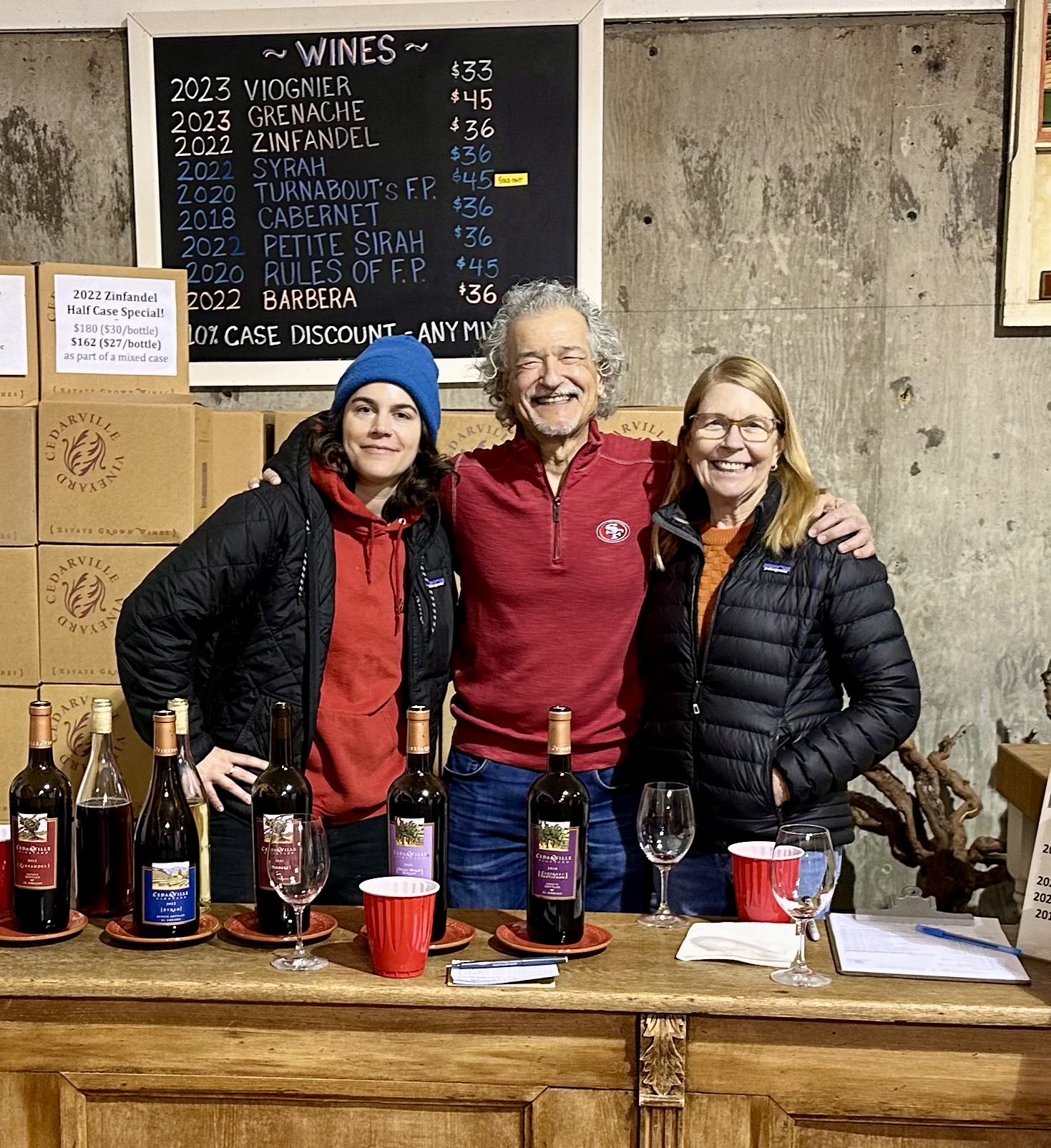
Just as Jane, Larry, and I were wrapping up our tasting with assistant winemaker Jill Winter of her own Quartz Vein wines, Cedarville owner/winemaker Jonathan Lachs arrived. I’ve been visiting Cedarville for over 20 years and writing about them for nearly as long.

Cedarville was established by co-winemakers Jonathan Lachs and his wife Susan Marks, who sadly passed away in 2020. They’d met while both were earning enology degrees at UC Davis, and though both worked at wineries after graduation, they eventually took other jobs in Silicon Valley. They always envisioned finding a place to plant a vineyard and make their own wine, and after looking in a number of areas, they purchased property at about 2,500-foot elevation in El Dorado’s Fair Play region in 1995 and planted a vineyard there. Jonathan and Susan produced Cedarville’s first commercial vintage in 1998, and they moved there full-time the following year. The winery building – partly built into a hillside for natural cooling – was completed a couple of years later. The name of the winery comes from the long-gone gold-rush era town of Cedarville that was located not far away.
While the winery’s focus has always been on wines from Rhône Valley grape varieties, they also make Zinfandel, Cabernet Sauvignon, and Petite Sirah, a couple of blends, and occasionally other wines. Other than the Petite Sirah, all of the fruit for their regular bottlings comes from their 10-acre estate vineyard, which has been organically-farmed since 2010. Over the past decade Cedarville has cut back on production of its own wine – current annual production is approximately 1,000 cases – while in turn selling more of their estate fruit to a number of well-regarded vintners. With this smaller production requiring a bit less space in the winery, Jonathan has been able to take on a few custom crush clients in recent years, and he said he’s enjoyed working with them there.
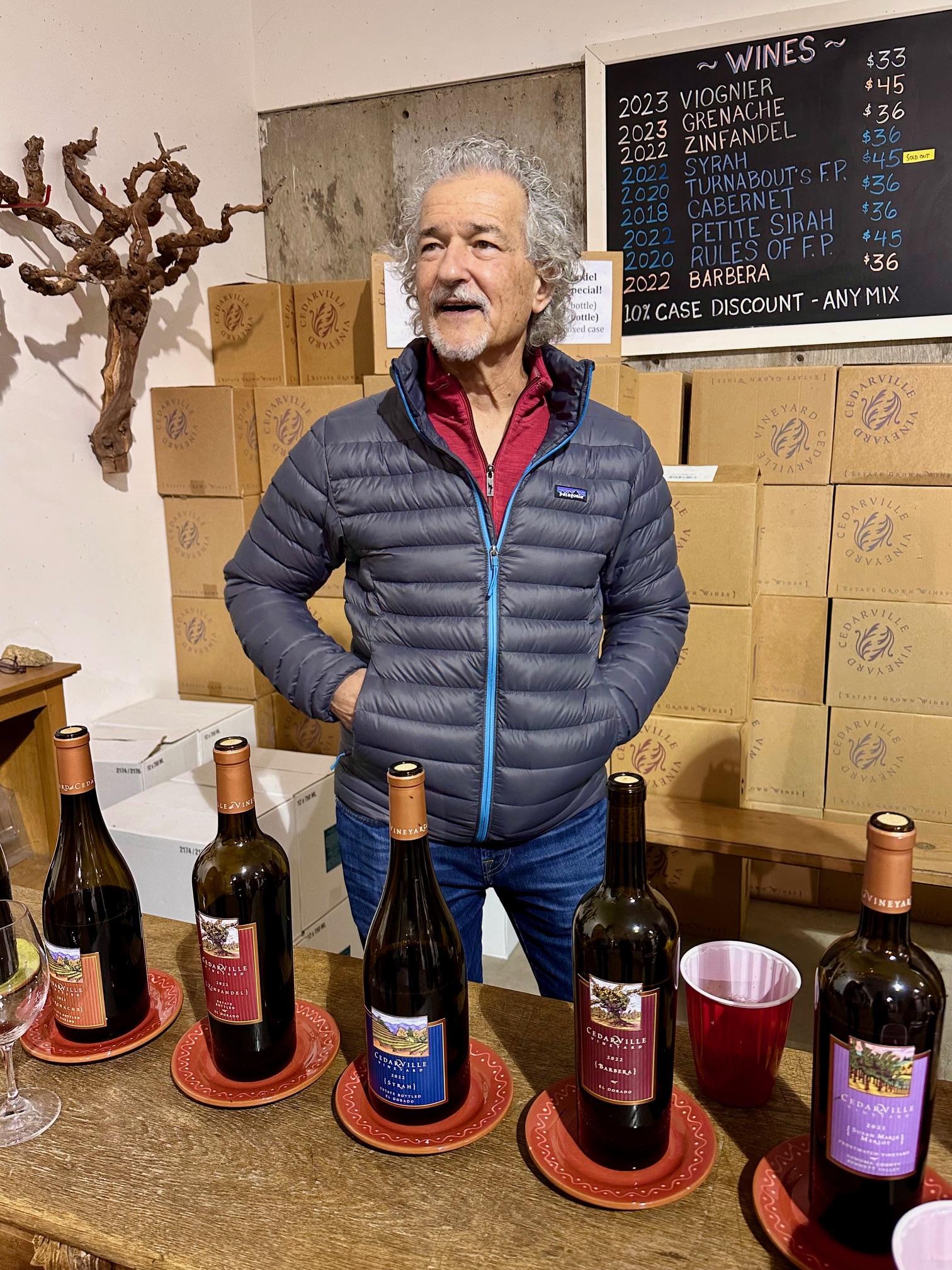
The goal of Cedarville’s winemaking has always been to showcase the character of their estate vineyard and its terroir. Jonathan uses a combination of new and older French oak barrels for aging each of the wines. A few years ago the Cedarville wine labels changed a bit from their original design, but they still retain the distinctive artwork by illustrator Jim Meyer that depicts different views of the vineyard.
As we talked with Jonathan, we were joined by the new Susan in his life, Susan Lund. Jonathan refers to her as “Susan Elizabeth” to distinguish her from his late wife “Susan Marie”. Susan Elizabeth has become an integral part of the Cedarville team and shares Jonathan’s warm and easygoing character. Jonathan continues to honor Susan Marie’s memory by making a special “Susan Marie” bottling each year – the sales of this wine help to raise funds for the Pancreatic Cancer Action Network (PanCAN). Jonathan has noted that with sales of these wines, along with donations from friends and family and his own contributions, he’s raised over $80,000 to date. The next “Susan Marie” wine will be a 2024 Rosé.
There are always new things to talk about each time my friends and I visit with Jonathan. He told us about how the vines there, planted in the decomposed granite soils that are distinctive of this region, seem to self-regulate much better as they have gotten older. Jonathan noted that there tend to be fewer clusters per vine, so there’s less work to be done in thinning a heavy crop during the growing season. He also mentioned that fruit clusters tend to be smaller, and with fewer “shoulders” on them.
Another fairly new development that Jonathan talked about with us was the formation of the “El Dorado 8” organization. I’d heard about this group of El Dorado wineries in passing, but our discussion with Jonathan led me to find out more about the group and its member wineries. Though there is already the established El Dorado County Winery Association helping to draw visitors to the county’s wineries – a vital part of the area’s wine business – the El Dorado 8 is a marketing group that’s looking to raise awareness of high-quality El Dorado wines among the broader wine industry and to help distinguish these wines from those of other Sierra Foothills regions. The high elevation, distinctive granitic soils, and other features of El Dorado County vineyards and wine are all part of this. The group is looking more to help promote wines that are in wider distribution rather than ones available only at winery tasting rooms or to wine club members only. They’re spreading the word on many of the region’s best-quality wineries and wines, mostly through social media, and looking to help their member producers push their wines to even higher levels. The El Dorado 8 has only been around for a short time so it should be interesting to follow them as they showcase the wines from these eight (and maybe additional) producers.

Jonathan began pouring most of Cedarville’s current release wines for Jane, Larry, and me, beginning with the 2023 Estate Viognier, their only white wine. This wine was bottled unfined and unfiltered, and with no cold stabilization. With stone fruit aromas along with supporting notes of spice, flowers, and a light touch of oak, this had a medium-rich mouthfeel and bright finish – this wine continues to be a consistent winner from Cedarville. Next was the 2023 Estate Grenache – this marks the first time since the inaugural 1999 Grenache vintage that this wine has been 100% Grenache, as it has usually included a small percentage of Syrah. Bright red fruit and spice with herbal undertones, this had great texture and fine tannins on the long finish – very nice now but a bit more time should really benefit this wine. We followed this with the 2022 Estate Zinfandel. This is also 100% varietal, as has been the case in most recent vintages of the Zin. This showed lots of spice, herb, and earth aromas along with red berries and supporting vanilla/oak notes, with medium texture and youthful tannins on the finish.
The 2022 Estate Syrah is 100% Syrah, the first time since 1999 that this was not co-fermented with some Viognier (the Viognier vines had just been recently planted back then), as there was not enough Viognier harvested in 2022 due to spring frosts that severely reduced the crop. Displaying dark berry fruit, smoked meat, herbs, black pepper, and a touch of black olive on the nose, this had a fuller mouthfeel and firm tannins – already showing fine complexity but could use a few years of cellaring to develop into something even better. A new wine for Cedarville, the 2022 Barbera was sourced from a nearby Fair Play AVA vineyard. Adding this wine to the lineup in the 2022 vintage helped compensate for the small production that year due to the spring frosts. This had ripe red fruit, spice, and vanilla/oak aromas, balancing a medium-rich texture and bright acidity, with fine tannins on the finish.
The fruit for the 2021 Frostwatch Vineyard “Susan Marie” Merlot came from the Bennett Valley vineyard of Jonathan’s longtime friends Brett Raven and Diane Kleinecke. Similarly to the 2022 Barbera, Jonathan looked for fruit to supplement his own in 2021, in this case due to smoke issues from the nearby Caldor fire that year. With herbal black cherry, spice, and an intriguing saline mineral note in the background, this had good structure with moderate tannins – a fine Merlot that deserves a few more years in the cellar. As with the 2022 Barbera, this Merlot was a “one-off”, as Jonathan prefers to focus on the estate vineyard for fruit. Our final wine was the 2018 Estate Cabernet Sauvignon – this wine is 100% varietal, and aged in 50% new and 50% second fill French oak barrels. Jonathan told us that their next Cabernet release will be from the 2022 vintage. This wine showed a black currant and darker berry fruit profile plus dried herb, spice, and vanilla/oak notes with plenty of structure for additional aging.
In addition to the wines we tasted on this visit, Cedarville also makes Petite Sirah, as well as two red blends – “Turnabout’s Fair Play” and “Rules of Fair Play”. I asked Jonathan whether he has anything new planned in the future and he said he’s looking forward to continuing his small-scale hands-on winemaking and making minor adjustments to his processes.
Cedarville has done a lot to help raise the quality level of wine from El Dorado County – and particularly the Fair Play area – over the years, and Jonathan is looking forward to continuing to be involved with the El Dorado 8 and their focus on the region’s highest-quality wines. Over the years, Cedarville’s wines have shown remarkable consistency, and while vintage variations are certainly evident, the winemaking always allows the vineyard character to show through. As usual, all of the wines we tasted were very good, with my favorite wines on this occasion being the 2023 Grenache and 2022 Syrah – perhaps the best of these two in some time – and I liked the 2023 Viognier, 2022 Barbera, and 2021 Merlot nearly as much. I always give Cedarville my highest recommendation whenever friends ask me where to visit in El Dorado County.