Santa Cruz and Gilroy Winery Visits, Part 1 – Madson Wines
I’ve posted a portion of a report on recent wine visits with friends Wes and Larry to Madson Wines and Margins Wine in Santa Cruz and to Deauratus Wines in Gilroy. This portion covers the visit to Madson Wines. The full version of the report is on the Grape-Nutz.com website:
Santa Cruz and Gilroy Winery Visits
Sunday April 12, 2026
Madson Wines
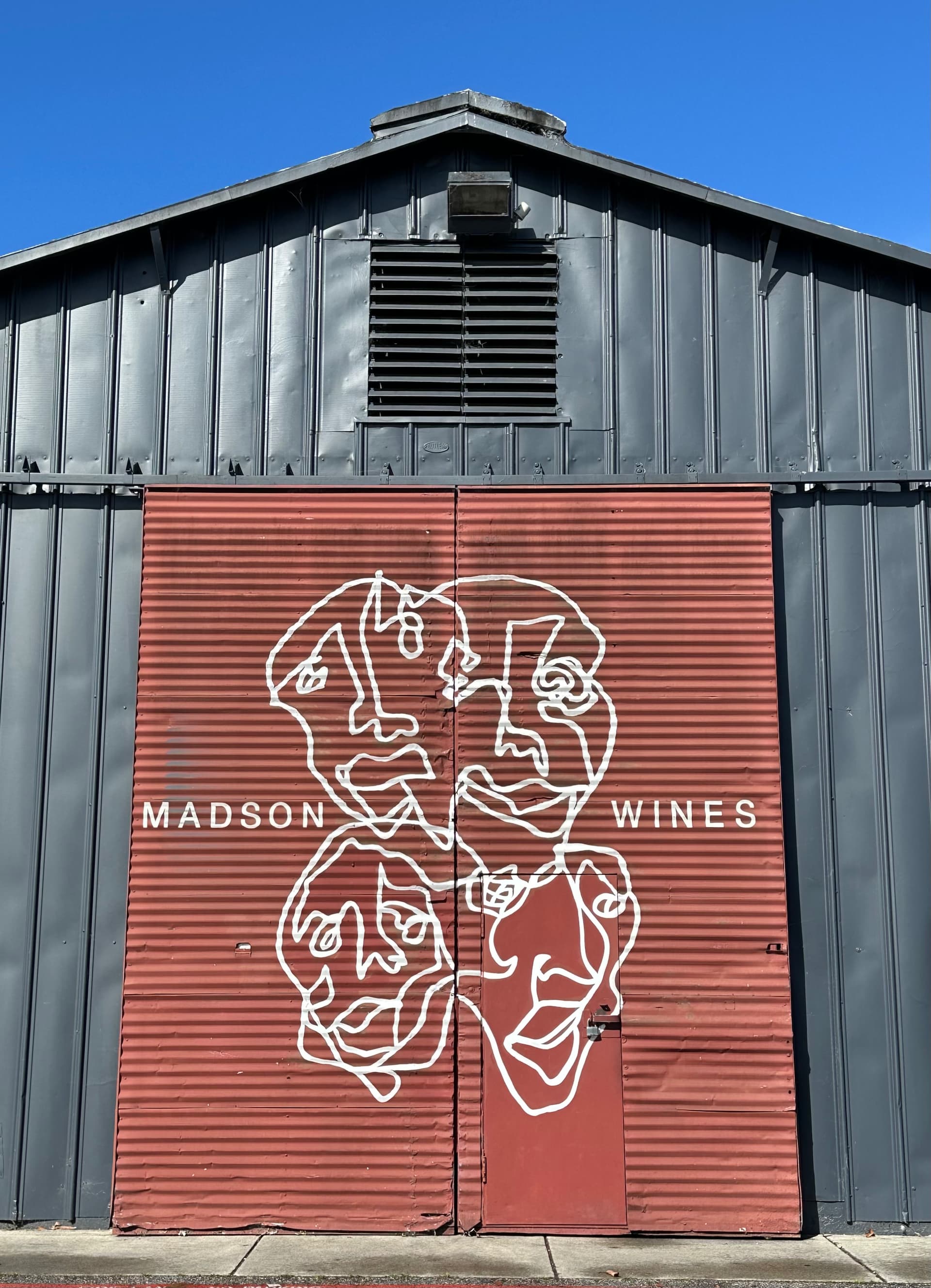
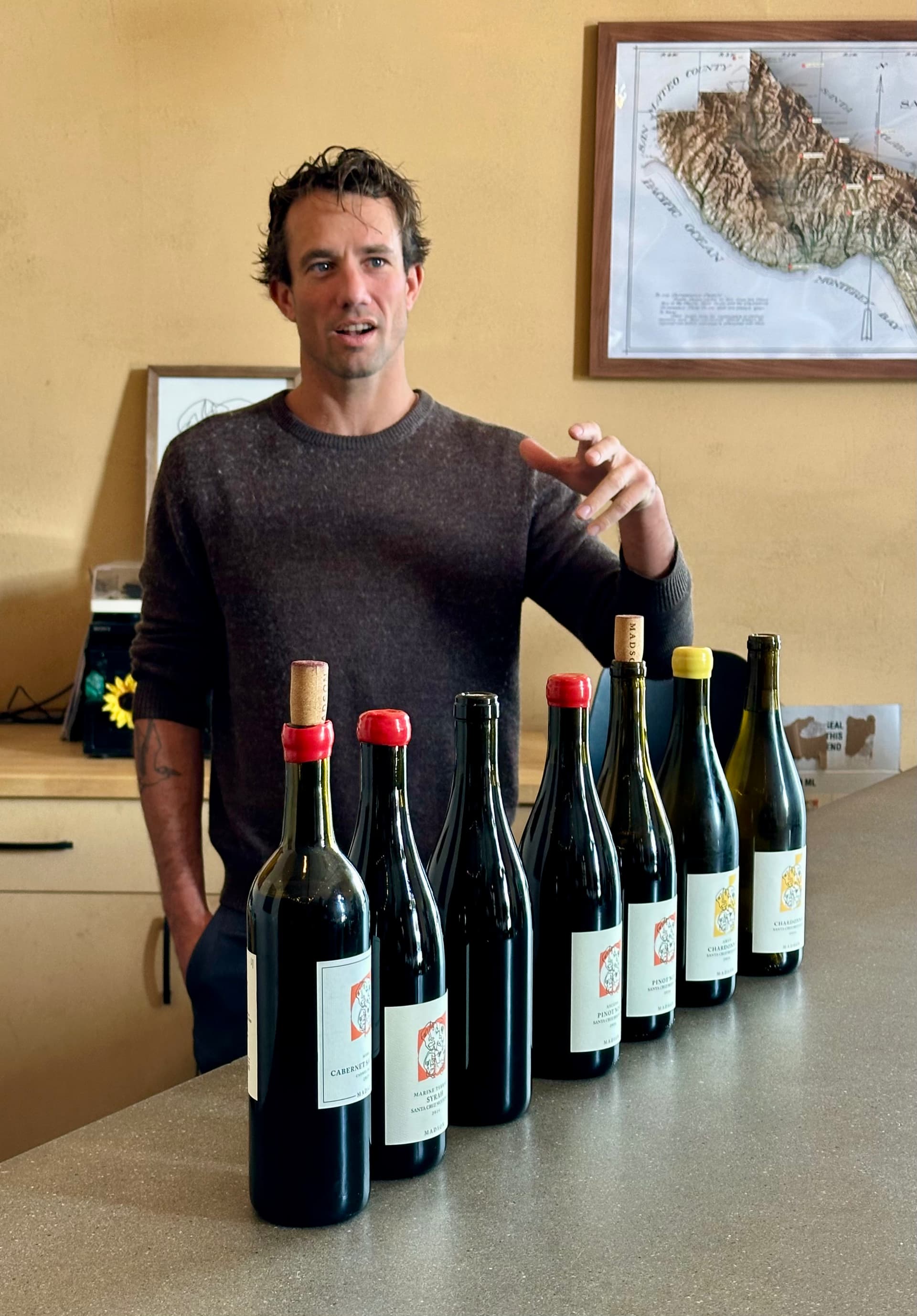
Wes, Larry, and I arrived a little early but after just a few minutes Madson Wines co-proprietor and winemaker Cole Thomas opened up the large metal sliding doors to the winery space to greet us. Madson is a partnership between Cole and his friends and wine colleagues Ken Swegles and Abbey Chrystal. I’d first learned about them some years ago when I’d met Ken – each harvest season he’s brought in fruit from several Santa Cruz Mountains vineyards he manages to wineries where I’ve worked part-time. Madson’s winery and tasting room are located in an industrial steel building just off Ingalls Street in Santa Cruz – there are a number of other wineries, breweries, bakeries and cafés, and other small businesses within a couple of blocks of one another along the street. The large doors that lead to the winery space are painted with the Madson “Four Faces” image – this represents the continuing cycle of the four seasons, both in the vineyard and in the winery. We followed Cole inside, and he began lining up bottles on the tasting bar that’s located in a corner of the winery space. He had been kind enough to meet with us on the morning we visited – he was heading to the annual Pebble Beach Food & Wine event later that morning (Ken and Abbey were already there) to help pour the Madson wines there.
Cole is the lead winemaker at Madson, while Ken focuses mostly on vineyard management and Abbey also manages a few vineyards in addition to other work for the label – they’ve each had years of experience with many aspects of winemaking and viticulture. All three are connected through their time working for Jeff Emery at Santa Cruz Mountain Vineyard, one of the region’s most notable longtime producers – both Cole and Ken became assistant winemakers there. College at UC Santa Cruz led Cole to working for its organic farm and then to helping create the biodynamic Demeter Seed Library. It was during an event for that organization that he first met Jeff and began his winemaking journey. In the years since, Cole has worked at Paringa Estate in Australia and at Prophet’s Rock and Amisfield in New Zealand as well as in the Santa Cruz Mountains.
Ken is widely recognized as one of the Santa Cruz Mountain’s premier vineyard managers and runs his own Skyline Viticulture business in addition to his work at Madson. He studied viticulture at UC Davis, and has worked for noted wineries including David Bruce, Rhys, and Williams Selyem. Abbey attended grad school at UC Santa Cruz and worked with Randall Grahm at Bonny Doon – in addition to her role with Madson, she also works in wine sales for Vintage 59 Imports. Assistant winemaker Tino Paccione rounds out the Madson Wines team. The label was established in 2018, though Cole and Ken had already been making a little wine together for a few years. The winery name comes from the maiden name of Cole’s grandmother. The initial vintages were made at the Santa Cruz Mountain Vineyard facility and then in Corralitos before moving to their current location in 2022.
One of the things that the Madson team is most proud of is their part in helping to convert a number of vineyards in the Santa Cruz Mountains and elsewhere to organic farming. These days making a transition to organic viticulture is not so unusual but when Cole and Ken began doing that it was much less common. And as you might imagine, two younger guys trying to convince longtime grapegrowers who had been farming conventionally to change their ways was not an easy task. But they’ve kept at it, attracting other like-minded people to do it as well, and the percentage of Santa Cruz Mountains vineyards that are organically farmed keeps growing. Madson currently sources fruit from about 15 vineyards, all of them organically-farmed (and most of which they manage) and nearly all of them located in the Santa Cruz Mountains. The vineyard sites are all fairly small and relatively close to either the Pacific coast or San Francisco Bay, with elevations ranging from 400 feet to 2,400 feet and featuring a variety of aspects and soil types. Cole told us that they prefer vineyards in cooler-climate areas, as those sites allow for a longer harvest season and slower ripening so they can really zero in on when they want to pick the fruit.
Winemaking at Madson is low-intervention, and uses all native fermentations. The wines are lower alcohol than most from California – low alcohol in and of itself is not their goal but the higher acidity that goes with it is an element in how they want their wines to express the vineyard sites they work with. Cole told us that they use whole-cluster fermentations for most of their red wines. He said they started doing that based on fermentation trials at the winery, as well as to do something different from what was typical at the time they started, to set themselves apart. He noted that not every variety or every vineyard works well for whole-cluster fermentation. For example, Cole pointed out that some vineyards with heavier soils can lead to stems staying greener even as the fruit ripens, while other sites with thinner soils often lead to stems lignifying, which is preferable for using whole clusters. Barrel-aging is typically in older French oak. Cole mentioned that they’ve started doing a rack-and-return during barrel-aging for Pinots to help prevent the wines from “shutting down” early on after they’re bottled and released.
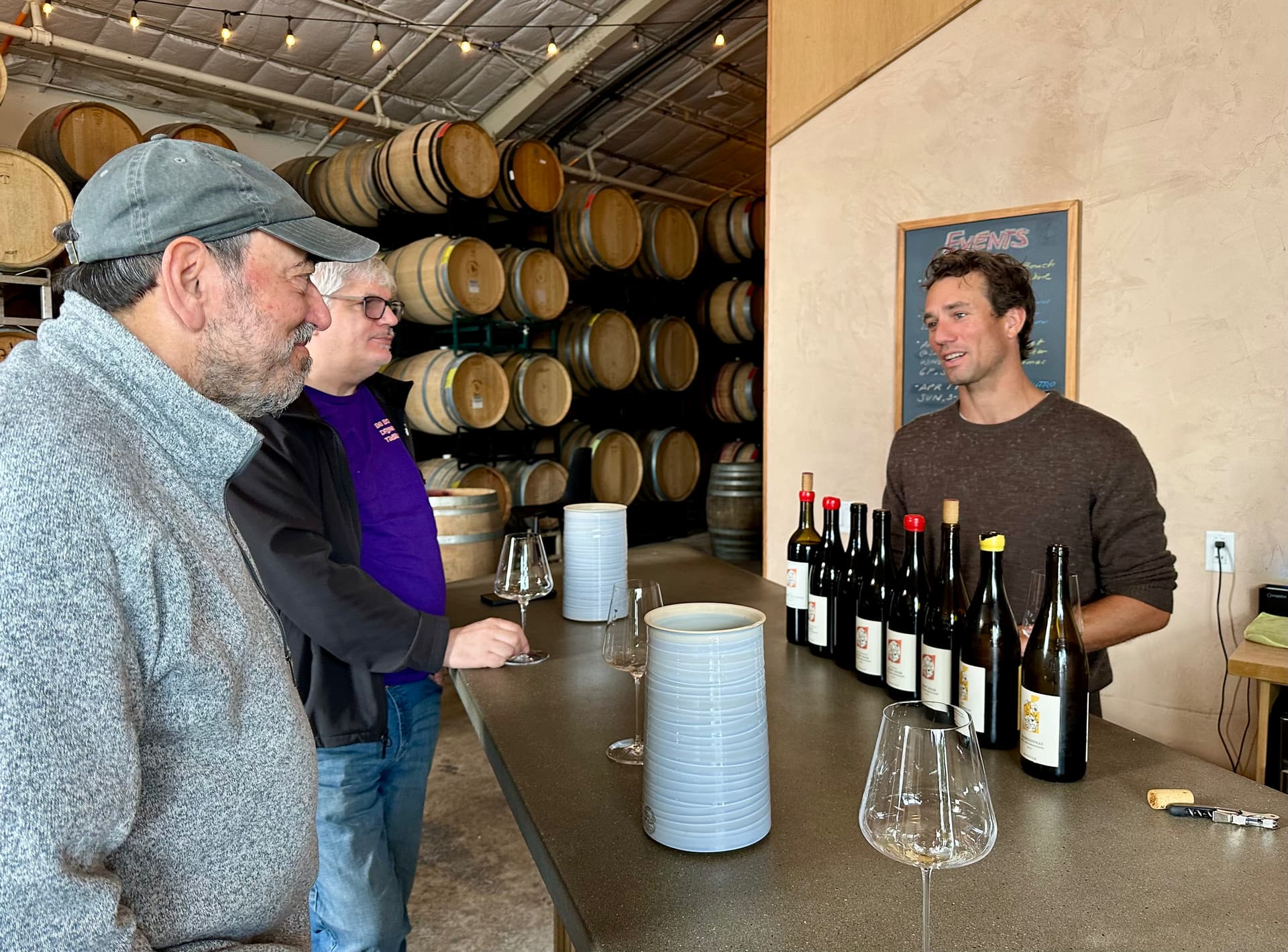
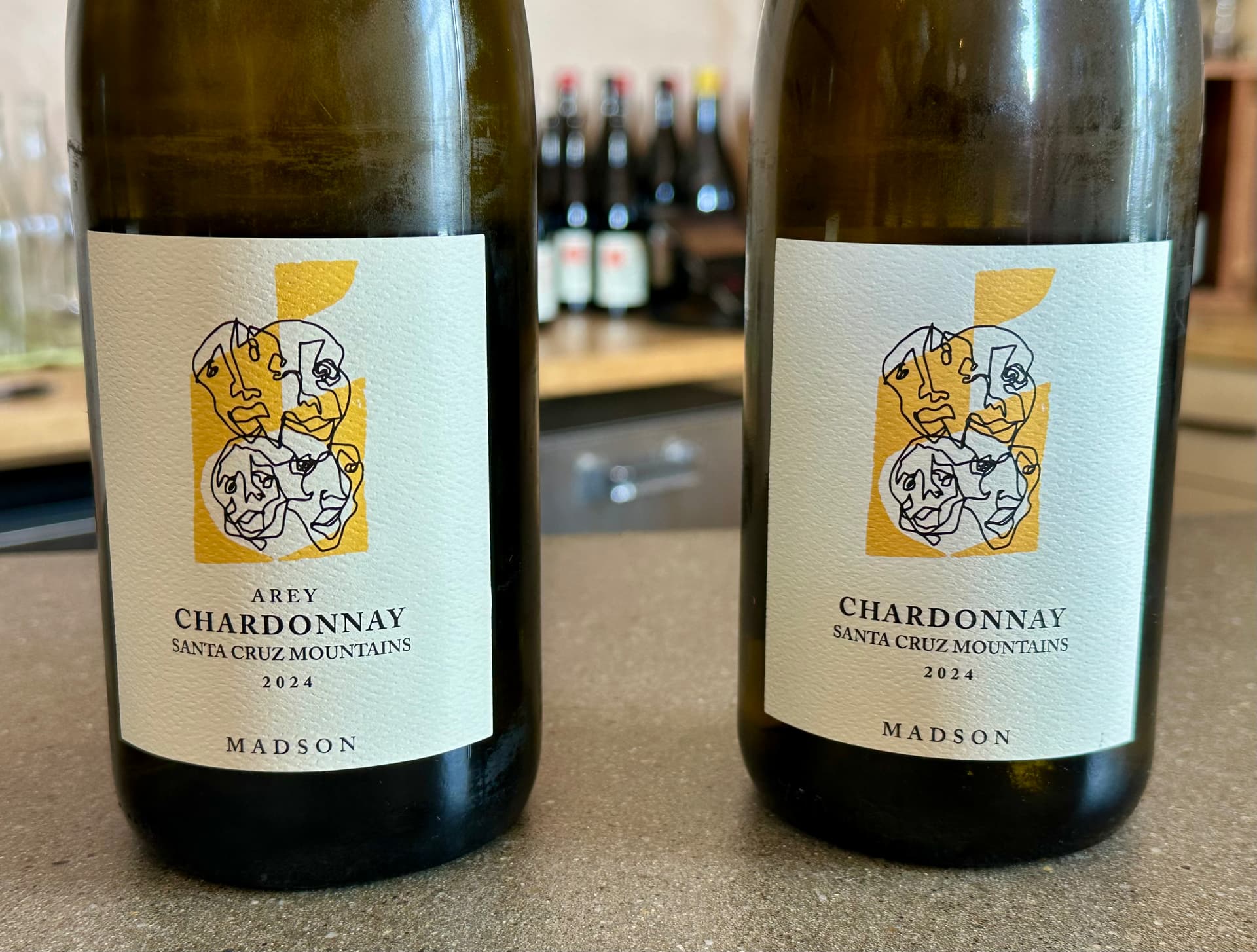
As we talked with Cole, he began opening up the bottles on the tasting bar that he’d selected for us to try. We first tried a couple of Chardonnays, starting with the 2024 Santa Cruz Mountains Chardonnay. This wine is a blend from six vineyards, all on the cooler ocean side of the main Santa Cruz Mountains ridgeline. The wine displayed lemon and stony mineral character, with a bright mouthfeel and a long, vibrant finish, a really nice appellation Chardonnay. We followed that wine with the 2024 Arey Vineyard Santa Cruz Mountains Chardonnay, from a vineyard site near Los Altos Hills. This had more of a pear and stone fruit profile along with citrus notes, showing greater depth, texture, and structure than the previous wine, but with similar fine acidity and long finish. Cole told us that they prefer to pick on the early side for their Chardonnays, and base picking decisions more on pH (aiming for about 3.1) than on brix (this usually ends up around 21). With such a low pH, and the fact that fruit from these cooler vineyard sites can ripen late in the season when it’s cold inside the winery, it was no surprise when Cole told us that the wines often don’t finish either primary or secondary fermentation for many months after harvest.
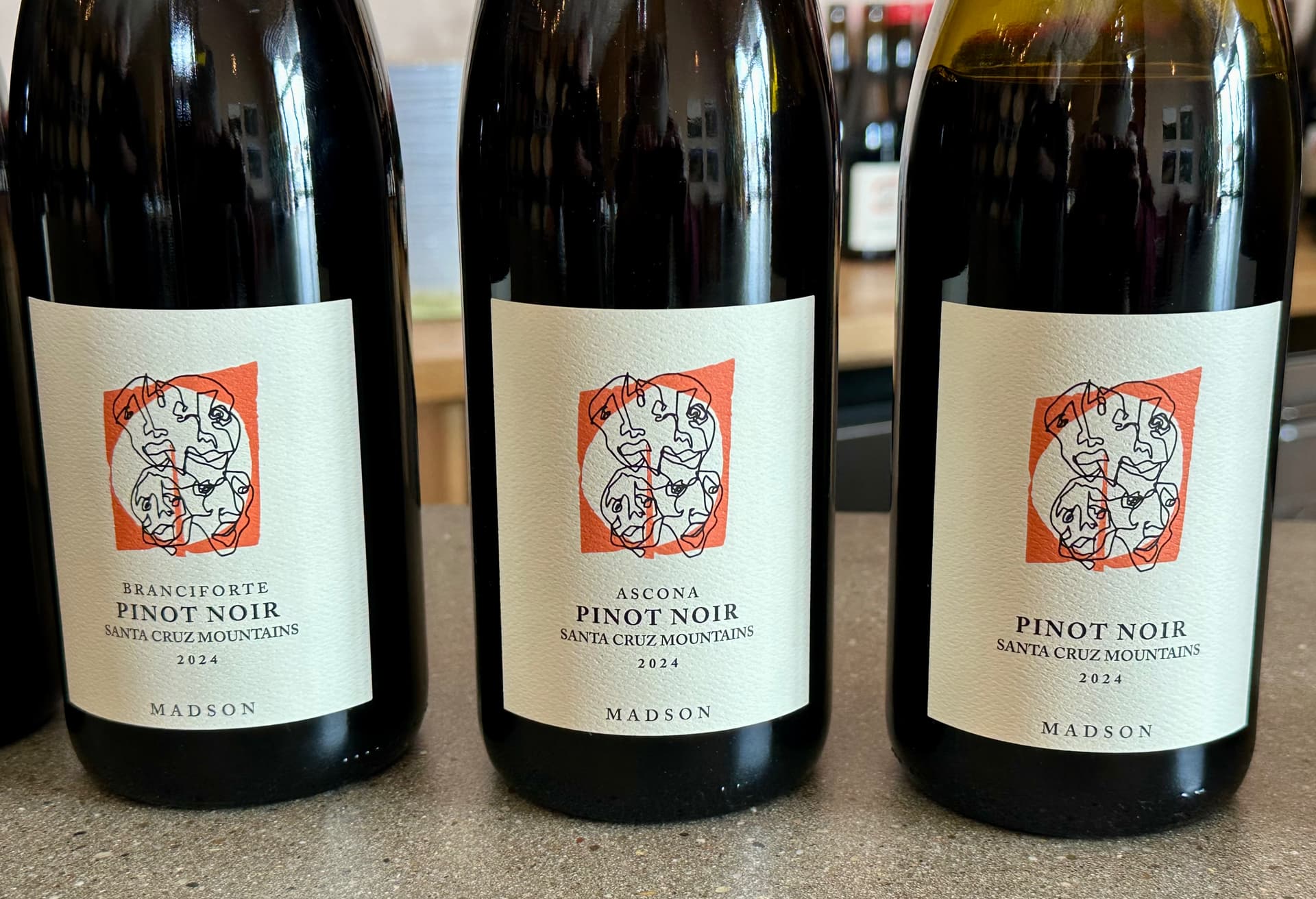
Moving on to reds, Cole poured us the 2024 Santa Cruz Mountains Pinot Noir. Sourced from four vineyards and fermented with whole clusters, this was made from a mix of various Pinot clones and spent a little under 12 months in barrel. With earth and forest floor notes upfront and black cherry fruit plus spice in support, this medium-bodied wine had good structure and youthful tannins on the finish. Next was the100% Pommard clone 2024 Ascona Vineyard Santa Cruz Mountains Pinot Noir, which was entirely whole-cluster fermented and then barrel-aged for about 11 months. This featured more red fruit along with spice and savory herbal aromas – another Pinot that’s tasty now and should develop nicely with a few years in the cellar.
We tasted two more 2024 Pinots with Cole, neither of which has been released yet. The 2024 Branciforte Vineyard Santa Cruz Mountains Pinot Noir, which will be released this fall, came entirely from low yielding (about one ton per acre) Pommard clone fruit grown on calcareous sandstone soil. Like the other Pinots, this was fermented with whole clusters, and the wine was aged in barrel for about 18 months. Cole told us that the vineyard had been planted in 1989 for David Bruce, and later Jeff Emery sourced this fruit for many years. Jeff eventually split the fruit from there with Madson, and they’ve been able to take the entire crop from Branciforte after 2022. The wine had loads of earth, spice, forest floor, and red cherry aromas, with terrific texture and structure – another Pinot worth aging. Our final Pinot was the 2024 Toyon Vineyard Santa Cruz Mountains Pinot Noir, to be released next spring – this features Pommard, Swan, 115, 667, and 777 Pinot clones. The vineyard was planted in 2002, and Madson has been farming it since 2018. This displayed more upfront fruit along with savory and spice notes, with fine acidity and grippier tannins on the finish.
Although Cole was running on a tight schedule the day of our visit he was able to taste us on three more reds. The 2024 Marine Terrace Vineyard Santa Cruz Mountains Syrah came from a site that’s only a few miles from the ocean, and was made with the rare Serine selection of Syrah. Whole-cluster fermented and then aged in a single puncheon, this is the first vintage of this wine for Madson. Dark berry fruit, savory herbs, and hints of black olives, with a bigger mouthfeel and plenty of tannin – still very young but with great promise, and it deserves time in the cellar to develop more fully. Cole poured us one more Syrah, the 2023 Red Tail Vineyard Santa Cruz Mountains Syrah. The Syrah fruit at this site originated with vine cuttings taken from Côte-Rôtie, and it was – surprise! – entirely fermented with whole clusters. Showing both red and black fruit aromas plus floral and herbal components with great structure – the tannins are a bit more approachable right now than the previous wine but it should also benefit from more aging.
Our final Madson wine of the day was the only one not sourced from the Santa Cruz Mountains, the 2023 Massa Vineyard Carmel Valley Cabernet Sauvignon, from a site planted in 1968. Unlike the other reds we tried, the fruit for this one was all destemmed. This was a terrific old-school California Cabernet, featuring upfront herbal aromas, black currant and plum fruit, earth, and spice, with marvelous texture and firm but not astringent tannins on the finish – another wine that’s already delicious but really deserves cellaring to show its full potential.

In addition to the wines we tasted with Cole, other current and recent Madson wines have included Pét-Nat Rosé, Aligoté, Chenin Blanc, Riesling, Gamay, Sangiovese, Cabernet Franc, plus additional Chardonnay, Pinot Noir, and Syrah bottlings. Total annual production ranges from around 3,500 to 4,500 cases. I asked Cole whether they have any new projects in the works for Madson, and he said that they’re grafting Chenin Blanc and Aligoté at several vineyard sites.
It would have been nice to spend more time with Cole – and to visit with Ken and Abbey too – but we were glad that he was generous enough to take an hour out of his busy schedule to talk with Wes, Larry, and me and to pour us so many of the Madson wines for us. These were very impressive wines across the board, and I think that Madson is producing some of the best you’ll find from the Santa Cruz Mountains. The Chardonnays we tasted had wonderful acidity and great balance, and while the whole-cluster character definitely came through in the Pinots and Syrahs, it wasn’t overdone – again, everything was in balance. The wines showed more complexity than you might expect for being so young and they also had plenty of potential for aging. I particularly liked both 2024 Chardonnays – with an edge to the Arey Vineyard bottling – along with the 2024 Ascona Vineyard Pinot Noir, 2024 Branciforte Vineyard Pinot Noir, and 2024 Marine Terrace Vineyard Syrah. Although I liked all of the wines we tasted with Cole, I thought the star of the show was the 2023 Massa Vineyard Cabernet Sauvignon – that was a real knockout. If you’re a fan of Santa Cruz Mountains wines, you owe it to yourself to stop in at the Madson tasting room or look for their bottles at your local wine shop.