San Benito County Vineyards and Wine – Part 1, Popelouchum Vineyard
I’ve posted a portion of a report on April wine visits with friends Wes,Stephanie, and Larry to Popelouchum Vineyard and then to DeRose Winery and Eden Rift Vineyards, all in California’s San Benito County. This portion covers the visit to Popelouchum – a post covering DeRose and Eden Rift will be following soon. The full version of the report is on the Grape-Nutz.com website:
San Benito Vineyards and Wine - April 2025
Before proceeding further, it might be useful to provide a brief introduction to San Benito County and its place in California wine history.
Introduction to San Benito County
The vineyards of San Benito County include some of the older plantings in California, yet they’re not very well-known, even among many fans of California wine. The region is located south of Santa Clara Valley and east of Monterey County, between the Gabilan and Diablo mountain ranges. It’s generally warm during the summer, though afternoon maritime breezes coming down from Monterey Bay and through the Hollister area help to temper the heat. The region includes two major earthquake faults – the San Andreas and Calaveras faults run through the county, contributing to its interesting geology and mix of rock and soil types, including volcanics, decomposed granite, and limestone, as well as some rare minerals.
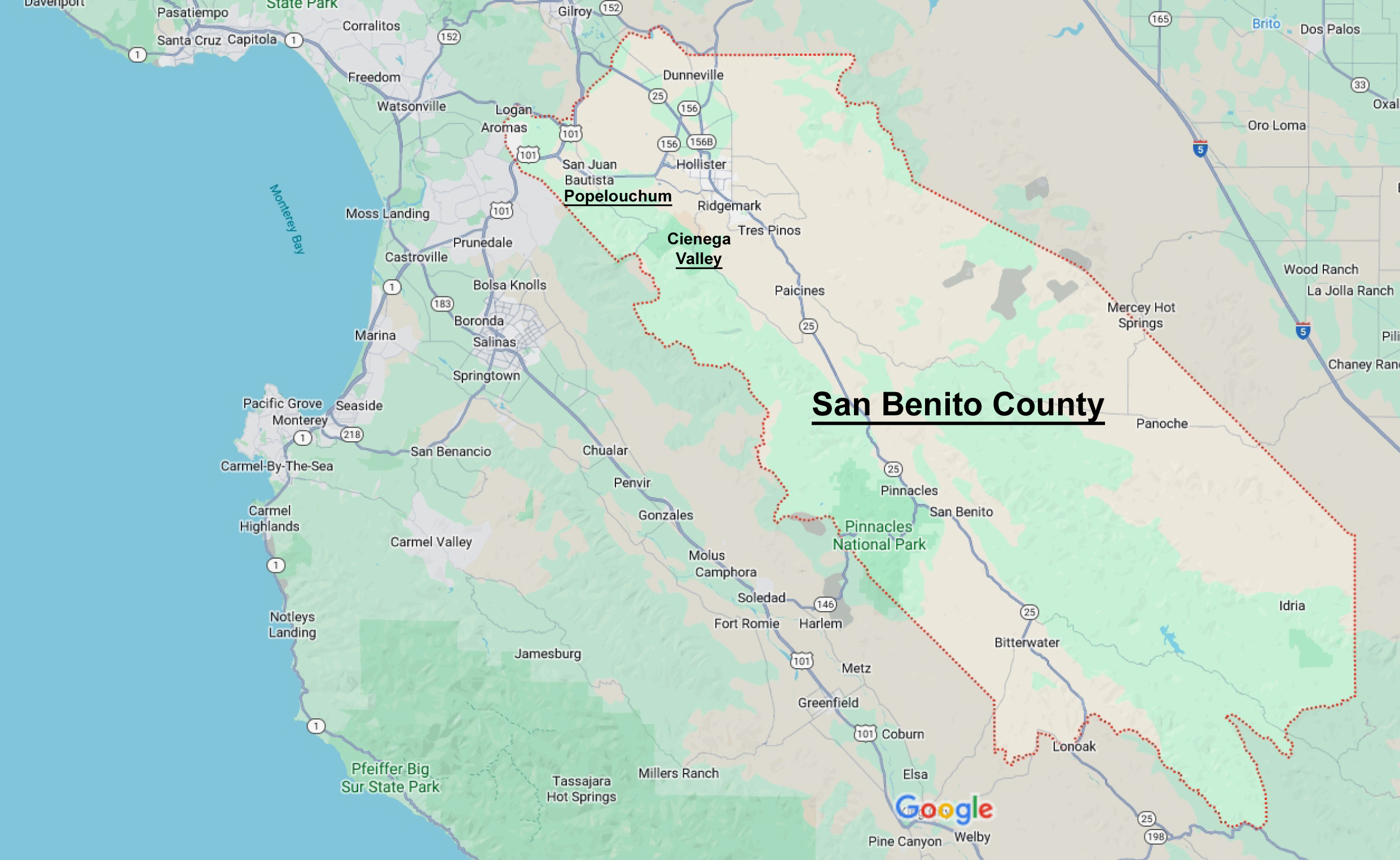
The first commercial winegrape plantings in San Benito County came around 1851, when Frenchman Theophile Vaché planted vines in Cienega Valley, at what are now DeRose and Eden Rift vineyards. William Palmtag purchased Vaché’s vineyard in 1883 and expanded it, adding more grape varieties. It’s been said that some vines planted in the mid-1850s remain at DeRose. Enz Vineyard, in the same area, may have first been planted as early as the 1880s, and some of those vines are still producing. Other vineyards that were initially planted by the early 1900s include Wirz and Gimelli (formerly El Gabilan). Wirz also has Riesling vines dating to the 1960s. Josh Jensen began planting his Calera vineyards in the Mount Harlan area in 1974. San Benito County’s vineyard heyday came in the 1970s when wine giant Almaden had extensive vineyards in the area. But that era didn’t last long for the region, and many of those vineyards are gone now. Newer plantings of note in the past 30-40 years include Siletto Family Vineyards, Vista Verde, and Paicines Ranch.
Popelouchum Vineyard
The first stop of our San Benito County wine tour was a short drive from the town of San Juan Bautista, meeting with Randall Grahm at his Popelouchum Vineyard. It’s a little tricky to find, but Randall had given me great directions in advance and then called me as we were about to enter the vineyard to let us know how to get to where he was. Once we found the right spot and parked, Wes, Stephanie, Larry, and I got out of the car and Randall welcomed us to the vineyard. Randall is one of California’s most legendary vintners, and he has a long history of being something of an iconoclast in the California wine world, so it’s no surprise that his current vineyard reflects that iconoclastic nature.
Randall was born and grew up in the Los Angeles area. He studied philosophy at UC Santa Cruz before returning to Southern California and taking a job at a wine shop, where he first experienced some of Europe’s great wines. He was especially enamored of Burgundy and began to think of making Pinot Noir in California. He enrolled at UC Davis and earned a degree there in 1979, and while there, he also visited Berkeley, where he discovered Kermit Lynch’s wine shop and tasted more wines from the Rhône and other French wine regions. By this time he was a firm believer in terroir and its key role in wine.
Not long after this, Randall was able to purchase property just outside of the tiny Santa Cruz Mountains hamlet of Bonny Doon, only a few miles from the Pacific Ocean. He planted mostly Chardonnay and Pinot Noir at this site, but he was disappointed with these wines and as early as 1983 he began to look at non-Burgundian grape varieties as an alternative. He purchased Syrah fruit that year, and the following year he also bought Grenache and Mourvèdre to make a California rendition of Châteauneuf-du-Pape, and voilà! Randall made his first “Le Cigare Volant” southern Rhône-style blend in 1984. One of the state’s original “Rhône Rangers,” he’s received numerous honors since then.
In the following years of Randall’s Bonny Doon wine label, he produced wines from a broad spectrum of grape varieties, some fairly common in California but many that were (and still are) considered esoteric varieties here. Production of the wines took off, and Randall spun off related labels such as “Big House Red,” “Ca’ del Solo,” “Cardinal Zin,” and “Pacific Rim.” As has been the case with a number of vintners whose production increases dramatically, he felt he was getting farther from what he loved doing, and he sold off his labels starting in the early 2010s, eventually selling the core Bonny Doon label at the beginning of 2020.
Randall could easily have enjoyed a relaxing retirement, but resting on his laurels would not have been his style. All through his wine career he’s looked for something new and different, whether it was unusual (for California) grape varieties, uncommon winemaking techniques, humorous labels that tell an interesting story, and the like. Though he certainly still pursues these facets of wine, in the past ten years or so he’s focused more on how grapevines are grown and propagated – working with distinctive methods of tweaking existing varieties and of creating new ones. This brings us to Randall’s Popelouchum project.
Popelouchum (pronounced pope-loh-SHOOM) comes from the name that the Native American Mutsun tribe gave to their land, and it’s also supposed to be word for “paradise” in their language. Randall purchased the vineyard property in 2012, and one edge of the site is right on the San Andreas Fault. The entire property is a little over 400 acres, and extends up and just over the hills to the southwest of where about 18 acres are currently planted. The climate at the vineyard site is relatively cool, and Randall compared it to the far northern part of Salinas Valley near the town of Chualar, where it’s cool and windy. Randall noted that the fruit from Popelouchum Vineyard tends to be particularly high in acidity, and the windy site may be a factor in this. The vineyard has a variety of soil types, including volcanic, granitic, and calcareous soil. The site doesn’t receive a lot of rainfall, and Randall said there’s not great access to water at the site as there’s no real aquifer below. The established vines do need some irrigation but Randall said it’s typically only once or twice in a growing season. In addition to the grapevines, he also grows olives, pears, apples, quince, and fava among other plants in order to foster biodiversity. Randall told us that he particularly loves quince, and said he wants to “make the world safe for quince!”
Grape varieties currently planted at Popelouchum include Grenache Blanc, Grenache Gris, Grenache Noir, Pinot Noir, Cinsaut, Ruchè, Roussanne, and Furmint. There are also self-crossed variants of Tibouren and both white and red self-crossed variants of Sérine (more on that later) plus “proper” plantings of Tibouren and Sérine. More varieties to be added include Cornalin, Nebbiolo Rosé, Schioppettino, Rossese Bianco, Timorasso, and Aligoté. These are particular favorite varieties of Randall’s and several of them are almost unknown elsewhere in California. The vines are farmed organically although the vineyard is not yet certified organic. There are cover crops planted between vine rows as well as native vegetation. Biochar produced at the site is added to the soil to help promote soil and plant health.
Randall talked with us about how his current projects can’t be fully figured out in advance, that it will be a process of experimentation to see what works and what doesn’t. For example, he loves sweet wines and has made a number of them in the past, and he wanted to make a botrytis-affected wine. He planted Furmint – the grape variety of Hungary’s renowned Tokaji Aszú sweet wines – around the vineyard pond near the low point of the property, hoping to help induce botrytis by the proximity, but it wasn’t working. So he grafted the Furmint vines to Petit Manseng but quickly found that he didn’t like the wine from it at this site – it was too acidic. The most recent development is that Randall had the Petit Manseng vines “decapitated” – he showed us where the earlier grafts were located near the base of the vines, and he’s hoping to promote sucker growth below the grafts to regrow the Furmint.
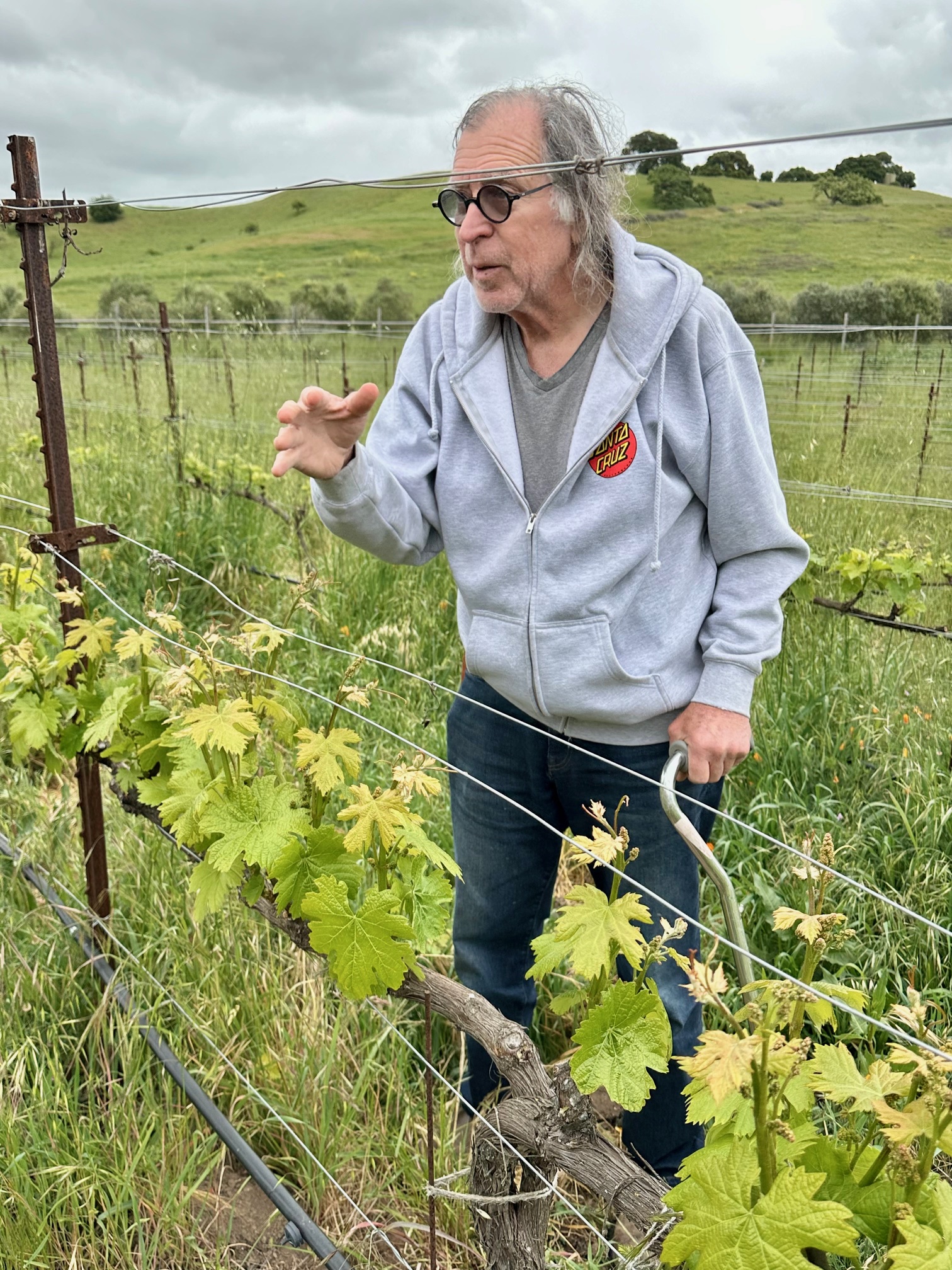
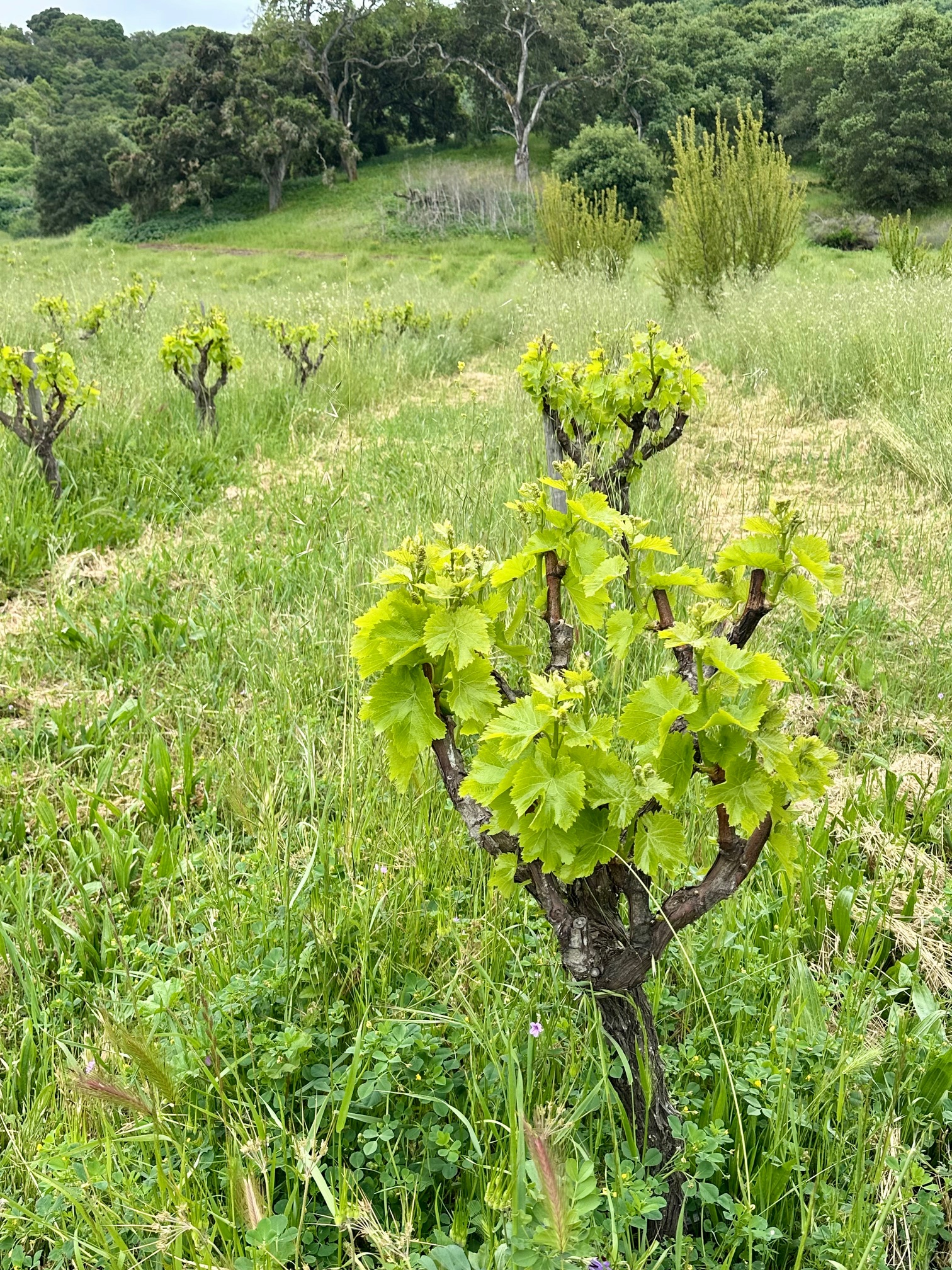
From the (hopefully) regrowing Furmint, we walked a short distance to rows of cordon-pruned Sérine vines, and Randall immediately began going vine by vine to clean up the early spring growth – and he soon had Stephanie’s assistance! Sérine is a variant of Syrah that originated in the Northern Rhône appellations of Côte-Rôtie and Hermitage. It has been shown to be genetically identical to Syrah, and though some believe that it’s a distinct clone of the variety, Randall has been told that it’s a virused strain of Syrah and he feels that this is most likely the case. Sérine can create a distinctive wine, different from that made from the typical Syrah clones. These vines are some of the “proper” Sérine plantings, as opposed to the self-crossed Sérine plantings elsewhere at the site.
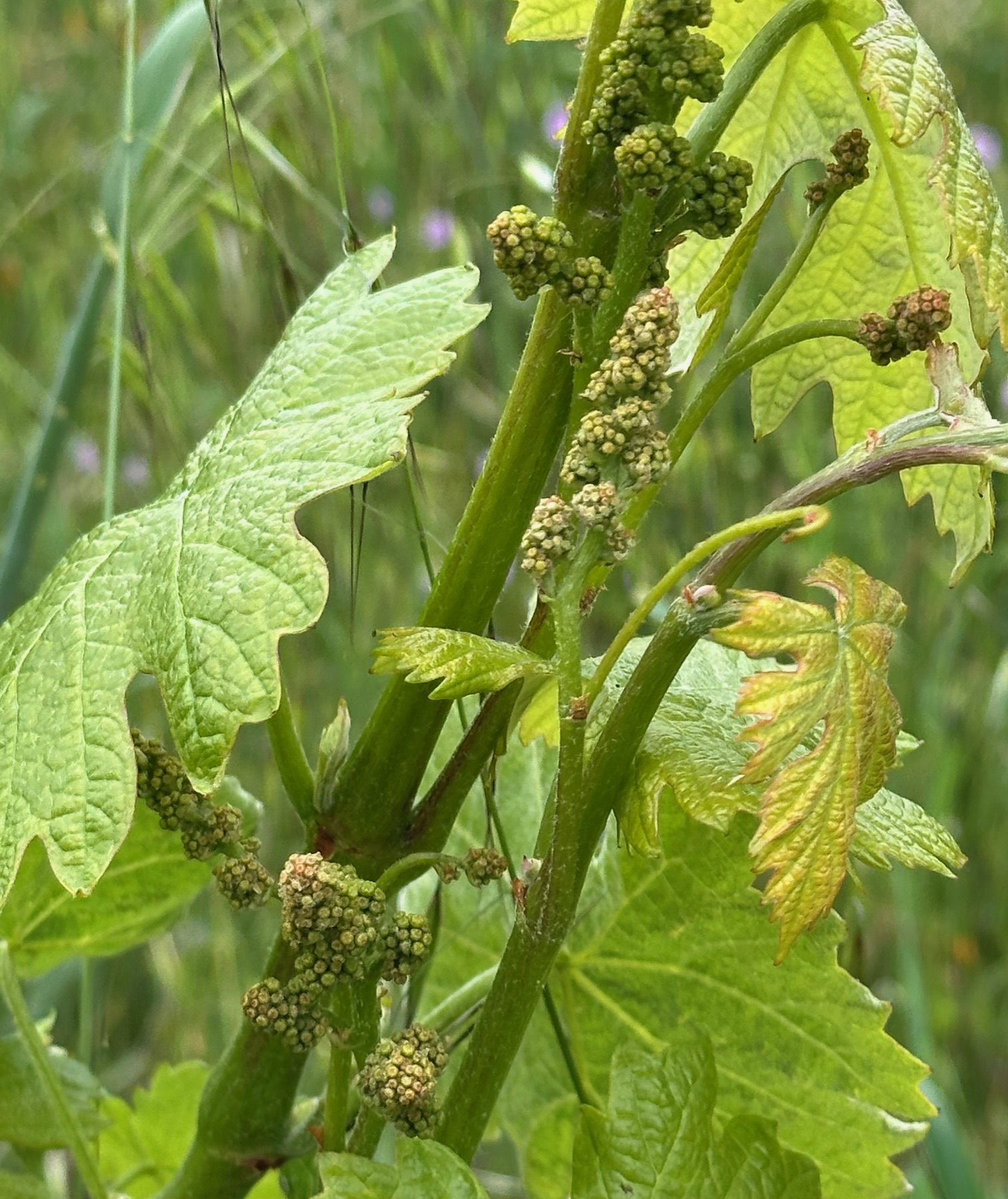
Producing self-crossed variants of Sérine, along with ones from a couple of other varieties, is one of Randall’s main projects at Popelouchum Vineyard. The aim is to produce new variants that will be different than the parent vine. Randall told us that his self-crossed Sérine has produced both red and white variants, due to the genetic parents of Syrah being Dureza (red) and Mondeuse Blanche (white), with the recessive white characteristic appearing in about 25% of the variants. The self-crossing method produces seeds that grow into seedling vines, which in time can then grafted to rootstock to be planted in the vineyard. Randall said that the variants produced in this way have been very inconsistent, and a fair number of them have not been usable at all, but this was not unexpected. Interestingly, Randall told us that any virus from the original vines is not passed along in the seeds produced from self-crossing. He feels that fruit from the whites has been particularly promising so far, with some displaying peachy character and others more peppery.
Randall has propagated 65 white Sérine variants that he had planted in 2023 and he’s recently done the same with about 65 red variants. His thought is that rather than trying to identify a single “best” variant, the combination of many of them in a field blend may result in a more interesting wine and will better express his vineyard’s terroir. Randall told us that vines grown from seeds using this self-crossing method take longer to become productive, so it’s taking awhile for this project to (literally) bear fruit. It will take another two or three years to compare wine from the self-crossed red Sérine variants to that from the basic Sérine planting. It’s planned that the self-crossed Tibouren will also be planted soon.
Another experiment that Randall is working on is crossing Ciliegiolo and Picolit – an Italian red and white – to create new varieties. He’s stated that his goal is to create 10,000 new grape varieties from this, although he knows that in reality the number will be far less. The result of the Ciliegiolo and Picolit crosses is expected produce an assortment of different varieties. Randall plans to have the mixed offspring vines planted in each of the site’s three distinct soil types – volcanic, granitic, and calcareous – to see how the vines respond to that and how the fruit may express the different soil conditions.
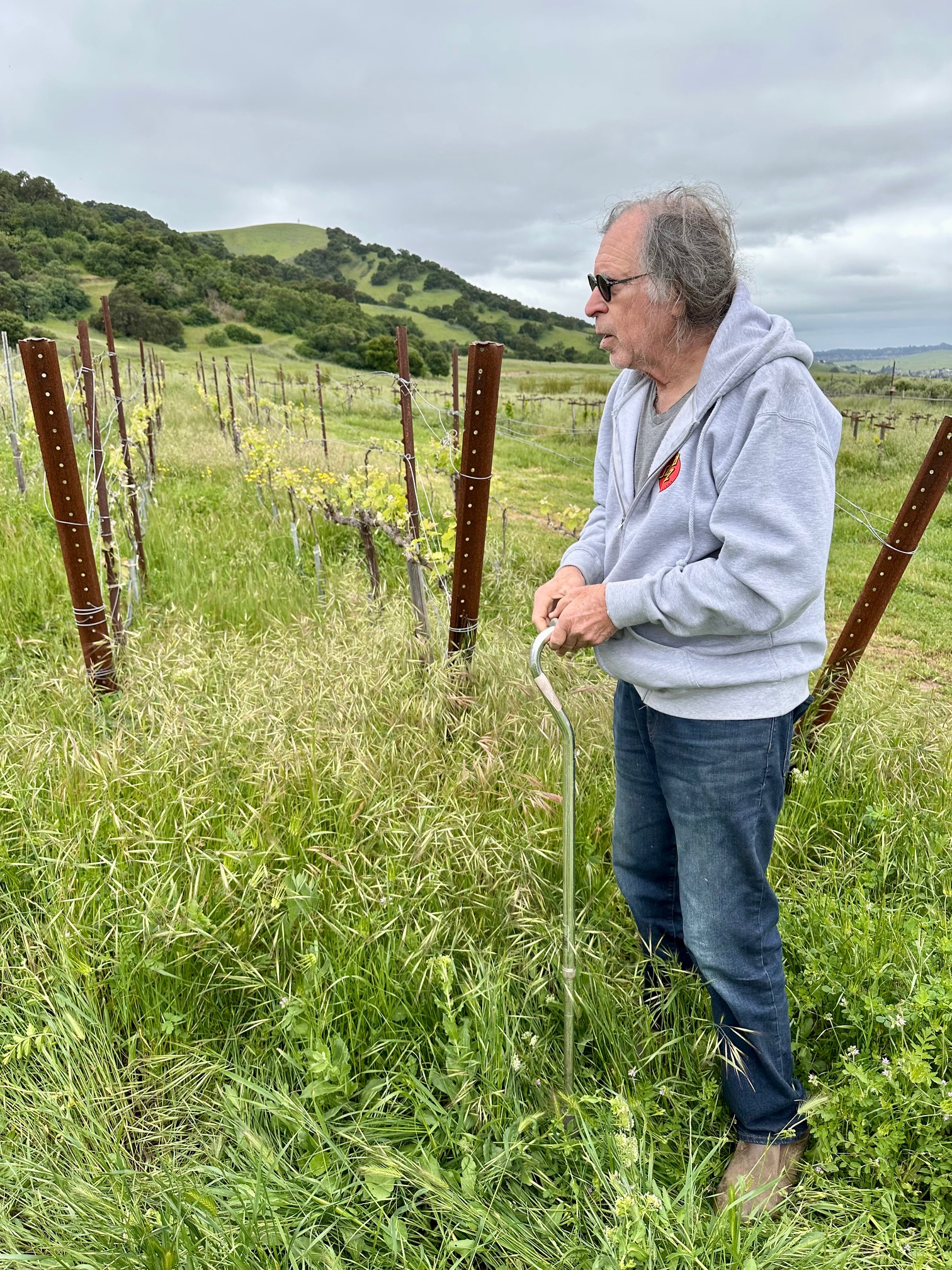
Randall wanted to show us another part of his vineyard, so we got back in the car and followed him to a spot where he led us to head-trained Grenache Noir, Tibouren, Ruchè, and Sérine vines. He told us that he loves the three-dimensional nature of head-trained vines compared with trellised vines. In addition to Grenache Noir, the Grenache Gris and Blanc are also head-trained. Randall said that turkeys especially like the Grenache Gris fruit, and since the “Popelouchum Blanc” bottling is a blend of Grenache Blanc and Gris, the turkeys have a big hand in determining the proportion of each in the blend! In addition to turkeys, other birds, gophers and ground squirrels, and – surprisingly – coyotes have been particular vineyard pests.
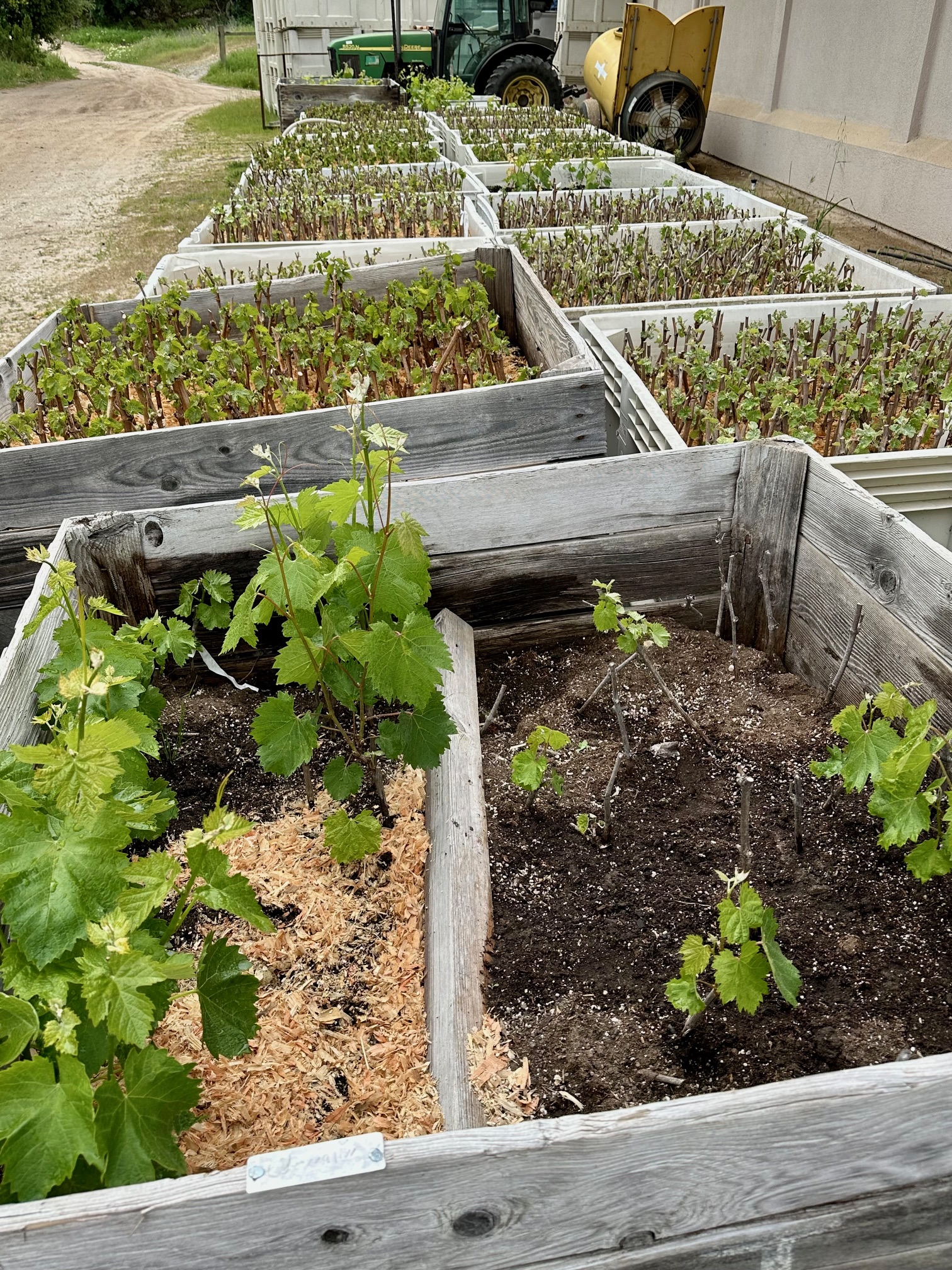
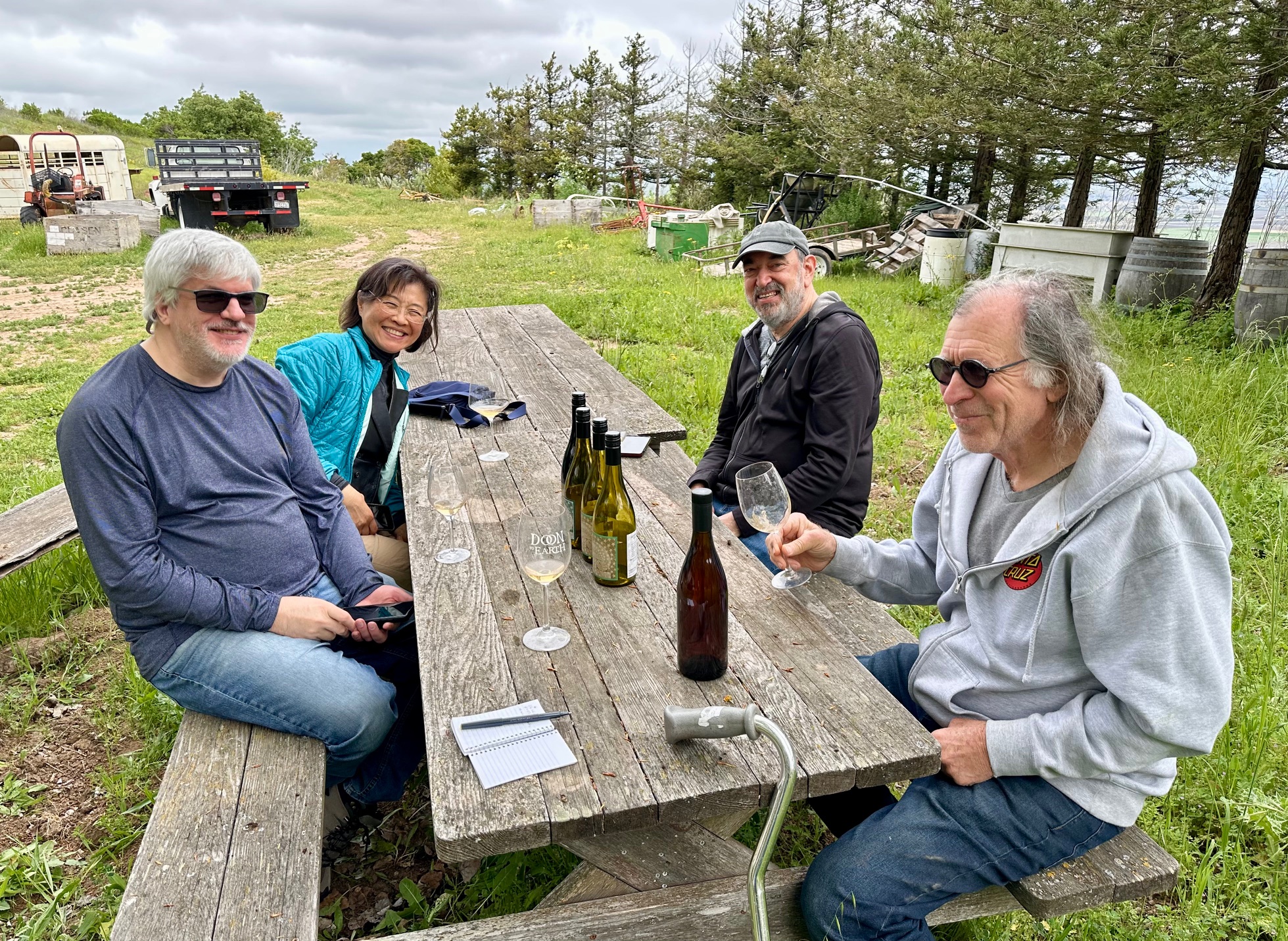
After looking at some of the head-trained vines, we continued in our cars to the vineyard barn up the hill. There we saw both vine cuttings being propagated from a number of varieties (Sérine, Aligoté, Timorasso, and more) and young seedling vines in planters that had been repurposed from old grape harvest macrobins. Randall led us to a picnic table under a tree and set out four wines that he’d brought for us to taste.
The white Popelouchum wines are usually made with direct press and no skin contact, though there have been exceptions to that. They’ve been fermented and aged in neutral French oak barrels. Randall likes to ferment his red wines with a percentage of whole clusters, and uses the labor-intensive “passerillage” method of carefully air-drying these clusters for three or four days after harvest, to lignify the stems in order to avoid a “stemmy” character and to manage the tannins. Most reds get from 50% to 100% whole-cluster fermentation, and recent Pinot Noirs have been 100% whole-cluster. All of the wines are fermented with indigenous yeast, they all go completely through malolactic fermentation so they can be bottled without filtration, and they’re aged in neutral French oak. Because the wines are fairly high in acidity, they require lower levels of SO2 to keep them stable and free of spoilage microbes. The wines are made at Chualar Canyon Winery in Salinas, and they’re all bottled under screwcap.
We started out with the 2021 “Popelouchum Blanc” – this is a blend of about 50% each Grenache Blanc and Grenache Gris, direct-pressed and co-fermented in neutral oak. This had subtle aromas of pear and stone fruit as well as saline and umami notes, with vibrant acidity and a persistent finish. We followed this with the 2022 “Popelouchum Blanc.” The blend is similar for this vintage of the wine, though the fruit came in somewhat riper than the 2021. Randall decided to give the fruit two hours of skin contact prior to pressing for this vintage. Showing a more upfront ripe stone fruit profile, this also had touches of spice, with a richer texture. Randall poured us one more white wine, the 2023 “Popelouchum Blanc,” which is about 60% Grenache Blanc and 40% Grenache Gris – the vineyard turkeys must have gotten to more of the Grenache Gris fruit that year! From this very cool and late-ripening vintage, the blend is back to a lower alcohol level (about 13% in this case) and like the 2021 wine it was direct-pressed with no skin contact. My favorite of the three vintages, the 2023 was somewhat reductive at first (it wasn’t racked until just before bottling) but opened up to display bright citrus and pear aromas along with savory herbal notes, and combining medium body with vibrant acidity and a long, lively finish.
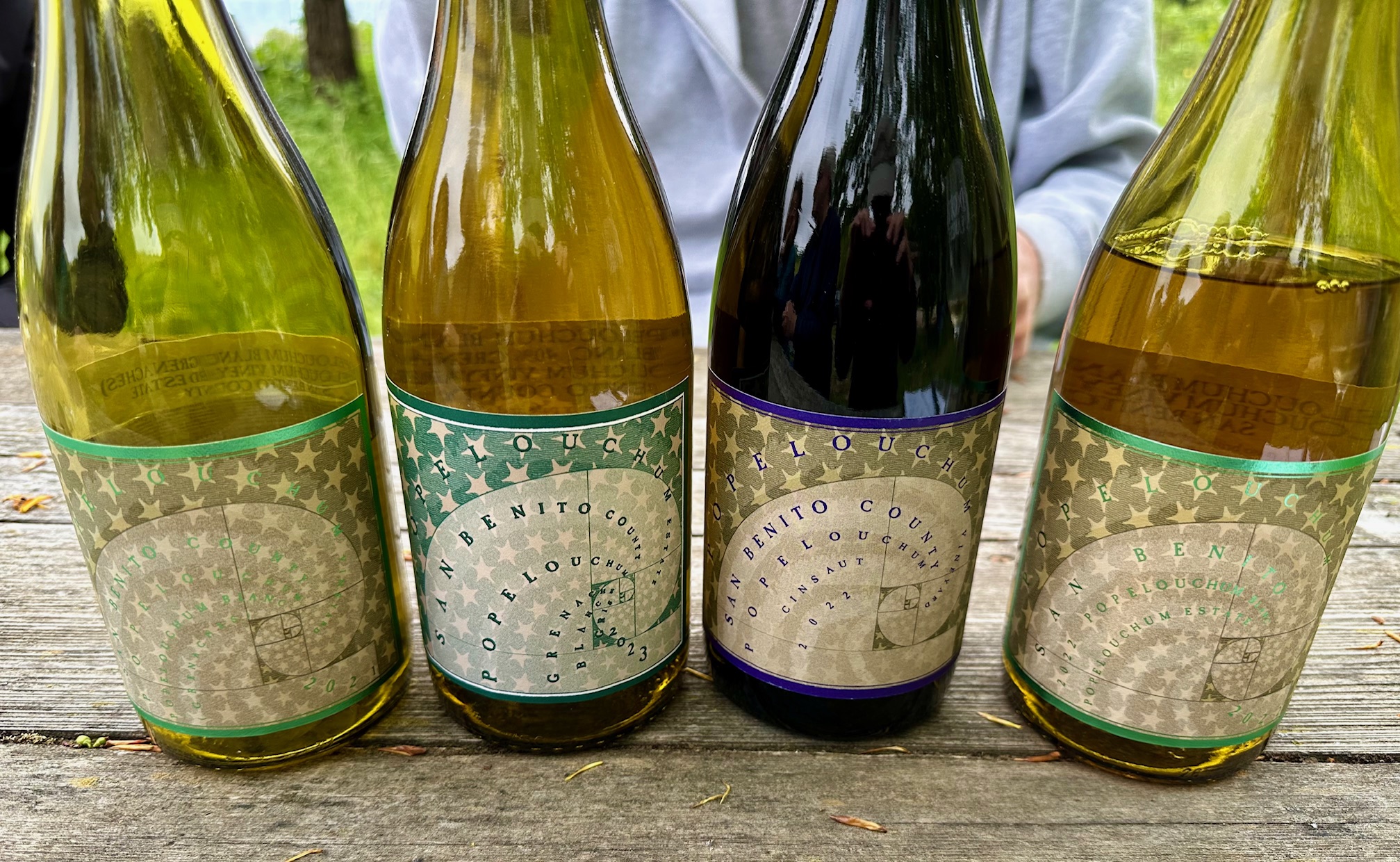
As we were tasting the white wines, Randall got up from the table and told us that he wanted to see if he had a bottle of another wine in the small cellar at the vineyard barn, and he returned a short time later with an unlabeled bottle. This was the 2024 Tibouren Rosé – it has not been commercially released, as Randall was able to make only about two cases of this wine in 2024! Randall feels that Tibouren is better-suited as a variety for rosé wine rather than red, and he plans to make more Tibouren Rosé going forward. Wow - this wine was a stunner! Herbal and umami-forward plus subtle strawberry and floral components as well as a saline note, with bright acidity and a long fresh finish. Hard to put into words adequately but I think everyone felt that this was our wine of the day. We finished up with the 2022 Cinsaut “En Passerillage.” Randall told us that Cinsaut is one of his favorite red varieties. The fruit was whole-cluster fermented after air-drying for four days, aged in neutral oak, and is only 12% alcohol. This was more fruit-forward, featuring plum and black cherry aromas as well as floral and earth notes, with medium-light body, lively acidity, and moderate tannins.
Subsequent to our vineyard visit, I was able to attend a small gathering for a tasting and conversation with Randall at Wine on Piedmont wine shop in Oakland. He poured a few wines that we didn’t taste with him at the vineyard, and I was able to re-taste some of the wines we did try there as well. We started out with an unreleased NV Sparkling Grenache Blanc / Grenache Gris. This was a blend from the 2018 and 2019 vintages, with extended aging in puncheon and then in bottle. Zippy acidity, with subtle aromas of ripe apple, apple skin, and herbs, with fine bubbles and a lingering finish. Randall also poured two vintages of Popelouchum Pinot Noir – there are twelve Pinot clones densely planted in a higher-elevation north-facing vineyard block. First was the 2022 “20.000 pieds/ha” Pinot Noir, with floral red fruit, fresh herbs, medium body and lively acidity – this seems like if could use more time to develop. The 2023 “Exuberance” Pinot Noir is already beautiful, with very floral aromatics, cranberry and strawberry fruit, a savory component, a bit lighter weight than the 2022 with great acidity and a vibrant finish.
Randall is hoping that he’ll be able to get the first commercial harvest of Tibouren, Ruchè, and “Sérine Blanche” this year. The first commercial wines from the vineyard were from the 2020 vintage. Current production is small, less than 1,000 cases, but Randall hopes that it can grow to around 5,000 cases after more vines are planted and start to produce fruit. Opening a tasting room may be in the future, though that does not yet seem imminent. Another possible future development is having a separate AVA approved for the area around Popelouchum, though this is also probably still a ways off.
I should mention Randall’s other wine project here. The Language of Yes focuses on wines from Rhône and southwestern French grape varieties, all sourced from Central Coast vineyard sites. Randall is partnering with Gallo’s Luxury Wine Group on this label. I tasted a few of The Language of Yes wines last summer and was impressed. The 2023 “Les Fruits Rouges” Rosé was made from mostly Grenache and Cinsault plus a little Tibouren, while the 2022 “En Passerillage” Grenache and 2022 “En Passerillage” Syrah, both sourced from cool-climate Rancho Réal Vineyard in Santa Maria Valley, each use the same process of air-drying grape clusters as the Popelouchum wines. For fans of Randall’s wines, The Language of Yes is another label to look for.
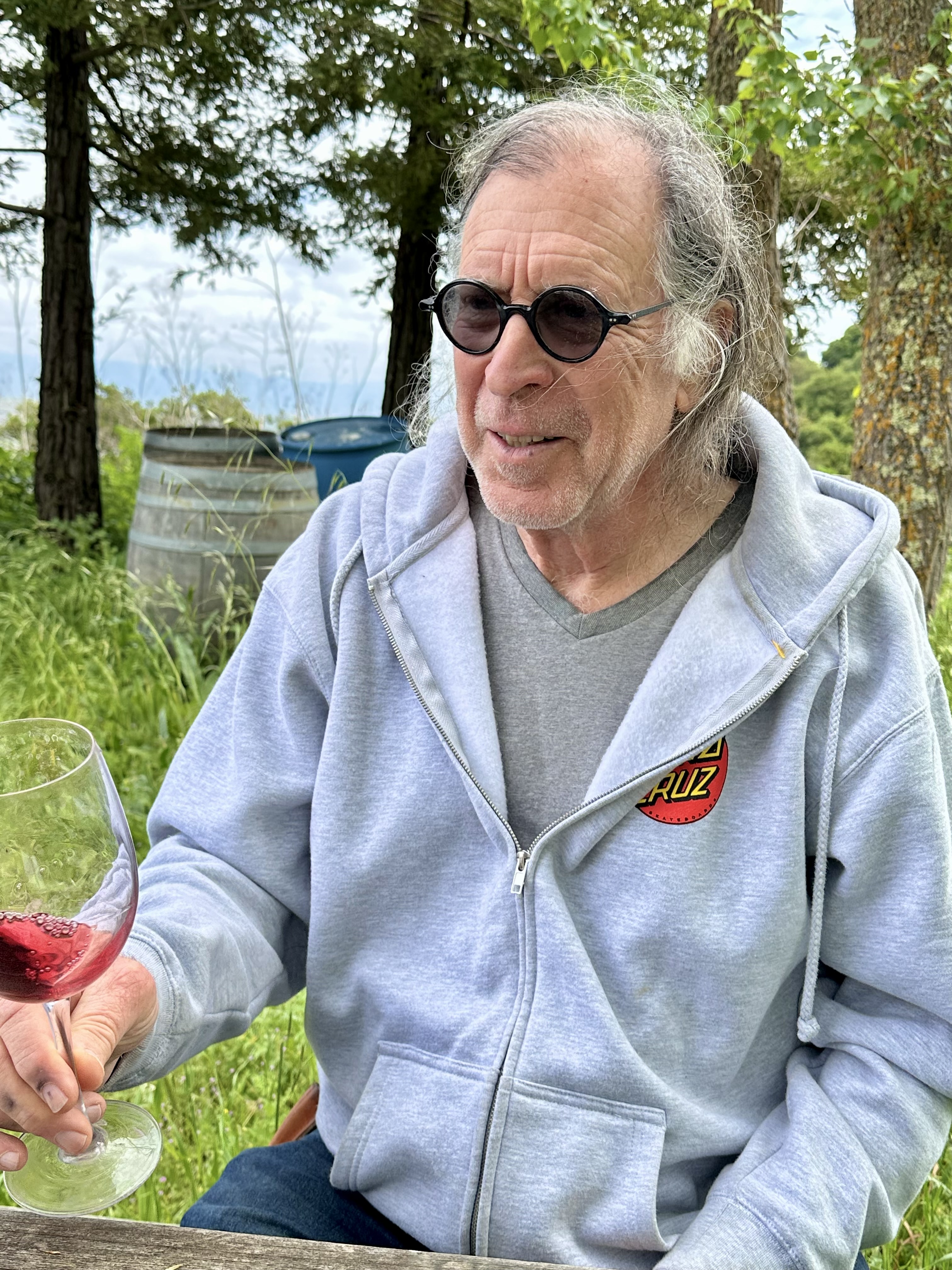
This was a memorable visit with Randall at Popelouchum Vineyard. I was very impressed that he’s continuing his search for terroir in California and is in the midst of several fascinating projects that push the envelope for how grapevines are propagated and grown here. Randall was a wonderful host at the vineyard – I certainly learned a lot there, and he kept us all very entertained as well. I really enjoyed all of the wines we tasted, and my favorites were the 2023 “Popelouchum Blanc,” 2024 Tibouren Rosé, and 2023 “Exuberance” Pinot Noir, while the 2021 “Popelouchum Blanc” and 2022 Cinsaut “En Passerillage” were not far behind. Though it’s still too early to tell just how Randall’s current work at the vineyard will turn out, we should start to see some results in the next few years. But as evidenced by the wines already being made from there, it’s certainly not too early to enjoy the wines of Popelouchum Vineyard.