Mark:
The wines sold for the following prices (including the 23% buyer premium):
1870 Mouton $13,530.00
1874 Mouton $14,760.00
1945 Lafite $3,936.00
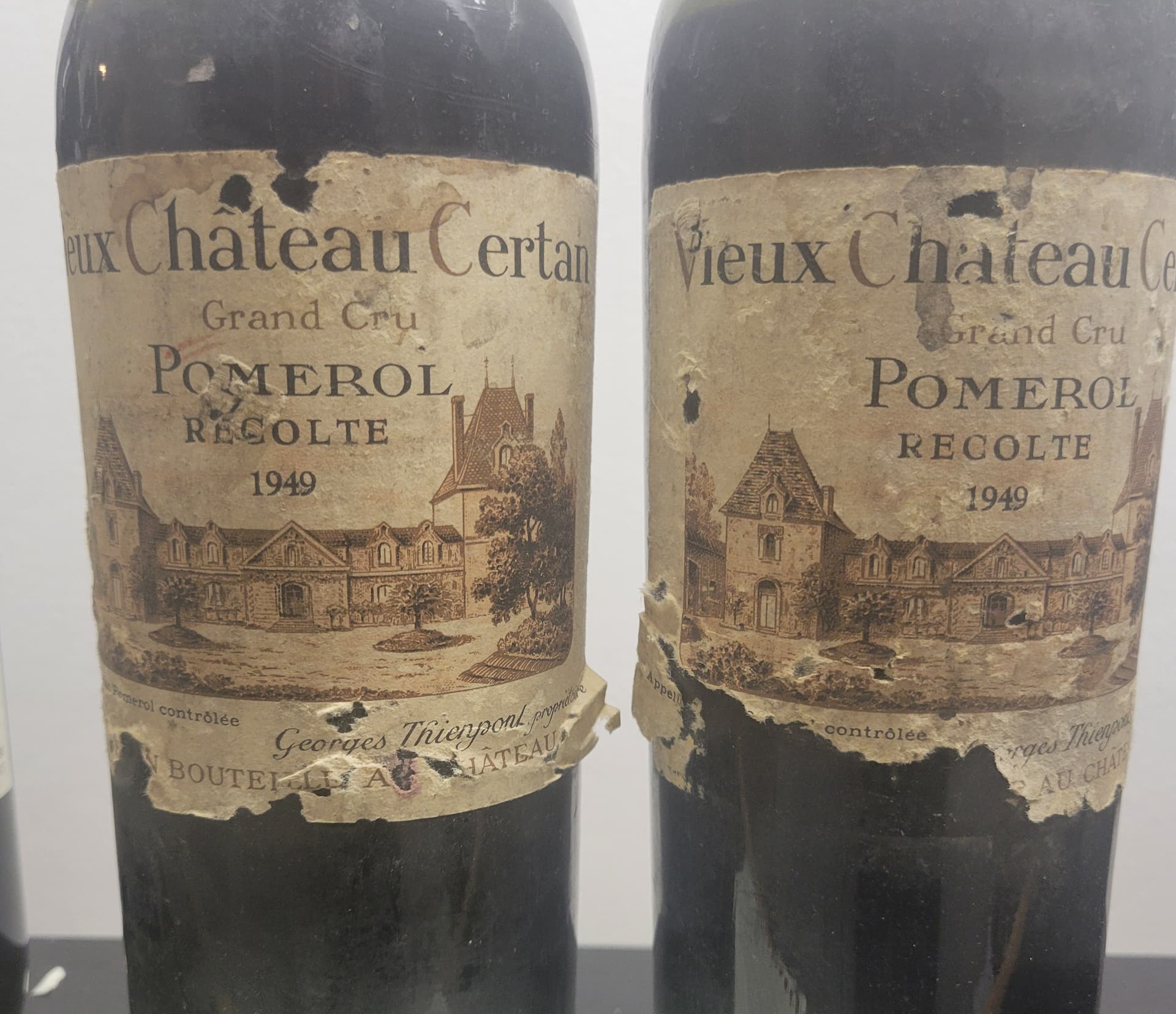
1949 VCC $2,152.50
Mark:
The wines sold for the following prices (including the 23% buyer premium):
1870 Mouton $13,530.00
1874 Mouton $14,760.00
1945 Lafite $3,936.00
1949 VCC $2,152.50
Well, as long as you drink the label instead of the wine, nothing to worry about!
I would guess that this is exactly what 99% of those that buy or drink those wines do. That includes the willing enablers of both Hardy Rodenstock and Rudy.
For some, they don’t even have to drink it. The satisfaction is in the ownership. With ancient bottles, there’s a significant risk that drinking them will burst the bubble when they turn out to be dead as a doornail. Especially those that have been around the block a few times,
I don’t think that number is close. There are certainly some who feel that just producing a bottle with a trophy label is enough, but I suspect most buyers are not interested in problem bottles, especially if they open them with people who have read this thread.
I wonder if that’s what happened here. Are the prices realized reflective of what bottles with perfect provenance sell for?
There is much about this auction, and the behavior of Heritage Auction in connection with this auction, that I find very disturbing.
When I see auction offerings with significant authenticity issues, my custom and practice has always been to contact the auction house directly and privately to point out the problem. Generally, I either seek to obtain further information from the auction house to help confirm the wine’s authenticity, or suggest further effort to verify authenticity, or suggest an appropriate correction in the lot description is needed. Sometimes the problems are significant enough to suggest that bottle does not meet the appropriate standards to be sold at auction as described and needs to be withdrawn. I only end up issuing warning posts here when that process fails.
Here, the private communication process failed. To summarize:
Three bottles from 1870 to 1945 were claimed to have been “reconditioned by chateau” with no supporting evidence – despite repeated requests to Heritage for disclosure of such evidence if it existed.
Heritage failed and refused to cut capsules on the three oldest wines in order to examine the corks to verify the claims of rebouchage by the chateaus and the existence of proper vintage-dated chateau corks.
Heritage failed and refused to address (or to verify the existence of) the apparent lack of a rebouchage back label on the 1945 Lafite Rothschild, which should be there if the bottle was reconditioned by the chateau as claimed.
The only evidence that the bottles had been recorked at all was that the capsules on the bottles were not original-issue capsules.
As pointed out here, but which was apparently undetected by Heritage, the capsule on the 1874 Mouton Rothschild, which sold for $14,760.00, was clearly not a capsule from Mouton Rothschild. So, less than 24 hours before the auction closed, the description of the wine was changed on the website from “reconditioned by chateau” to “reconditioned by Whitwhams.” (The bottle had an importer strip indicating it had been acquired from Whitwhams). This was nothing more than a supposition to try to explain the inconsistency between the non-chateau capsule and the claim that the bottle had been been “reconditioned by chateau.”
The consignor, who posted here, the former President of a wine importer in Dallas, offered no evidence to confirm that any of the bottles had ever been reconditioned by the chateau. Instead, he simply stated that the bottles were essentially as he received them following his father’s death in 2003.
The 1949 Vieux Chateau Certan was sold despite a significant question about its authenticity. I first contacted Heritage on August 13 to obtain high resolution photos of five lots, including the four described in my post (the photos were not then posted on the website) and to ask about the evidence that the three bottles described above had been “reconditioned by chateau.” I received a response from Heritage Wine Department director Frank Martell the following day stating in part: “We sent photos to the chateaux for authentication of course and we are still waiting on the ultimate green light, but the chain of custody is sound.” After forwarding a large number of photos of Vieux Chateau Certain from 1942 to 1961 to Mr. Martell (most of which came from two chateau-hosted vertical tastings), I ended up contacting the chateau myself. As reported above, Alexandre Thienpont, the director of the chateau, stated that he had never seen a bottle having both Récolte and 1949 on the same line and recommended prospective purchasers "not to bid on this lot.” So, here the implicit claim that Heritage would rely upon any opinion that they received from the respective chateau about authenticity has proven to be false.
With respect to the 1945 Chateau Lafite, I ended up sending to Heritage a copy of the Washington Post article and two other published articles describing the details of the Chateau Lafite recorking process and a series of photos from the contemporaneous time period showing the rebouchage back labels applied by the chateau when it engaged in recorking wines. I asked repeatedly whether there was any evidence of such a rebouchage label on the bottle offered by Heritage – and received no response. On August 18 I wrote an email to Mr. Martell stating in pertinent part: “Please answer my question rather than play the avoidance game. Does the bottle of 1945 Lafite have the back label regarding Rebouchage? If not, it is presumptively counterfeit (refill). [¶] If I don’t hear from you promptly, you will leave me no choice but to post a warning about these bottles.” In response, I received an email from Mr. Martell the same day which failed to address the question and stated among other things that: “this is not going to be a dialog” and that “Mr. Ivy, our C.E.O. has asked me to inform you in the strongest terms possible that we will turn this matter over to our attorneys if you defame Heritage or myself in any way to any third parties.”
I strongly suspect that the individuals who purchased the four “ancient” bottles in question were not aware of the problems listed in this thread and that they might have acted differently if they were.
The consignor coming on here to cry about besmirching his father and family’s name only to never to respond to any followup questions/comments was especially sleazy.
Sorry I missed this over the last week, such bad behavior from Heritage. I have a couple of 49 VCC, the labels support Don’s contentions.
Thanks, Don, for your insight. I was looking at the 1949. It is a friend’s birth year.
(I did not bid on it.)
10 posts were merged into an existing topic: Trolling posts moved from Rudy Kurniawan thread
27 posts were split to a new topic: Trolling posts moved from Rudy Kurniawan thread
So anyways, I definitely think the '49 VCC was a fake, and I wouldn’t have bid on the others, either.
I bet Audouze bought the old ones 
I agree with our post.
Thanks Don…for years of your hard works to provide your opinions. .
Peter Chiu
Thank you Peter (and Karl). It’s nice to know my efforts are appreciated by others.
Thanks for the reply - Don.
Much appreciated your reply…
Peter
Acker is going to auction a bottle of '45 Romanee Conti at the end of the month. Unless it came from the recent Drouhin cellar auction, I wouldn’t at all trust that it’s genuine.
The 45 is indeed one of the Drouhin cellar bottles
Yes, I remember that particular bottle with the typed label from the Sotheby’s Drouhin sale. The typed in date bothered me at the time (as I’ve never seen another one on 1945 Romanee-Conti), but I verified that it came directly from Drouhin as you see it and that they acquired it directly from the domaine as one of their distributors at that time. So, yes, that appears to be authentic.
But there are a couple of bottles in the Acker catalog that I saw which, based on the photos, are highly suspect in my opinion.
1978 Jayer Richebourg (Acker Lot 3410) - The label printing appears to be photocopied. (I owned 1978 Richebourg bought on release). There is obvious glue all around the vintage tag and Macon medal label. I wouldn’t touch this.
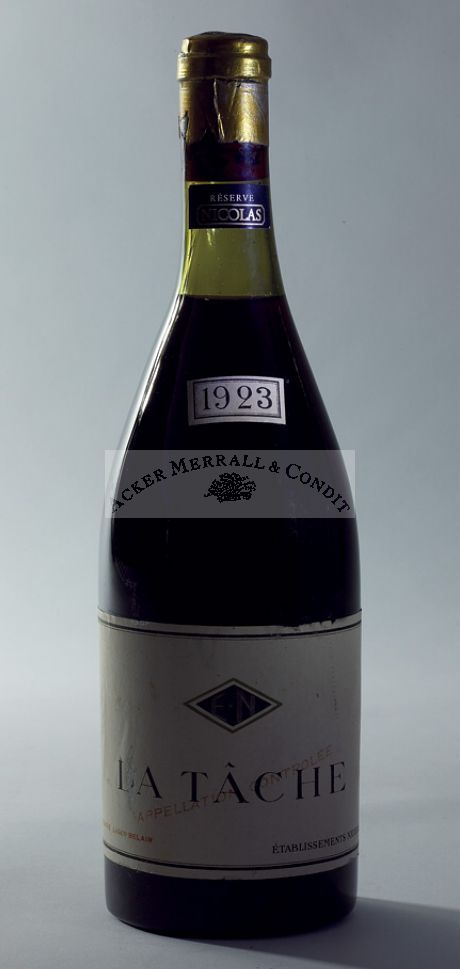
1923 La Tache (Nicolas bottled) allegedly from Liger-Belair (Acker Lot 3154). The introduction claims that Acker compared an empty bottle found at the Chateau du Vosne Romanee and found them identical. The catalog description makes no claims at all other than “bsl, tl, outstanding color and condition.” (Gee, where have I heard that description before for ancient bottles from Acker?)
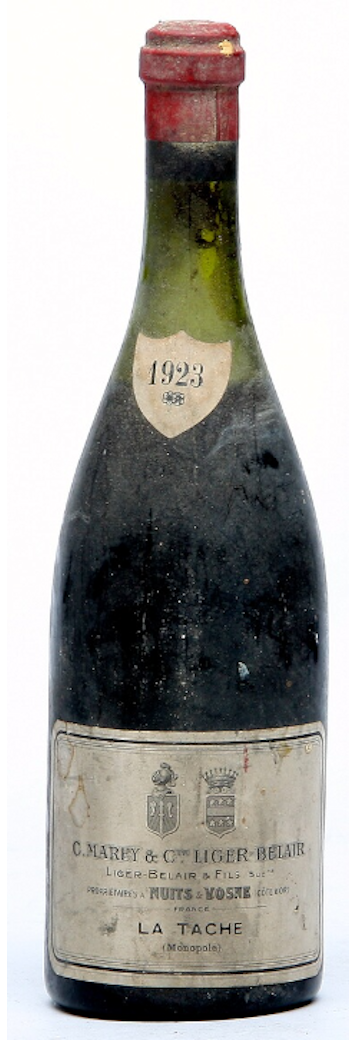
in 1923, the firm was known as C. Marey & Comte Liger-Belair. (The Marey family owned Liiger-Belair.) Their labels stated “C. Marey & Cte. Liger-Belair”. They had a distinct label. On the left side was a shield with armor helmet above it, on the right was different shield with a crown above it. I have seen many exemplars of their 1923s from different appellations, including one bottle of alleged 1923 La Tache offered by Bruun-Rasmussen auction. See below.
One interesting wrinkle is that in 1923, La Tache was a Monopole owned by C. Marey & Cte. Liger-Belair. Romanee Conti owned Le Gaudichots, which under the rules of the time could be sold as Le Gaudichots or as La Tache. After the family patriarch died in 1931, many of the C. Marey vineyards were sold in 1933, including La Tache. DRC bought their C. Marey La Tache vineyards. Near the same time DRC won a court case to be able merge its La Gaudichots vineyards into La Tache. Thereafter, all but three non-contiguous plots of Gaudichots considered to be only 1er level vines became part of La Tache under DRC’s ownership.
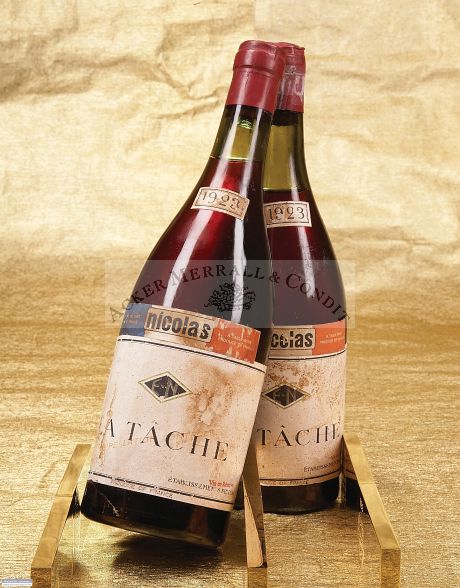
The 1923 La Romanee in the Acker catalog is allegedly from Nicholas. It is substantially identical to two bottles of alleged Nicolas-bottled 1923 La Tache previously sold by Acker which I believe to be counterfeits that were produced by Rudy Kurniawan and were sold to the two consignors by Rudy – Eric Greenberg (Golden Cellar Auction Lot 1094) and Robert Rosania (Acker April 25, 2008 auction – yes the auction where Rudy and Acker got caught selling counterfeit Ponsot (and Roumier and Rousseau). Both Mr. Greenberg and Mr. Rosania bought large quantities of wine from Rudy allegedly from the Nicolas cellars.
The bottles previously sold by Acker from Rosania and Greenberg, as well as the bottle in Lot 3154 all say “Appellation Controlee.” But there was no appellation controllee law in effect until 1936. Could the Nicolas bottles offered by Acker all have been labeled with an Appellation Controlee label sometime after 1936? Perhaps. But in addition to the above problems, the bottle in Lost 3154 has massive amounts of glue smeared onto the bottle around the main label and around the 1923 vintage label. These were glued on by someone, but were not originally applied in that manner.
Thanks for the post - Don.
Much appreciated…your above text and the names : Rosania and Greenberg bought back lots of old memories. Time flies…