MORE ON THE SEIZURE OF THE COUNTERFEIT SASSICAIA IN MILAN
This is not the first time that the Italian government has seized a substantial quantity of counterfeit Sassicaia, but it appears to be the most sophisticated such counterfeiting effort found to date. In 2000, the Italian government seized approximately 16,000 bottles of fake Sassicaia. But the level of sophistication of the earlier counterfeits was quite different. For example, on December 11, 2008 James Suckling of the Wine Spectator, wrote an article describing tasting a counterfeit Sassicaia at a friend’s house in Pisa. Drinking Fake Sassicaia | Wine Spectator As Suckling noted: “The big giveaway was the branded cork that didn’t have a vintage printed on it. And the bottle was a modern dark-green bottle with a long neck. The bottles of current vintages of Sass are not like that, and all of the recent vintages, as well as earlier ones, have the vintage printed on the cork.” Suckling was able to readily identify the counterfeit by comparison with known authentic bottles – the way that most counterfeit wines are detected.
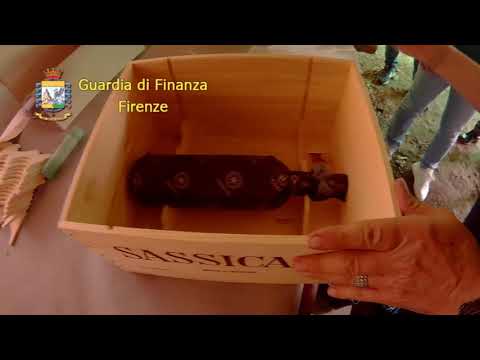
As to the newly seized bottles, the Florence police claim that the bottles, labels, corks, capsules, wood boxes, printed tissue paper, and even the printed security banding for the wood cases appear identical to the ones used on authentic Sassicaia. The video (link shown in my prior post) shows the wood-burned boxes (complete with vintage date on the exterior of the box), fully branded corks bearing vintage dates and counterfeit security banding used to seal the wood boxes. According to an article in Forbes, the counterfeiters “used perfect copies of the labels including original holograms and distinctive features.” Italian Police Bust Counterfeit Wine Ring Producing ‘World’s Best Wine’ As noted previously, Dario Sopranzetti, the spokesperson for the Florence Financial Police stated that “The bottles and the packaging were perfectly identical to the originals. Even the weight of the tissue paper was the same.”
Hopefully, Maureen Downey or Michael Egan will have a chance to perform a side by side comparison looking at the glass, paper, printing and inks to see if there are any differences that that the wine counterfeiting experts can discern.
But assuming that counterfeiters are able to produce wines with no visible differences from simple physical examination, that makes detecting counterfeits all but impossible for the trade. This should also be a four alarm fire warning to all of the producers of the highest priced wine brands, and to wine buyers who purchase high-end wine that the simple security bells and whistles that are currently being utilized like holograms, ink visible only under ultra-violet light, and printed banding can be, and now demonstrably have been, duplicated by the counterfeiters. In the case of 2015 Sassiacaia, this occurred on a wine which sells for $150 to $250 a bottle in Europe and $230 to $300 in the US. The level of attention being paid to anti-counterfeiting measures is not even close to what it needs to be to protect the brands that are the targets of the counterfeiters.