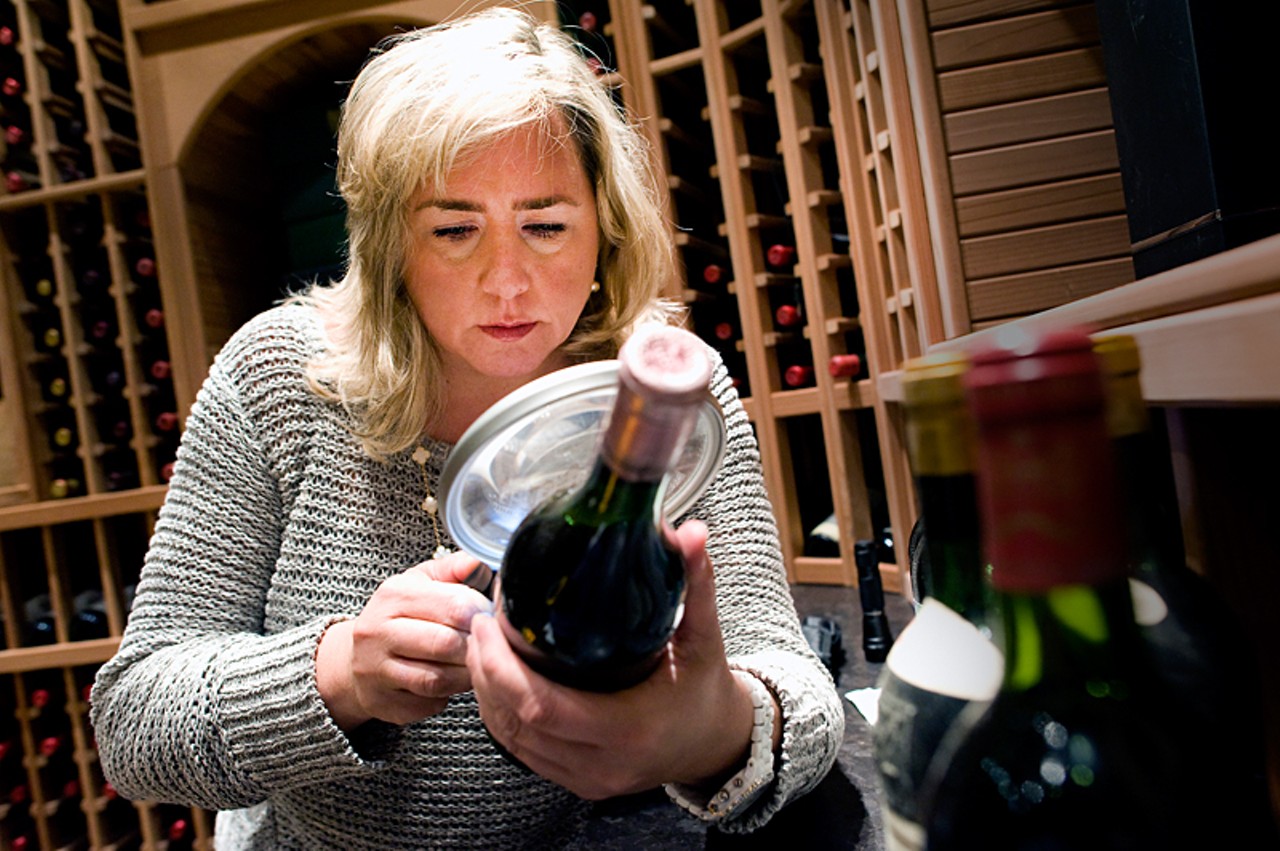
It is a little more complicated than that, but yes, most of the fake labels can be detected using a jeweler’s loupe or a microscope (fixed or portable) – it’s just not as direct as you think and the process of detection is a little more subtle/skilled.
My understanding is that all of Hardy Rodenstock’s fake labels were printed offset. Most of Rudy’s labels were also professionally printed on offset printers. However, as carefully explained and illustrated to the jury at Rudy’s trial by Michael Egan, Rudy created those labels by first scanning and digitizing pieces of existing labels and then creating a computer composite which became the basis of the fake label that was sent to an offshore printer, printed on offset equipment on paper bearing the Concorde watermark (from an Indonesian paper company), and shipped to Rudy.
Even though the bottles are printed on offset equipment, pixilization usually shows up in the printing from the scanning process.
I think there is a slight difference in the glass colors, but you would need to physically inspect the Madrigale bottle to be certain that it isn’t a difference in the color scaling on the photographs.
You are also correct about the visiblity of the glass seam, although that too could be the photography and lighting conditions.
However, there is something else I had in mind. I’ll leave the mystery for people to ponder for a while longer.
I’ll take a stab. The fake bottles have a very rounded, almost inward cut, lip on the top of the bottle. The real ones look as if near the top there is a very small but sharp outward edge to it. Simply put, the top edges are different.
This thread is one that rewards coming back to it again and again. Today’s treat aside from more great education courtesy of Don C: seeing a celebrity super somm hoisted on his own snarky social media petard. WBers can be a tough crowd, but Mike M really only got beaten up with his own words and he was the only one who was unprofessional, uncivil, and condescending in that Instagram thread.
I have to admit that you out-geeked me on this. You are correct and it is related to what I had in mind, but that wasn’t it either.
In 1970 and 1971 the magnums that DRC used had a slightly bulbous neck.
The fake magnums from the Christie’s auction have a conventional continuously tapering neck with very smooth lines. See the photo from the Christie’s auction catalog below.
But the legitimate magnums in the 1970 and 1971 vintages have a slightly bulbous neck. Starting about one inch below the lip of the bottle the glass curves outward a bit and then like an S curve on a train track it immediately curls slightly inward again. The glass continues almost straight down for approximately 1.25 inches before curving out towards the shoulder. These may not be the best set of photos to capture it because of the dark backgrounds, but take a look below. The side by side photos also demonstrate that the numerals on the neck labels do not match – particularly the 1s and the 7:
Now this is gonna get interesting! Don has already proven without a shadow of a doubt the Madrigale bottle is the btl from lot 117. Here is a full bottle shot from the same btl including what looks like a completely different foil then it left Christie’s with! This picture came from a staff member @ the restaurant the bottle was opened at.
According to K&L’s description, this bottle was purchased from The Chicago Wine Company during the 1980s. It has a 3cm fill-level with an exposed cork and a cut, oxidized capsule.
Oh, my. This is unbelievable. I double-checked to make sure that Lot 117 sold, which it did – for the low estimate of $24,000 (before premium) or $8,000 per magnum.
Maybe the bottles were rejected/returned as fakes by the buyer because of the Leroy capsules, or one of the other listed defects? And then Rudy took the bottles back and recapsuled them with Mise Du Domaine capsules and sold them again?
The one thing that seems clear is the importance of determining (a) who brought this bottle to Boulud; and (b) all of the details about that person obtaining the wine. So far, Rudy is the only known US counterfeiter from the 2010 time period who was recapsuling wines like this.
Don, my opinion is that this “new” capsual probably has nothing to do with Rudy. It has been taped onto after the fact as some one knew the btl was a fraud and the cut capsual had to go! It has been completely taped on! Yes if I was the collector I would be seriously talking to the person he bought the bottle from.
I’ve copied the photo below so we don’t lose it, for what it might be worth. It’s a low-res photo, so it’s hard to see the small details. The provenance is stated as:
Purchased from The Chicago Wine Company during the 1980’s. Stored in a temperature controlled home cellar in Northern California by a lifelong collector. Delivered to K&L Auctions by hand.
I particularly love the professional reviews, done 16 years apart. Speculation: the bottle Parker tasted was real, and the one Meadows tasted was Rudy.
95 points Allen Meadows - Burghound: > “Classic and very ripe mature burg fruit intermingles with a wonderful array of spices, especially anise and soy all of which are framed by a touch of caramel. The flavors are extremely rich, sweet and wonderfully concentrated with a deep, very sweet essence of Pinot finish that still retains glimpses of its former power. The tannins are fully resolved and the finish is nothing but pure silk and velvet. Tasted many times and while there is some bottle variation, well-stored bottles are consistently marvelous.” (10/2011)
90 points Robert Parker’s Wine Advocate: > “Very sweet, extremely alcoholic, yet also somewhat fuzzy and lacking precision, the 1971 La Tache is still an outstanding wine because of its voluptuous texture, and thick, juicy, succulent flavors. The color is nearly brown, but the nose remains intense and provocative. This wine is living on borrowed time as there is little grip or structure. Run, don’t walk, to guzzle this vintage.” (08/1995)
![[bye.gif]](/uploads/db3686/original/2X/9/984858d1d14f8b2f351499080ee63857219b69ad.gif "bye") LOL
LOL