And as my poker playing Dad used to say “Don’t show your hole card till all the money’s on the table”. I’m thinking Rudy needs to cut a deal if he has anything to deal with.
To help illustrate the difficulty in proving wine counterfeiting, here are my colleague Doug Barzelay’s comments on Mr. Kurniawan’s 1923 Roumier Bonnes Mares from his article entitled "The Rise and Fall of a Wine Counterfeiter,” June 18, 2012 (THE RISE AND FALL OF A WINE COUNTERFEITER | Old Vine Notes):
- Had it not been for those bottles of Ponsot Clos St. Denis that never existed, Rudy might not be sitting in jail today. Wine fraud is extremely difficult to prove, and often a matter of expert opinion in an arcane field, hardly the stuff a prosecutor likes to take to court ( it was only after Rudy was arrested that the search of his home turned up “smoking gun” evidence that showed he was actively manufacturing fake bottles). What brought him to make these particular bottles? His imprecise knowledge of Burgundian history had come close to tripping him up at least once before, when he offered for sale bottles of ’23 Roumier Bonnes Mares—the domaine was founded in 1924—but he, or someone, dreamed up the un-disprovable story that because the domaine’s plot of Bonnes Mares had come as a dowry from Georges Roumier’s wife in 1924, it was also possible that her dowry included a yet-unbottled cask or more of the prior vintage’s wine as well. Unlikely, but given that the domaine had no records from that era, and the principals were long dead, not disprovable.
In that same article, Doug recounts the story of the Roumier authentication tasting held on January 14, 2007 in New York as follows:
- When “The Cellar” sale at Acker took place in January 2006, it seemed natural to me (though apparently not to others) to wonder whether this amazing flood of Roumier, Rousseau, etc. could in fact be real. Here were wines produced in miniscule quantities, of which I had seldom seen more than single bottles despite many years of searching, now available in case+ quantities. Thus, the six-month unconditional guarantee that Rudy offered seemed to provide a good opportunity to test my and others’ doubts. As my good friend Don Stott had bought a substantial number of the Roumiers and Rousseaus, he and a group of us hatched the idea of putting the Roumier bottles to the test–and of inviting Christophe Roumier to join us.
Before that tasting could take place, the October 2006 Cellar II sale occurred, and that sale raised further doubts about how so many of these ultra-rare bottles could suddenly have surfaced. . . .
Three months later, in January 2007, the long-planned Roumier tasting finally took place, and the delay allowed us to include some additional bottles that Don Stott had purchased in the Cellar II auction. Christophe Roumier participated in the tasting, as did Allen Meadows, Tim Kopec and other tasters with long experience of Roumier wines. In all, we tasted 15 bottles of Roumier (6 Musigny, 8 Bonnes Mares and 1 Amoureuses), of which 11 had been purchased from the two “Cellar” auctions and 4 from other sources. Other than with respect to one bottle, there was no difference whatsoever in the conclusions of the tasters. Of the bottles sourced from the two “Cellar” auctions, 3 were clearly authentic—and superb–6 were clearly fraudulent, one was corked, and one was probably but not clearly fraudulent. Among the wines deemed fraudulent was a bottle of the ’59 Musigny, which had aroused our skepticism the prior October, as well as the ’55 Musigny (two bottles were tasted), clearly a wine from grapes grown well south of Burgundy, and the ’45 and ’29 Bonnes Mares (the latter also not a Pinot Noir).
According to Doug, Christophe Roumier and the other people attending the tasting unanimously agreed that the 1923 Roumier Bonnes Mares was counterfeit. (I am unclear as to whether there was any discussion that evening about the fact that Roumier did not produce any Bonnes Mares from Domaine Belorgey’s vines until 1952.)
To my surprise, Allen Meadows admits to having tasted the counterfeit 1923 Bonnes Mares three times, including at the January 14, 2007 authentication tasting. But Mr. Meadows’ notes do not reveal his opinion that the wine was counterfeit and, even more amazingly, he rated the counterfeit 1923 tasted at the authentication tasting at 93 points:
-
1923 Bonnes Mares 750 ml
Tasting note: (noted on the label as Ancien Domaine Belorgey; the story behind this wine is that when the Domaine was founded, apparently certain barrels of '23 that were in the acquired cellars were bottled under the Roumier name - there is no incontrovertible proof of this however). An expressive and potent nose that combines notes of lactic and volatile acids, sous bois, earth, spice and tertiary aromas precede rich, full and robust flavors that possess plenty of sweetness and mouth coating velvet on the long and silky finish that is slightly marred by just a touch of acidity poking through. This is really in fine shape and is a lovely if not truly profound example. (Note however two other bottles were marred by fairly strong volatile acidity and both possessed unusually deep colors and heavy, sweet and mocha-infused finishes, atypical even by the standards of a very ripe vintage at 80+ years of age. It’s possible that these bottles had been reconditioned, and not deftly, at some point in their evolution). Tasted: Jan 14, 2007 Score: 93 Drink: Now+
Given that Kurniawan is clearly a very gifted faker when he wants to be(something, in fact, not so difficult if the material and the curiosity is there) one wonders if even the other august tasters were fooled as AM was. As has been pointed out it is the height of absurdity to think that a wine can be authenticated by tasting alone, nor matter how experienced the taster.
What’s striking is how suggestible people are in believing the fantasy stories (a ‘reconditioned’ bottle in particular is a great plausible smokescreen) over the more likely reality that the wine is fake.
Knowing the players involved, I doubt they viewed this as a major problem.
Don, Are you saying that people like Aubert du Villaine could be forced to appear for deposition? Even if this took place in France, I think such people would consider this as an insult. I don’t know how concerned M. du Villaine is about all this, but like we discussed, another Burg producer did not seem disturbed at all by known counterfeits of his wine and didn’t seem to want to waste time talking about it.
Phil – I don’t believe their testimony can be compelled abroad. This would be voluntary, and presumably with defense counsel present to cross-examine them.
Don - Was the January 2007 authentication tasting done blindly? That seems like a key fact.
Here’s a link to a NYT story about the 2007 authentication dinner. It doesn’t seem as if the writer actually attended the dinner. Meadows is quoted as saying 3 of the 17 wines served were clearly fake. I’m guessing that the wines were tasted unblind, but any actual participant can quickly clear up this question. http://www.nytimes.com/2007/03/14/dining/14pour.html?pagewanted=all
ADDITIONAL INFO ON THE JANUARY 17, 2007 ROUMIER AUTHENTICATION TASTING
Doug Barzelay confirms that yes there was considerable discussion that night of the fact that Roumier did not have access to any vines from Domaine Belorgey until the 1950s. Thus, everyone in the room knew to a certainty that the wine was counterfeit.
This makes Mr. Meadows’ failure to mention that the 1923 Bonnes Mares was counterfeit, as confirmed by Christophe Roumier at the tasting, even more difficult to explain. The same is true for the 93 point rating. It would seem that either his tasting notes should have clearly disclosed that the wine was counterfeit, or he shouldn’t have reviewed the wine at all. As Dan Collins has rightly figured out, there is a fundamental inconsistiency in Mr. Meadows statement quoted in the New York Times that 3 of the 17 wines tasted were fakes versus Doug’s statement in his article:
- Other than with respect to one bottle, there was no difference whatsoever in the conclusions of the tasters. Of the bottles sourced from the two “Cellar” auctions, 3 were clearly authentic—and superb–6 were clearly fraudulent, one was corked, and one was probably but not clearly fraudulent.
Doug has repeatedly assured me the statement in his article is correct and all were in agreement that the 1923 was clearly counterfeit (and the information from Christophe Roumier left no room for doubt.)
There was some extended discussion last June in this thread about Mr. Meadows’ posts about the wines tasted that night, including the fact that he substituted a review of a different bottle of 1945 supplied by Christophe Roumier and consumed on a different date for the counterfeit bottle of 1945 served at the authentication tasting. One can’t help but wonder if his then-friendship with Rudy Kurniawan didn’t get in the way of accurate disclosure of what happened.
Doug also pointed out that the group at the tasting also had some discussion about the following item (again quoting directly from Doug’s article on his Old Vine Notes website):
- The high number of fraudulent wines was clearly disturbing, but what was in a way more disturbing was the apparent randomness of the bottles deemed authentic. The labels on the fraudulent bottles were surprisingly pristine for wines that were ostensibly 50-85 years old, and there were other label and capsule issues; however, the authentic bottles looked much the same (in other words, in this case it wasn’t that the fakes looked real; rather, the real bottles looked fake). Also, most of the bottles we drank, fraudulent and genuine, had been pulled at random from a larger quantity of the same wine that had been purchased. What to make of this? Our supposition was that in order to remove whatever doubt the new and questionable labels might have engendered, the authentic bottles Rudy had served at tastings were given the new labels as well. For example, a bottle of ’62 Roumier Musigny with a pristine-looking label would naturally raise some questions. But if you serve a real bottle onto which you’ve applied the same pristine label, then you can overcome many of the suspicions that such a label would otherwise raise. All that needs to be added is a story about why the labels are so new-looking (one version I heard was that the bottles had been stored in the Nicolas cellar outside Paris since release and that because the original labels had deteriorated, they had all been re-labeled prior to sale.) Yet there must have been some way for the forger to tell which bottles were authentic, and could be served, though we were in our examination unable to discern what that was. Also, assuming there was indeed some inconspicuous way of telling good from bad, then Rudy would have been able to reach into a case and, seemingly at random, pull out a bottle that could be opened and “prove” the authenticity of the remaining inauthentic bottles.
John:
Doug responded to your question as follows:
- The 1/07 authentication tasting was most definitely not a blind tasting. The whole point was to bring the knowledge and experience of the tasting group fully to bear on the question of whether what was in the bottle was what the label said it was: given one’s prior tasting experiences with '45, with Bonnes Mares, and in the case of many in the room, with authentic, from-the-cellar bottles of 1945 Roumier Bonnes Mares, does this purported 1945 Roumier Bonnes Mares taste like (1) 1945; (2) Bonnes Mares; or (3) Roumier? (The answer was no.)
A fabulous blog piece by Doug Barzelay. I have never met him but we have several mutual friends. He is a real lover of Burgundy and smart cookie. Great job Don with all of this. Thanks for keeping us informed here.
Don, is there a link to a new blog piece by Doug?
perhaps Don is referring to this:
That’s correct. The beginning point was the government’s letter to the Judge explaining what Christophe Roumier would testify to at the trial. I then fleshed out the details about the counterfeit 1923 Roumier Bonnes Mares from Doug’s June 18, 2012 blog piece.
Thanks so much for your diligence,I’ve been on the email list for spectrum for several years,but have never purchased from them. I would have had no idea or to stay away from this auction,and did have several lots I was interested in!although most were Rhine Rangers and a smattering of German wines,but armed with the information you have provided,it’s seems that one would have to have masochistic tendencies in order to take such a risk.
Once again,thank you for providing the lowdown on these lowlifes.
Rick
Don,
Based on my past experience, what the tasting authenticated is that they were excellent Burgundy from the correct period. I am not quite sure whether anyone can authenticate the wine being the 45 Roumier BM.
BTW, the latest Christies NY auction has a magnum of the 62 La Tache with wax capsule.
Kevin:
Thanks for calling this bottle to my attention. Your suspicions were correct. Despite a relatively poor photo in the catalog, in my opinion, this bottle is unquestionably counterfeit and, moreover, it’s apparent it’s a bottle created by Rudy Kurniawan because the defects are identical to bottles he sold at Christie’s Auction on April 27, 2007.
Here is the best photo I can download of the main label of Lot 1243 of the upcoming Christie’s Finest and Rarest Auction to be held on May 31, 2013 in New York:

Here is a link to a full sized photo of this magnum: http://i1049.photobucket.com/albums/s385/doncornwell/Christies%20Auction%2005-31-2013/1962LaTachefromChristiesNYMay312013_zpsffcf621f.jpg
For those of you who recall the posts about the problems with the bottles in the Spectrum/Vanquish auction, some of the following problems the following should be familiar:
-
The Aigu on Propriétaire shouldn’t be there on a 1962 vintage wine.
-
The circumflex over the A in La Tâche shouldn’t be there on a 1962 vintage wine.
-
The spacing on the word Appellation appears slightly too cramped–particularly between the initial “A” and the first “p.”
-
The Appellation Controlée Line is somewhat miscentered under La Tâche --being indented more than a quarter inch on the left and extending to the end of Tâche on the right.
-
The washed out four digit bottle number (0001 or 0601?) doesn’t quite align horizontally or vertically; the font doesn’t match other exemplars of 62 La Tâche either -
The "62" on the vintage date on the main label doesn’t align with "19" horizontally or vertically. -
Very uneven ink on 26,740 Bouteilles -
The printing on the first two lines of the main label appears smeared and darker in some areas and lighter in others
Compare the above with the following photo of the main label of a magnum of 1962 La Tache from the Grunewald Auction in October 2008:

Here’s a link to a full page photo of the 1962 La Tache magnum from the Grunewald auction:
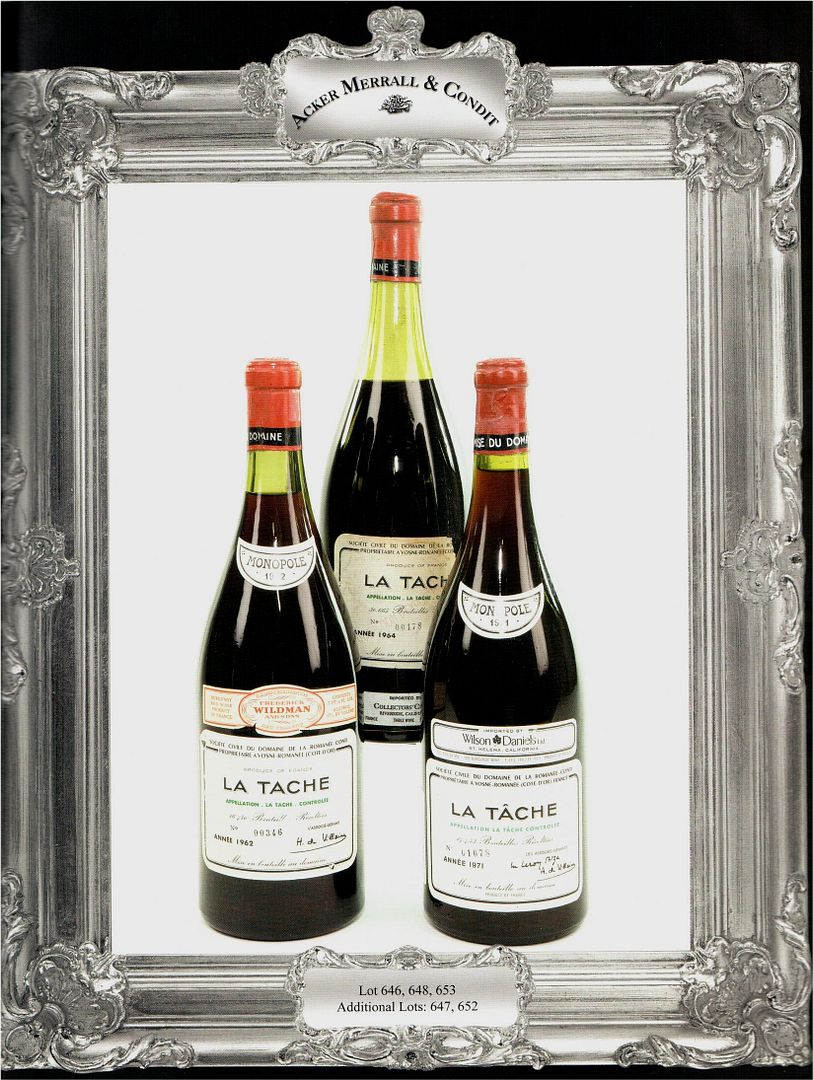
Notice that the Grunewald magnum has no Aigu on Propriétaire and no circumflex over the A in La Tâche. The spacing on the word Appellation is appropriate and the green-colored AOC line is centered under the block La Tâche. The vintage date and bottle number properly align and the printing has consistent density across the label.
Even ignoring that the Christie’s bottle has a four digit bottle number, non-original short red wax capsule, the apparent defect in the glass in the upper part of the bottle neck and possible issues about the double-line border on the neck label, Lot 1243 in the Christie’s auction is an obviously counterfeit bottle. One must ask how Christie’s could have included the bottle in the catalog in the first instance, let alone after including a full page photo of the bottle.
It’s also apparent that this counterfeit magnum of 1962 La Tache originaled from Rudy Kurniawan because the defects are identical to several of the pre-1978 DRC bottles in the February 2012 Spectrum/Vanquish auction and in the April 27, 2007 Christie’s Auction in Beverly Hills. (Yes, that is the same auction which had magnums of 1982 Le Pin on the cover which were withdrawn at the request of the Chateau because they were counterfeit.) Here is a photograph of one of the main labels of a case of purported 1962 La Tache sold by Rudy Kurniawan in the April 2007 auction:

Here is a link to a full-sized photo of Lot 87 of the April 27, 2007 Christie’s auction:
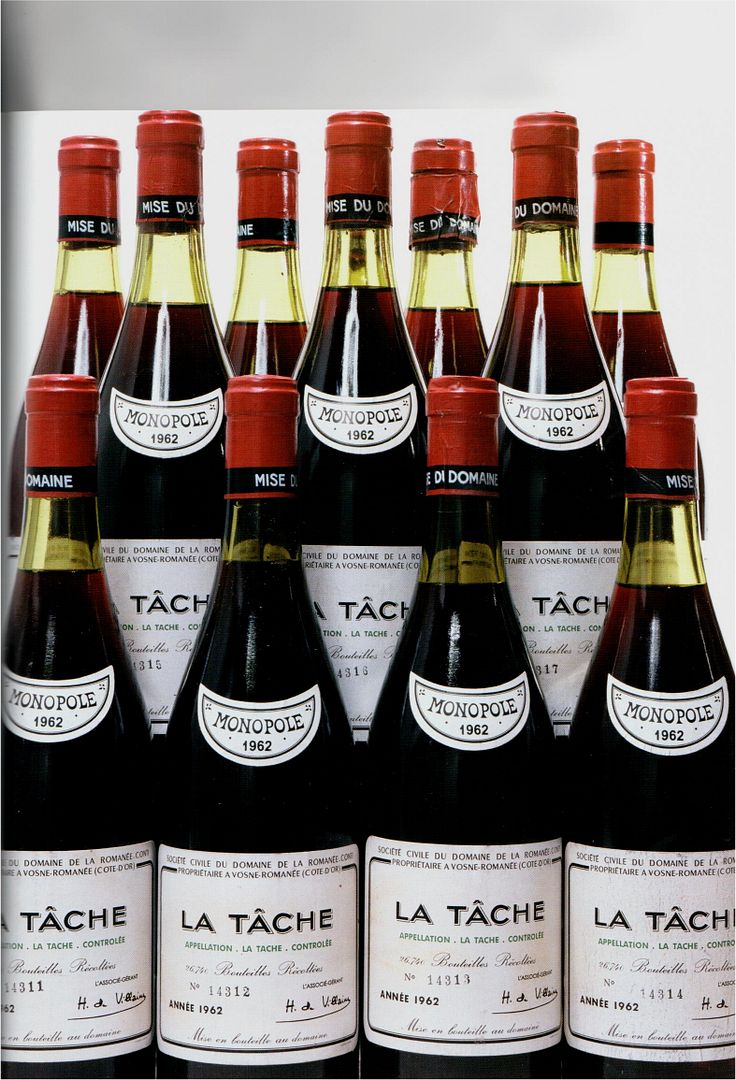

Here is photograph of the main label of a case of 6 magnums of 62 La Tache sold by Rudy Kurniawan in the same auction:

Here is the link to a full-sized photo of the complete lot 88: http://i1049.photobucket.com/albums/s385/doncornwell/Christies%20Auction%2005-31-2013/1962LaTacheMagnumsRudyChristiesApril2007_zps3b015e3a.jpg

Notice that the April 2007 bottles have the identical errors on the Aigu, the circumflex, the spacing on on the word Appellation and the slightly mis-centered green AOC line and the same misaligned vintage date.
SO, BUYER BEWARE!! Six years later Christie’s is still selling counterfeit wines made by Rudy Kurniawan. I’ll be checking what I can on other bottles in this auction.
Yes, this seems to be a rather rudimentary mistake by Rudy, and even the experts at Christie’s (Anthony Hanson ?).
Have they done their due diligence before offering the wine for sale ?
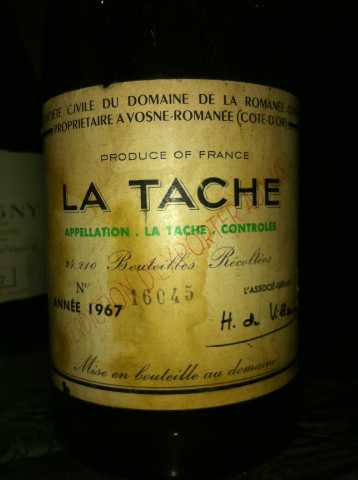
I have attached photo of a bottle of 1967 La Tache:
and a magnum of 1971 Richebourg:
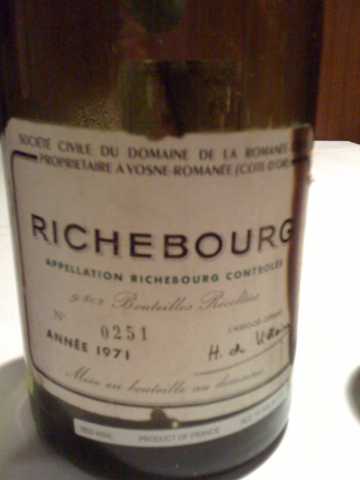
both of which lack the aigu on proprietaire and the circumflex on Tache.
Thanks again Don,
Wow, these auction houses really are unbelievable…disgraceful effort on their part to do due diligence that should be a prerequisite to selling anything of this order.
Glad I don’t deal with any of these, I’m amazed that anyone who hears about their recent behavior would either…how could you possibly have any confidence in them at all?
I agree Paul. I’m not apologizing for them, but I suspect that for some of the auction houses they just accept fakes as a cost of doing business, and a tiny cost at that. With thousands of bottles going under the hammer and only a small percentage (presumably?) likely to be counterfeit it’s just easier for them to ignore the issue. Even the $25,000 bottles sell for just a tiny fraction of what a rare painting would bring, so they just don’t bother. Very sad especially when you consider that in this case the wine has already been publicly and prominently identified as a fake!
I don’t hold much hope for a change in this behavior. Perhaps the industry will wake up if Acker and John Kapon lose a large settlement or are convicted on criminal charges. Even then, if it’s just a bottle or two out of thousands, and if they’ve been recycled through several owners since Rudy, the auction houses may still feel little pressure to up their game.
Ouch.
I assume the art world has been dealing with counterfeiting at a high level for a much longer period of time than the wine world. Have there been any prominent cases where an art dealer has been convicted of criminal charges for selling art they clearly should have known was fake (absent a smoking gun proving such knowledge)?