Flatiron has started using clearly AI generated descriptions on their product pages, and quite often they are downright wrong.
For example, take this lovely wine from Rheinhessen… Alsace? It also claims that it’s 100% chardonnay. Nope, it’s pinot blanc.
I have emailed them about other mistakes like this in the past which were quickly taken down, but it’s a real bummer to see this proliferating. As a customer, now I know I can’t trust the information on these product pages. They’re so vague and similarly worded, full of platitudes and who knows what other errors.
If I were a winemaker, I would be insulted that no one bothered to even proofread these, let alone take the time to sell my product with genuine words.
Of course wine internet sales platforms have always had lots of errors, even when written by humans. But I agree that someone with knowledge should be checking these. And it’s also not clear what the ‘saved labor’ is doing instead that is of so much higher value. Plenty of good uses for AI, but writing the basics shouldn’t be one.
It’s been ~13 years since I had a retail sales job but back then there was a huge amount of cut and paste in-store and on websites. This is probably the logical progression of it. LLM swallowing data and spitting out what seems most plausible. Sucks but I can only see this becoming more and more prevalent. So many people are enamored of AI (particularly at the ownership level). The only brake I can see on this in wine retailing is the “ardor for the story.” Can AI fashion rhapsodical prose combining the winemaker’s childhood, the 30 centimeters of limestone above clay, and the 45 degree slope of the vineyard. Plenty of room for hallucination.
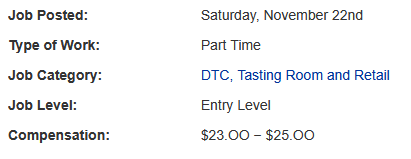
It’s instructive to understand what both basic floor staff as well as store management make in wine retailing. It ain’t much. So anything to reduce hours, salary, FTE, etc. will get a long hard look. Beyond the most “hand sale” boutique stores true wine expertise is a push on whether or not it covers the employee costs. Big duh that employee contribution has to be greater than employee cost.
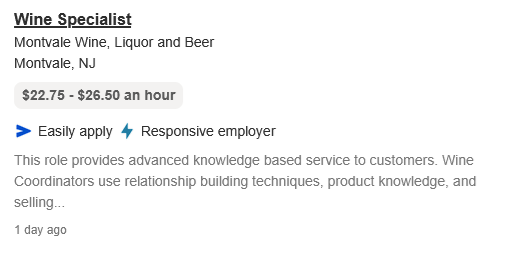
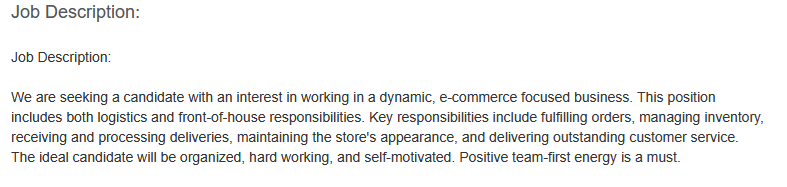
I get Indeed job opening emails all the time and once in awhile look at WineJobs. Pretty sad if one is trying to work in wine retail. Kinda needs the significant other who banks major coin.
Not picking on anyone in particular, of course. Just trying as best as possible to illustrate that it’s quite plausible to see AI/LLM prose become, if not the norm, then commonplace. And allocating human time to double check the verbiage makes little sense as why not just have the human do it in the first place? There will probably be an intermediate point where the verbiage gets spit out, a human quickly reviews and up on the website it goes. After that, it’s just whoops, a thousand pardons sahib, and fix it on the fly. Maybe.
Yeah I can definitely see how its tempting to reduce costs in this way, but the quality issues are the obvious tradeoff. There have always been errors in this process, but there is definitely a huge increase in obvious discrepancies than even a customer not at all familiar with the product in question can spot. I can’t speak for everyone, but I would rather see the 2-sentence blurb from the importer than 3 paragraphs of half-hallucinated information.
I use certain AI generated text for wine and beer all the time. Never for actual tasting notes, but for basic history or process. It’s like getting a ‘base’ to rewrite. It saves me a ton of time.
For example; we are doing a Sherry flight this weekend, and I was looking for a good explanation for how sherry is made. The AI version was super simple and easy to understand (and rewrite to my liking).
I’m not sure using AI for pitches is any worse than cutting and pasting the importer or distributor’s notes and passing it off as the retailer’s own opinion, which is very, very common.
Hey, curious what you then do with the freed up time? Because I think that is an important aspect of the conversation. Which then relates to the question of if you have this new free time and you use it for value add activities for the business then can you as a result reduce business headcount? (Or at least employee hours.)
People do that because search engine results are filled with ads and SEO spam, to the point that it can’t really be trusted. What do they think is going to happen when ChatGPT/Gemini/etc start integrating ads into the experience?
I have felt for a long time that most mainstream media’s first allegiance is to being first and then being correct after that. Print first, correct later.
For AI, getting people to buy in to the new technology is the goal so, as far as I can tell, most of it tends to be overtly cheerleading and on the sycophant side of the equation.
When I search online for actual information or thoughtful, nuanced research I sigh and try to enter good (or unusual) key words into the search bar. That is, I don’t really expect useful results any longer. Or at least until around page 3-4 if the key words are good.
I have learned that if an article ends with something along the lines of “in summary” or “the conclusion is” that there is a very high probability of it being AI created. At least I can get a chuckle out of what human name was selected as the author or the little head shot in a circle.
Concur that right now it is all about adoption. Eliminate actual, real live human created content or bury it so deeply that you don’t see it or even doubt it when you find it. I feel I can pretty much tell when someone worked on an article. You can kind of see the imprint of human thought. But once again it seems convenience trumps autonomy.
Either way I would like to see “nestled” and “curated” struck from the English language.
I have a brewery/restaurant/wine bar and tend to do my social media late at night. This kind of cuts into my ‘alone’ time. But I have always enjoyed this part of the business. And I was just stating that AI generic posts on the subjects are super helpful. Because of the nature of our business, no one is going to lose their job. AI can’t make beer or wait on tables.
Now regarding other professions, take a regular law firm for example. They usually have secretaries drafting the multitude of letters that have to go out. Now with AI, you can obtain a draft of a letter for free, do a little rewrite and out the door. No more need for that extra secretary.
It’s actually quite useful. If a business uses “curated” to describe their offerings, it’s a clear signal that I should try to avoid their premises, if possible.
I think you took my post as aimed personally at you. When you were more the “occasion” for asking the question generally. At this juncture in time certainly a restaurant/bar is a lot more dependent on humans than a retail store. I was thinking more about retail. I did not know what type of establishment you owned.
The general point of the question still stands. At what point will the shortcuts AI provides in fashioning client facing verbiage or the basis for things like tasting notes result in reduced headcount or lessened hours in the wine industry? It stands to reason that a restaurant/bar will need humans longer than retail. Fast food places have already starting automating but its apples and oranges. For now. Humans get used to a lot of change over time. “Mom, Bobby is hogging the phone and I am waiting for Jimmy to call me!”
Working on the warehousing side of things at the wholesale level things are getting a lot more automated and it is reasonable to expect that “more can be done with less” going forward due to AI. If Amazon can do it… A key will likely be robotics scaling and becoming more affordable to more businesses.
Luckily for me the type of warehousing I do still involves climbing up and down ladders with cases of wine on your shoulder, cutting open a box, and making sure you pick the correct bottle. Inventorying inbound wine is more apt to be automated first, label recognition and such. How shelves are organized makes automating outbound bottles harder too. What we do involves a good bit of knowledge (e.g., the label changed from 2018 to 2019) and human judgment. I hopefully have only 8-9 years left before I hang it up. Fewer if the body gives out and there’s insufficient desk work (see AI). I think I am one of the lucky ones.
A bit of a digression, but I want to take issue with that, having been a member of the mainstream media for 25 years. That’s painting with a VERY broad and not very accurate brush.
Yes, being first matters, but being correct is much more important. Substantive mistakes in reporting are blot on reporters’ and editors’ records at serious news organizations like the NYT, WSJ, Bloomberg, Reuters, FT, etc. Do that too often and the editors won’t trust your reporting.
Not so much at Fox and the NY Post or the British tabloids…