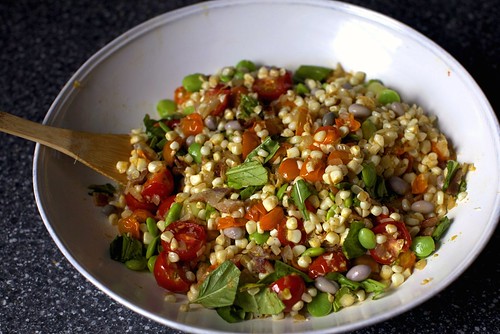
Over the weekend I cooked up some beautiful, tender green butter beans and took them to a pot luck dinner. One of the guests, a transplanted Midwesterner, said she had never been able to develop a taste for lima beans. I told her butter beans are different. She insisted they are the same. SOS.
Okay, okay, before anyone points it out, taxonomically speaking lima beans and butter beans are the same genus and species: Phaseolus lunatus. Everything else about them is different.
Modern lima bean and butter bean cultivars all developed from two distinct wild types. The large-seeded variety (Lima type) was domesticated circa 2000 B.C. in the Andes of Peru; it got the name “Lima” because the beans were first shipped to Europe from Lima, Peru. The small-seeded variety (Sieva type) was domesticated circa 800 A.D. in Mesoamerica. Both types come in many cultivars with varying plant habits (bush vs. climbing), seed colors (white, cream, yellow, green, brown, purple), seed shapes (flat vs. oblate), and seed patterns (solid vs. variegated or “speckled”).
In the South, the small-seeded Sieva type is almost universally called a butter bean, sometimes a Dixie (green) or Henderson (speckled) butter bean after the two most widely grown cultivars. Sometimes it is called a baby lima, though it is not an immature Lima type.
Here’s the important part: In culinary use, the Sieva type (butter beans) and Lima type (lima beans) are distinctly different. Butter beans are milder in flavor and considerably lower in starch than the larger, starchy, more earthy flavored limas. Butter beans are delicious, lima beans not so much to many people.
At my insistence, she tried the butter beans. Without third-party encouragement, she had a second helping.
Another convert.

![[cheers.gif]](/uploads/db3686/original/2X/0/0ff9bfcdb0964982cd3240b6159868fbdf215b1a.gif "cheers")
![[thumbs-up.gif]](/uploads/db3686/original/2X/f/f84c5acc11486ee4baba6dee6cf61dbd133abb18.gif "[thumbs-up.gif]")