Day 5 cont’d
After our morning tournée to Côte-Rôtie we returned back to Tournon. With an hour or two to spend, we took a stroll over the river Rhône to Tain to check out Compagnie de l’Hermitage, a wine shop Ilkka and Mikko seemed to be already quite familiar with.
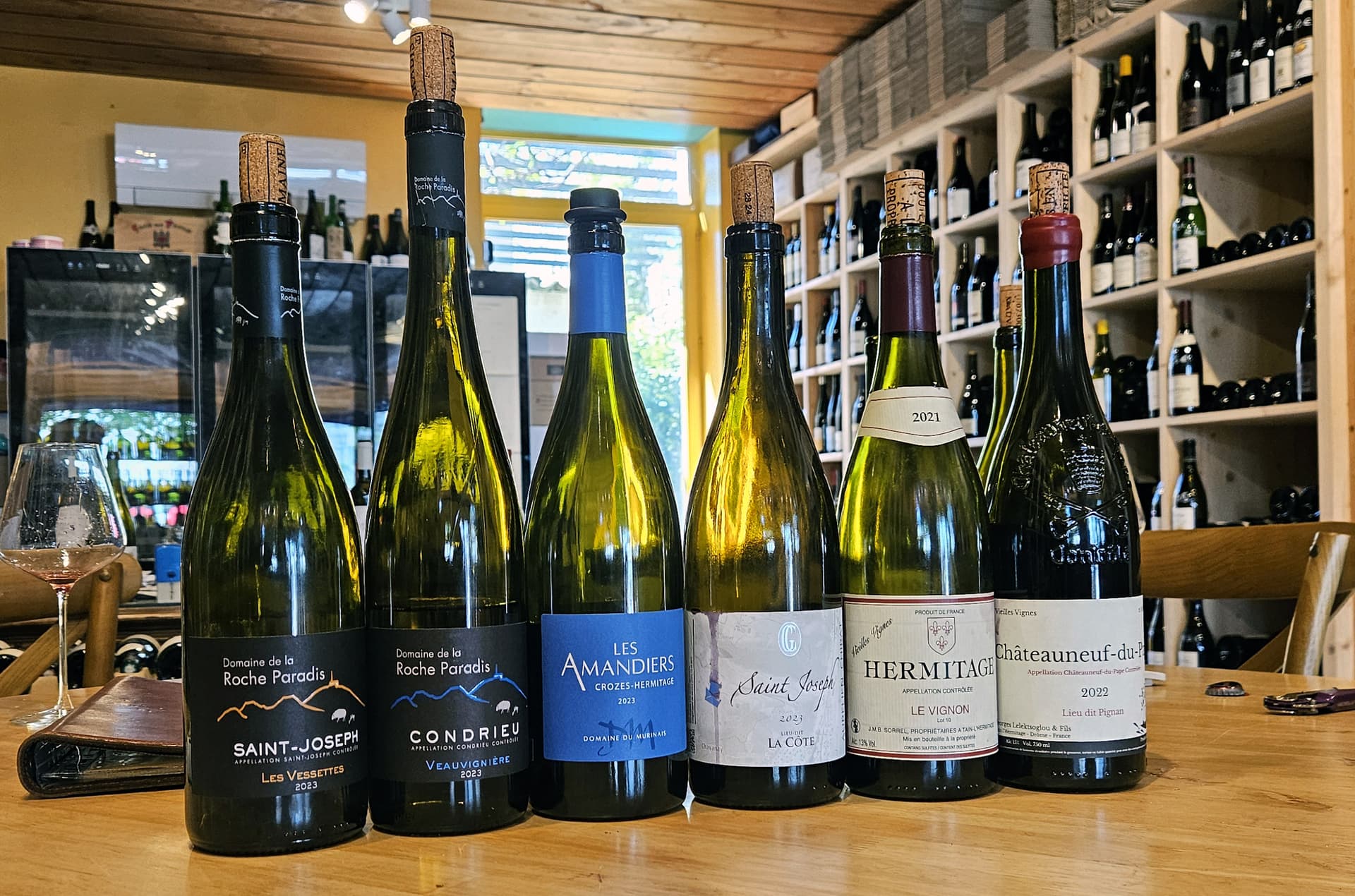
This turned out to be quite a terrific little place. They packed amazing wines - not just from Rhône, but from all over France - and also some older vintages, at reasonable prices. They also had some bottles open which we were offered some samples - a few bottles had been opened already a few days ago, whereas others were just opened and still in great shape.
- 2023 Domaine de la Roche Paradis St. Joseph Blanc Les Vessettes - France, Rhône, Northern Rhône, St. Joseph (25.4.2025)
A blend of organically farmed old-vine Marsanne (50%) from a parcel planted in the 1950's and young-vine Roussanne (50%), sourced from lieu-dit Les Vessettes above the commune of Chavanay. Barrel-fermented spontaneously, aged for 8 months in oak, bottled unfiltered. 12,5% alcohol.
Luminous golden yellow color. The nose feels open and sweetly-fruited with heady aromas of cantaloupe, some youthful pear notes, a little bit of apple jam, light floral notes of lavender and chamomile and a hint of creamy oak. The wine feels ripe, juicy and slightly viscous on the palate with a medium-to-moderately full body and youthful flavors of cantaloupe and clover honey, some white peach, a little bit of ripe pear, light sweeter nuances of apple jam and a hint of creamy oak. The wine is surprisingly fresh and high in acidity for a white St. Joseph, making the overall feel enjoyably balanced and offsetting the slightly viscous texture of the wine. The finish is ripe, juicy and slightly spicy with a rather long aftertaste of white peach and sweet Fuji apple, some youthful pear notes, a little bit of floral spice, light honeyed nuances and a hint of cantaloupe.
A fresh, balanced and sophisticated white Saint Joe. Wonderful sense of freshness and purity of fruit here. The overall feel might still be a bit too youthful and primary for my preference, but the wine nevertheless shows great sense of promise. While not as impressive as the more sumptuous 2023 Condrieu Vauvigniére that we tasted at the same time, this wine is still pretty much on par with that bottling. Good stuff, probably should keep an eye on this producer.
(90 points)
- 2023 Domaine de la Roche Paradis Condrieu Veauvignière - France, Rhône, Northern Rhône, Condrieu (25.4.2025)
100% organically farmed Viognier sourced from a parcel planted in 1990 in lieu-dit Veauvignière near Malleval. Fermented spontaneously, aged for 8 months in oak, bottled unfiltered.
Luminous, medium-deep golden-yellow color. The nose feels very rich, open and perfumed with youthful, fragrant aromas of pear drops, some rosewater, light sweet apricot tones, a little bit of exotic spices, a primary hint of grapey fruit and a touch of ripe pear. The wine feels rich, textural and somewhat oily on the palate with a rather full body and youthful flavors of ripe peachy fruit, some crunchy nectarine, a little bit of grapey primary fruit, light floral notes of roses and a hint of juicy pear. The medium-to-moderately high acidity doesn't really offset the rich, somewhat viscous texture of the wine, but lends good sense of freshness and balance to the overall feel. The finish is rich, youthful and juicy with a long aftertaste of sweet white peach, some floral spice, a little bit of ripe apricot, light grapey notes of primary fruit, a hint of rosewater and a touch of creamy oak.
A rich and ripe yet still relatively fresh and enjoyably balanced Condrieu. The wine felt somewhat heftier and more viscous than the 2023 Saint Joseph Blanc Les Vessettes we tasted at the same time, but despite the slightly lower acidity here, this Condrieu still felt a bit more impressive in its own, succulent way. I feel the wine was still a bit too youthful with the somewhat grapey primary fruit flavors, but most likely they will disappear in a year or two. This wine might not be built for the long haul, but I'd still wait a little bit more with this one. A fine and thoroughly enjoyable Viognier with great sense of varietal typicity.
(91 points)
- 2023 Domaine du Murinais Crozes-Hermitage Cuvée les Amandiers - France, Rhône, Northern Rhône, Crozes-Hermitage (25.4.2025)
100% Syrah from 15 to 25 yo vines in the flat lands of the commune of Beaumont Monteux. All fruit is destemmed. Fermented spontaneously and macerated with the skins for 25 days in concrete tanks. Aged in concrete tanks and old demi-muids for 12 months.
Youthful, somewhat translucent cherry-red color. The nose feels youthful, peppery and somewhat herby with aromas of fresh raspberries and crunchy lingonberries, some floral notes of chamomile, a little bit of tobacco, light spicy nuances of cracked peppercorns and a hint of olive. The wine feels quite lively but also very supple and somewhat mellow on the palate with a medium body and youthful flavors of crunchy lingonberries, some olive, light herby tones, a little bit of ripe raspberry, a hint of stony minerality and a touch of peppery spice. The wine is a bit on the soft side with its medium acidity and light, gently grippy tannins. The finish is soft, dark-toned and juicy with a tiny bit of tannic grip and a medium-long aftertaste of tart lingonberries, some ripe raspberry notes, a little bit of olive, light herby nuances and a hint of stony minerality.
A juicy, varietally correct and relatively red-toned Syrah that would be very lovely, if it weren't for the lack of structure and intensity. I love the olive and peppery flavors here, but to me, a proper Northern Rhône Syrah must have enough acidity, and style permitting, also some tannic grip; this wine didn't have either of them. The overall feel was a classically styled NRS that just lacked intensity, freshness and sense of structure due to the somewhat modest level of acidity, and there wasn't enough tannic structure to make up for the lack of firmness. While not a bad wine in any way, this just didn't leave a lasting impression on me.
(86 points)
- 2023 Vignobles Chirat St. Joseph La Côte - France, Rhône, Northern Rhône, St. Joseph (25.4.2025)
100% Syrah from lieu-dit La Côte. Most of the grapes are destemmed, a small portion kept in whole bunches. Fermented spontaneously, macerated with the skins for three weeks. Aged in 500-liter demi-muids and 2500-liter foudres (20% new oak) for 10 months.
Moderately deep, dark and somewhat translucent black cherry color. The nose feels quite classically styled but also somewhat sweet-toned with aromas of cracked peppercorns and ripe black raspberries, some floral notes of violets, light blueberry tones, a little bit of pipe tobacco, a hint of oak spice and a touch of olive. The wine feels juicy, dark-toned and quite youthful on the palate with a medium-to-moderately full body and vibrant flavors of blueberries and dark plums, some peppery spice, light brambly notes of raspberries, a little bit of grapey primary fruit, a hint of stony minerality and a floral touch of violets. The moderately high acidity and firm yet quite ripe medium tannins make the overall feel balanced and pleasantly structured. The finish is juicy, dark-toned and gently grippy with a rather long aftertaste of black cherries, some peppery spice, light meaty tones, a little bit of brambly black raspberry, a floral hint of olive and a touch of oak spice.
A pleasant and balanced Saint Joseph. Not particularly complex or memorable, but that might be just the young age - there is still some candied primary fruit character that will take some time to disappear. Structurally the wine is on the gentle side of things, but the framework is sturdy enough to keep the overall feel balanced and to lend some nice intensity to the flavors. Good, but maybe not great. A solid everyday Saint Joe.
(89 points)
- 2021 Jean-Michel Sorrel Hermitage Le Vignon, Vieilles Vignes Lot 10 - France, Rhône, Northern Rhône, Hermitage (25.4.2025)
Tasted from a bottle that had been open for a few days. This is 100% Syrah from parcels in Les Plantiers, Les Greffieux and Les Bessards. The average vine age is between 50 to 70 years, including a portion of Bessards planted between 1910 and 1915. Vinified in whole clusters, fermented spontaneously. Aged for two years in old French oak barrels. Bottled unfined and unfiltered. 13% alcohol. The label says "Lot 10" but I have no idea how the lots of JMB Sorrel Le Vignon differ from each other.
Somewhat translucent blood-red color. The nose feels dry, meaty and slightly oxidative with aromas of soy sauce, some ripe dark berries, light olive tones, a little bit of smoky bacon and a hint of wizened cherry. The wine feels savory, meaty and a bit tired with a moderately full body and quite intense flavors of gamey meat and tobacco, some oxidative notes of soy sauce, light gravelly mineral notes, a little bit of wizened dark fruit, hints of juicy blackberries and a touch of olive. The overall feel is pretty firm with the rather high acidity and moderately grippy medium-plus tannins. The finish is juicy, rather grippy and a bit tired with a quite long aftertaste of succulent dark berries, some gamey meaty notes, a little bit of gravelly minerality, light oxidative notes of soy sauce, a hint of olive and a smoky touch of charred bacon.
This was a pretty firm, tasty and balanced Hermitage, but unfortunately it was quite impossible to get a full picture of the wine as it had been open for too long and it was starting to get tired and oxidative. I'm quite sure a sound bottle would be wonderful and built for the long haul, but as this bottle was in a less-than optimal shape, it's impossible to say anything with full certainty. Leaving the wine unrated.
- 2022 Georges Lelektsoglou / Compagnie de l'Hermitage Châteauneuf-du-Pape Vieilles Vignes Lieu-dit Pignan - France, Rhône, Southern Rhône, Châteauneuf-du-Pape (25.4.2025)
100% Grenache from a centenarian parcel in lieu-dit Pignan. Made with purchased fruit. 15% alcohol.
Youthful and quite translucent ruby-red color. The nose feels heady, somewhat spicy and a bit spirituous with aromas of meaty character and somewhat peppery spice, some strawberry tones, a little bit of darker-toned bilberry character, light floral nuances, a hint of raspberry jam and a touch of boozy alcohol. The wine feels rich, juicy and rather sweet-toned on the palate with a full body and lush flavors of strawberries and licorice, some dark plummy tones, a little bit of peppery spice, light blueberry nuances, a floral hint of violets and a touch of raspberry marmalade. The high alcohol makes the overall feel quite hot and the medium acidity doesn't lend much if any freshness or sense of structure to the wine; fortunately the ample, moderately grippy tannins bring some welcome firmness to the mouthfeel. The finish is long, hot and pretty grippy with a bold, rather sweet-toned aftertaste of ripe strawberries and peppery spice, some blueberry jam, light dark plummy tones, a little bit of raspberry marmalade, a savory hint of meaty umami and a touch of licorice root.
Ugh, this was more or less a textbook example why I don't like contemporary Châteauneuf-du-Pape: the wines are just too hot, heavy and sweet-toned in overall feel with very little to no acidity to keep all that jammy messy in balance. I guess this can be an impressive wine to some, but I didn't like this one little bit. The only good thing here was the firm tannic backbone that gave the wine at least a semblance of balance and structure.
(84 points)
After we had sampled the bottles we made some purchases (including a 2001 Sorrel La Gréal we four bought together as a souvenir bottle that is to be opened at some point in the future) and then returned back to our headquarters in Tain to drop off our freshly acquired bottles from Jamet and Compagnie de l’Hermitage. Then we were off to our penultimate producer visit.
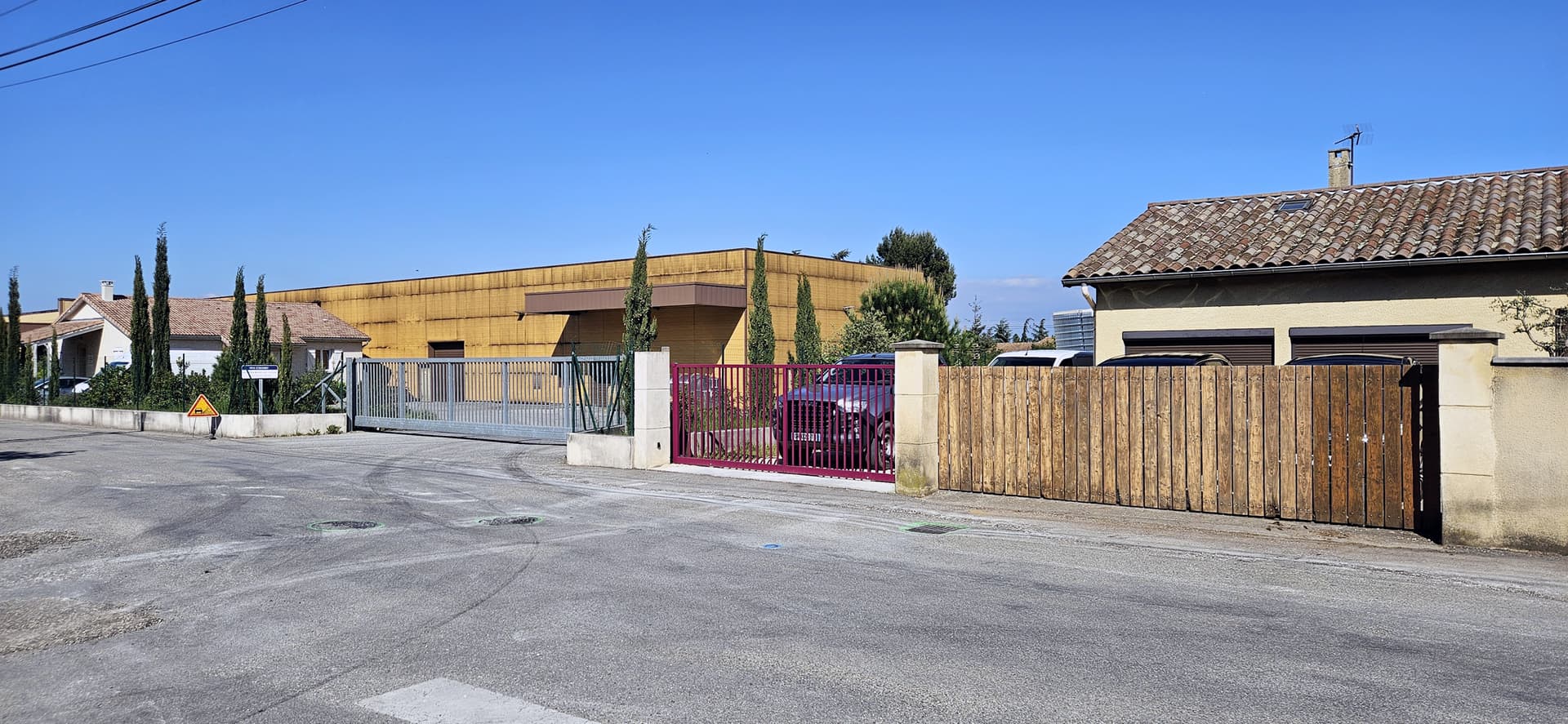
Only after we arrived in Cornas it truly dawned to me how awfully tiny this commune really is! In a span of a minute or maybe two, we drove past domaines Alain Voge, August Clape, Thierry Allemand and (the huge industrial facilities of) Jean-Luc Colombo to get to the small almost-garage-winery of Franck Balthazar. Just like in the tiny hamlets of Burgundy, almost every producer here is located a mere stone throw’s away from one another.
The buildings of
Centre Oenologique Cotes Du Rhone and the winery of
Jean-Luc Colombo, right next to Franck’s winery.
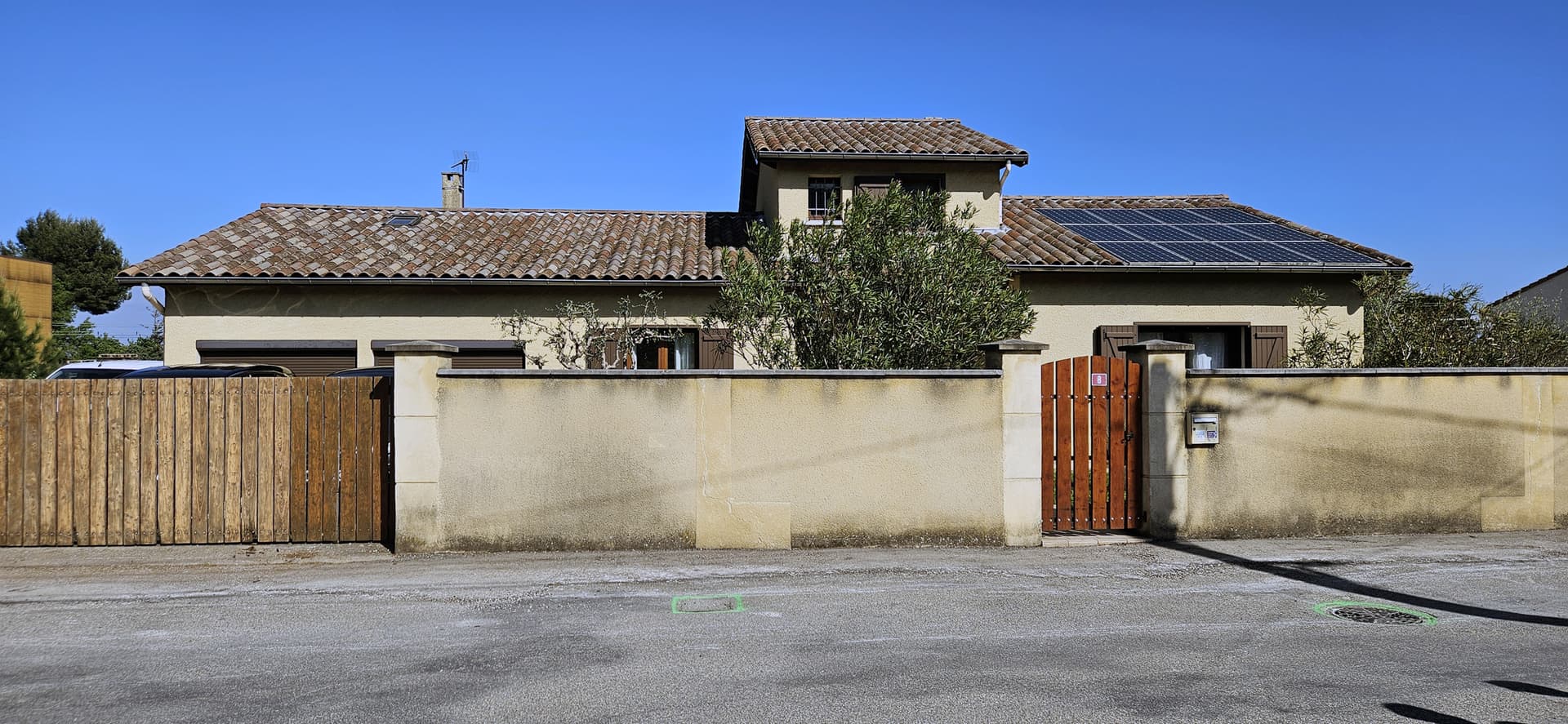
Anyways, we arrived at Balthazar’s house right on time - yet nobody seemed to be there. We waited for a few moments, but nothing. We knocked on the gate and threw a few bonjour in the general direction of the house-winery, but still nothing. Fortunately, after another few unsure moments, Franck Balthazar finally emerged from the house and let us in.
The house and the winery of Franck Balthazar - in front of which we waited for some time.
- Although Franck Balthazar himself hasn’t been making wines for that long, the Balthazars are true stalwarts of Cornas; Franck is only third-generation winemaker at the family domaine, but it was founded almost a century ago, already in 1931!
- Franck’s grandfather Casimir Balthazar founded the winery and ran it for a couple of decades until his son and Franck’s father, René, took over in 1950. Back then the domaine only farmed grapes and sold wine by the barrel to the local establishments.
- René Balthazar began bottling the domaine wines in the 1970’s while also continuing to sell a part of their production locally in cask.
- In 2002, Franck Balthazar left his job as a textile machine engineer and took over the family domaine from his father. François Ribo (of Dard et Ribo fame) was Franck’s teacher in wine, having a great indirect impact in the stylistic direction the Balthazar wines started to take after Franck was in helm.
- The estate covers slightly over 4 hectares (10 acres) today, including a 1-hectare parcel of Noël Verset’s centenarian vines in the famed Chaillot cru. An overwhelming majority of the estate vineyards is planted to Sérine aka. Petite Syrah, a local low-yielding, high-quality clone of Syrah; however, in 2013 Balthazar acquired a small parcel of Roussanne in St. Péray, so the production is not exclusively red anymore. All the vineyards have been farmed organically since 2010 and have been certified since 2013. The annual production varies greatly from year to year, typically ranging between 8500 and 15000 bottles of Cornas, plus a number of other wines.
- Although rarely considered a naturalist wine producer, Franck Balthazar’s wines are arguably very natural from a winemaker’s perspective. Balthazar’s style is very minimalist as he employs indigenous yeasts in the fermentations, although he normally prepares a pied de cuve to guarantee a reliable start; for the most cuvées, no grape bunches are destemmed; sulfite use is kept to a bare minimum at all times and occasionally no SO2 is used at all; he shuns new oak and prefers large 600-liter demi-muids over smaller-format casks, although some smaller casks are used as well due to the tiny production; after a long aging period (often close to two years) the wines are bottled unfined and unfiltered.
- Today Balthazar produces eight different cuvées regularly; most these wines are made with estate fruit, but the Crozes-Hermitage and Côtes-du-Rhône wines are made with organically farmed fruit purchased from farmers Franck trusts, or from vineyards Franck himself manages.
- St. Péray: A rare 100% Roussanne (most St. Péray vineyards are Marsanne) from a parcel Franck acquired in the neighboring appellation of St. Péray in 2013.
- Côtes-du-Rhône: A blend of purchased Syrah (75%) and Grenache (25%) from Séguret, near Gigondas.
- Crozes-Hermitage: Made with purchased Syrah from the communes of Mercurol and La Roche-de-Glun. Some sources say the grapes for this cuvée are destemmed, but Franck himself told us that the wine (at least the vintage 2024 we tasted) was vinified in whole bunches.
- Cornas Cuvée Casimir: Named after Franck’s grandfather. The early-drinking cuvée made mostly with younger-vine fruit but also including some fruit from the +50-yo parcels in lieu-dit Les Mazards.
- Cornas Cuvée Juliette: Named after Franck’s mother-in-law, who gifted this one-hectare parcel in lieu-dit Les Prés that Franck in turn replanted between 2015 and 2016. A lush, fruit-forward cuvée where the emphasis is often on the fruit, not so much on the structure. Annual production is one demi-muid, ie. 800 bottles.
- Cornas Sans Soufre Ajouté: Franck realized that one of his parcels in lieu-dit La Lègre (planted in 2007) produces grapes that consistently turn into wine that begins and finishes the primary fermentation quickly. As this reduces the need to use SO2 during the vinification, Franck began bottling this parcel separately without any added SO2.
- Cornas Chaillot: The main cuvée of the domaine. Made mainly with old-vine fruit sourced from the Chaillot vineyard, but also including some old-vine fruit from lieu-dit Les Mazards.
- Cornas Hommage: The old-vine cuvée of the domaine that debuted in 2019, made with old-vine fruit sourced exclusively from the Verset vines that were planted between 1911 and 1913 in Chaillot. Annual production is one demi-muid, ie. 800 bottles.
- In addition to these wines, Franck also makes some occasional one-off cuvées or might make some special sans soufre releases of his labels that normally receive a tiny addition of SO2.
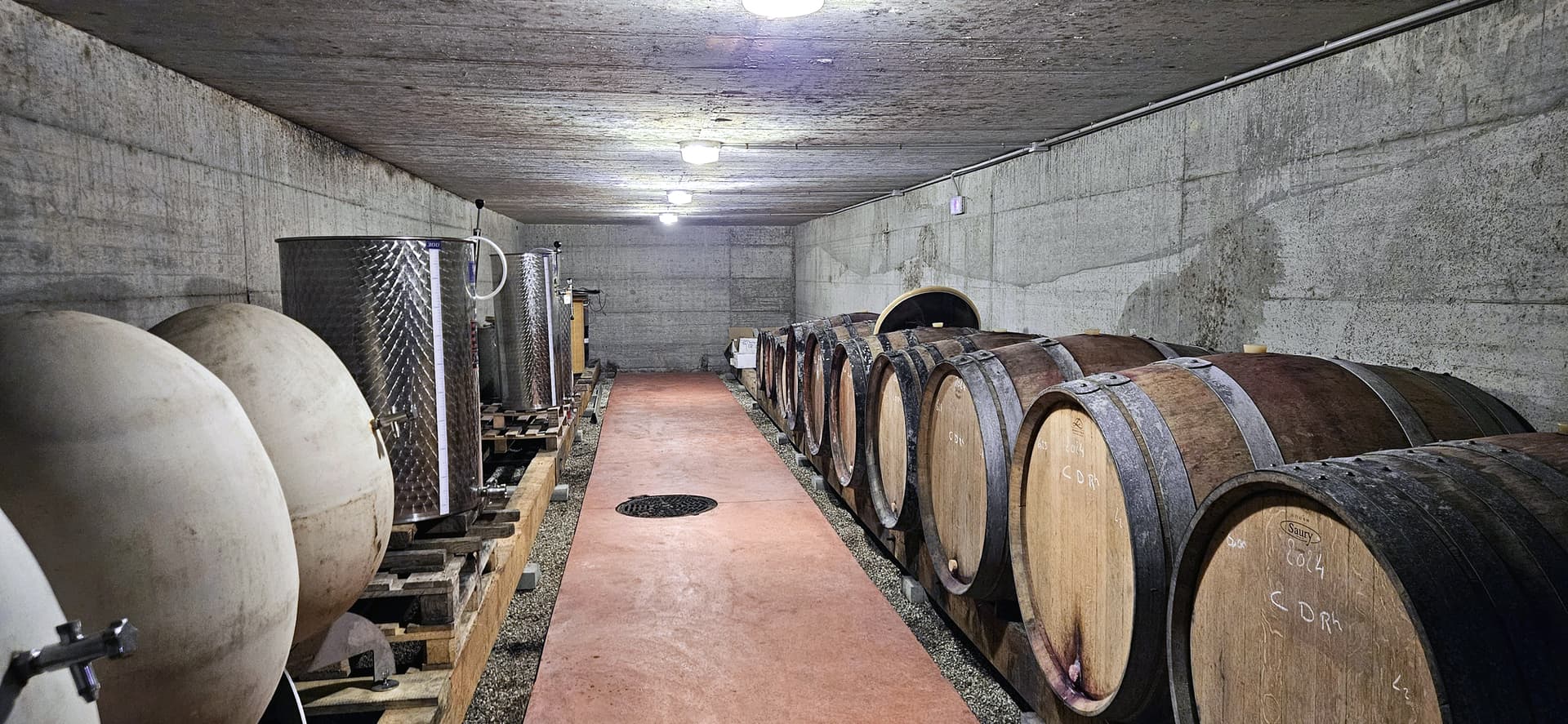
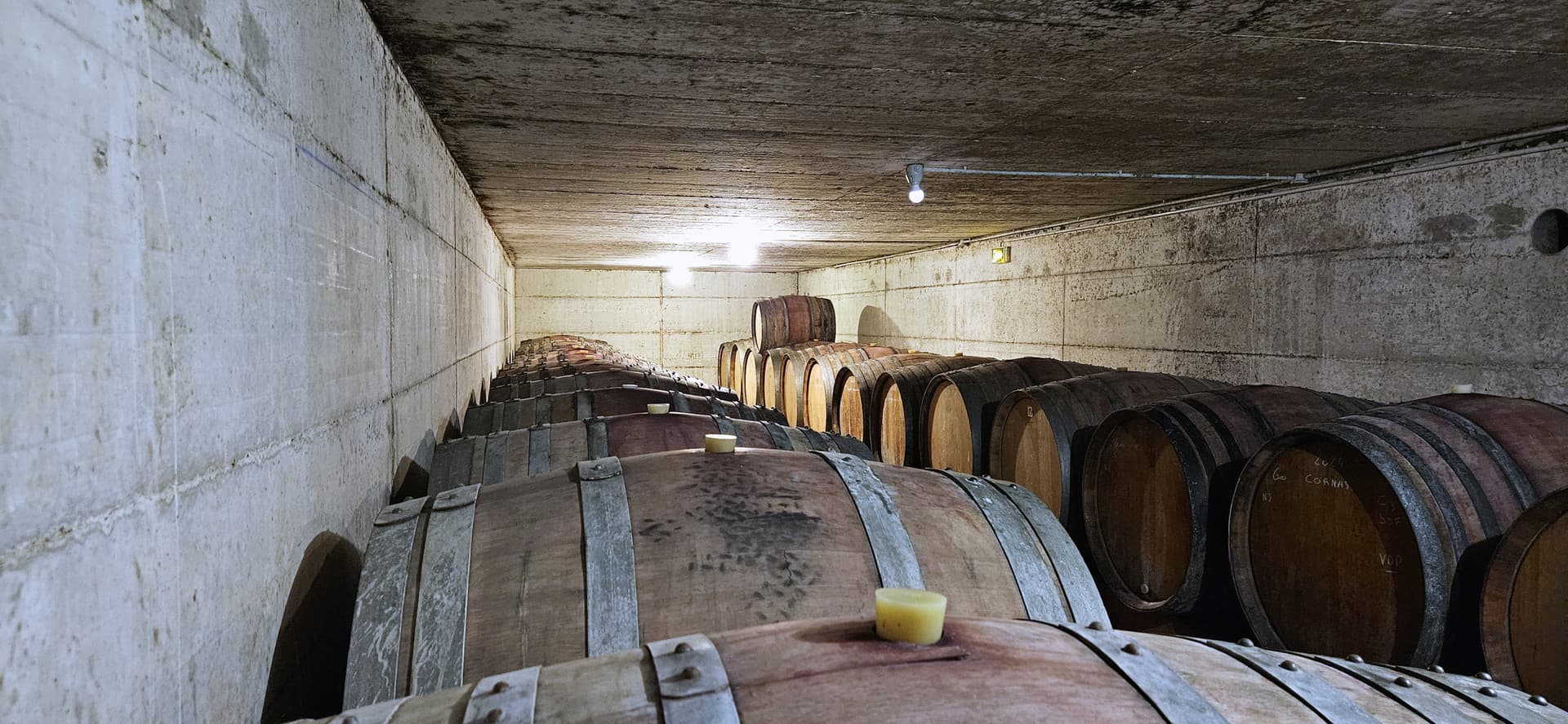
Some concrete eggs, stainless steel tanks,
demi-muids and a few smaller casks in Balthazar’s cellar.
The remaining
demi-muids and a rare 228-liter
pièce.
Unlike at all the other wineries, where we tasted just bottled wines - or maybe sampling one or two unfinished wines from the barrel - basically all the tasted wines chez Franck Balthazar were from the barrel! As Balthazar ages almost all of his wines for more or less two years, we had a rather sizeable selection of wines to taste from! Franck wasn’t particularly parsimonious with his wines, so we tasted a considerable portion of vintages 2023 and 2024 that were yet to be bottled! Conversely, we didn’t taste any bottled wines - save for one bottle that had been opened a week ago and was already fading.
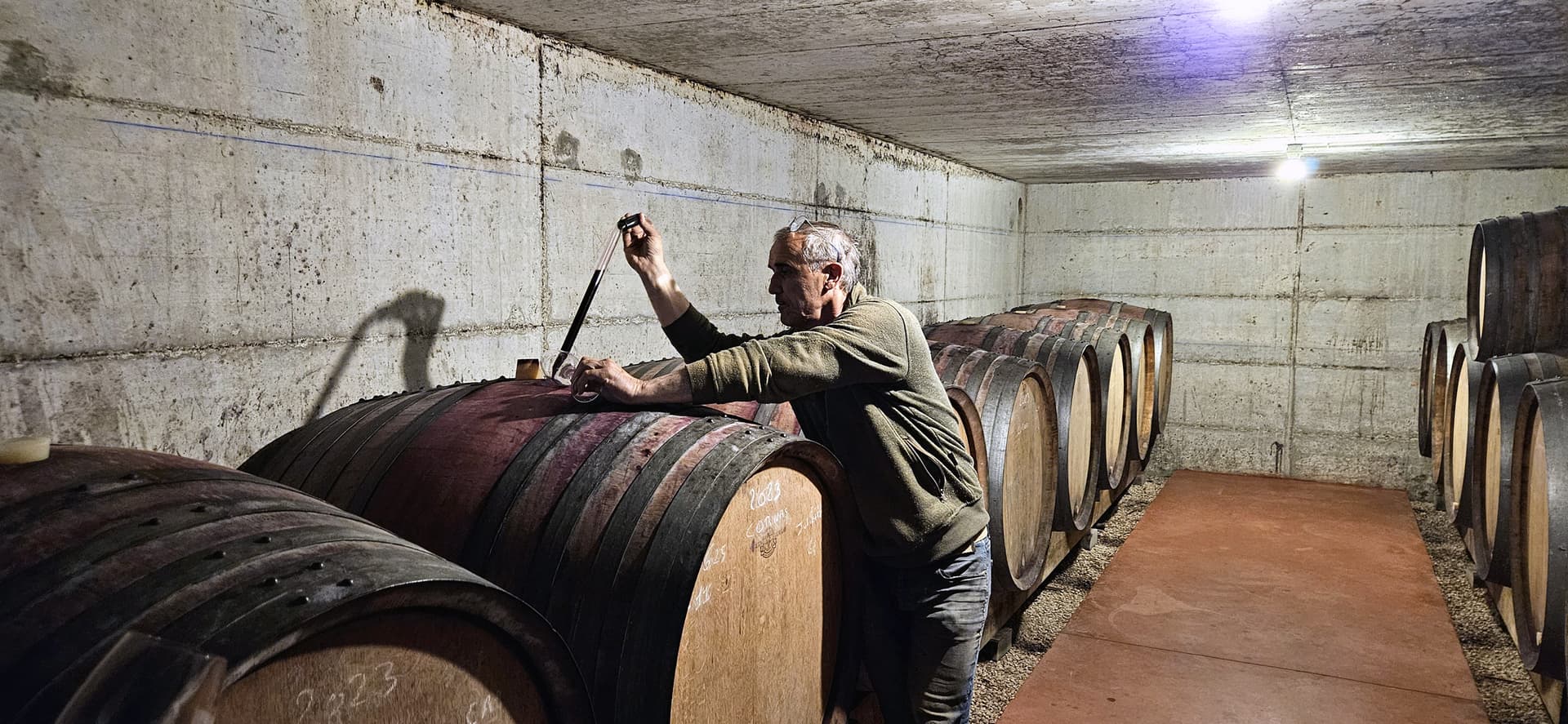
Franck obtaining yet another barrel sample for us.
As a person, Franck seemed more like a quiet somewhat timid and also self-effacing type of fellow. I don’t know if it was just because he was somewhat unsure of his English skills, for which he was apologizing consistently - even when we repeatedly told him it didn’t matter, and should he be grasping for words, two of us understood also French! Nevertheless, he just showed us around his cellar and explained what he did or didn’t do, in his slightly reserved and humble yet very knowledgeable manner.
For example it was fun to listen him explain how he’d rather use no SO2 at all, but nevertheless was vehemently opposed to that funky, heavily volatile swamp juice all too many natural wine producers would happily bottle. He seemed to especially unsympathetic to any mousy wines, saying that he’d always rather use some SO2 than bottle a mousy wine. He was also pretty adamant that whenever he bottled wines without any added sulfites, they’d still always be clean wines - similar to his wines that have some SO2 added (in quite minuscule quantities, mind you).
It was also interesting to hear that his Sans Soufre Ajouté cuvée - the only one consistently bottled without any added SO2 - is actually from a parcel planted in 2007, where the vines produce fruit that consistently begins to ferment very quickly and proceeds to ferment to full dryness, always rapidly and reliably. He told us that as the wine made from this specific parcel is typically sufficiently low in pH and very microbiologically stable, it is very easy for him to vinify completely without any added sulfites - and he virtually never has any problems with the wine. Would there be any problems with the quality of the wine due to the lack of SO2, he’d rather not bottle it, just for the sake of the image of this particular cuvée.
On a more amusing note, Franck also wondered why so many people are so crazy about Burgundy. He told us how he tasted so many wines on his last trip to Burgundy and was astounded how almost all the wines he tasted were sulfited to oblivion! There were a few good producers making clean, vibrant wines - he didn’t want to mention any names, though - but to him, most of the Burgundies he tasted seemed quite “dead” to him. Not faulty or flawed, but wines that seemed just closed and lacking the vibrancy Franck was expecting. So I guess your palate can get unaccustomed to the impact of SO2 (especially in young wines) if you work with low-to-no-SO2 wines every single day!
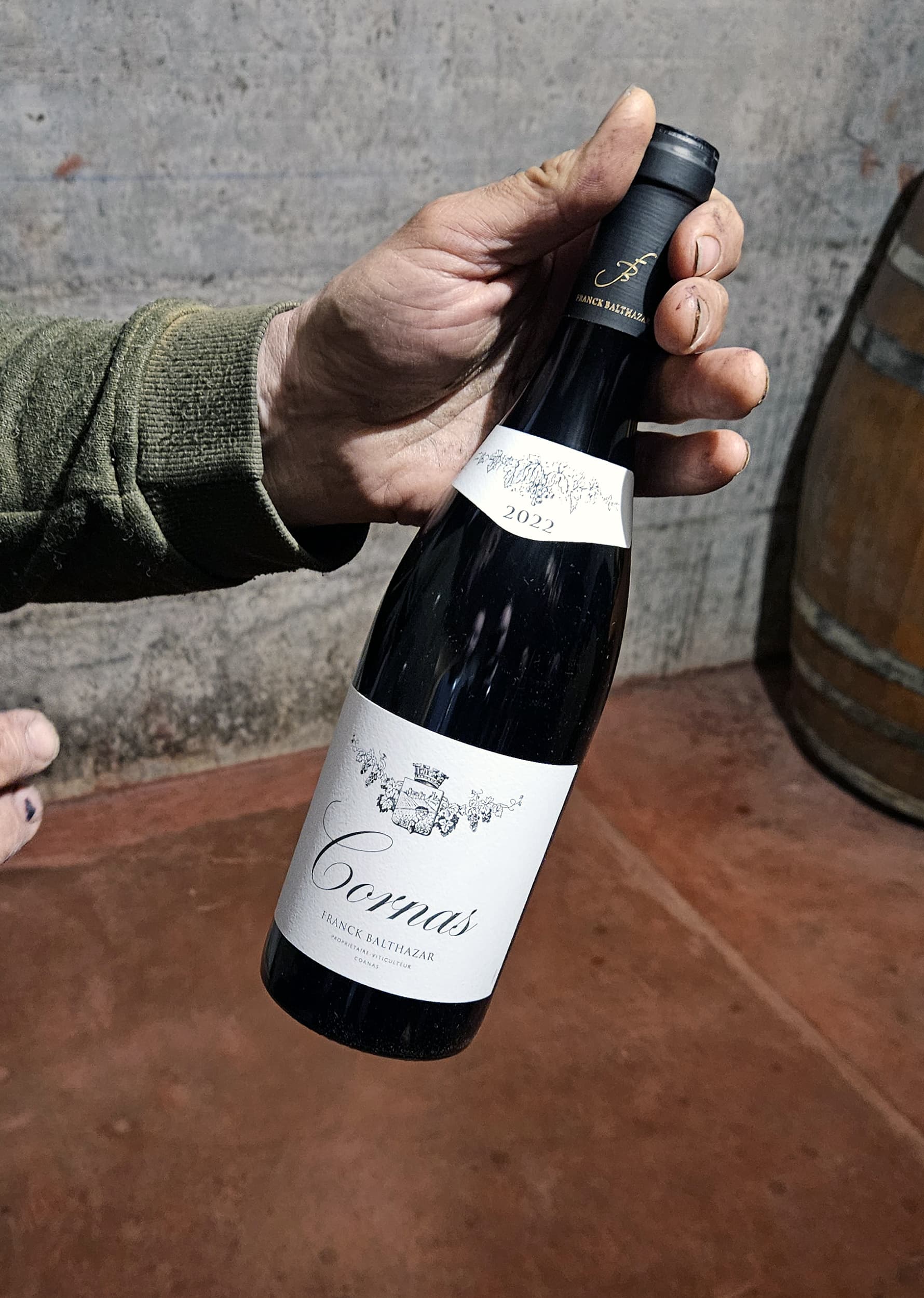
We also discussed about the history and the future of the domain. Franck told us how he was planning on toning down the current labels, which are not only a bit on the modern side, but also a bit all over the place (there are like four different fonts in six different sizes!). Franck showed us the label of his Hommage cuvée, which is a very simple one, having the Cornas text in a cursive script in the middle of the label. I maybe didn’t get a full picture, but Franck said that his labels feel a bit too modern for his liking and the future labels will be more similar to the label of Hommage.
Franck explaining how his future labels will be more similar to this current label of cuvée
Hommage.
He also told us that he doesn’t really know for how long he’ll be making wine. After all, he isn’t getting any younger and at the moment there doesn’t seem to be anyone who would continue in his footsteps. He told us that it seems his daughter doesn’t seem like she’ll be continuing in her father’s footsteps. When we asked if he is sad about this, he immediately responded “absolutely not” and with glimmering eyes told us how he was so proud of his daughter, explaining about a research paper of hers that was recently published and what it was about. Franck might be running an outstanding little winery, but even then, he’s a family man before anything else!
Anyways, here are the wines we went through with Franck:
- 2024 Franck Balthazar St. Péray - France, Rhône, Northern Rhône, St. Péray (25.4.2025)
100% organically farmed Roussanne from a plot Franck Balthazar acquired in 2013. Fermented spontaneously, aged in a single 300-liter oak barrel. Tasted from the barrel one month before the scheduled bottling.
Slightly hazy pale green color. The nose feels surprisingly fresh and herby for Roussanne with a somewhat skunky, flatulent streak of reduction. The wine feels ripe, youthful and quite fresh on the palate with a moderately full body and somewhat sweetly-fruited flavors of peachy stone fruits, some stony mineral notes, a little bit of sweet aromatic herbs and a hint of reductive funk. The moderately high acidity lends good sense of balance to the wine. The finish is long, quite fresh and a bit reductive with a youthful aftertaste of sweet peachy fruit, some crunchy apple, light herby tones and a hint of skunky reduction.
A rare Saint-Péray Roussanne that is very youthful and relatively fresh for a Northern Rhône white. Although not dominated by any candied primary fruit flavors, the wine is still obviously very youthful as it is quite dominated by the sulfurous reductive notes. However, the wine shows good promise and I'm quite sure this will turn out to be a lovely white with a few additional years of aging. As the wine is just a sample from one barrel and not fully representative of the final bottled wine, I'd rather not rate the wine yet. If I did, this would be somewhere around 90 points with some upside.
- 2023 Franck Balthazar Cornas Cuvée Casimir Balthazar - France, Rhône, Northern Rhône, Cornas (25.4.2025)
The young-vine bottling of Franck Balthazar, the grapes sourced mainly from vines planted in the early 2000's in lieu-dit La Légre (70%) with some old-vine (averaging 50 yo) fruit from Les Mazards (30%). The grapes are vinified in whole clusters, fermented spontaneously in concrete vats, after which the wine is aged for 14-18 months in old 600-liter demi-muids. Normally the wine would be bottled unfined, unfiltered and with a tiny addition of sulfites, but this was sampled from a barrel at the domaine, about five months before the scheduled bottling in September.
Dense, youthful, more or less fully opaque black cherry color. The nose feels clean, fragrant and very much Syrah with attractive aromas of ripe blackberries, some crushed peppercorns, light floral notes of violets, a little bit of something meaty, a hint of fresh bilberry and a faint lifted touch of VA. The wine feels ripe, clean and pretty dry on the palate with a medium-to-moderately full body and bright flavors of juicy blackberries, some crushed peppercorns, a little bit of ripe blueberry, light gravelly mineral nuances, a floral hint of violets and a touch of elderberry juice. The overall feel is still pretty firm and tightly-knit with the high acidity and grainy, moderately grippy tannins. The finish is juicy, dry and rather grippy with a long, vibrant aftertaste of brambly blackberries and sweet blueberries, some floral notes of violets, a little bit of peppery spice, light lifted volatile tones, a hint of gravelly minerality and a touch of tart red cranberry.
A firm, sinewy and classically styled Syrah - feels less soft and more serious than Cuvée Casimir normally does. Very textbook Cornas with a nice, fresh and fruit-forward overall feel and quite tightly-knit structure. Compared to the somewhat more substantial 2023 Chaillot, I felt this wine felt a bit more direct but also perhaps a bit more closed at the moment. However, I recognize both this and the Chaillot were only samples from just single barrels of wine and the final cuvée might perform differently. Nevertheless, based on this barrel, this is a very promising effort. As the wine is just a sample from one barrel and not fully representative of the final bottled wine, I'd rather not rate the wine yet. If I did, this would be somewhere around 91-92 points with good upside.
- 2023 Franck Balthazar Cornas Juliette - France, Rhône, Northern Rhône, Cornas (25.4.2025)
The most recent addition to the range of Franck Balthazar, the Syrah grapes for this wine are sourced from a one-hectare parcel in the lieu-dit Les Prés, which was gifted to Balthazar by his mother-in-law (after whom the cuvée was named). Mostly younger vines planted in 2015 and 2016. The grapes are vinified in whole clusters, fermented spontaneously in concrete vats, after which the wine is aged for 14-18 months either in old 228-liter pièces or in a 600-liter demi-muid. Normally the wine would be bottled unfined, unfiltered and with a tiny addition of sulfites, but this was sampled from a barrel at the domaine, about five months before the scheduled bottling in September. Annual production is around 800 bottles.
Youthful and rather opaque blackish-red color. The nose feels clean, quite peppery but also rather reductive with smoky struck match notes, some sweet dark berries, light spicy notes of cracked peppercorns, a little bit of earth, a hint of brambly black raspberry and a touch of bretty funk. The wine feels sweet-toned, open-knit and very juicy on the palate with a full body and clean, dark-toned flavors of juicy dark fruits, some brambly blackberry tones, a little bit of peppery spice, light plummy nuances and a hint of smoky reduction. The medium-to-moderately high acidity feels somewhat lower than in the other Balthazar Cornas bottlings, contributing to the juicy, open-knit overall feel. However, the wine is still pretty firm and structured, all thanks to its ample and rather stern tannins. The finish is dry, long and pretty tannic with a juicy aftertaste of fresh blackberries and ripe blueberries, some spicy notes of crushed peppercorns, a little bit of earth, light brambly black raspberry nuances and a hint of smoky reduction.
An attractive, broad and tasty Cornas that feels more juicy and open-knit than the other Balthazar cuvées. This wine is more about richness of fruit framed by relatively stern tannins rather than freshness and acidity. Lovely stuff, but with its assertive tannin structure and still somewhat noticeable reduction, I'd say this wine still needs some years more after the bottling. If opened now, I'd let the wine breathe for some time, hoping it would be enough to blow off the reduction. Even then, I'd say this wine is more approachable and sooner ready to be drunk than the 2023 vintage of the normally early-drinking cuvée Casimir. As the wine is just a sample from one barrel and not fully representative of the final bottled wine, I'd rather not rate the wine yet. If I did, this would be somewhere around 90-91 points with solid potential for further improvement.
- 2023 Franck Balthazar Cornas Sans Soufre Ajouté - France, Rhône, Northern Rhône, Cornas (25.4.2025)
The young-vine bottling of Franck Balthazar, the grapes sourced mainly from a parcel planted in 2007 in lieu-dit La Légre which produces fruit that ferments exceptionally fast, reducing the need to sulfite the wine. This cuvée is vinified entirely without SO2, from the fermentation to the bottling. The grapes are fermented spontaneously in whole clusters and the wine is aged for 12-18 months in old 600-liter demi-muids. Bottled unfined, unfiltered and without any sulfites. Tasted from a barrel at the domaine.
Dense and almost fully opaque black cherry color with a youthful purplish hue. The nose feels relatively closed and understated with aromas of savory meaty tones, some floral notes of violets, a little bit of crunchy bilberry, light skunky notes of reduction, a smoky hint of struck flint and a faint touch of peppery spice. The wine feels juicy, ripe and moderately closed on the palate with a moderately full body and a bit understated flavors of juicy blueberries, some olive tones, a little bit of earth, light notes of tobacco, a reductive hint of smoke and a ferrous touch of blood. The structure of the wine feels a bit overstated with its quite high acidity and rather stern and grippy tannins. The finish is juicy, dry and tannic with a firm, somewhat closed aftertaste of crunchy bilberries, some licorice root, light olive tones, a little bit of peppery spice, a ferrous hint of blood and a smoky touch of reduction.
This was one of the most reduced and closed wines we tasted at the domaine. The wine shows impressive sense structure and beautiful varietal typicity with a remarkably clean fruit profile - I actually thought this wine was perhaps cleaner and less volatile or funky than the Balthazar Cornas cuvées that actually saw some sulfites! However, it is very hard to say anything conclusive about the wine as it was still so closed and grumpy. If I tasted a bottled wine that was this closed and reduced, I'd think the wine just needs more age. Fortunately that is the case, as the wine is not going to be bottled at least before September. As the wine is just a sample from one barrel and not fully representative of the final bottled wine, I'd rather not rate the wine yet. If I did, this would be somewhere around 90 points, as it was still so closed and reductive. However, I'm sure the wine will open up considerably with some additional aging, so my score is definitely on the conservative side - expect the points to go up as the wine ages. Recommended.
- 2023 Franck Balthazar Cornas Chaillot - France, Rhône, Northern Rhône, Cornas (25.4.2025)
The old-vine bottling of Franck Balthazar; the organically farmed Syrah grapes sourced from the revered Chaillot vineyard, approximately half of which come from a parcel planted in 1914 and previously owned by Verset. The grapes are fermented spontaneously in concrete vats, after which the wine is aged for 18 months in old 600-liter demi-muids. Bottled unfined, unfiltered and with a tiny addition of sulfites. Tasted from a barrel at the domaine.
Quite dense and rather fully opaque blackish-red color. The nose feels clean and rather archetypal with classic Syrah aromas of cherries and sweet dark fruits, some brambly blackberries, light olive notes of tapenade, a little bit of peppery spice, a hint of sun-backed rocks and a touch of juicy red fruits. The wine feels ripe, broad and quite rich on the palate with a rather full body and pretty intense flavors of ripe blackberries, some sweet black cherries, some gravelly mineral tones, a little bit of raspberry marmalade, light notes of kalamata olives, a spicy hint of cracked peppercorns and a subtly sauvage touch of volatile lift. The overall feel is pretty open-knit and supple, yet still pretty firmly-structured, thanks to the rather high acidity and ample, grippy tannins. The finish is dry, juicy and pretty grippy with a long and rather intense aftertaste of brambly blackberries and ripe black cherries, some olive tones, a little bit of peppery spice, light earthy tones, a hint of crunchy red fruit and a lifted touch of VA.
An attractive, clean and pretty fruit-driven Cornas with quite a bit of breadth but also enough structure to keep it all firm, packed and sinewy. I expected this cuvée to be leaner, tougher and more structured than the earlier-drinking 2023 Cuvée Casimir, but even if this wine packed more tannic structure, I felt this was a bit more expressive and open-knit in character while the slightly less tannic 2023 Casimir felt a bit leaner, less open-knit and more strict in nature. I feel both the wines are still way too young at the moment and they pack quite a bit of aging potential as well. While it will take both the wines some time before they start showing their best, I feel I like 2023 Casimir a bit more at the moment, but at the same time I feel this this vintage of Chaillot is going to be accessible sooner than the Cuvée Casimir - but at the same time it is possible this Chaillot is going to be the more longer-lived wine in the long run as well. Great stuff, that can be drunk both in a few years and also after a few decades. As the wine is just a sample from one barrel and not fully representative of the final bottled wine, I'd rather not rate the wine yet. If I did, this would be somewhere around 91-92 points with tons of upside. Highly recommended.
- 2024 Franck Balthazar Crozes-Hermitage - France, Rhône, Northern Rhône, Crozes-Hermitage (25.4.2025)
100% Syrah made with purchased fruit. The organically farmed grapes are sourced from plots in Mercurol and La Roche-de-Glun. Vinified in whole bunches, fermented spontaneously and macerated for two-three weeks in concrete vats. The wine is aged for approximately 15 months in old 228 and 600-liter demi-muids. Bottled unfined, unfiltered and with a tiny addition of sulfites. Tasted from a barrel at the domaine. Total production is approximately 6000 bottles.
Slightly translucent black cherry color. The nose feels youthful and slightly reductive with aromas of fresh blueberries some ripe black cherries, light inky tones, a little bit of smoky reduction, a floral hint of violets and a touch of stemmy character. The wine feels clean, ripe and slightly sweetly-fruited with a medium-to-moderately full body and youthful flavors of juicy bilberries and dark plummy fruit, some black cherry tones, a little bit of brambly blackberry, light smoky notes of reduction, a hint of ripe black raspberry and a touch of licorice root. The wine is relatively stern and structured for a Crozes-Hermitage with its high acidity and moderately grippy tannins. The finish is youthful, dark-toned and quite grippy with a rather long aftertaste of brambly blackberries and fresh bilberries, some licorice tones, a little bit of red-toned cherry fruit, light reductive notes of smoke and rubber, a hint of ripe black raspberry and a touch of stony minerality.
A surprisingly stern and serious effort for a Crozes-Hermitage, this wine is stylistically more in line with Balthazar's Cornas bottlings. The overall feel is still super youthful and very fruit-forward - most likely also somewhat sweeter-toned than how the wine is going to be after it is bottled and released - but compared to some 2024 Balthazar wines, this didn't feel as candied or primary in overall feel. Not that reductive, either. Although the wine is not made with estate fruit, it is nevertheless pretty much as serious as Balthazar's wines made with estate fruit. Unsurprisingly, it is not as punchy as substantial as the Cornas wines, but I'm happy that it shows good sense of firmness and structure as these are qualities Crozes-Hermitage wines are all too often lacking in. A lovely, promising and varietally correct Syrah. As the wine is just a sample from one barrel and not fully representative of the final bottled wine, I'd rather not rate the wine yet. If I did, this would be somewhere around 91 points with a good amount of aging potential - especially when taking the appellation into account.
- 2024 Franck Balthazar Cornas Cuvée Casimir Balthazar - France, Rhône, Northern Rhône, Cornas (25.4.2025)
The young-vine bottling of Franck Balthazar, the grapes sourced mainly from vines planted in the early 2000's in lieu-dit La Légre (70%) with some old-vine (averaging 50 yo) fruit from Les Mazards (30%). The grapes are vinified in whole clusters, fermented spontaneously in concrete vats, after which the wine is aged for 14-18 months in old 600-liter demi-muids. Normally the wine would be bottled unfined, unfiltered and with a tiny addition of sulfites, but this was sampled from a barrel at the domaine, about year and a half before the scheduled bottling in September 2026.
Dense, inky and fully opaque purplish color. The nose feels sweet and rather primary with aromas of fresh blueberries, some ripe blackberries, light inky tones, a little bit of elderberry juice and a candied hint of cherry jellies. The wine feels ripe, clean and very slightly fizzy on the palate with a moderately full body and rather primary flavors of candied sweet dark berries, some blueberry tones, a little bit of ripe black cherry, light elderberry juice tones, a hint of brambly blackberry and a touch of earthy spice. The wine is moderately high in acidity with rather firm medium tannins. The finish is juicy, fruit-driven and somewhat grippy with a rather long aftertaste of blueberries, some cherry tones, a little bit of elderberry juice, light candied notes of sweet primary fruit and a hint of cherry marmalade.
After the somewhat firm and relatively tightly-knit 2023 Casimir, this 2024 vintage seems to be a more typical version of this cuvée, ie. somewhat softer and more accessible version of the old-vine Chaillot cuvée. However, the wine is still way too primary to give a realistic picture of the wine; it is still slightly fizzy and heavily dominated by the candied fermentation esters, lending a very sweet and primary overall feel to the wine. There's good potential here, but I felt the 2023 showed more promise. As the wine is just a sample from one barrel and not fully representative of the final bottled wine, I'd rather not rate the wine yet. If I did, this would maybe be somewhere around 89-90 points with a good deal of aging potential. Nevertheless, I'm sure the wine will change considerably before it is released.
- 2024 Franck Balthazar Cornas Juliette - France, Rhône, Northern Rhône, Cornas (25.4.2025)
The most recent addition to the range of Franck Balthazar, the Syrah grapes for this wine are sourced from a one-hectare parcel in the lieu-dit Les Prés, which was gifted to Balthazar by his mother-in-law (after whom the cuvée was named). Mostly younger vines planted in 2015 and 2016. The grapes are vinified in whole clusters, fermented spontaneously in concrete vats, after which the wine is aged for 14-18 months either in old 228-liter pièces or in a 600-liter demi-muid. Normally the wine would be bottled unfined, unfiltered and with a tiny addition of sulfites, but this was sampled from a barrel at the domaine, about a year and a half before the scheduled bottling in September 2026. No sulfites have been added at any point when the wine was tasted. Annual production is around 800 bottles.
Dense, inky and fully opaque blueish color. The nose feels clean, open and wonderfully expressive with heady, youthful and very textbook Syrah aromatics of fresh bilberries and ripe blackberries, some inky tones, a little bit of candied blackcurrant character, light primary notes of cherry jellies and a hint of peppery spice. The wine feels ripe, youthful and still slightly fizzy on the palate with a full body and juicy flavors of sweet blueberries and blackberries, some inky tones, a little bit of peppery spice, light candied notes of cassis-driven primary fruit and a hint of cherry marmalade. The overall feel is enjoyably firm with the quite high acidity and moderately grippy tannins. The finish is very youthful and primary, juicy and somewhat grippy with a moderately long aftertaste of blueberries, some sweet blackberry tones, a little bit of cherry marmalade, light primary notes of cassis jelly and a hint of inky character.
A very youthful but also quite serious and promising vintage of Juliette. This vintage seemed to show a bit more firmness and structure than the 2023 vintage, but otherwise they were definitely cut from the same cloth as both the wines were quite expressive, fruit-driven and somewhat supple in overall feel. As the wine is still so super youthful, it is very hard to say anything conclusive about this vintage, but it does show good promise and even if the wine is in all likelihood going to evolve considerably before it is released, it is going to go nowhere but up from here for the next 10-15-ish years. As the wine is just a sample from one barrel and not fully representative of the final bottled wine, I'd rather not rate the wine yet, but if I did, this would maybe be somewhere around 91-ish points with lots of development potential.
- 2024 Franck Balthazar Cornas Sans Soufre Ajouté - France, Rhône, Northern Rhône, Cornas (25.4.2025)
The young-vine bottling of Franck Balthazar, the grapes sourced mainly from a parcel planted in 2007 in lieu-dit La Légre which produces fruit that ferments exceptionally fast, reducing the need to sulfite the wine. This cuvée is vinified entirely without SO2, from the fermentation to the bottling. The grapes are fermented spontaneously in whole clusters and the wine is aged for 12-18 months in old 600-liter demi-muids. Bottled unfined, unfiltered and without any sulfites. Tasted from a barrel at the domaine.
Dense, fully opaque purplish-black color. The nose feels sweet, quite primary and rather closed with very youthful aromas of blueberries, some purple fruits, a little bit of smoky and rubbery reduction and candied hints of cherry jellies. The wine feels clean, understated and slightly fizzy on the palate with a moderately full body and rather closed flavors of sweet bilberries and elderberry juice, some dark plummy tones, a little bit of tart lingonberry and a hint of licorice. The overall feel is pretty stern with the rather high acidity and ample, quite grippy tannins. The finish is rich, quite grippy and slightly fizzy with a juicy but also pretty closed aftertaste of blackberries, some ripe blueberries, a little bit of smoky reduction and a hint of elderberry juice.
For some reason Balthazar's Sans Soufre cuvées seem consistently more closed and reductive than the other cuvées - just like the 2023 vintage, this was also quite understated compared to the other cuvées of the same vintage with still somewhat reduced overall feel. As the wine was still way too young for its own good with still some dissolved CO2 and sweet, candied primary flavors, it was more or less impossible to say what kind of wine this will evolve into. Nevertheless, as the wine shows quite impressive sense of structure, I have no doubts this wine will be able to evolve and improve effortlessly for a few decades, meaning that this wine will make great old bones. It just needs a lot of time. As the wine is just a sample from one barrel and not fully representative of the final bottled wine, I'd rather not rate the wine yet. If I did, this would be somewhere around 90 points, as it was still so primary, closed and reductive. There is, however, tons of room for the score to grow up.
- 2024 Franck Balthazar Cornas Chaillot - France, Rhône, Northern Rhône, Cornas (25.4.2025)
The old-vine bottling of Franck Balthazar; the organically farmed Syrah grapes sourced from the revered Chaillot vineyard, approximately half of which come from a parcel planted in 1914 and previously owned by Verset. The grapes are fermented spontaneously in concrete vats, after which the wine is aged for 18 months in old 600-liter demi-muids. Bottled unfined, unfiltered and with a tiny addition of sulfites. Tasted from a barrel at the domaine.
Dense, fully opaque blueish-black color. The nose feels open, expressive and - surprisingly - not that primary with fragrant aromas of fresh bilberries and floral notes of violets, some meaty tones, a little bit of brambly blackberry, light sweeter notes of ripe blueberries, a hint of peppery spice and a touch of licorice. The wine feels ripe yet dry, firm and pretty tightly-knit on the palate with a quite full body and intense flavors of juicy blueberries and black cherries, some licorice, light peppery tones, a savory hint of meaty character and a touch of smoky reduction. The overall feel is very muscular with the high acidity and the ample, grippy tannins. The finish is youthful, juicy and grippy with an intense aftertaste of blueberries, some dark plummy tones, a little bit of licorice, light primary notes of black cherry marmalade, a hint of brambly blackberry and a touch of peppery spice.
I was surprised how remarkably open and seemingly complete this Chaillot was; almost all the other 2024's we tasted at Balthazar were still both fizzy and heavily dominated by candied primary fruit flavors - and often also quite closed and reductive as well. This super-young Chaillot, on the other hand, was already very expressive and didn't just exhibit those candied fermentation esters, but also varietally correct Syrah aromatics and flavors - and at great intensity! Structurally the wine was very stern and tightly-knit, showing not only great acidity, but also lots of assertive, astringent tannins. Although the wine was remarkably impressive already now, I feel it is going to get even better as it ages in the barrel - and with that much structure, I feel this wine is going to need at least another decade of aging before it really enters its optimal drinking window. As the wine is just a sample from one barrel and not fully representative of the final bottled wine, I'd rather not rate the wine yet. If I did, this would be somewhere around 92-93 points with lots and lots of promise for further evolution and improvement.
- 2024 Franck Balthazar Cornas Cuvée Hommage Chaillot - France, Rhône, Northern Rhône, Cornas (25.4.2025)
The rare very old-vine cuvée of Franck Balthazar's Chaillot that he has made since the 2019 vintage and has dedicated it to his father René and his grandfather Casimir. The organically farmed Syrah grapes are sourced from a parcel planted in 1914 and previously owned by Verset in the revered Chaillot vineyard. The grapes are not destemmed but vinified in whole bunches; the wine is first fermented spontaneously in concrete vats over approximately two weeks, then aged for 18 months in an old 600-liter demi-muid. Bottled unfined, unfiltered and, only if need be, with a tiny addition of sulfites prior to the bottling. Tasted from a barrel at the domaine. Annual production is one barrel, ie. approximately 800 bottles.
Dense, fully opaque blackish-red color. The nose feels a bit reductive but also surprisingly dry and serious with aromas of brambly blackberries and tobacco, some meaty tones, light reductive notes of struck flint, a little bit of olive, a hint of licorice root and a flatulent touch of sulfurous reduction. The wine feels juicy, rich and rather dry with a full body and clean, vibrant flavors of ripe blackberries and black cherries, some gravelly mineral tones, a little bit of licorice root, light skunky notes of flatulent reduction, a hint of tobacco and a touch of plum juice. The overall feel is pretty stern and tightly-knit with the high acidity and assertive, structured tannins. The finish is long, juicy and pretty tannic with an intense aftertaste of black cherries, some licorice root, light notes of tobacco, a little bit of smoky and sulfurous reduction, a hint of blackberry and a touch of olive.
Just as the 2024 Chaillot, this was remarkably open for a 2024 Balthazar: basically all the other wines were still super primary, slightly fizzy and often quite closed with reduction, whereas these Chaillot and Hommage cuvées were much more open and seemingly more ready - even if they were merely half a year old! This cuvée showed very similarly to the 2024 Chaillot, perhaps coming across as slightly more reductive, but also showing a bit more heft, structure and precision. With its expressive and varietally correct aromatics, great flavor intensity and remarkable sense of structure, this was easily the most impressive wine we tasted at the domaine - not an easy feat with so many excellent wines that we sampled with Franck! As the wine is just a sample from one barrel and not fully representative of the final bottled wine, I'd rather not rate the wine yet. If I did, this would be somewhere around 92-94 points with loads of promise for further development and improvement.
- 2022 Franck Balthazar Cornas Chaillot - France, Rhône, Northern Rhône, Cornas (25.4.2025)
The old-vine bottling of Franck Balthazar; the organically farmed Syrah grapes sourced from the revered Chaillot vineyard, approximately half of which come from a parcel planted in 1914 and previously owned by Verset. The grapes are fermented spontaneously in concrete vats, after which the wine is aged for 18 months in old 600-liter demi-muids. Bottled unfined, unfiltered and with a tiny addition of sulfites. Tasted at the domaine from a bottle that had been open for a week or so.
Fully opaque blackish-red color. The nose is already starting to get somewhat tired and oxidative with aromas of beef jerky, some black cherries, a little bit of soy sauce, light earthy tones, a hint of licorice, a touch of gamey meat and a whiff of smoke. The wine feels dry, juicy and quite direct on the palate with a full body and a bit tired flavors of licorice and earth, some gamey tones, a little bit of tobacco, light crunchy notes of crowberries and brambly blackberries, a hint of soy sauce and a ferrous touch of blood. The overall feel is pretty stern and tightly-knit with the quite high acidity and pretty ample and moderately grippy tannins. The finish is long, dry and pretty grippy with a slightly oxidative aftertaste of licorice and ripe blackcurrant, some brambly blackberry tones, a little bit of soy sauce, light earthy tones, crunchy hints of crowberries and fresh bilberries and a touch of beef jerky.
An impressively structured and sinewy vintage of Chaillot, but as the wine was unfortunately getting already pretty oxidative and tired, it was hard to get a full picture of the wine. Structurally the wine seemed very sound and promising from the aging perspective, so I'd say the wine won't have any problems committing to the rule 15. Although the wine was aromatically quite open already now, suggesting that it is drinkable in its youth, I see the wine as one with still so much unrealized potential. I'd wait with this for a long time, based only on its firm, muscular structure. As the wine wasn't in an optimal shape anymore, I'm leaving it without a rating. Nevertheless, I believe a pristine bottle will easily be worth the 60€ and more.
After we had tasted an impressive selection of barrel samples, we asked if there were any bottles Franck would be able to sell for us. He told us that all his small-production wines were already allocated, but he had some Chaillot and entry-level cuvées to sell - meaning that we wouldn’t have to leave the domaine empty-handed!
After we had made our purchases, we thanked Franck for his time and generous tasting and returned to Tournon, where we had booked a table in Le Cerisier - a very promising restaurant just a stone’s throw away from our (infamous) night spot!
If Le Cerisier had seemed like a promising place before, it certainly confirmed its standing as such from the moment we entered! Not only were the premises already beautiful, and the food nothing short of excellent, but also the service there was just spot on - sort of slightly pontifical yet not one bit haughty or too pompous - with just the right amount of playful, not too serious attitude mixed in. You know, the kind where a wine you choose is followed by “an excellent choice, sir!” that feels genuine and a witty joke, both at the same time. I had such a great time at this address, on so many levels. If you are ever in Tournon or Tain l’Hermitage, I heartily suggest checking this place out!
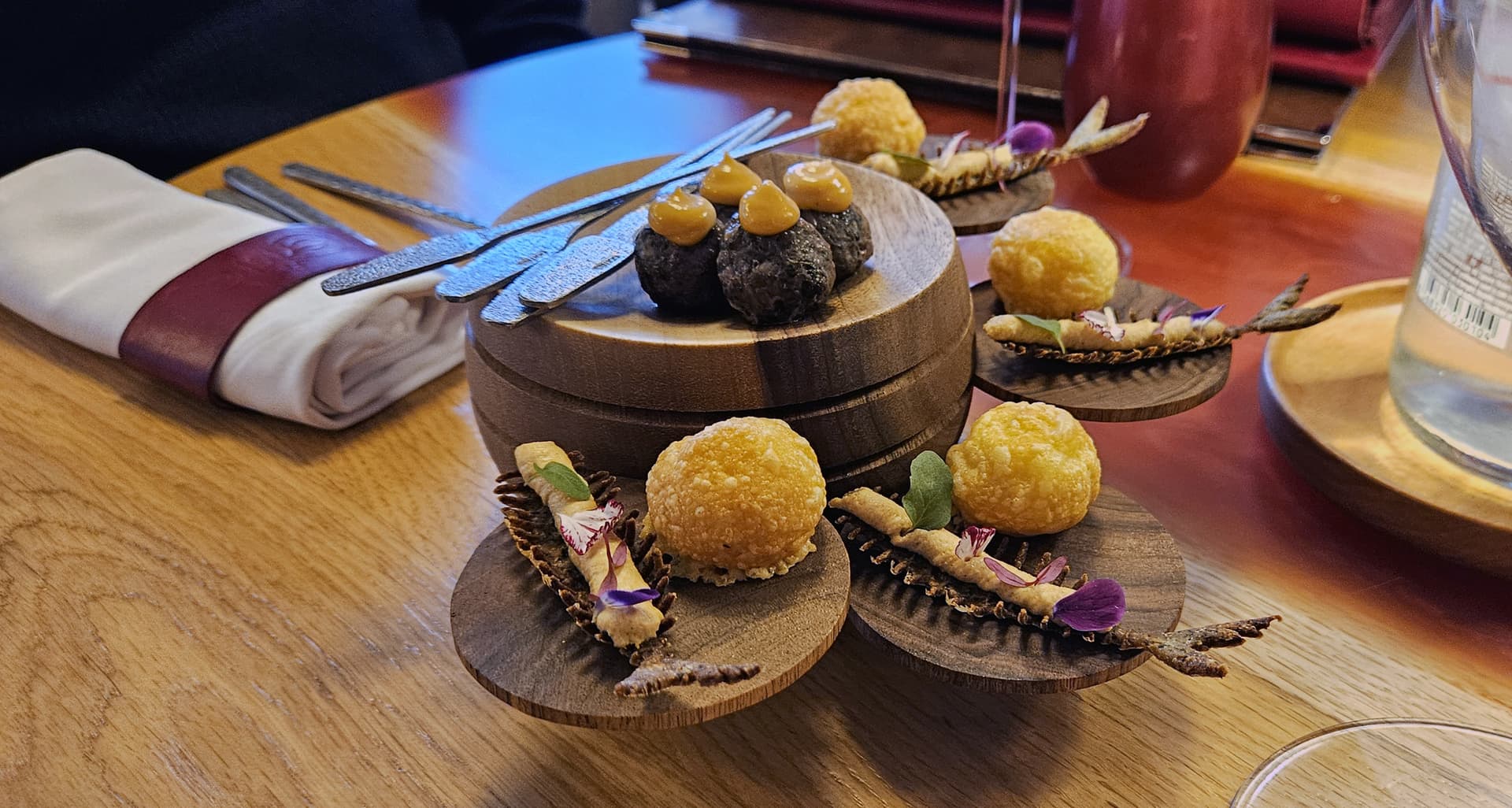
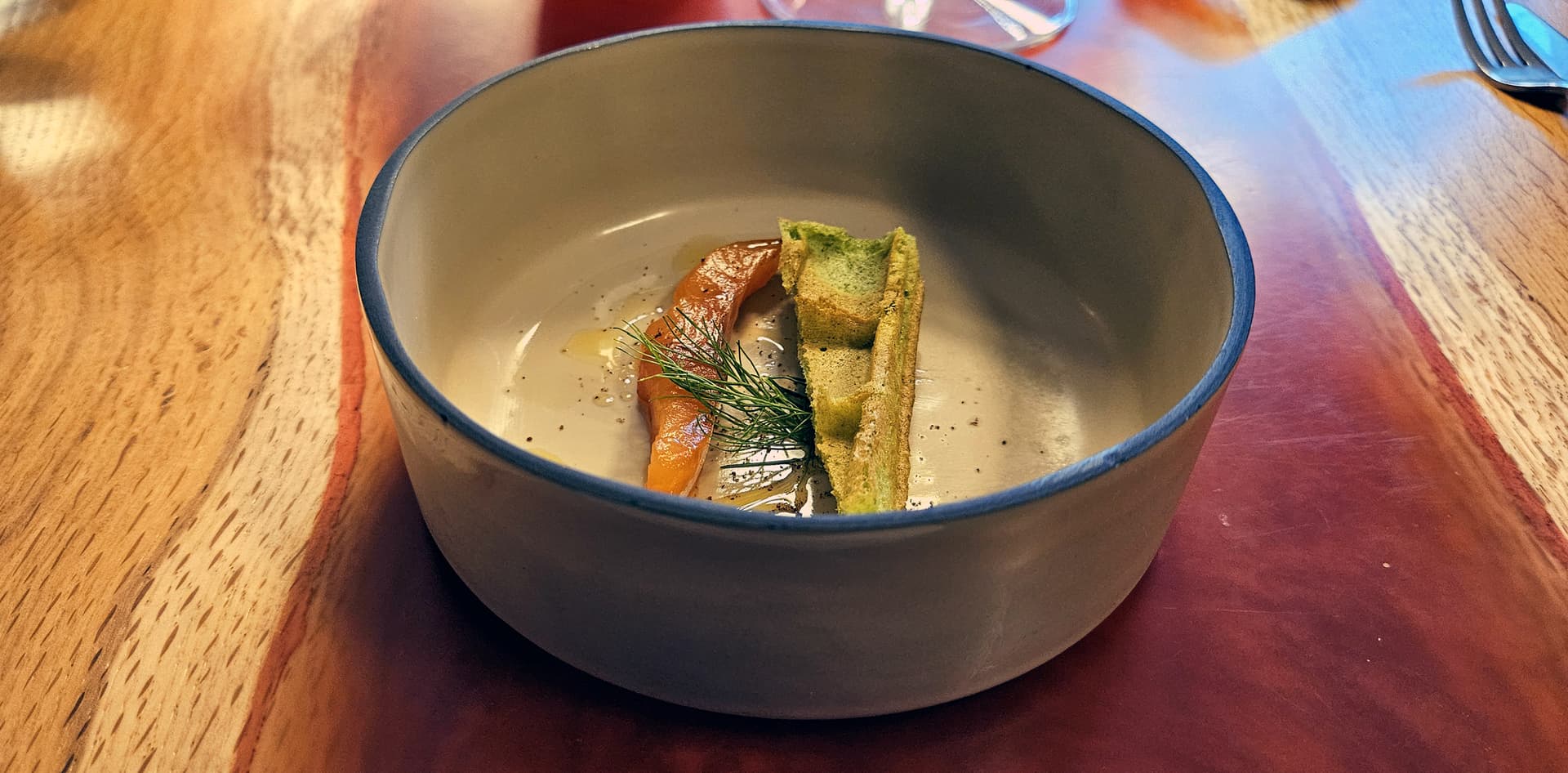
The
amuse-bouche complex (unfortunately these were for the four of us, not just for me!).
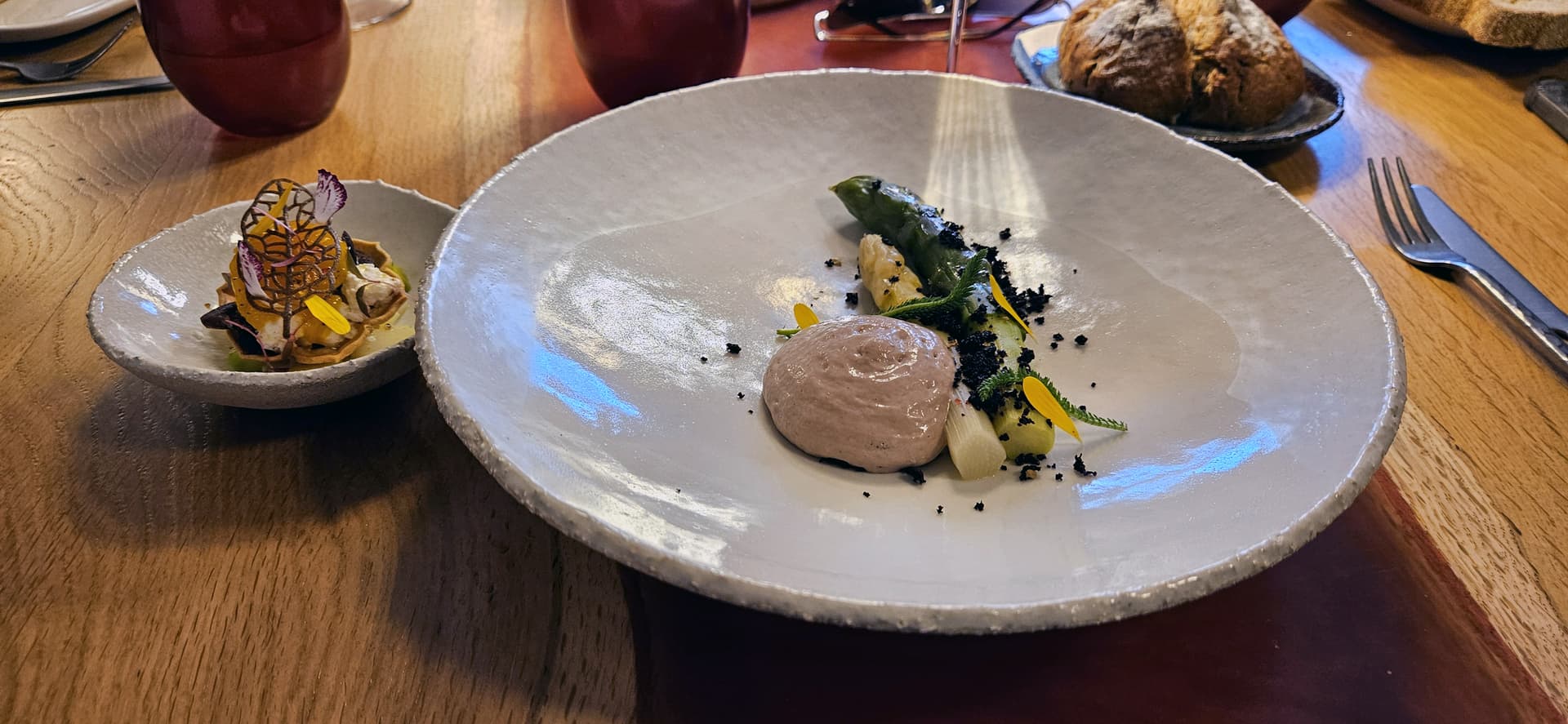
The first entrée…
…and the second entrée.
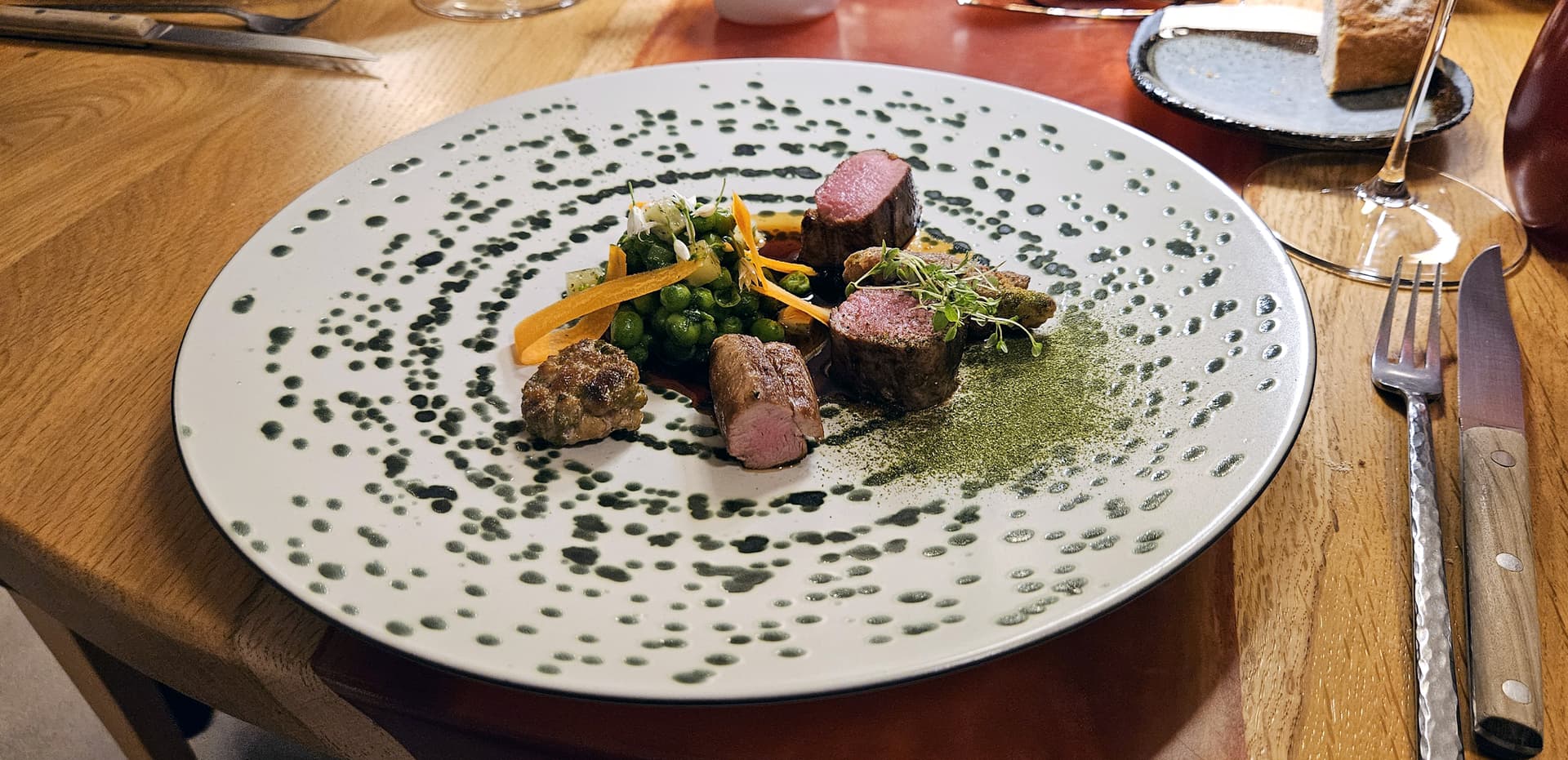
The main course, lamb.
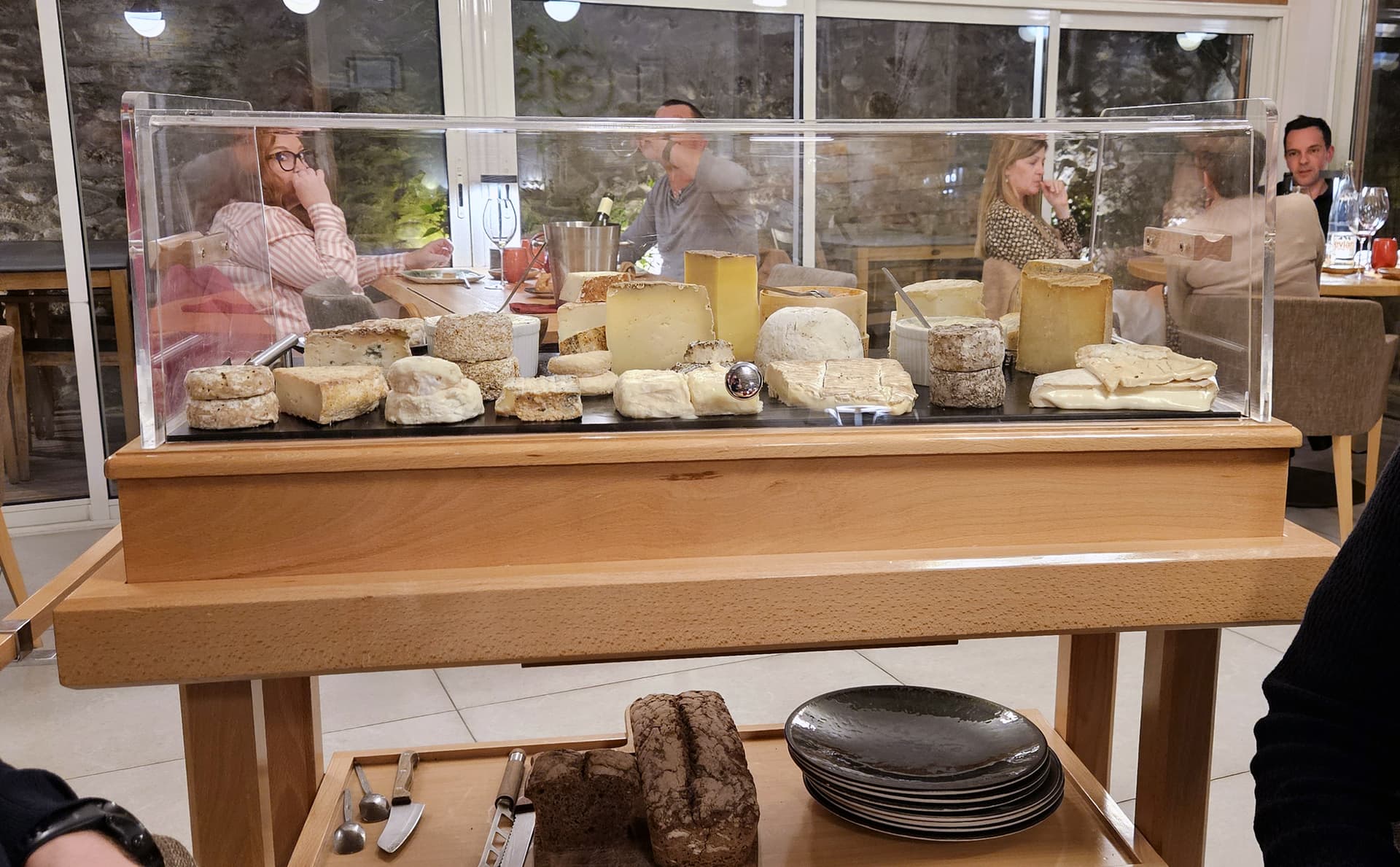
A respectably sized cheese cart appeared next to our table before the dessert…
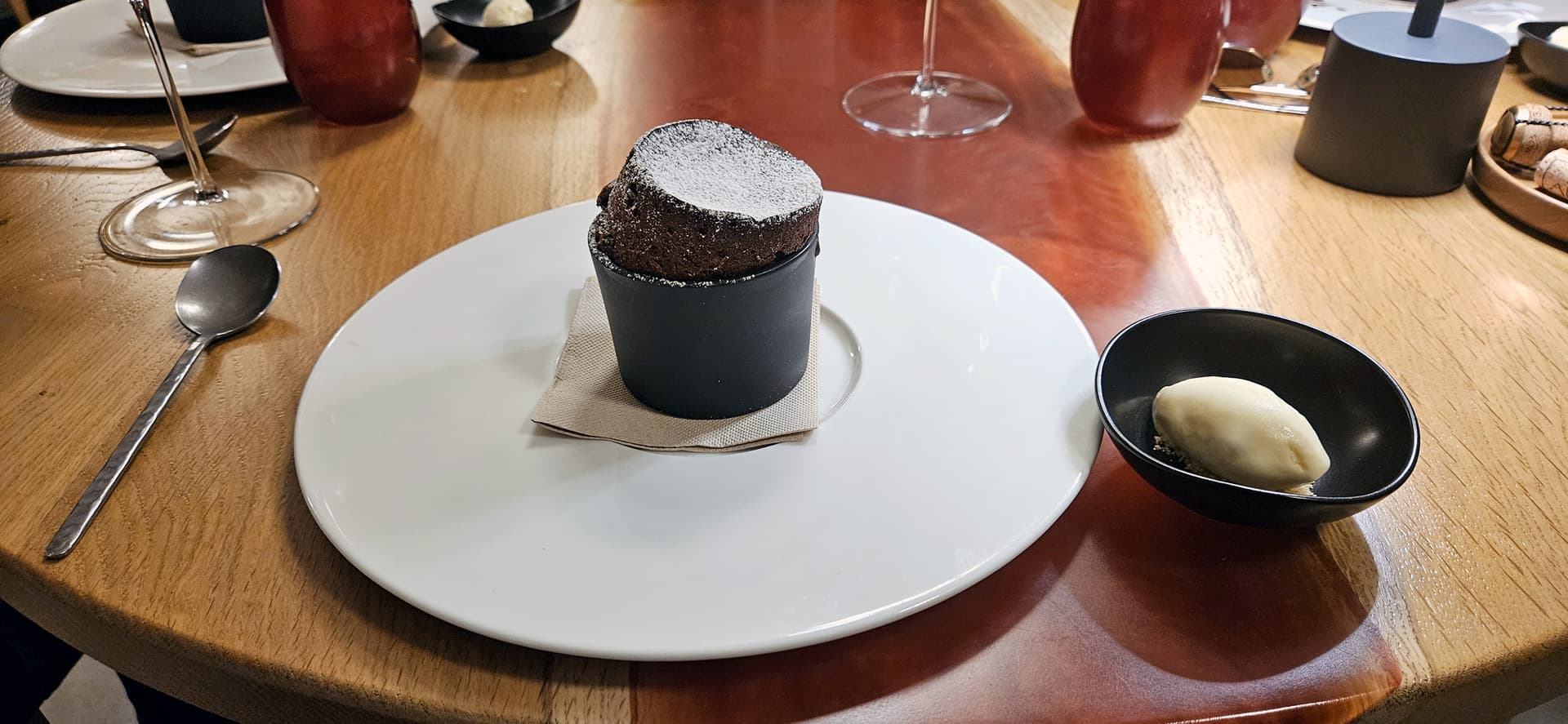
…that was this absolutely delicious chocolate soufflé with Chartreuse ice cream…
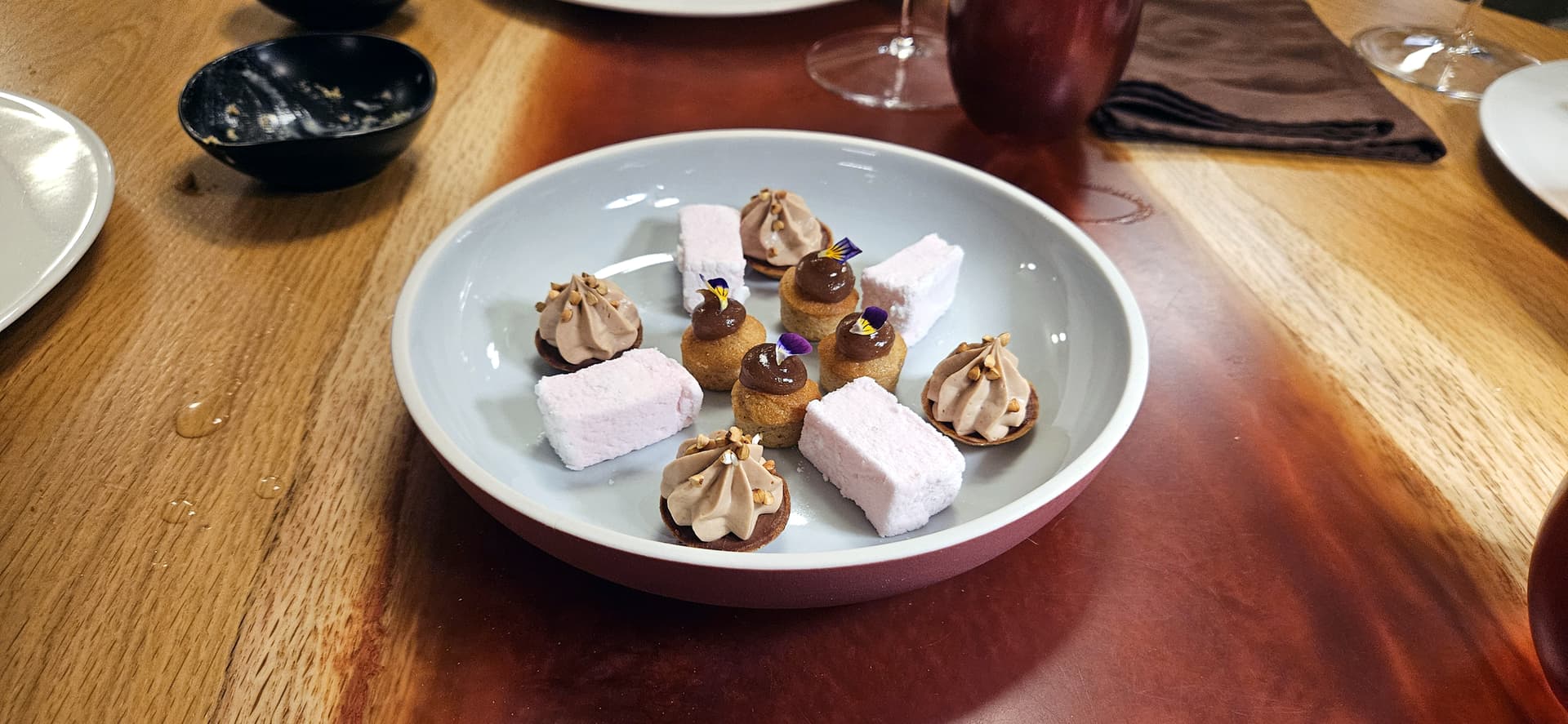
…and these tiny little sweet things.
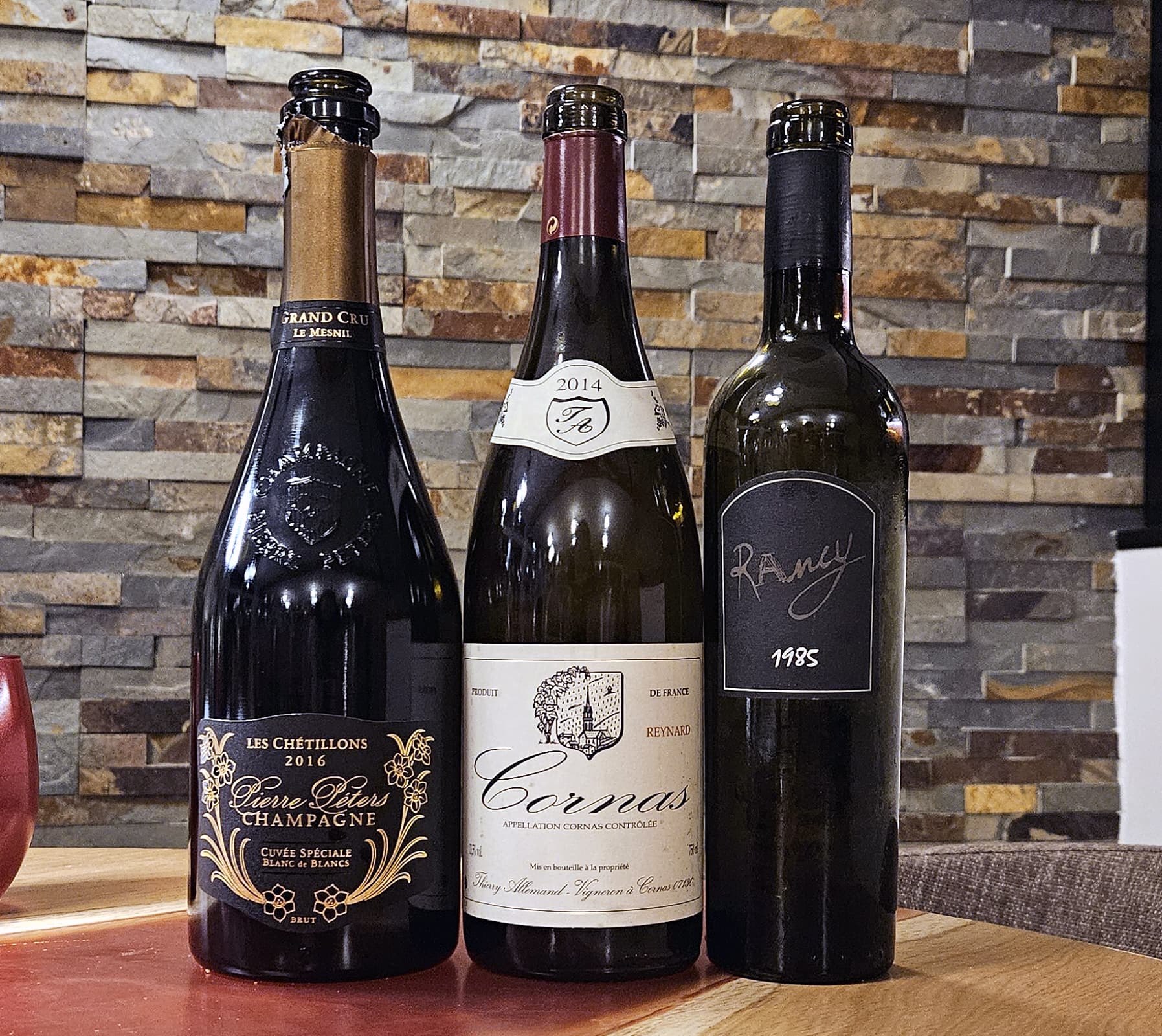
Et finalement, our selection of wines for the evening.
- 2016 Pierre Péters Champagne Grand Cru Cuvée Speciale Blanc de Blancs Les Chetillons - France, Champagne, Champagne Grand Cru (25.4.2025)
100% Chardonnay from thee old parcels in Grand Cru Les Chétillons. Fermented and aged in stainless steel tanks. Disgorged in January 17th, 2024, after approximately 7 years of aging sur lattes. 12% alcohol, dosage 3,5 to 4,5 g/l yet the wine is labeled simply as "Brut".
Relatively youthful and quite intense yellow-green color. The nose feels ripe, fleshy and expressive with layered aromas of juicy yellow fruits and white peach, some sweet custard tones, a little bit of leesy creaminess, light nutty notes of slivered almonds, floral hints of apple blossom and - especially after some aeration - an autolytic touch of brioche. The wine feels broad, ripe and subtly sweetly-fruited on the palate with a full body and rich flavors of white peach and juicy Golden Delicious apple, some chalk dust and stony mineral notes, a little bit of leesy creaminess, light autolytic notes of brioche and roasted nuts, a hint of vanilla custard and a touch of zesty citrus fruit. The mousse feels silky, persistent and voluminous, contributing to the breadth of the wine, while the wonderfully high acidity keeps the overall feel very fresh and structured. The palate-cleansing finish is long and nuanced with an intense aftertaste of ripe lemony citrus fruits and fresh Golden Delicious apple, some leesy notes of creaminess, a little bit of ripe white peach, light stony mineral tones, autolytic hints of brioche and toast and a touch of baking spices.
A beautifully structured, intensely-flavored and harmonious Blanc de Blancs with a relatively substantial and vinous overall feel. Tons of depth and complexity with quite a bit of emphasis on the autolytic notes, yet the wine isn't just a dough-y bread-and-nuts fest, but also showing quite a bit of surprisingly ripe Chardonnay fruit. What's remarkable, though, is how the wine manages to be relatively ripe and vinous, yet so wonderfully mineral with a superb streak of structured acidity, all at the same time. All in all, this is a very remarkable Champagne by all standards. The overall feel is still very youthful and even though the wine is very impressive and immensely delicious now, I can see it evolving and improving for many, many more years. Not the most affordable bubbly out there at 190€ (in a restaurant), but manages to deliver for the price. Outstanding, very highly recommended - especially if you like toasty, vinous Champagnes.
(95 points)
- 2014 Thierry Allemand Cornas Reynard - France, Rhône, Northern Rhône, Cornas (25.4.2025)
100% Syrah mainly from the centenarian vines in lieu-dit Reynard, acquired from Noël and Louis Verset, but often including a little bit of old-vine fruit from parcels in Chaillot, Geynale and Pigeonnier as well. Vinified mostly or completely in whole bunches. Fermented spontaneously in stainless steel tanks and open-top oak fermentors. Aged in old oak casks for 18 to 24 months. 13,5% alcohol.
Luminous, very slightly translucent and still remarkably youthful dark ruby color. The rather perfumed nose feels beautifully vibrant, open and juicy with intense and classically styled textbook Syrah aromas of ripe blackberries and fresh bilberries, some floral notes of elderflower, light peppery tones, a little bit of savory and earthy spice, a hint of olive, a touch of sweet black cherry and a whiff of smoke. The wine feels quite ripe, focused and slightly sweet-toned on the palate with a moderately full body and intense flavors of juicy blackberries and blueberries, some ripe boysenberry tones, a little bit of sanguine iron, light floral notes of violets and elderflowers, a briny hint of olive and a touch of stony minerality. The overall feel is very firm and quite structured, yet not stern or aggressive with the high acidity and ample yet ripe and quite silky tannins. The finish is long, juicy and quite grippy with an intense aftertaste of bilberries and black cherries, some sweet blackberry tones, a little bit of ripe boysenberry, light stony mineral notes, a hint of olive and a spicy touch of cracked black pepper.
An exceptional, so harmonious and simply just textbook Northern Rhône Syrah. Still remarkably youthful in overall feel, not really showing any signs of age despite being already a decade old - yet not feeling closed, reductive or particularly primary in any way, either. However, the wine does come across as relatively ripe and rich in overall feel, both for a 2014 Northern Rhône Syrah and for an Allemand - but I guess that's just old vine concentration for you. Seeing how the wine is still so exceptionally youthful, I can see the wine easily aging, evolving and improving for at least another decade, minimum, and keeping for much longer. An absolute unit of Cornas wine and while the wine is indubitably expensive at 350€ (in a restaurant), I have to point out that very few more affordable Northern Rhône reds manage to reach the highs this wine hits. The price is pretty silly, but then again, this wine is silly good.
(95 points)
- 1985 Domaine de Rancy Rivesaltes Ambré - France, Languedoc Roussillon, Roussillon, Rivesaltes (25.4.2025)
Typically either 100% Maccabeu or mostly Maccabeu with a tiny bit of Grenache Blanc or Grenache Gris blended in. Fermented spontaneously in concrete vats. Fortified while the wine is still sweet (at approximately 120 g/l RS) with home-made marc. Aged sur lie for a few months, then bottled into ancient oak casks. Aged oxidatively, untopped, until bottled. 18% alcohol. Lot number L 201327.
Quite deep and dark mahogany brown color. The nose feels sweet and heady with very attractive aromas of caramel and oxidative nuttiness, some dried orange wedges, a little bit of wizened apricot, light perfumed nuances of dried flowers and aromatic herbs, a spirituous hint of alcohol, a touch of bruised apple and a whiff of loose pipe tobacco. The wine feels sweet, concentrated and slightly viscous on the palate with a medium body and intense flavors of caramel and bruised apple, some oxidative nutty tones, a little bit of acacia honey, light notes of orange marmalade, a hint of warm brown spices and a touch of dried yellow fruits. The relatively high acidity makes the wine feel surprisingly fresh and wonderfully balanced for such a concentrated and sweet wine. The finish is juicy, concentrated and moderately warm with a very long and complex aftertaste of caramel, some bruised apple tones, a little bit of orange marmalade, light honeyed notes, a hint of dried apricot and a touch of exotic spices.
A fantastic, classically styled and eminently tasty Rivesaltes that is relatively lively and not that big and heavy for the style. I suppose the biggest reason why the wine shows such good sense of acidity and freshness despite all that sweetness, concentration and alcohol is because it is made with Maccabeu, not with Grenache of any color, as would be more typical for most producers of Rivesaltes. This is an immensely tasty fortified wine and a perfect way to close an excellent restaurant dinner. Not particularly affordable at 110€ for a 500 ml bottle (in a restaurant), but delivers for the price. Highly recommended.
(94 points)

 fortunately wasn’t the case the next morning, would have been devastating