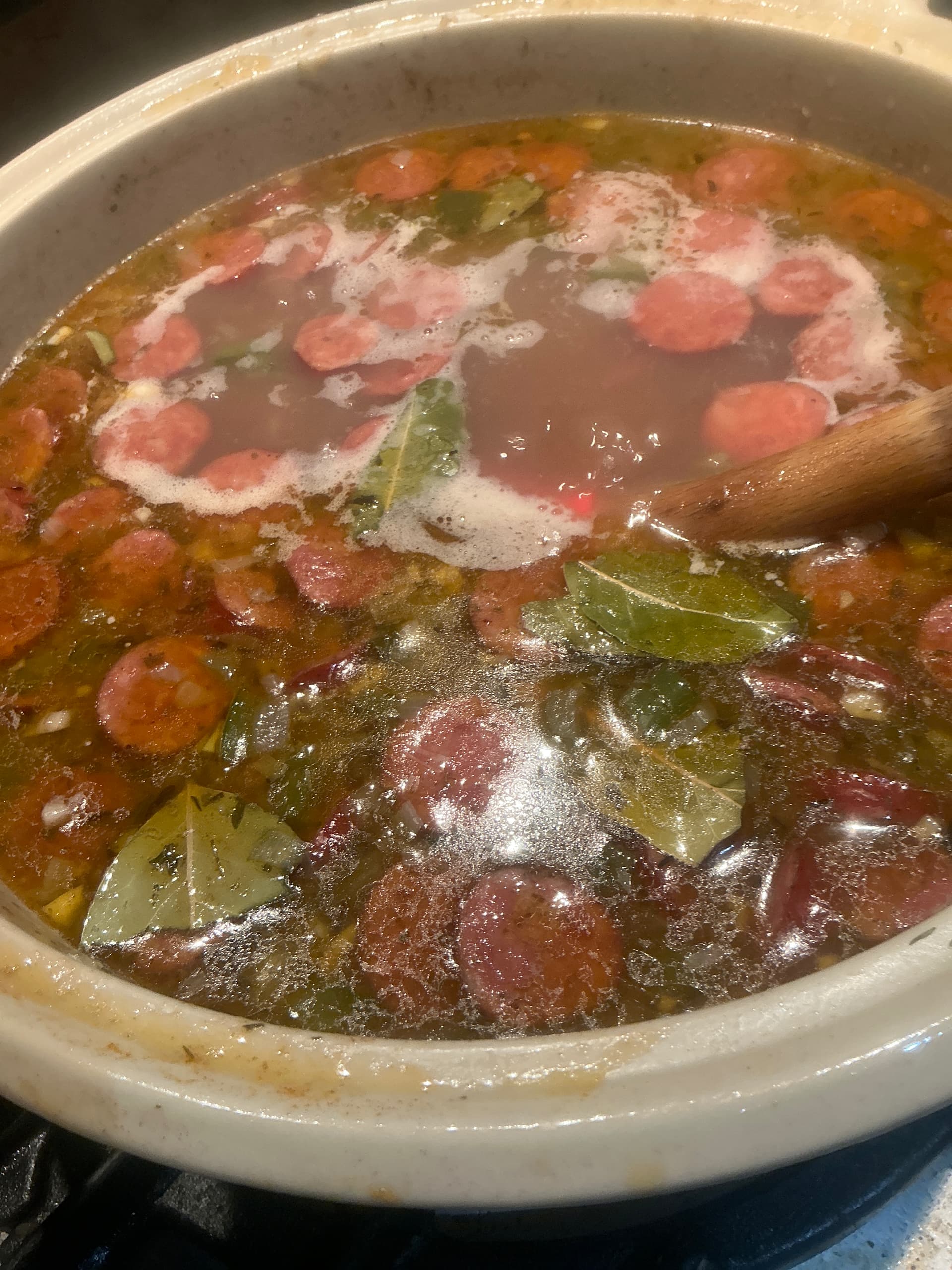
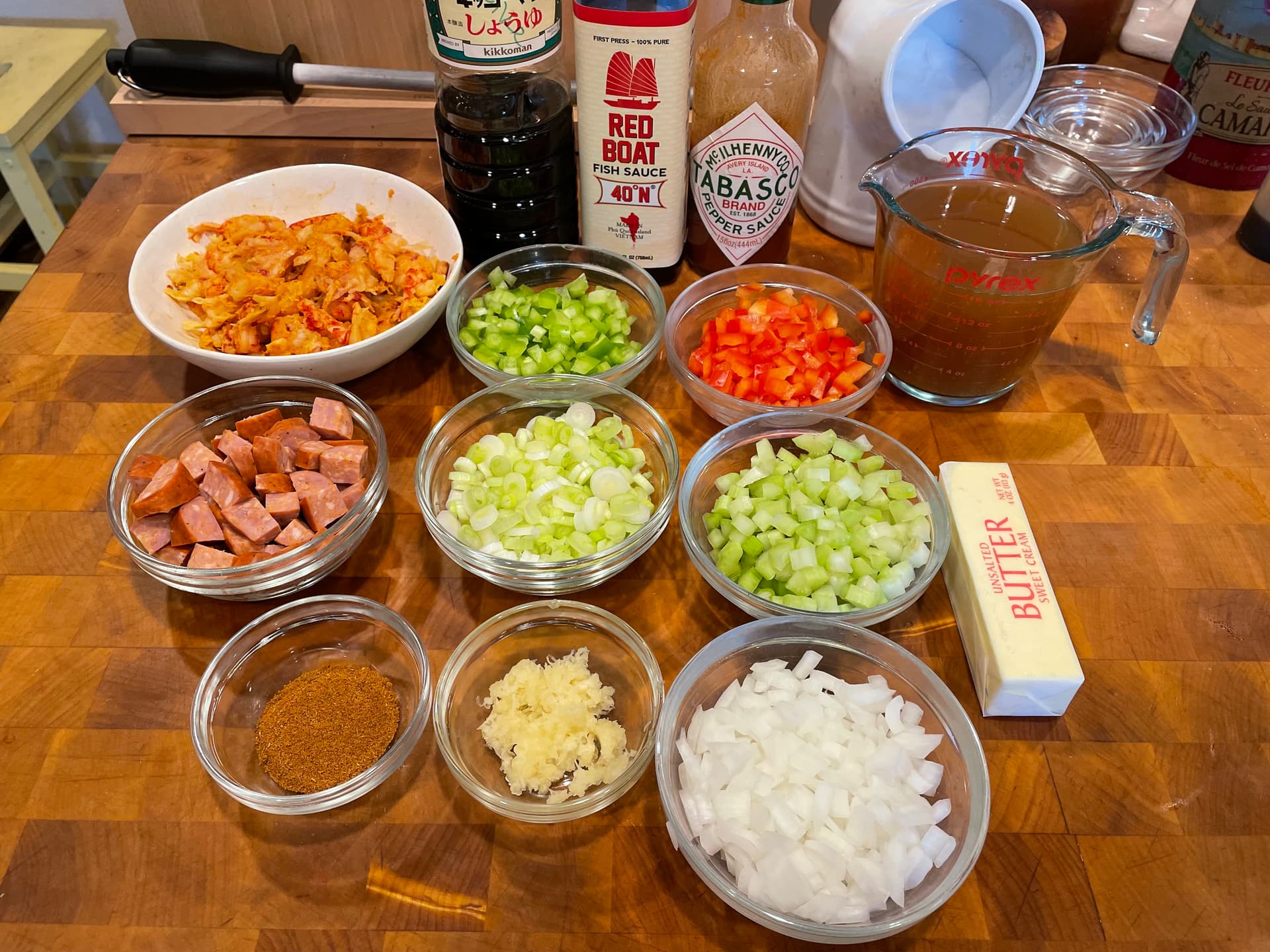
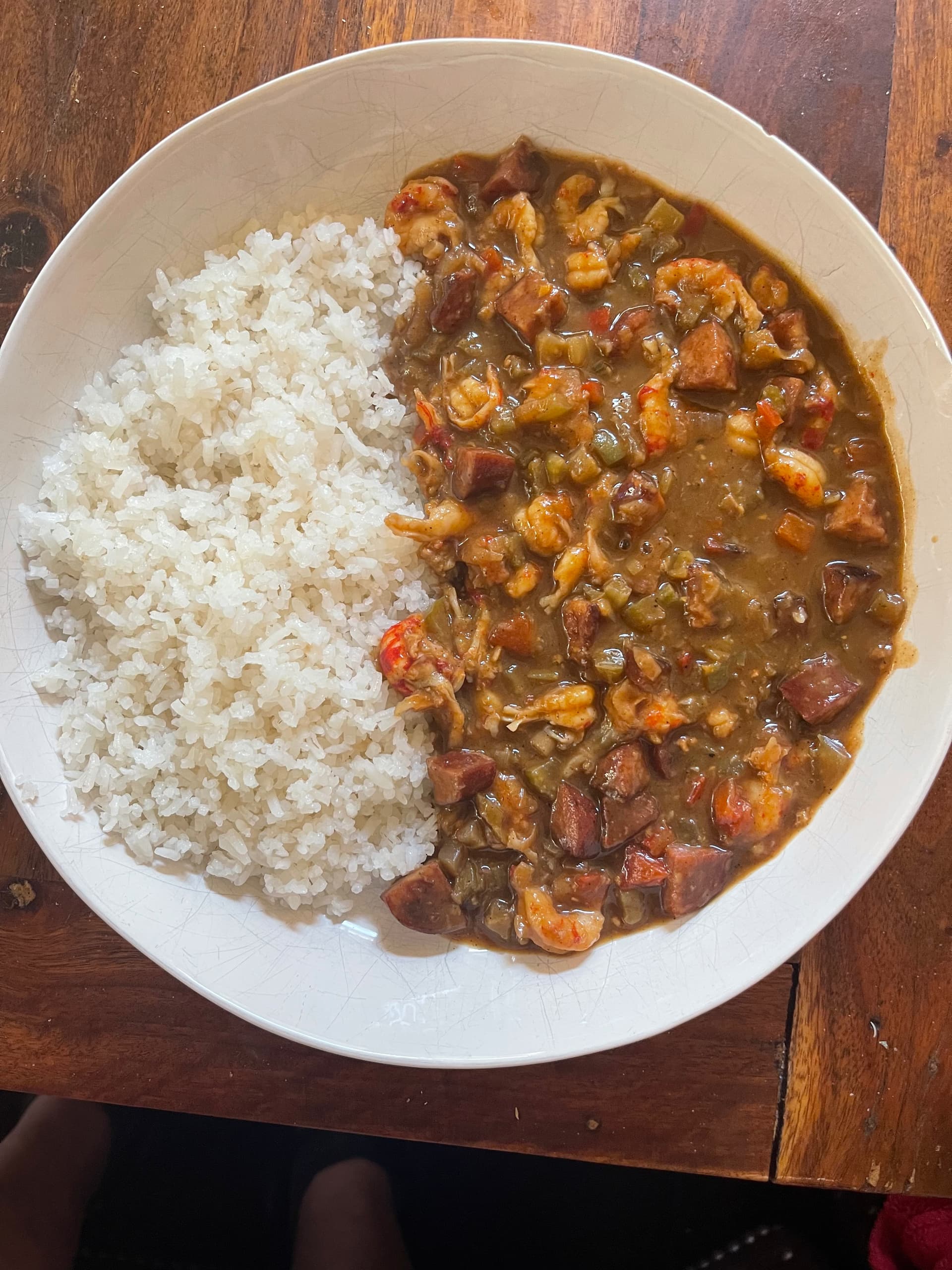
So I soaked the beans yesterday and sweet sweet aromas
Anybody have a favorite.?
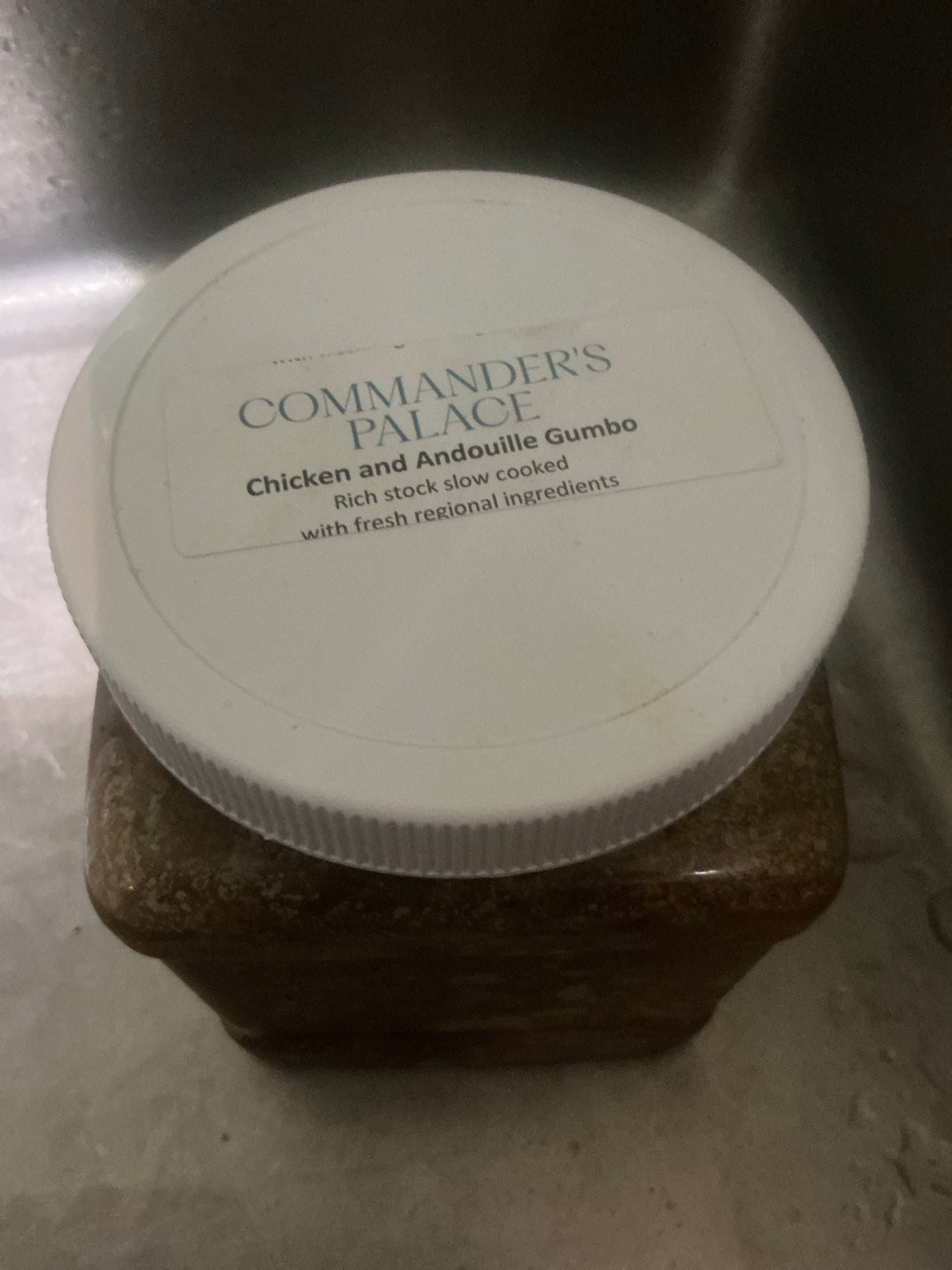
I usually do my own gumbo but for this Sunday I’ll let Commanders take it and just make the Red Beans and Martinis (plus Pimms Cup)
It is said in southern Louisiana that there are as many gumbos as there are people who make them. There are three main categories as well as an outlier: seafood, meat, creole which is a combination of the two, and the outlier is Gumbo Z’herbes traditionally made the day before Good Friday or Holy Thursday. The one common denominator is the making of a roux. A roux is the cooked combination of fat and flour. The making of a roux can vary from the light colored to as dark as chocolate and the amount of it used can result in a thin or thick textured gumbo. The use of stock in lieu of water greatly adds flavor to the finished product. In the case of poultry and sausage gumbo, the two main ingredients are often precooked and added towards the end. The remnants of the Thanksgiving turkey will be used to both make a stock and provide whatever meat remains. With seafood gumbo, the seafood cooks very quickly and should be added near the very end to prevent overcooking or even dissolving. Traditionally, okra is added to seafood gumbo while file is used to thicken the meat variety. Making gumbo is a lengthy, multi-step process that requires patience. The making of the roux alone can require 30 minutes of continuous stirring to achieve the desired color without burning. Patience is rewarded with a delicious end product that can feed a large gathering.
The titles Creole and Cajun are often used interchangeably. But they are very different cuisines. Creole is the more refined of the two and is the indigenous food of New Orleans. Many historical influences have contributed to modern day Creole cooking. Cajun cuisine is the food of southwestern Louisiana. It evolved from farmers, hunters, and gatherers. Something that the two have in common, is that they used what was available, often with very limited resources. Paul Prudhomme stated that his was a family of sharecroppers with many children. The best of what they raised was sold and what remained was that on which they subsided. To put it another way: it was the opposite of finding the best possible ingredients and trying not to screw them up. It was taking ingredients generally considered inferior, and making something delicious with them. I find it interesting that things like ribs, oxtails, brisket, etc. once considered “trash” cuts, have gained widespread popularity with the corresponding price increases. Cooking techniques like braising and low and slow smoking were necessary to make these tough cuts tender and palatable. Creole food flourished with the abundance of seafood available in southeastern Louisiana. A common myth about both Creole and Cajun cuisines is that they are overly spiced and pepper hot. What they are, if done properly, is well seasoned.
I finally made a Chicken Piquant that makes me happy, then immediately found a new technique that’s sort of a blackened sauce. Anyway, if you have made quite a few gumbos, try couvillion. A local pronunciation of court bouillon. Anyway, you cook your gumbo down, then use that to poach a fish. I also like to take leftover gumbo and just turn it into gravy. Also, there’s backbone stew. Make a roux, use it to cook your meat, then add your trinity. Yeah, I may have lived in New Orleans for a number of years. Funny story, I once heard that New Orleans was one of the few test markets for wine in the US, due to the high level of cuisine.
Having experimented with oil, a combination of oil and butter, I’ve decided that I like making a roux with just butter, with a ratio of one stick per one cup of flour. I like a very dark roux and when doing so you come close to burning it if not careful. It’s important to have the seasoning (for me, onion and celery) chopped and ready to be added to the roux in order to quickly decrease its temperature. Liking gumbo that has some viscosity, I’ll usually use two cups of flour for the roux for an eight quart pot of gumbo. Not usually having seafood stock on hand, I improvise by using a couple pounds of very small peeled and deveined shrimp, which will all but be disolved by the end of cooking. We also have available small, cleaned “gumbo” crabs that are added for additional flavor for the stock. As stated earlier, okra is added to the seafood version. It is important to parboil the chopped okra in order to “de slime” it before adding to the pot. The use of tomato is optional and may be added to the creole version but not the Cajun one. I will sometimes add a couple of cans of Rotel. It should be allowed to simmer for some time to allow the flavors to blend. Any combination of shrimp, crabmeat, and oysters are added shortly before serving as they cook very quickly.
You can cook roux on high heat, everything happens a lot faster. I do it all the time. If you keep it moving there is no danger of burning it. Best to use a spoon with a flat edge on the front.
Preferences when making poultry and sausage gumbo:
The making of the roux is the same as with the seafood version. Quite a bit of chopped onion and celery is used. I neglected to mention flat leaf Italian parsley with the seafood gumbo. I think it adds a lot of flavor and typically will use two bunches finely chopped. I don’t use green (bell) pepper because it has such a dominant flavor. Also, while using both onion and garlic in the same dish is very common, I prefer to use one or the other. For the poultry, my order of preference is duck, turkey, and last chicken. I’m always using the meat from roasted birds and using the carcass to make stock. For sausage, I like to use a combination of andouille and smoked sausage. In his book “Seasoned America” Paul Prudhomme introduced the concept of layers of flavors and textures. One way of doing this is to add the same ingredient at different times during the cooking. I fry off (very yat) some more chopped onion as well as the cut sausage and add all to the pot. Deglazing the pan with a little water adds a lot of flavor. Shortly before serving I will add chopped scallions. Hot sauce and file (ground sassafras leaves) can be added at the table as desired.
If you are not using green bell pepper you are not making gumbo.
The trinity (in a rough ratio of 50% onion, 25% green pepper, 25% celery) is a non-negotiable.
To suggest someting like ‘well there are 1000 ways to make gumbo’ to gloss over green pepper, would be a way of turning the dish into completely sometihing else that probably deserves a different name than gumbo (although I’m sure it might taste lovely)
Gumbo without green pepper is like paella without saffron.
I saw this movie where a TV chef says “and remember, never use green peppers, because they are unripe.” I just shake my head, I’ve always loved them green too.
A useful roux technique I saw on TV from Cajun country. I use to add too much flour, and then I moved my roux from really dark to really really dark. What the locals do to make ultra dark rouxs, use more oil to flour. With a thin roux you can keep the roux from thickening and burning, and so get it really dark.
I will say, of course, creole just means mixed. So there are creole cuisines all along the Gulf and Caribbean. Louisiana Creole cooking is mostly a variation on Cajun cuisine. While some Cajun purists will say it has to be one way, truth is they break all the rules they set.
One last plug, I get Andouille out of town from Jacob’s in La Place. I can see whole meat pieces in it when I cut it up. It’s so good that when I make sausage dishes like say Spanish Fabada, I use their sausage.
In Louisiana context, Creoles are original (pre-USA basically) inhabitants of New Orleans and their descendants, a definition especially relied on after the Louisiana Purchase when Americans started showing up. It evolved to also mean people of mixed race and/or people of specific heritage (a varying combo of Spanish/French/African/Native American/Italian/Etc). This is historically a moving target and one should be skeptical of people asserting very specific and unshakable genetic makeup. The only thing unshakeable is that Creoles are not Cajuns, and although Creole is a term used in several places, in my experience Louisiana Creoles do not especially think of themselves as a part of some big tapestry of Creole people in the Americas. The Low Country might as well be Mars to me, although I do understand why people would group us together with them. Anyway, from both perspectives I am Creole and I have zero Cajun ancestors.
Louisiana Creole cuisine is firmly the cuisine of New Orleans. Its relation to Cajun cuisine is due to proximity to Cajun settlements and access to similar/same ingredients. “Cajun food slightly different” doesn’t really describe either cuisine well and Creole cuisine almost certainly developed first in terms of codification.
Addressing Paul’s post which brought me here, green bell pepper in trinity is pretty important, but your dish isn’t going to break if you omit it or use a red pepper, for example (although I think you’re missing out on some necessary background vegetal character that melds with the richness of something like gumbo if you leave it out). Indeed, red bell pepper is really nice in crawfish etouffee. Personally I use poblanos instead of green bell peppers as they function identically when cooked and add a little extra heat. I’m not the first to swap in poblanos. And of course we cannot ignore the practical functionality of traditional Louisiana cooking, as my Me-Maw on rare occasion would omit bell pepper or celery if for whatever reason she didn’t have any (onion was never left out though). I grew up in a very stereotypical New Orleans household wherein we ate red beans, etouffee, grillades, fried seafood, etc every week and I often watched dinner get made.
I’ve seen some questionable gumbos on the internet over the years. I vigorously reject the idea that gumbo is “whatever you put in the pot”, there’s indeed a line that when crossed something stops being gumbo, but I don’t think omitting green bell pepper is over that line at all. I suppose if you subbed green pepper out for something nuts like squash I’d ask you meet me outside. But green bell pepper haters, keep hating ‘em, doesn’t matter much to me.
If I had to pick one nonnegotiable ingredient for gumbo (excluding things like gumbo z’herbes) it’s the sausage. It doesn’t have to be andouille, but it does have to be a Louisiana style smoked sausage. I learned this when I cooked jambalaya in Washington state. I was surprised by the lack of smoked sausage options and we went with some generic thing, I don’t remember what. What shocked me was how wrong the jambalaya tasted to me, I couldn’t believe the sausage messed it up so much. Everyone loved it but I thought it was just terrible. I spent five very strange months in Salt Lake City, the only time I’ve ever lived outside of New Orleans, and I brought with me something like twenty pounds of frozen smoked sausage so I wouldn’t die out there.
For clarification: I don’t dislike green (bell) pepper. When I cook brown lentils I use onion and green pepper and leave out the celery. But I don’t add it to the pot raw, always sautéed. I will also use it when making sausage and peppers.
Ain’t no one should ever be adding raw bell pepper to any finished pot of gumbo, red beans, jambalaya, or etouffee so we’re all good on that one!
For me, Trinity needs to meld into the dish. I chop it fairly fine and cook it in fat as the first step, or second if a roux is involved. I do not prefer big chunks of veg in these dishes.
I’ve have never cooked it and I have never had it. It’s made with a copious amount of various greens. I am sure that I would enjoy it because there isn’t a green that I don’t like. In New Orleans, Leah Chase is deified, and rightly so. It’s a long standing tradition that on the Thursday before Good Friday, her restaurant “Dooky Chase” makes a huge quantity of the dish and people flock to the place from all over the area to partake. Tradition has it that an odd number of greens should be used, I think that they use nine, and that for every one used you will make a new friend. I’ve never really have understood the Lentin connection since her version is loaded with various meats. I’m sure that it’s a tough seat to get but I think they do a lot of takeout for the masses.
I have been making a pretty good gumbo lately out of smoked rabbit, smoked sausage from Best Stop in Lafayette and shrimp. I use a Smokai attachment on the smoker so I can essentially cold smoke the rabbit for a long time without drying it out and it gets smokey as hell, which adds a wonderful element to the gumbo. Equal parts deeply reduced shrimp stock and deeply reduced chicken stock which has been enhanced by browning a ton of batches of chicken in a skillet, deglazing with a little water and pouring that water into the stock.
Unorthodox here for sure but I like to add a little Maggi Arome (the French version) at the end for umami.
My in-laws (large family) are from SOLA, but focused around Lafayette and they are extremely food/cooking serious when it comes to SOLA food. Michael has hit on some good points, especially the difference between creole and cajun. My relatives cook cajun. While they do cook seafood gumbo, by far the most common is fowl (wild duck or chicken or both) and sausage and they’ve moved away from andouille (too dry - the local version) and over to pork and venison local smoked sausage.
Here’s an antithetical tip - while it is hard to find outside of SOLA, use premade roux. Savoie’s is their favorite. It’s a simple item (oil and flour) that is routinely messed up at home and inconsistent. Using the premade ensures that critical part is never messed up. So easy to get it too dark (burnt) or not dark enough and it is a lot of effort. They convinced me with the results and I’ll never go back.
The most difficult thing for those of us not living in SOLA is to source some of the ingredients. Our local concept of andouille is just another sausage with some spices. Local smoked sausage is nowhere near flavorful enough. Down there, every grocery store sell big bags of the trinity already chopped and ready to go.
This list is from my most food centric person down there. I’ve been to about half of them and many times to the crawfish places. In mostly random order for you to check out:
Riverside Inn
Dupuys in Abbeville
Don’s
Nash’s
Prejean’s
Pop’s Poboys
Old Tyme Grocery (poboys)
BJ’s Pooboy & Plate Lunches (sister restaurant to Old Tyme Grocery)
Cajun Claws in Abbeville (seasonal ~Dec. through April)
Crawfish Time (seasonal ~Dec. through April)
The last two only open during crawfish season and boiled crawfish is the show. The absolute best is. Cajun Claws. Huge and clean crawfish. You’ll need to PM me for insider tips on the protocol if you get down there. Doesn’t even show up on Google Maps. Truly entering a different world - just a couple of trailers put together for dining rooms, but the crawfish will spoil you.
Crawfish are small earlier in the season. Feb.-April tends to be prime time.