After what I can only describe as an ordeal with our Sixt rental (more details here), my husband and I finally made it to our friend’s lovely home in Föhren, a nice midway point between my targeted Mosel and Saar wineries.
Day 1 (no actual tastings on this day)
Our first stop was to Rieslinghaus, the wine shop in Bernkastel. I had made a single slight attempt at attaining a Prüm tasting two weeks before arriving and received the expected redirect to Rieslinghaus. I decided not to press the matter: we already had a full schedule and I didn’t feel the need to press things with this 2-person winery. So the stop at Rieslinghaus was to book their Prüm tasting. While there, we had a nice chat with Jurgen who recommended that we taste some Unterlind. This is a winery started in 2019 by Veronika and Heiner Bollig (also at Egon Müller) based on their 2 hectare holdings in Trittenheim, Brauneberg and Leiwen. I noted the recommendation.
Day 2: Falkenstein
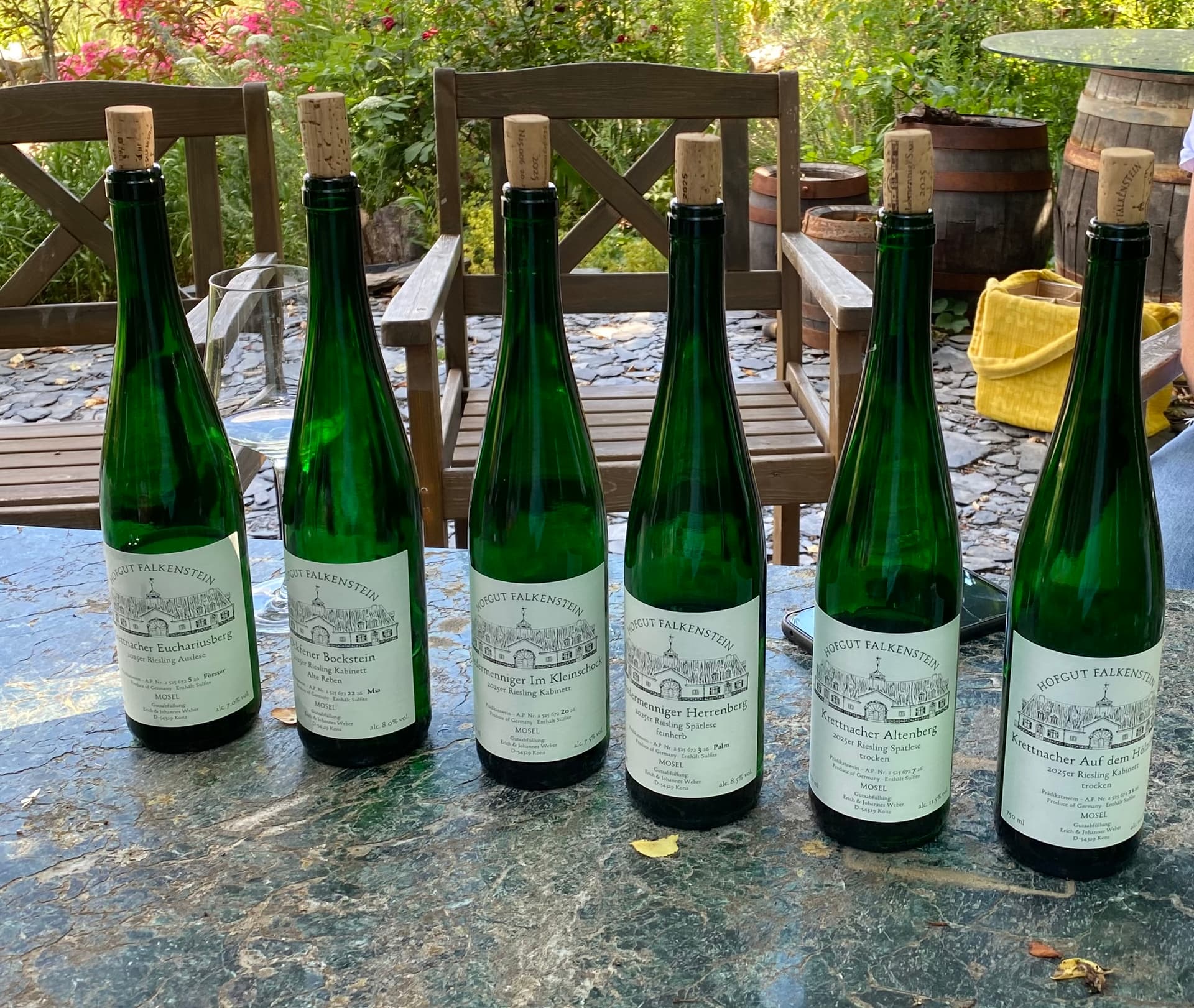
We met Johannes Weber at 11 am at his vineyards in Konz. The weather was just perfect (we arrived in the region just after the heat wave) and we enjoyed a relaxed series of their fantastic 2025 offerings, accompanied by a casual, spirited and wide-ranging conversation. His wife and their lively young daughter made a couple of brief appearances, highlighting a consistent theme in our Mosel-Saar tastings, that these are family run enterprises.
(The name in parentheses refers to the cask designated for fermenting from the parcel.)
**
2025 Krettnacher Auf dem Hölzchen, Kabinett trocken**
Johannes used the phrase “lemonade” with reference to his wines. That is ultimately the only beef I have with him. I know what he means, but lemonade does not even begin to describe the delicate yet potent precision of Falkenstein wines. This wine is lemonade if the progeny of lemons and apples were juiced on grey slate and herbs, then laser-beamed directly onto just the right taste buds of the mouth. I remember sitting up at this this early point in the tasting. Here I was, thinking only about the Forster Euchariusberg that was surely to come, but things had already gotten interesting.
2025 Krettnacher Altenberg, Spätlese trocken
From the same vineyard as the Kabinett above, but not just from prized the “Auf dem Hölzchen” parcel. Lemons and votsala (Greek for pebbles). I use the Greek term because it nicely depicts the slight roundness of this wine that comes with no compromise of acidity. It’s this point that I start waxing on about how the US South really needs to learn that Rieslings such as this are just the antidote to our humid summers. Johannes nods good humoredly.
2025 Niedermenniger Herrenberg, Spätlese feinherb (Palm)
Not from the Meyer Nepal that I may have been secretly hoping for, but a lovely wine, from lower vines that are picked a little earlier. Yet another beautifully balanced: lemons, herbs, and minerals. And again, marked by Falkenstein’s signature spontaneous fermentation in pretreated old fuders.
2025 Niedermenniger Im Kleinschock, Kabinett
I myself am fond of the term “fruchtsüßen” (“fruit-sweet”) to indicate a harmonious coexistence of fruit and natural sweetness. Although not fully dry, this citrus fruit-forward wine comes from a vineyard much prized in the 19th century, and has the “er zappelt” characteristic celebrated in Lars Carlsberg’s recently published translation of Karl Koch’s 1897 “Moselwein.”
2025 Ockfener Bockstein, Kabinett Alte Reben (Mia)
Here Falkenstein winemaking meets the venerable old vines of Ockfener Bockstein. The result is linear acidity paired with complex concentration. Not to be touched for a good long while.
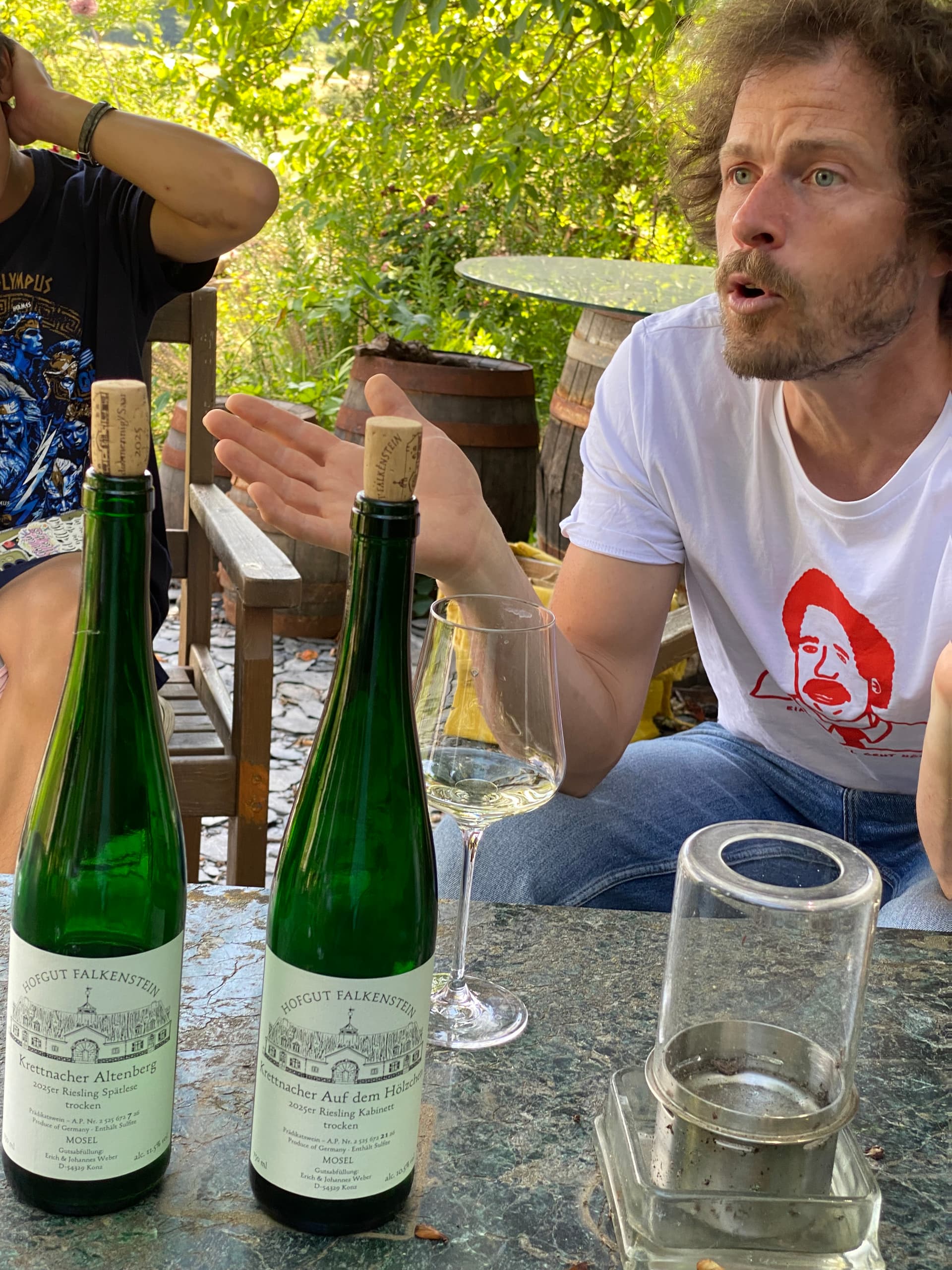
2025 Krettnacher Euchariusberg, Auslese (Forster)
This is the one I was waiting for (of course). 2025 was a warm vintage, and this wine shows it in its bold fruit flavor. But I was happy to find that high-tuned acid balance again. Great stuff.
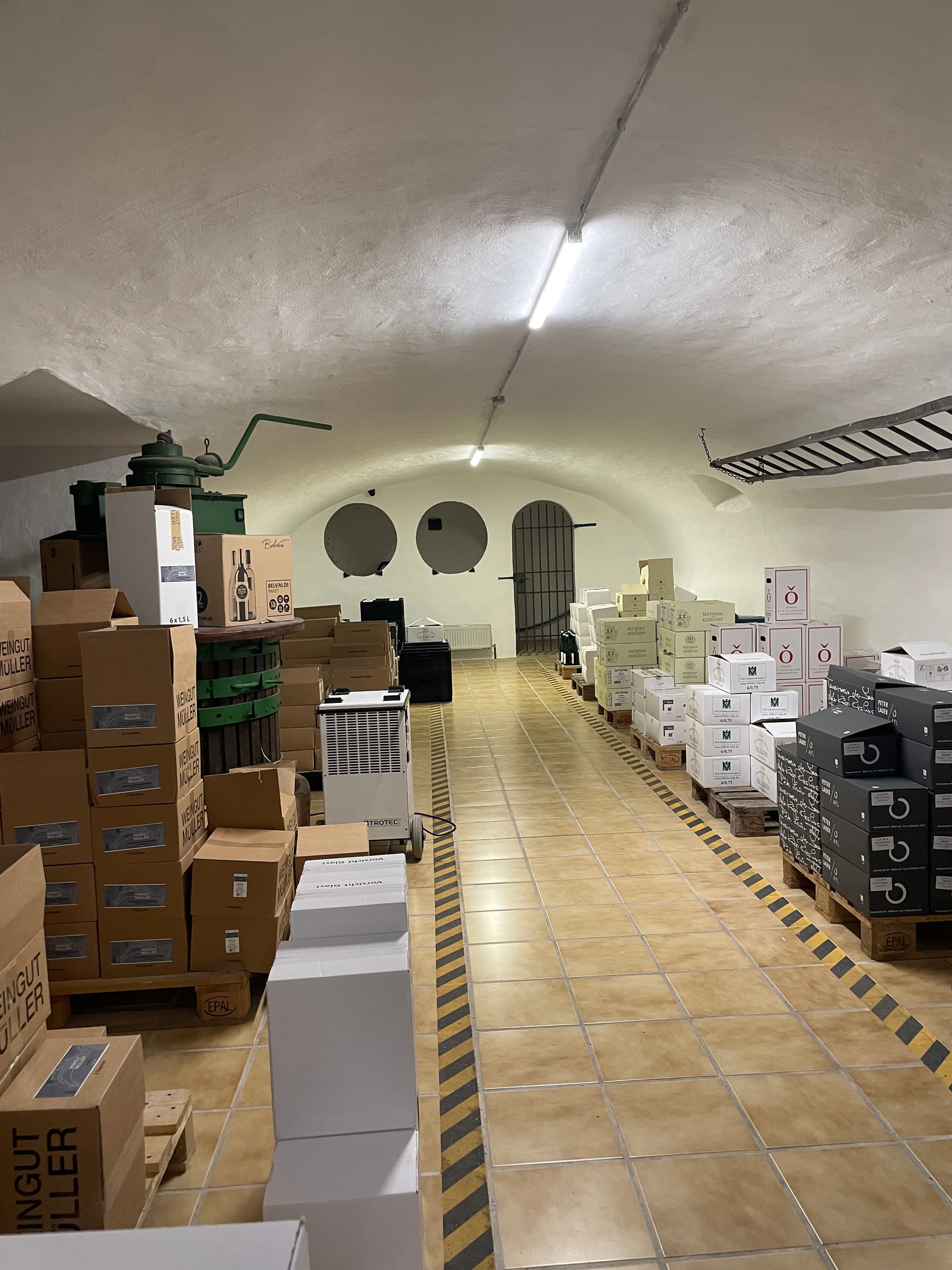
Johannes had no wines to sell, so we hotfooted over to Vinothek der Saar to begin to fill up the 24 slots in our wine suitcases, and here we were met with the highly capable Marius Klein. This is a wine shop I happily recommend (I believe this is the same shop “Bonsai and Wine” recommended previously here on WB — no idea why “Bonsai”). Not only was Marius’s expertise welcome, but he was also kind enough to drive us to his warehouse (photographed below with permission) where he held the particular wines we were seeking. The Vinothek’s storehouse, it turns out, used to be owned by Weingut Gebert, a nice space for the shop to pick up! Marius said something in his shop that struck: pointing at an Unterlind, he called it the best wine produced in 2024 when everyone struggled. Yes, all this Unterlind talk could be part of some dastardly sales conspiracy, but I bit. I’m not so paranoid, and fully capable of taking on good advice when I receive it. I look forward to tasting this new maker to me.
Day 3: Willi Schaefer and Clemens Busch
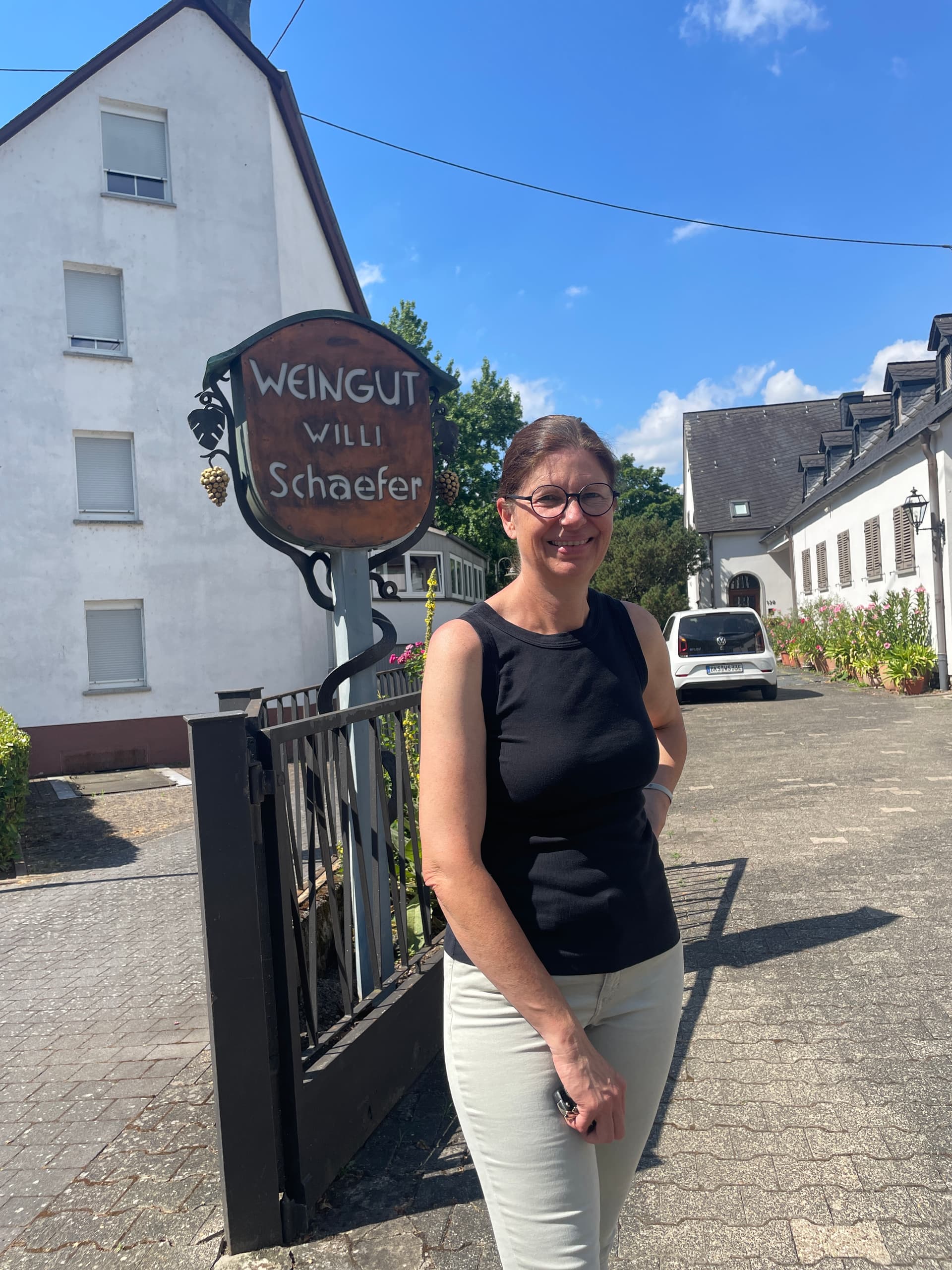
Andrea Schaefer met us at the door and invited us in to their tasting room, gracefully furnished with an oak table. Andrea was both welcoming and personable, and Christoph joined our conversation a few times during our visit, as he went about his work. Andrea started by pouring an amber liquid from a green unlabeled bottle and gestured that we try it. “What is it?” I asked.
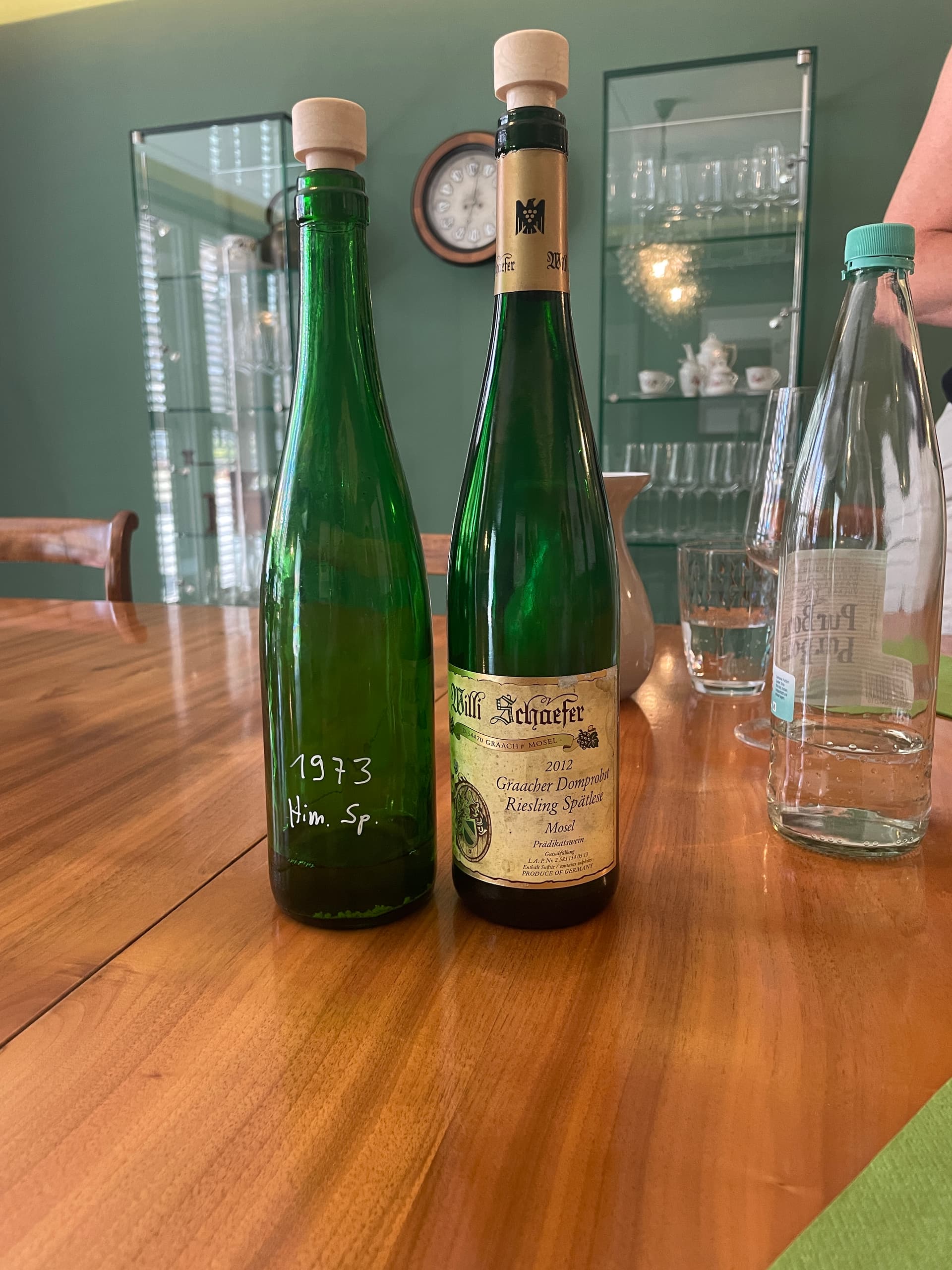
1973 Graacher Himmelreich Spätlese
Wow. Lively, pronounced tertiary fruit notes and balanced acidity. This Spätlese drank like an off dry Auslese.
2012 Graacher Domprobst Riesling Spätlese #5
A fantastic balance of citrus, apricot, acidity and slate. In its prime with at least a decade of life in it. A fine vertical comparison to the 1973 before it.
2025 Graacher Riesling trocken
Refreshing, well balanced, with lively acidity and citrus, stone fruit.
2025 Graacher Himmelreich Riesling Kabinett
I have an affinity to the fruit-forward nature of the wines that come from Willi Schaefer’s holdings in this vineyard. This 2025 Spatlese is no exception, showing the results of an excellent year. This is a lively, bright and juicy wine.
2025 Graacher Domprobst Riesling Kabinett #3
The fruit-mineral balance here veers towards the latter in this Domprobst, affected as it is by the blue and grey slate of the vineyard. There are also more green fruit notes on the palette.
Our series of Spätlesen continued to show the strengths of this vintage, which was smooth sailing for the Webers and their team until harvest time which brought wet, warm conditions. The harvest was completed speedily to protect the grapes, while retaining careful picking techniques. All the wines below showed beautifully and the #5 was a standout for its intensity.
2025 Graacher Himmelreich Spätlese
I got pineapple, a hint of lychee, citrus and a mineral background. A clearly age worthy wine of its own right.
2025 Graacher Domprobst Spätlese #10
Here, the minerality resulted in a wine that is light on its feet. Yet a hint of cassis attributable to Domprobst’s clay soil gives it a distinct expression.
2025 Wehlener Sonnenuhr Spätlese
A grosse läge vineyard but without the Domprobst’s spice notes.
2025 Graacher Domprobst Spätlese #5
A more concentrated wine than the #10. A remarkable opportunity to compare Willi Schaefer’s particular numbering system.
Our tasting ended with three sweet wines. The concentration, complexity of the 2006 #9 was certainly a standout.
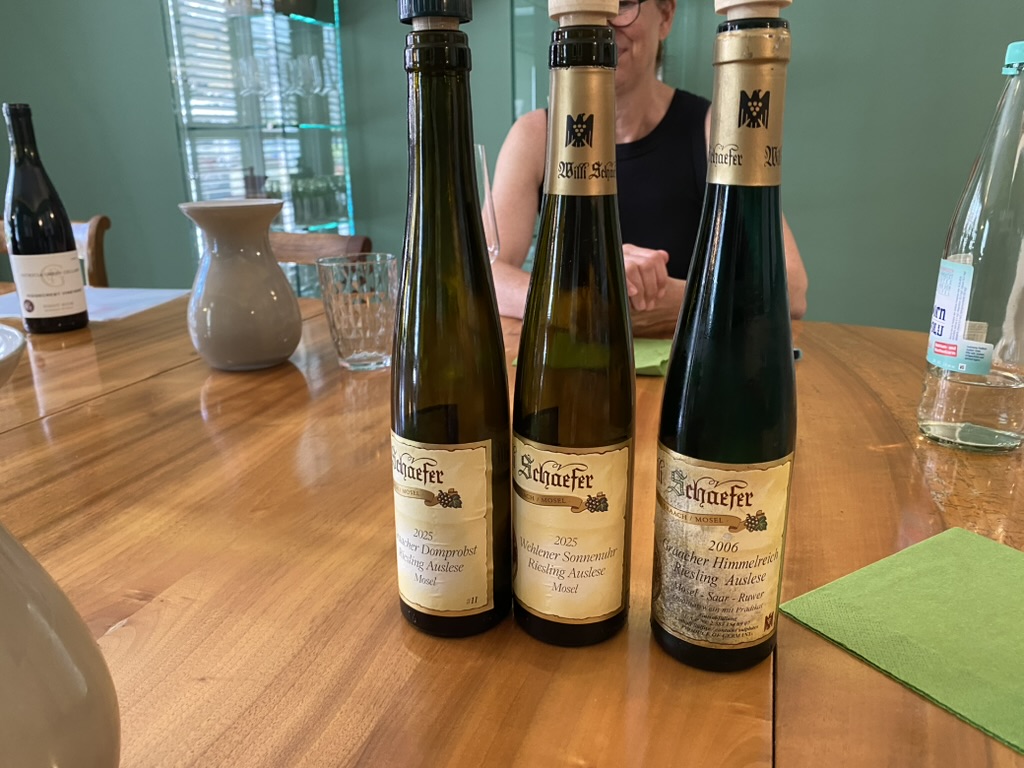
2025 Graacher Domprobst Auslese #11
The lightest of this flight.
2025 Wehlener Sonnenuhr Auslese
An outstanding sweet wine.
2006 Graacher Himmelreich Auslese #9
Once again, Willi Schaefer’s numbering “curiosity” withstands scrutiny but now with age. The #9 showed a concentration and fruit forward complexity. If only I had had the opportunity to taste an auction wine, but frankly what I had was plenty good enough for not only my but also the most privileged of Riesling drinkers.
Our tasting at Willi Schaefer confirmed just how unique their wines are. In my opinion, it’s hard to overstate the persistent quality of Willi Schaefer wines. This tasting was a study in Riesling excellence.
Stay tuned for my forthcoming write up of Clemens Busch, and Day 4: A detour to Nahe/ Rheingau for Donnhoff and PJ Kuhn.