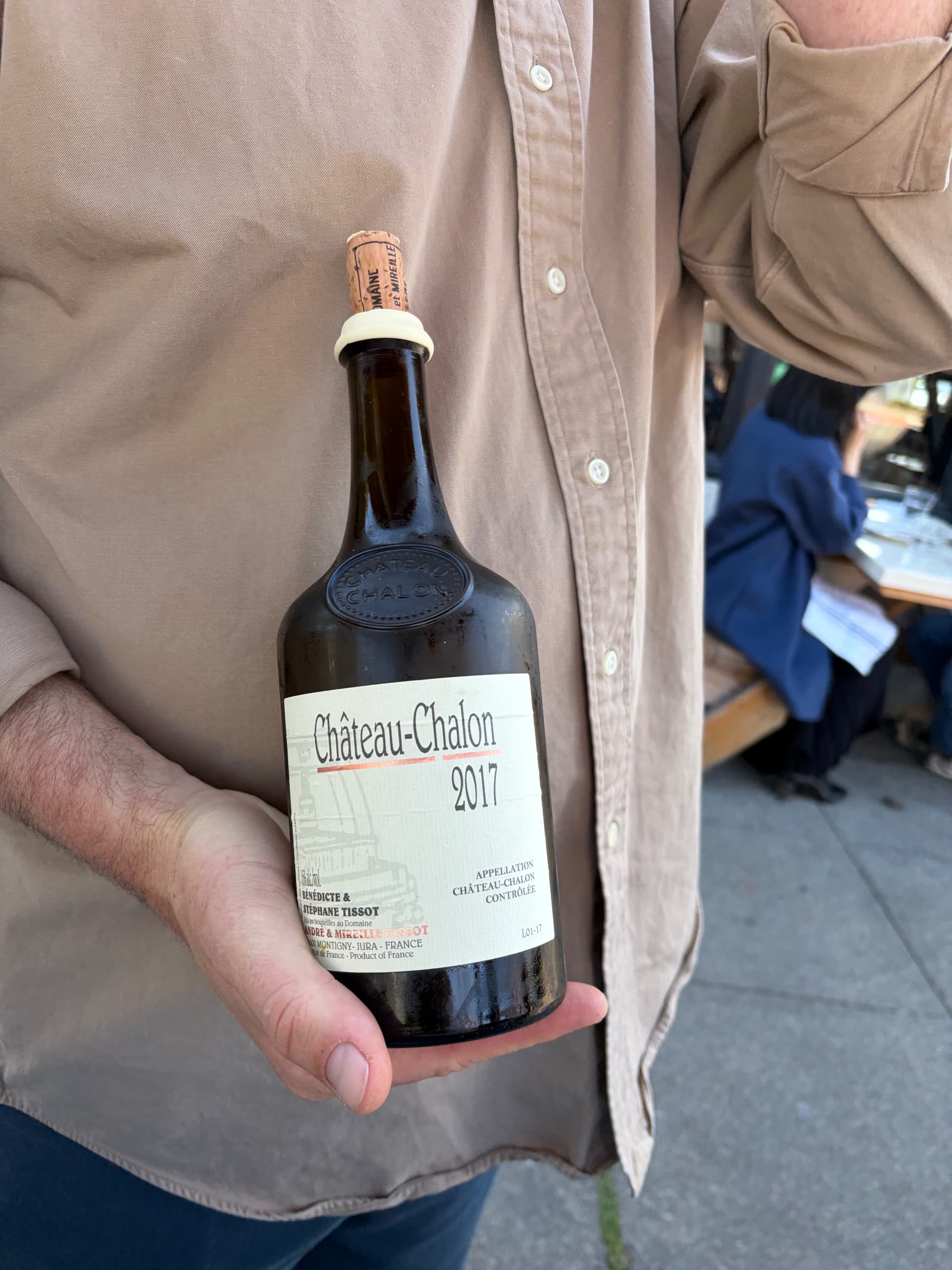
Hi, I was looking to see if I could get any additional info here. I am new to Jura but I have been really wanting to try some. For reference I appreciate the Blanco’s from Lopez de Heredia and it seems the wines of Jura draw a similar crowd and are made in a unique and oxidative way. My local wine shop carries the 2017 Tissot Chateau-Chalon and I am interested in grabbing a bottle but I am having a hard time finding answers online so I figured I would make this post.
How is Tissot as a producer?
Where does the Chateau-Chalon fall in the Tissot lineup?
Was 2017 a good vintage?
How much of this wine is made?
First of all, do you know what you are getting into? Sure, both Heredia whites and vins jaunes of Jura are made oxidatively, but that’s about it when it comes to things these wines have in common. Heredia whites are Rioja whites that are aged in topped-up barrels for a very long time, whereas vins jaunes are aged in un-topped barrels, under a layer of yeast flor, which makes these wines very aldehydic - similar to a dry Fino Sherry, just without the elevated level of alcohol from the fortification.
A good one. Many consider to be among the top producers, but I’ve never been as thrilled. They make several different Vins Jaunes, but many of them feel a bit overworked to me.
Château-Chalon is the top appellation of vins jaunes in Jura. They declare a vintage when the wine quality seems good enough and no matter how good your wine is, if CC vintage is not declared, you can’t bottle CC.
Tissot makes some odd single-barrel vins jaunes, too. However, even if they are more rare, I’d say their CC sits on the top. The rest of the wines are experimental oddballs, CC is classic.
No. It was one of the most miserable vintages in Jura innthe recent past. However, if CC vintage was declared, the wines that were released should be good stuff. I’d be more wary of the regular Jura 2017’s - the CC’s have passed a panel approval so they should be good.
Not much of CC is made as a whole - it is just a small village in Jura and all CC should come frome the vineyards surrounding the historical village. If any producer makes any CC, it should be good and normally the production numbers range from some thousands of bottles to just a few hundreds (ie. just a few barrels).
Thank you for the awesome info! This is exactly what I was looking for. To answer your question, do I know what I am getting into? Absolutely not! But I am intrigued and figured it’s worth a shot. How else will I know?
Not much to add since Ilkka and Otto covered it well.
My recommendation is buy the bottle. Go to a cheese shop and buy aged Comté (or Gruyère if you can’t find Comté).
Select your day. Refrigerate your vin jaune 20 to 30 minutes before serving. Take the Comté out of the fridge at the same time.
Pour yourself a glass, slice yourself a piece of cheese, enjoy. You might find that one glass does it for you. If that’s the case, rejoice, vin jaune will keep for a while. Recork and refrigerate.
If you’re like me, that clavelin will call your name and will never see the inside of the fridge again.
Calories = 62cl of wine + 200g of Comté. Don’t repeat too often.
They do. They evolve with time but not in a dramatic way. Acidity normally subsides a bit and they add weight (mouthfeel). Some of the nutty flavors can also become more prominent.
I tried this wine by-the-glass at Snail Bar in Oakland, CA (for a very fair price, I might add) and it was absolutely lovely. Powerfully oxidative as you would expect from the style but with a viscous yet lifted palate that betrays none of the alcoholic heat. Perhaps a better year would yield more drive and intensity but this was lovely. Drinking great now - heavenly with a fatty halibut in a coconut cream sauce.