Our Monday Night Blind Wine Dinner Group was formed over 4 years ago for the primary purpose of creating an educational format to taste wines blind over the course of an evening and in such a way as to learn more about wine{s}.
All of us were and still are involved in other wine dinner groups which are larger and feature fine wines, often too many to allow for much conversation and therefore not conducive to a lot of in-depth learning as we have to hurry through each wine with one or two samplings.
At a recent dinner, one of our members mentioned a Master of Wine, who is a friend of a friend, putting on an event for another group in which she supplied and reviewed wines in such a way as to expand their knowledge.
I thought that would be a great thing for our small group to do and encouraged us to perhaps add an occasional format such as that. The others agreed and we immediately started to brain storm and put together some ideas about what, who and how we could set this up occasionally.
Our Burgundy centric member volunteered to do something for us relative to that region and did so a couple of weeks later for which the wines are reviewed herein.
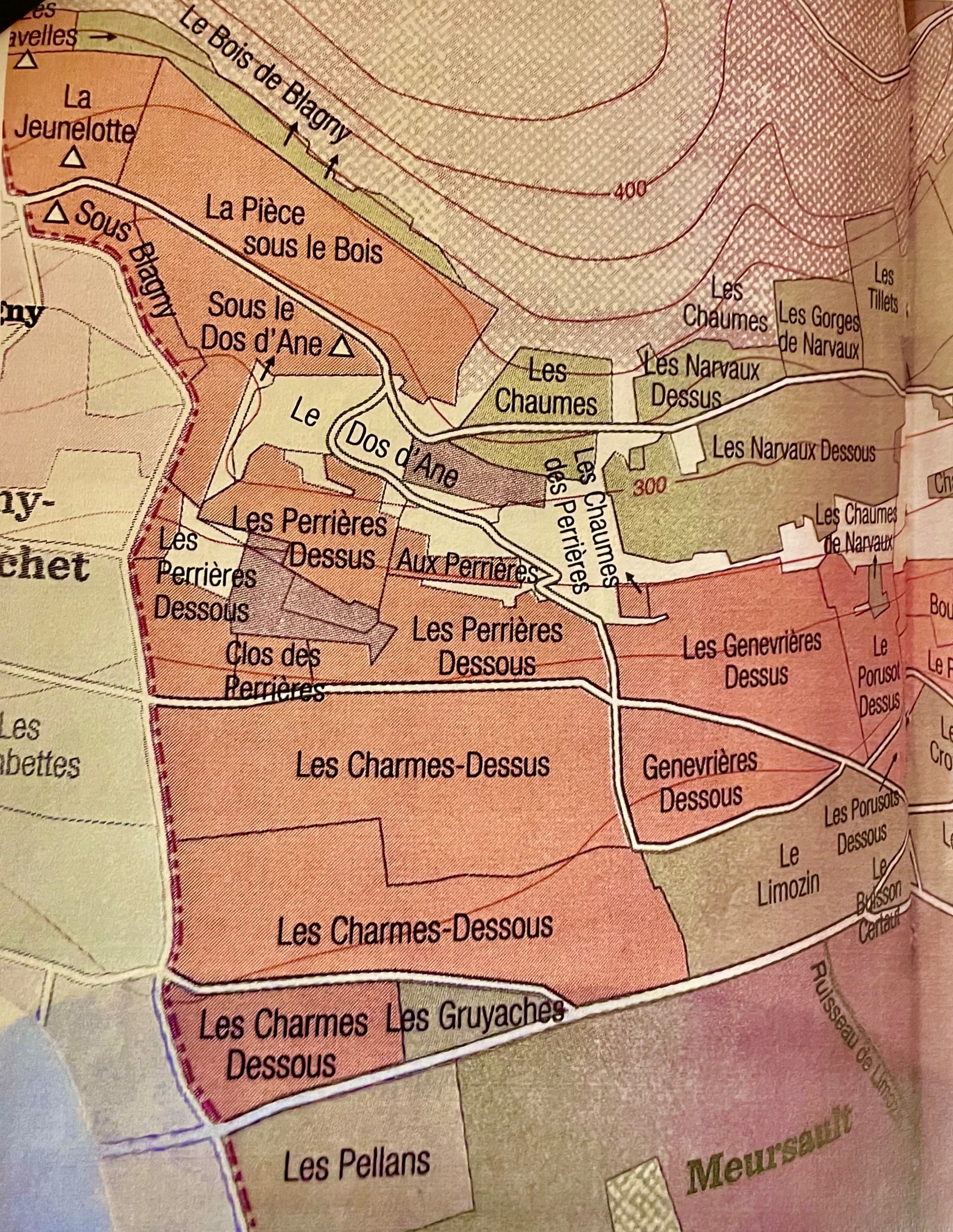
We had an amazing experience and our host went over the top not only with the quality of the wines, but in suppling supportive materials including handouts with reviews of the vintage by Allen Meadows and Jasper Morris and maps and discussion about the commune and the producers copied from Jasper Morris’s book “Inside Burgundy, 2nd Edition”, the book “The Grand Crus of Burgundy” by Laurent Gatti and score sheets so we could grade our group responses.

Additionally, he provided 3 optional themes and asked us to select which theme he had chosen from these:
All 5 of the wines were either:
a} a 5 vintage vertical of a single Domaine and same vineyard, or
b} 5 different Domaines from a single vintage and the same vineyard, or
c} 5 different vineyards from a single Domaine and same vintage.
That was tough to do. 3 of the wines were light yellow and 2 were yellow gold. The nose was very different for each as was the taste profile. After going through each one first for the color and then for the aromas and then the tastes and feel, I had no clue and guessed it was a}.
And, 15 minutes later, the aromas and tastes were way different and kept changing over time.
Each of us offered our guesses as to the vintage, vineyard and producer. I struggled mightily to come up with anything I could feel certain about.
There was some who thought they were all Corton- Charlemagne and one who stated Meursault. For me, CC has always been about depth, power and finesse and we really only had 1 or 2 that came close to having those traits.
As it turned out, b} was the correct answer to what we had in front of us as we had 5 different Domaines from a single vintage and the same vineyard
It was a super challenge and I learned there is a lot to know and it will have to decide as to how far I choose to take it. Most of what I could deduce was in recognizing the traits that I preferred and what contributed to expressing those traits such as the oak influence and later picking riper or longer lees contact, etc.
We just had to start this off righteously with some champagne and I volunteered to bring one, serving it blind to the others.
Here’s my notes on all of the wines:
2006 TAITTINGER COMTES de CHAMPAGNE BLAMC de BLANC- my bring poured blind; it had a yellow gold color, but no other real indications of aging; as stated by Jasper Morris, “2006 is a ripe vintage; though it is perceived as a “low acid” year, the combination of ripe tartaric acidity and high natural ABV gives the wine structure and precision);” as with most all other bottles I’ve had of this Comtes, it had bright acidity that embellished the aromas and tastes of ginger, honey and toasty brioche accented ripe lemon, lime citrus fruit and yellow apple notes; it had a wondrous creamy mouthfeel with some weight which carried all of the goodness to the back end where it just hung on for a long, satisfying finish; this was a really good bottle.
After lots of discussion, the others concluded this was in the 2006- 2008 range, a blanc de blanc and from a big house; one had it perfectly. We’re learning.
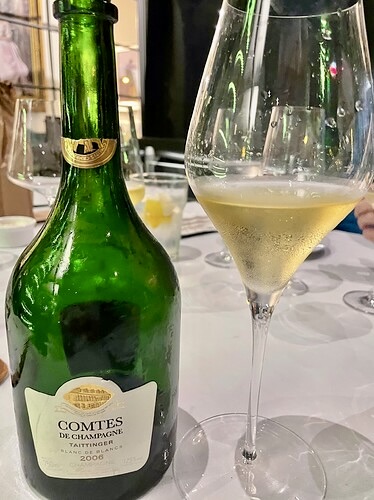
And, we got off to a stellar start as the Comtes was one of the best ever bottles. Now, for the grand theme which turns out to be white Burgundy and as stated above, from 5 different Domaines, but the same vintage and vineyard, all poured blind.
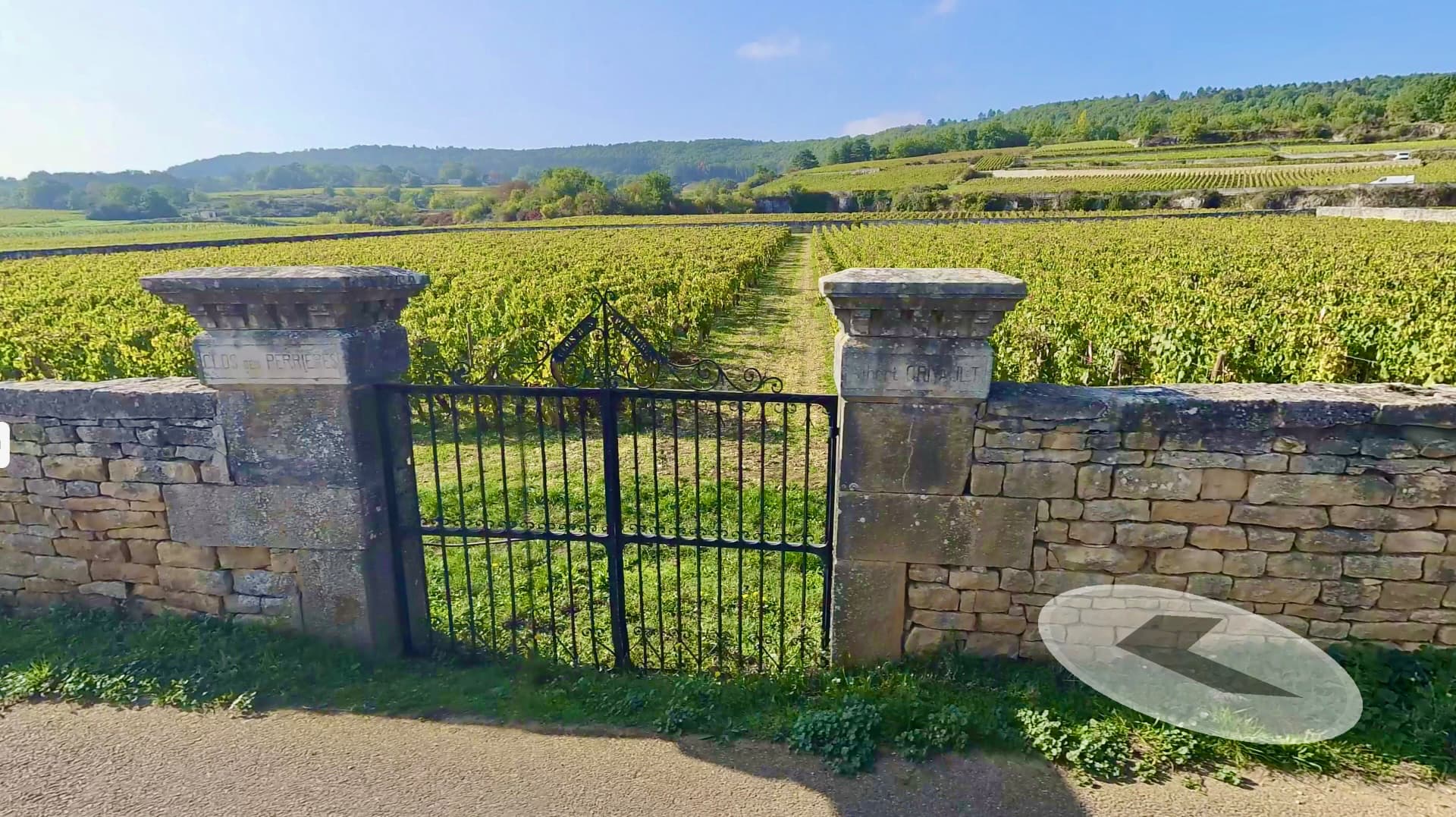
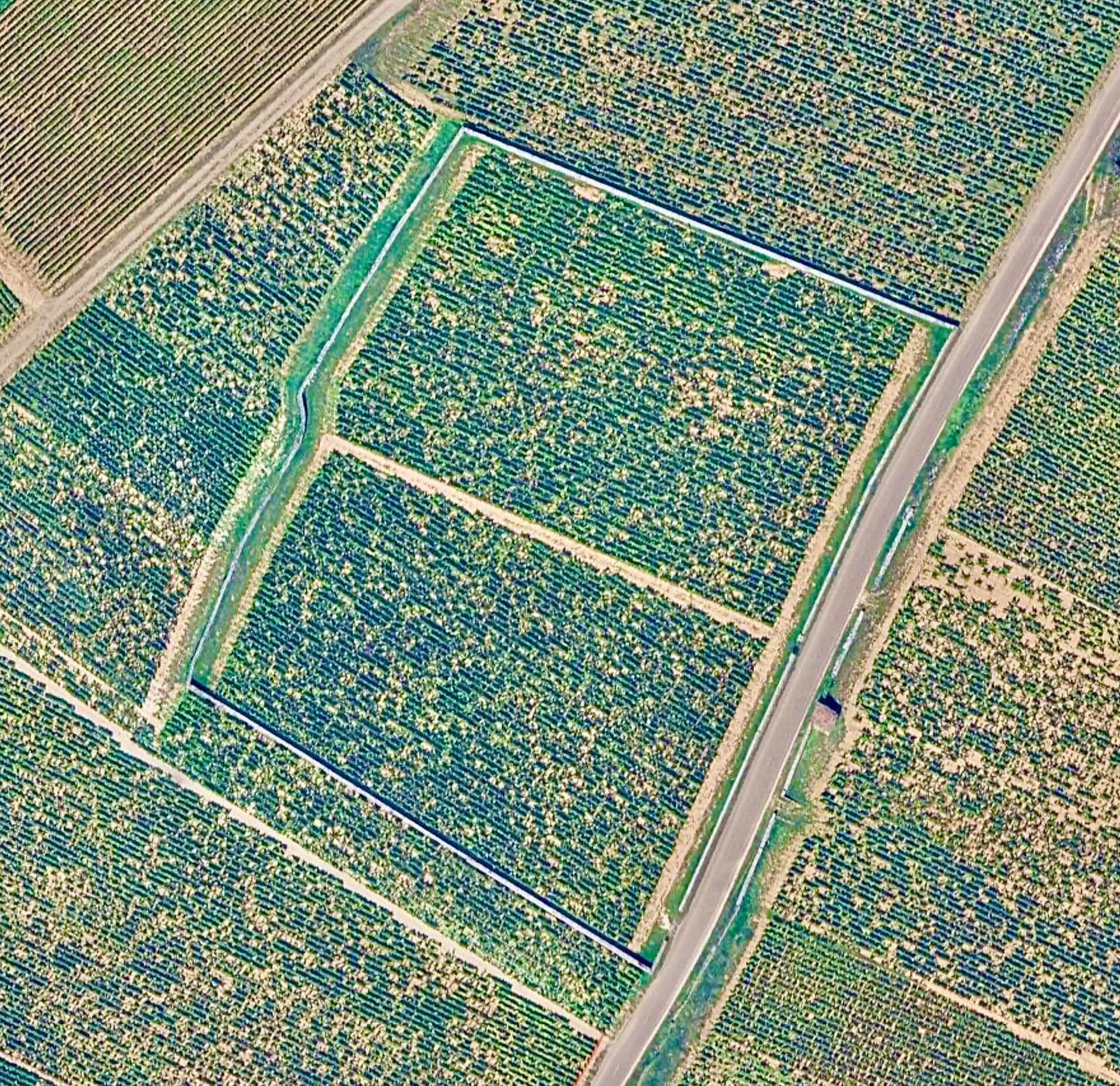
1} 2017 DOMAINE BALLOT-MILLOT MEURSAULT- PERRIERES 1er Cru- white Burgundy blind; the fruit is sourced from a parcel situated next to Grivault’s Clos des Perrières; this had a light yellow color and mild aromas of white flowers, honey, vanilla oak and minerals were joined on the palate by mild lemon and white peach fruit; all notes were understated and as such, it possessed more elegance and charm; even the texture was light weighted; I kept going back expecting more, but it never did manifest; I did not know what to think other than maybe this was shutdown and in a dumb stage; of the 5 wines on this night, this was the highest critic rated in the lineup, the 3rd favorite of the group and my least favorite- go figure.

From “Inside Burgundy” 2nd Edition, “ the whites made by this producer tend to be lively and racy and muscular without flesh and have considerable weight due to how they are processed including extended times on the lees.” From this statement, I can only conclude we had a bottle variation here.
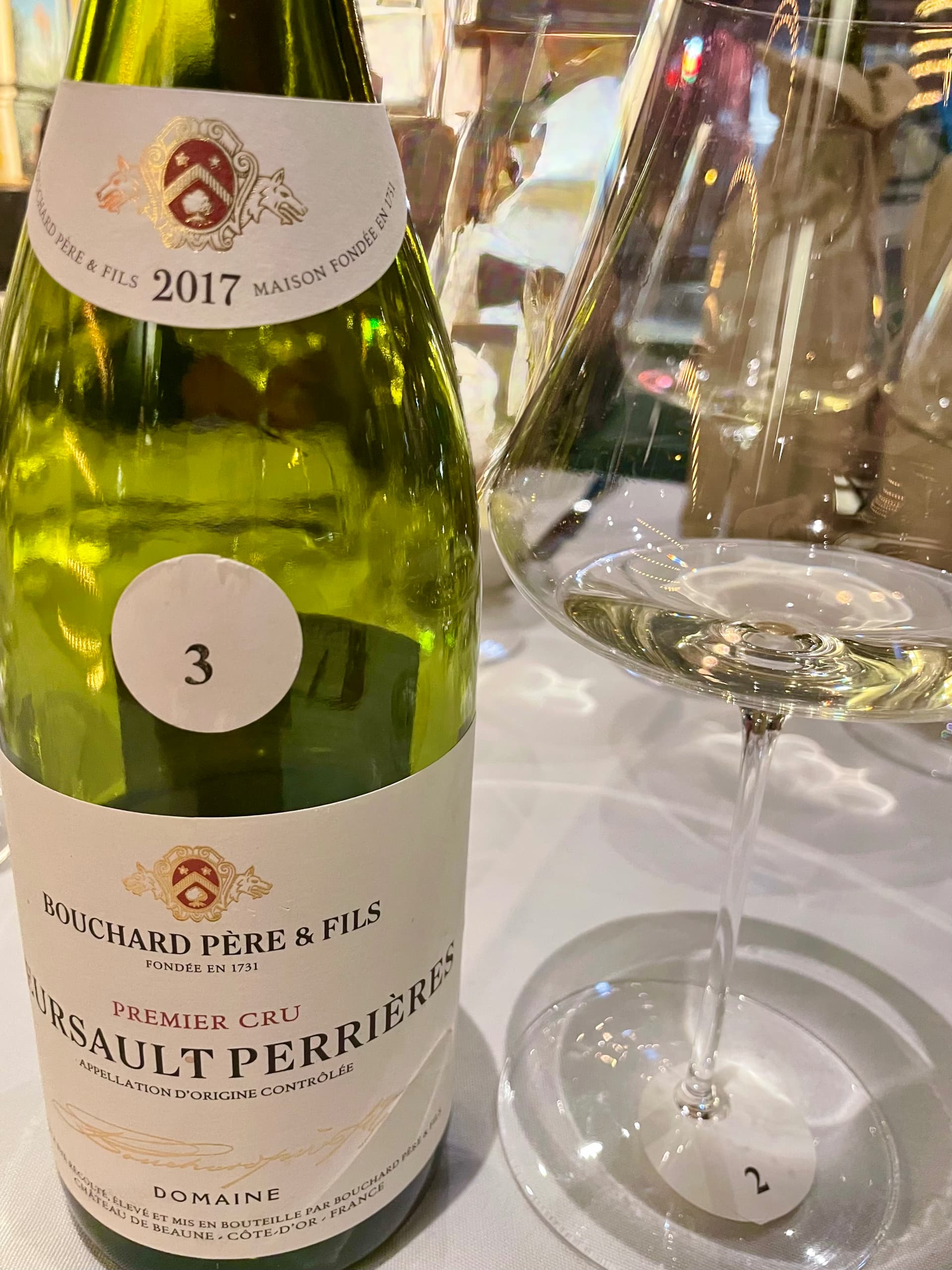
2} 2017 DOMAINE BOUCHARD MEURSAULT-PERRIERES 1er Cru- white Burgundy blind; following its light yellow color came mild aromas of honey, butter and coffee laden yellow apple with a sprinkle of cinnamon, all of which continued on in the flavor profile; it had lovely soft, smooth mouthfeel, was in ideal balance and IMHO, a fabulous wine that I ranked 3rd in the flight and the group voted it #5. The fruit is sourced from 1.2 hectares of vine.
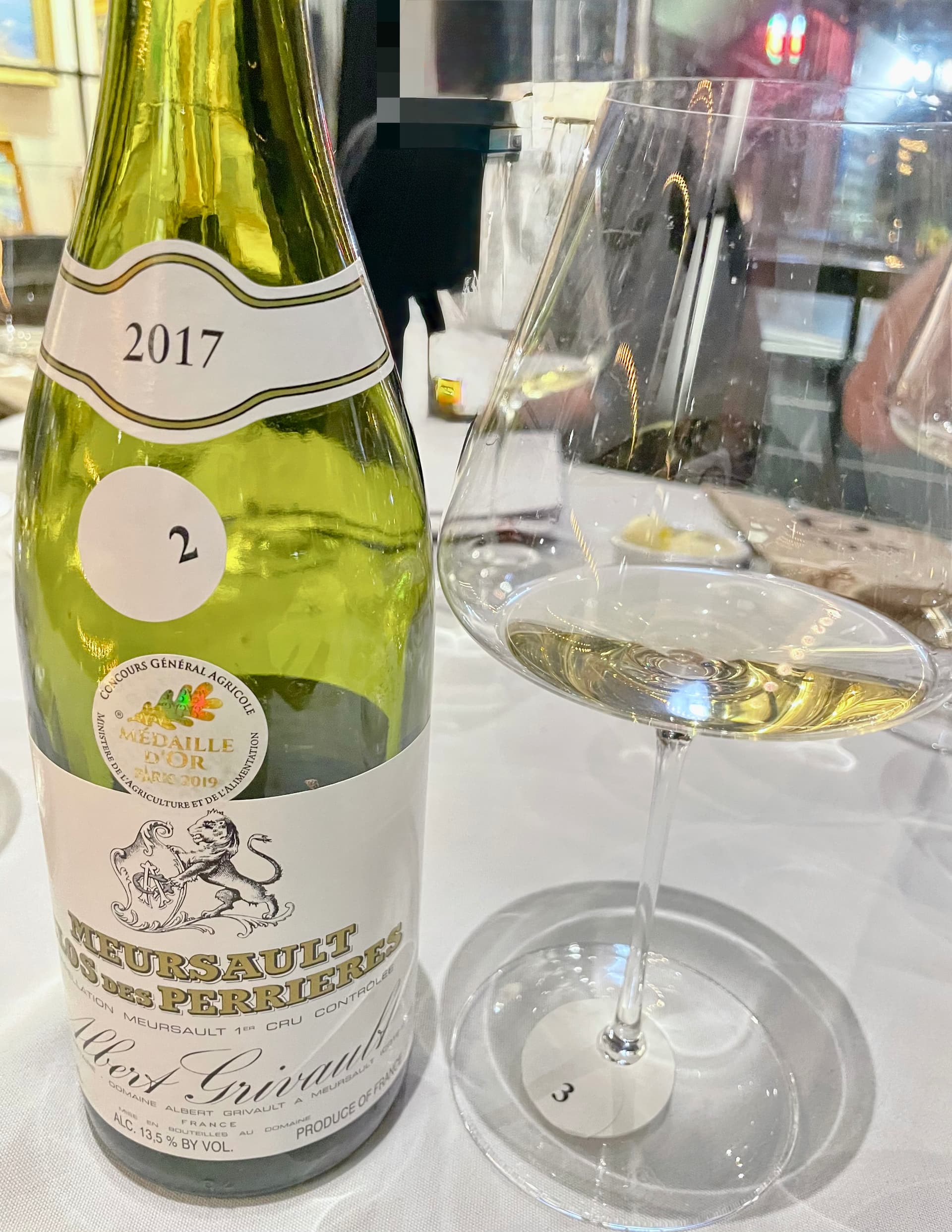
3} 2017 DOMAINE ALBERT GRIVAULT MEURSAULT-PERRIERES CLOS DES PERRIERES 1er Cru- white Burgundy blind; our guide found his first bottle was pre-moxed; he tasted us on it and it definitely had advanced notes of caramel, butterscotch and in this case, coconut; so, this was bottle #2; the color was yellow gold suggesting it was advanced as well, but the aromas of ripe honeyed yellow apple confirmed it was not; in fact, it was a wonderful wine with additional accents of flint and minerals, a super soft and smooth mouthfeel and ideal balance; I also found a sprinkle of cinnamon in this one was I did with ’17 Bouchard M-P; I ranked it 2nd as did the group.
According to a review of this producer in “Inside Burgundy, 2nd Edition, “ this could be one of the great domaines of Meursault, especially with its substantial holding of Les Perrieres and the monopole of the Clos des Perrieres.”
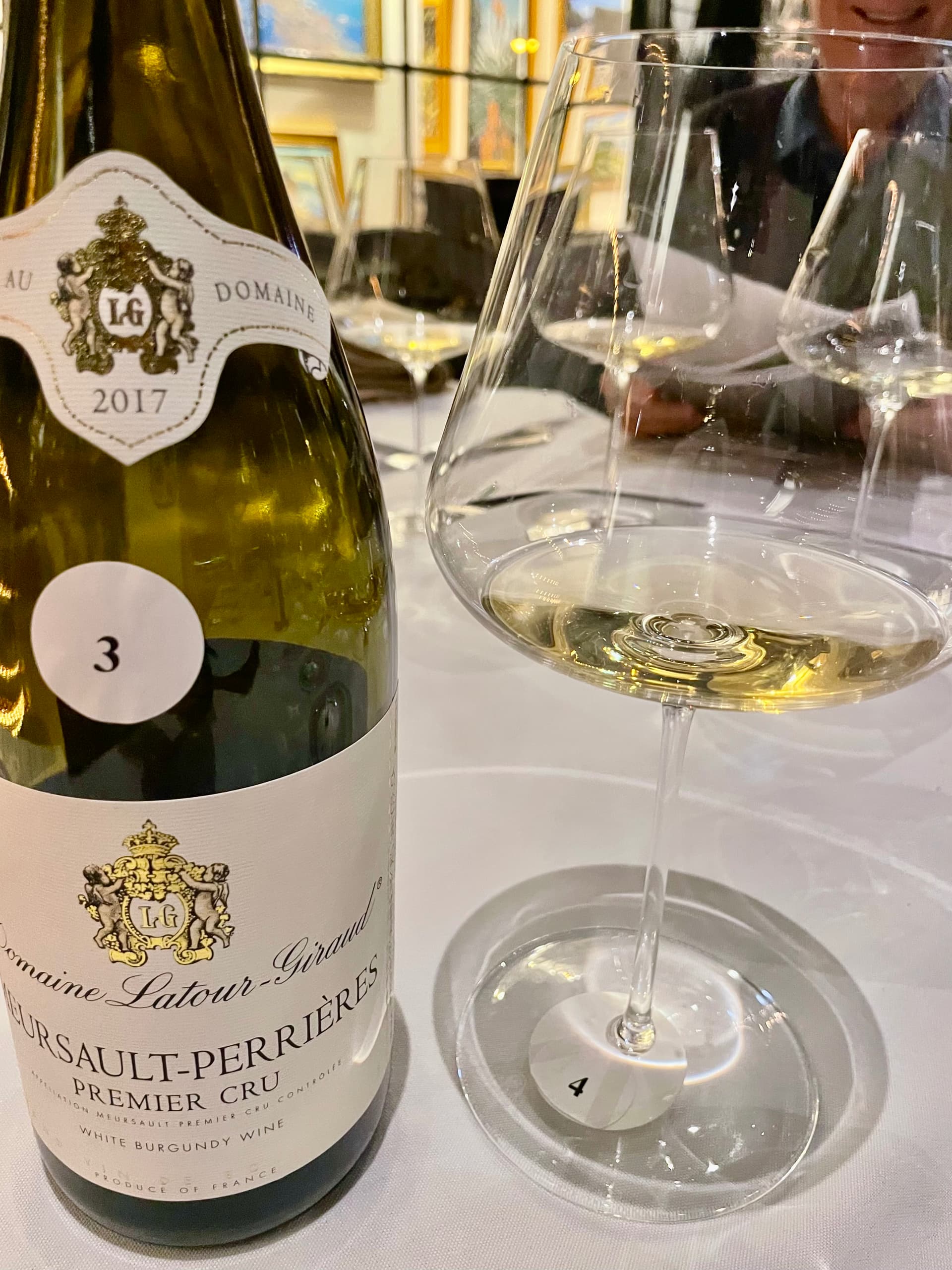
2017 DOMAINE LATOUR-GIRAUD MEURSAULT-PERRIERES 1er Cru- white Burgundy blind; it had a medium yellow color and inviting aromas of spicy, yellow apple that received a coat of honey on the palate; it was round, seamless, smooth and perfectly balanced with lots of finesse and charm; I had it as 4th in the flight as did the group.
From “Inside Burgundy, 2nd Edition”: “The whites are direct pressed, settled if necessary, then encouraged to ferment in tank before transfer to barrel, with 20% new wood for the village wines and no more than 25% for the whites, all in the traditional 228 liter size. There is some lees stirring. The wines are racked to tank after 11 months and bottled early the following year.”
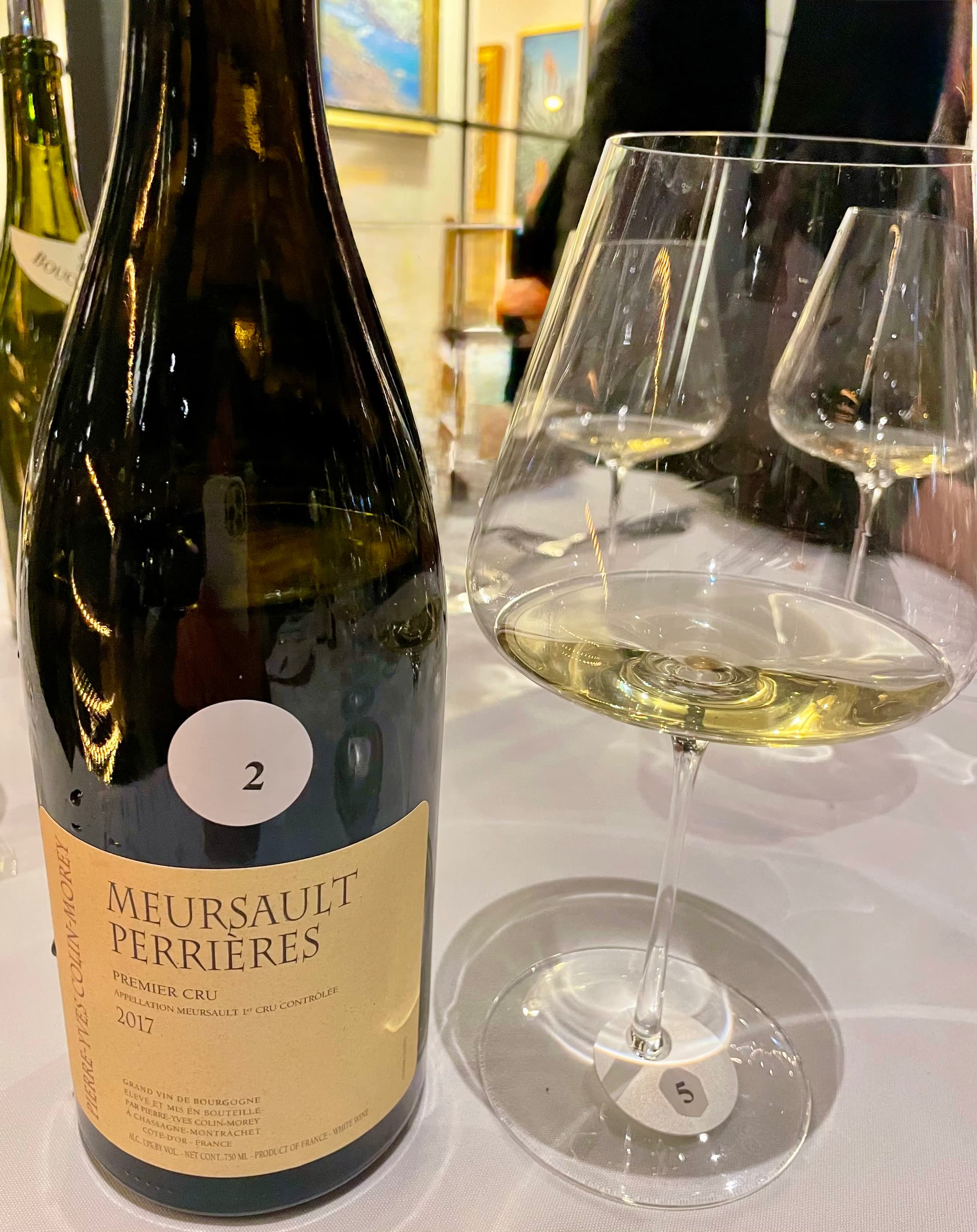
2017 DOMAINE PIERRE-YVES COLIN-MOREY MEURSAULT-PERRIERES 1er Cru- white Burgundy blind; following its medium yellow color came aromas of honeyed yellow apple with a toasty oak and vanilla kicker; some nice citrus fruit and a streak of minerals and a hint of flint joined on the palate while being delivered in a super smooth and creamy texture; it made a big statement with its flavor profile which was somewhat softened by its soft mouthfeel and as such, was my #1 preferred wine in the flight; amazingly, all others agreed.
Once we had finished the flight, we mostly agreed the 5 wines were superlative, individually distinct, free of pre-mox, had a common thread of mineralality and should evolve even to greater heights within a few years.
We also agreed there is so much to learn about each region, commune, vintage and producer and as stated above, there are no limits as to how far we can take this learning experience.
From the materials handed out, I got a lot more. Here’s a few of the things I gleaned from the first pass through:
According to Jasper Morris, the 2017 vintage was “both generous and of good to every good quality, with in general, a preference for the white wines”. Morris highly recommends perusing the vintage for many jewels, especially for wines from St.-Aubin and Auxey-Duresses, previously regarded as cooler areas, and of the 3 grand vineyards of Meursault, Perrieres, Charmes and Genevrieres.
Allen Meadows claims 2017 white Burgundy offers the best quality since 2014 and are more homogenous than 2018, but says 2016s are more powerful and 2015s are riper and richer.
Excerpted from the book “Inside Burgundy” by Jasper Morris, he states “Meursault is the largest village in the Cote de Beaunne with a vinous history dating back to Roman times” and "in this part of the Cote, is located more on the plains rather than on hillsides”. He goes on to say “Meursault is the softest, richest and most rounded of the 3 main village appellations for fine white Burgundy”.
“Meursault has 17 premier crus, 29 if all subdivisions were counted separately, with 3 main board groups: the main band which begins with Perrieres, Charmes and Genevrieres and continues through Porusots, Boucheres and Gouts d’Or; a church around the hamlet of Blagny {La Jeunelotte, La Plece sous le Bois, Sous le Dos d’ans, Sous Blagny- all of which are usually sold as Meursault-Blagny} and the Santenots family on the Volnay border {Santenots du Milieu, Santenots Blancs, Santenots -Dessous, Les Plures, Les Cras, Les Caillererts}.” Perrieres, Charmes and Genevrieres are the stars with Perrieres normally quoted as there best.” He does not think these 3 will ever be promoted to Grand Cru status.
I also learned that Meursault used to be characterized by butter and hazelnuts, but the more recent change in the growers making their own wine has led to more variations due to the specificity of the single vineyard designates.
Cheers,
Blake