I would like to amend my response to this thread and delve a bit deeper into the variability aspect of this wine, as it pertains to halves. I have drank through several 12 packs of halves of this champagne over the past months and have certainly noticed the variability I mentioned previously. However, this weekend I drank (along with company) 5 halves over the course of about 4 hours. Each bottle was different from the previous and they were all from the same carton. Some were sour up front, some were sweet. Some gained weight over 20 minutes in the glass, some became a bit “cheesey” Some had a noticeable imbalance between the dosage and fruit, some were perfectly balanced. Maybe Brad can answer this question, but perhaps the variability everyone is experiencing (at least in halves) isnt between “batches” but instead because some dosage variability between bottles when they fill them? Do they transversage (is that the terminology??)from 750 to 375 and then dosage the 375s?
All I can add (other than “fascinating thread” to me) is that whenever I have Krug NV in a lineup of Champagne, it’s always my Champagne of the night!
It may very well be stylistic preference. I’ve never had a Krug (MV or vintage) which I thought better than okay.
I’ve never understood the pricing for this wine. I’ve never had a great one. Lots of other Champagne out there that I’d rather drink at half the price or less.
But, to each his own.
I find Krug NV fresh with some richness but not powerful. I personally find NV Krug very consistent. (93-95 pts) However, it shows significantly better with at least ten years of cellaring.
I love Krug MV.
I’ve yet to be disappointed by it.
I have found it to be quite consistent over the last 12 or so years since I started buying it.
I do not find it to be a poor value.
YMMV.
I had this on Friday afternoon out of a half bottle. Yeasty, rich, creamy, golden delicious with lemon curd and graham cracker. Loved it, and I find it far better than many champagnes. I’d have Krug NV over most vintages of Dom that have been released in the last decade or so, with the exception of 2002 and perhaps 1996. It’s certainly stylistic, as I prefer a nice rich style, like Cuvee WC, to Dom’s lime laced granny smith on limestone.
Justin,
In general, I avoid half-bottles though I have given in to a few downright “steal of a deal” offers. I’ve also returned multiple cases of halves for being inconsistent and all over the place in terms of quality. Half bottles are more prone to damage for multiple reasons - these include: they hang around the supply chain longer, they mature more quickly, and they are more sensitive to ill handling. Add to this the fact that I think LVMH wines are probably the most mishandled Champagnes on the US market and you have a recipe for a possible disaster. There is no excuse for variability like you describe. I would personally take back every bottle and demand a replacement of fresh stock. What you describe sounds to me like mistreatment, which unfortunately is far to common with some wines and formats.
As far as dosage goes - this is all computerized and very precise. While mistakes do happen, they are usually caught and bottles destroyed. You are more likely to see dosage issues/variability with very small producers. The big guys are not going to have it. Also, 375’s are not eligible for transvasage. You have to ferment in the bottle. Splits are almost always transvasage.
So Gilman reports that Krug is planning to release Grand Cuvee bottlings with an additional decade or so of post-disgorgement aging. Hopefully the price won’t be a joke, then I can pick one up and see what I think of it with these extra years.
Bingo. its very unfortunate how most of us or almost all of us at some point or another defer to wiki for answers. WIKI is not where the truth lies. many errors esp. with more technical subjects.
Had this early last week, and I thought it was great. To each his own, I suppose.
Essentially they will be doing “Krug Collection” type releases with the Grande Cuvee. In the past year, they have done some tastings of “older” Grande Cuvees that have not left Krug’s cellars as they toyed with the idea of releasing them. As they move through different releases, there will likely be a mix of post-disgorged aging and undisgorged aging.
I just opened a recently purchased bottle with code 111011, a winter 2010/2011 disgorgement. The acidity was overwhelming compared to the 6+ bottles I’ve had in the past. Over the course of four hours as I expected/hoped it would open and balance out, it actually tightened up, with the yeast and elegant mouthfeel typical of Krug completely disappearing behind the acid. Frankly, it thinned out, which is the last thing I’d expect.
The remainder of this case is going to need at least a decade. How do I fulfill my Krug needs in the mean time?
This matches my experience. I’ve not been overly impressed with newly released bottles and my great experiences with this wine are with bottles that were 10-15 years from release.
. . . but still a valid, if somewhat confusing, & (obviously) divisive part of the wine lexicon. Like it, or not.
![[cheers.gif]](/uploads/db3686/original/2X/0/0ff9bfcdb0964982cd3240b6159868fbdf215b1a.gif "cheers")
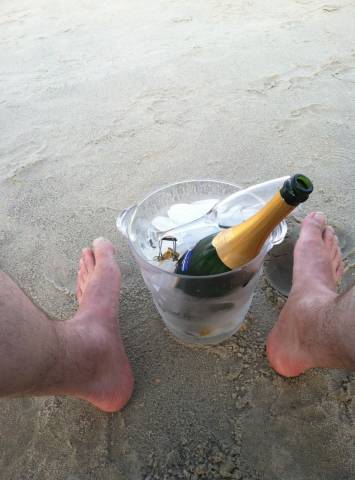
Just back from the beach, where we drank many, many wonderful bottles of champagne. We also drank Krug MV. Of all of the champagnes we drank, it was the most meh-ish. It was good. Maybe even really good. But it was put in the shade by many other bottles, including Tarlant Cuvee Louis, Larmandier-Bernier, Bollinger, C. Bouchard, Vilmart, and most of all by a sensational Paul Bara Comtese Marie de France.
And lest you say that context made a difference, I can assure you that few bottles of champagne have ever been enjoyed in a more favorable setting.
I have enjoyed every Krug NV that I ever had, and for the folks that can afford it I guess it is “to each their own.” But when the purchase was on my dime I have always been underwhelmed. I am looking for more than “enjoyed” out of a $100 bottle and I have never had a Krug NV that I thought was particularly memorable.
There are so many really good champagnes out there that Krug does not stand out as much as it used to. It is wonderful champagne but so are many others. Clos de Mesnil is a cut above but the price is ridiculous now.
Don’t get me wrong, every bottle of Krug I’ve had previously has been memorable and well worth the price I paid (around or under $100). I posted my take on the young bottles as I was under the impression it would be ready to go upon release and clearly that’s not the case. If this latest bottle was my first Krug experience, I’d probably never try it again, or at least not seek it out, as the market’s too competitive to spend $100 and not expect a superb experience. I’m eager to find out how this “Grand Cuvee Collection” will work out and how much of a premium it will command - after all, it may be worth it!
First of all, thank you Brad for the wealth of fantastic information. I love reading your replies!
Second, I have never turned down a glass of the Krug NV as it often shows quite brilliant. However, given the price tag and the unknown variability given lots, it seems like a dicey proposition to buy on a consistant basis. In fact, I think I’d rather focus on cherrypicking a few bottles of the 96 for special ocassions and having bottles of PP or Billot ready for more common occasions. When you think about it, if the bottling requires 10 years of age to become enjoyable, it is even more expensive than the $50 grower which has a faster maturation scale, given the time-cost of money. For me, Krug NV doesn’t quite equate on the value spectrum.