Indian mother dishes

My current cooking adventure is slowly trying to gain a better understanding of Indian dishes and cooking methods. It’s tricky knowing where to get started, and the less familiar wording (compared to Romance languages i guess for me?) makes it tough for me to sort the things I HAVE learned in my head.

I’m curious if there are some Indian “mother” sauces that can be used as a base to learn the major skills from and branch out from there, and some good resources on where to get good step by steps on them so I can start to learn the reasoning for what gets added when (whole spices, ground spices, onion, tomato, when is a ground “masala” used, etc)?

Anyone have any good suggestions?

I can’t answer your question, but curious to see answers myself. I have learned competence on a few Indian dishes myself and had some help advice from a neighbor of Indian descent. I can say that my first step was to learn how to make a proper ghee which is a key building block of many dishes. Good, fresh spices are key, as well as properly blooming them or in some cases (like cumin) toasting them in ghee, There are also different styles of things like garam masala, based on region or type of usage.

But alas I am still very much a beginner and recipe follower on the whole.

Might as well ask for the mother sauces of South America, Asia, or Africa while we’re at it. I think India is pretty diverse for food, etc.

Of course I’m not expecting a single answer just like theres not a single mother sauce in French cuisine. Im not expecting “mother sauce” to even directly translate given the fact that so much of the cuisine in family-specific and passed down rather than a tradition of being so well defined like French cuisine. Actually- I dont even know if thats true for Indian food or not, I’m just assuming it. But i would imagine that just like mother sauces in France, Indian cuisine probably has dishes you can master and then use small variations to create a wide array of other dishes.

No single mother sauce in European cuisine which is a more relevant comparison.

Watch Rick Stein’s India if you want to get some good basics of cooking Indian cuisine for a westerner.

1 Like

Yes there is.

In BIR cooking (British Indian Restaurant) - which is the prototype of most western restaurant Indian and takeaway - there is almost always a Base Gravy. It is used in pretty much every dish. Frustrated with the LA Indian scene when I moved here form UK, I used to make it all the time - and it really speeds the cooking up and adds a lot of quick depth of flavors.

For that authentic takeaway taste I highly recommend the e-book Curry Secrets, by Julian Voigt. He spent years with small UK Indian restaurants and takeaways learning how to get that authentic takeaway taste he could never get home cooking - and one of the secrets is precisely the Base Gravy. I think he has 3 different recipes, but I used to make the most complex one with cabbage. Pain to make, but you make one huge batch, then just freeze it and it lasts forever.

Just DM me with your email and I can send the e-book Curry Secrets over as pdf.

1 Like

I cannot recommend this cookbook highly enough: Maya Kaimal’s “Indian Flavor Every Day”

It has sprinted into my Top 5 cookbooks.

3 Likes

I dont think i asked for a single mother sauce. Im not quite sure i understand your push back here. Im just asking for some standard basic Indian dishes to use as examples to build a repertoire of skills from. I understand it is a diverse cuisine, that is the entire point of the question.

My wife and I eat primarily Jain-style, and we have great affection for the Rasoi Magic Jain lineup. They call it ‘No Onion No Garlic’ and supply over a dozen spice mix bases.

We use coconut milk in lieu of milk and they make great mother sauces to work up from!

If we feel like adding chicken or meat, still a glorious match!

Helpful hint. If you shop for these online, don’t go to Amazon. Find an online Indian grocery and they run about $1.99 a pack. Delicious and very affordable.

Best wishes!

2 Likes

There are a ton of things you can watch on YouTube, but many of them will all basically be making an onion and tomato gravy often with regional accents whether it’s cashews, coconut and so on.

I make dry style Indian vegetable curries; sometimes they’re called ‘sabzi’.

4 Likes

Do you have any favorite creators on YouTube for this? I’ve been following the chef from Swadish on Insta lately, i like his videos a lot

I really like Chef Ajay Kumar
www.youtube.com/@ChefAjayKum
He has great videos

1 Like

This looks outstanding. We would love this.

To answer the OP, I make a curry “base” sauce in a large batch and then freeze in manageable portions for butter chicken or tikka masala:

4 28oz cans of fire roasted tomatoes
4 medium yellow sweet onion, quartered
4 heaping tbs of ginger-garlic paste
4 tbs garam masala
2 tbs turmeric
2 tbs Kashmiri chile powder
8 tbs ghee
2 cups chicken stock
Sea salt

  1. In a large food processor place the onion and pulse until completely obliterated. Strain the onion through cheesecloth and reserve the onion juice for chicken marinade.
  2. Place ghee in a large stock pot over low heat and add drained onions with some sea salt. Stir and cook until justbarely golden.
  3. Add ginger-garlic paste and sauté until fragrant
  4. Add garam masala, turmeric and chile powder, stir and cook 2-3 minutes until fragrant.
  5. Add tomatoes to food processor one can at a time and blend until smooth.
  6. Add tomatoes and chicken stock to onion mixture and raise heat to medium and simmer for 45-60 minutes.
  7. Taste and adjust salt/heat level as needed
  8. Allow to cool to room temp and place sauce in a Vitamix and blend until homogeneous.

I don’t add any heavy cream or extra butter at this point. I think that it doesn’t freeze well with the fat.

1 Like

I would start with making what you already like to eat. And then you will find yourself using many of those same ingredients to make other foods over time. For example, if you start with channa masala, you’ll start with a onion tomato base to then branch out into other foods with that same base. A chicken tikka masala would be fun to start playing with. Perhaps make one daal and then as you take recipes for other daals you will see the interplay between ingredients (yellow dal vs. dal makhani vs. yellow moong vs. green moong vs. red kidney rajma).

Many ways to start… I would just pick one common dish you are familiar with and then branch out from there.

1 Like

I went through my history, and it seems I have watched a bunch from Hebbars and Babish. I think the former is particularly vegetarian focused. There is also a food company ‘Swad’ which has some videos which are good, but are in Hindi (I think). I can sort of follow them by reading the subtitles.

Here’s one I have watched a few times; it seems reasonable but I don’t like freezing this kind of stuff for future use.

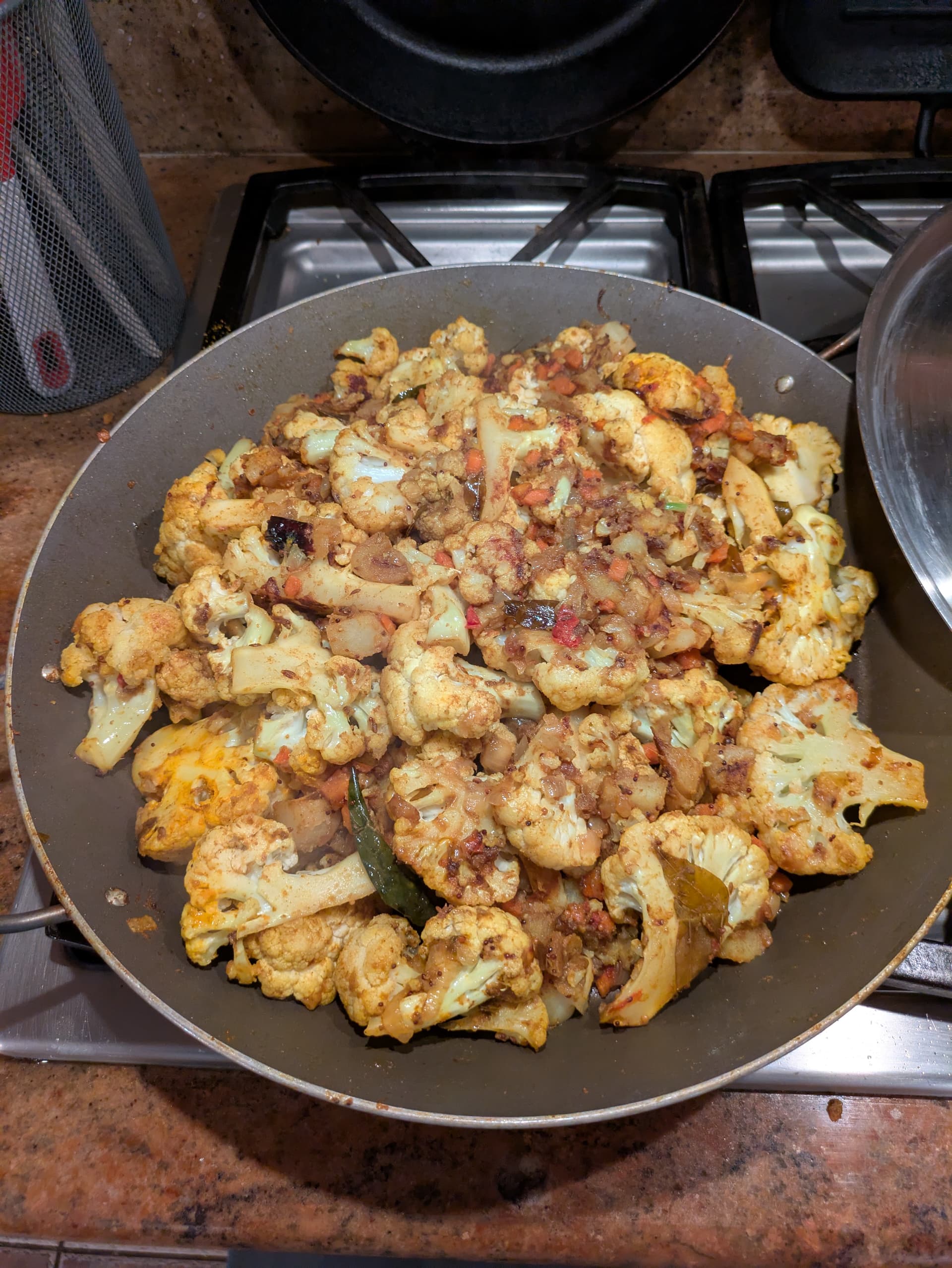
Above is my interpretation of ‘aloo gobi’ made in a dry style, which unfortunately does not lend itself to scaling up for groups, nor really being made far ahead of time. I use a giant non stick paella pan, since cauliflower is so voluminous initially.

Ingredients

1 Cauliflower
1 onion - can use any type you have handy
2 potatoes - can use yams, sweets, or carrots too
frying/cooking fat - personally prefer neutral oil, then butter, and lastly (too strong flavor) ghee
spices - whatever you prefer or have on hand but I like Indian curry powders, garam masala, ginger, garlic (only a little), curry leaves, mustard seeds, chile peppers fresh/dry, etc.

Order

Start by chopping onion and frying in fat
Add aromatics - typically I use ginger, curry leaves, mustard seeds (any color is fine, even multiple), garlic, and a dried chile or two if desired
As that browns, peel and cube potatoes, adding them and more fat as needed. Can cover the pan to help everything cook well. Keep stirring / tossing and at this point I add curry powder, chili powder if desired, and some salt. Its hard to get the salt right on this, so it might need a few adjustments as time goes along.
Prepare the cauliflower - I remove the central stalk and trim everything to chunky size, add to the pan, assuming the potatoes are getting done. For me the trick it to get a nice brown crust on some of the pieces. I add turmeric powder at this step too to get an orange/yellow color; above is actually not very good color wise. Be careful with getting turmeric on clothes, fingernails etc.
As everything is buzzing along - keep tossing! - prepare lemon juice, chopped cilantro, and butter cubes for finishing. I also add a teaspoon of garam masala too. The dish benefits visually from some color, so small chopped red bell peppers can be a good touch. Others add big chunks of tomato…but that can mess up the crispy/browned bits.

If you have leftovers, it can be mashed/minced, and turned into the stuffing for samosas.

Most of my kith & kin, say all of the above is non traditional / heretical but the dish gets consumed, and it’s what I’m generally requested to bring to family potlucks. Everyone else make a soupy/watery version, which I don’t care for. It could also be that I have that glorious pan, which is the key help for this.
2 Likes

Sorry if I sound like an asshole for saying this but I don’t understand the idea that someone’s work is found to be valuable and yet there’s a conscious decision to not compensate them for that work. Also I just bought the book, thanks for the recommendation.

You are of course correct, but he used to circulate it for free and the clips were on YouTube. My edition is from that very early period, so there might be some benefit to buying the new and updated one.

2 Likes