Counts for you, not for Alfert
2 Likes
Being chemically literate does not make one more sensitive to aromas. It just teaches you that every compound has its unique aroma.
I’ve certainly experienced any number of wines that smelled “musty” of some sort on opening, and made me thing “this might be corked”, only to realize, with more air time, it wasn’t. TCA is a particularly unique - and strong, for its concentration - aroma. At very low levels, it can be hard for the average person to detect, or specify. In the end, the only way to know for sure in these case would be to have a Mass Spec in your garage 
3 Likes
Same. I’ve gotten a TCA-like musty note in very mature classically ripe reds. Mostly Bdx and CA Cabs. In those cases, it’s always been in the mix, not super-dominant. I learned to withhold judgement. If it’s corked, I’ll become clear soon enough. If it fades away, great! But, I’ve never had a wine that reeked of TCA resolve. It’s that middle ground where you wait in limbo.
3 Likes
Nope, it does not.
3 Likes
I was just about to say this. Like things of beauty, brett is a joy forever.
3 Likes
Yeah, I agree, Brett definitely does not blow off. And often it gets worse. And that’s coming from somebody that occasionally likes a little hint of Brett in his wines.
I think the thread has identified two distinct issues and perhaps they are being conflated a bit. Brett is not TCA. And a little muskiness is not necessarily TCA either. A lot of mature Bordeaux, especially from the 1980s, blows off a lot of musk when first opened. I call that the perfume of Bordeaux, but perhaps that has other meanings to other people. I grew up with the wines of that era, and I find that opening perfume a bit of an intoxicant. But I also believe it does often blow off a bit with some air.
Now on that Magdelaine. The cork taint on this wine was ever so faint. I definitely don’t have the best nose in the business, granted I have a rather large nose, but it was not apparent to me on the first night. And I had maybe 2/3 of the bottle over the course of a couple of hours. It was not the freshest showing of this 2011, and I’ve had quite a few bottles, but it was still very enjoyable. The second night it took me a few minutes, but I definitely started to detect that hint of Court taint. I think we’ve all experienced varying degrees of cork taint, sometimes it’s really really bad and other times it is just a hint.
I have absolutely zero scientific background, and in fact, my worst grade in college was chemistry where I barely passed. I think the teacher took mercy on me. So I’m not sure that I can answer Todd’s question, to the extent that it has a valid premise.
4 Likes
Even taking that into account, it could be that the faint cork taint was simply overpowered by the other aromas on the wine and how they had evolved over 6 days.
Maybe Todd can negotiate a quantity discount on mass spectrometers for Berserker Day and we can lay all these debates to rest.

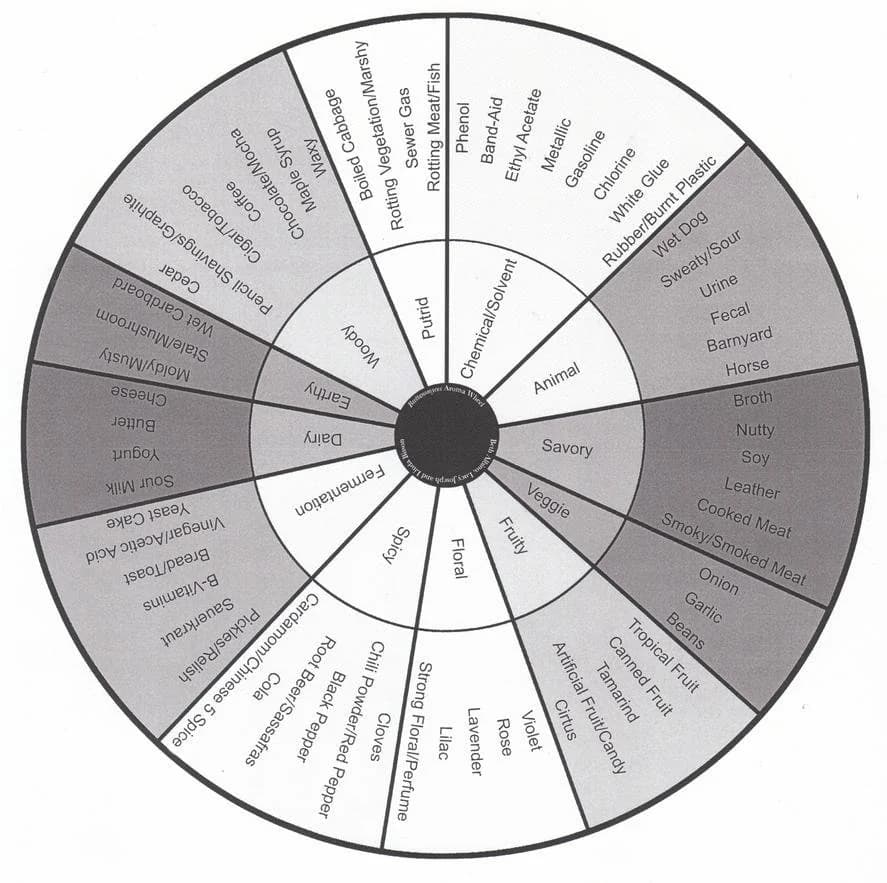
brettanomyces can do extraordinary things that might not be considered “bretty” in character, and lead one to think of TCA or or other anisole stuff. The Brett aroma wheel is like 90% of the regular aroma wheel…go figure. How its compounds ebb and flow in the glass/palate/olfactory is quite mysterious and can be highly personal i.e. may only effect certain tasters in my experience

So - as someone who does have a mass spec and has run quite a few suspect wines for TCA, I can’t remember running a suspect wine that has come back TCA-free in analysis. That’s probably because, though there are plenty of other “musty” taint culprits, none of them smell like TCA. Also probably because we are working in a professional wine setting and most people in that setting are painfully attuned to the smell of TCA. That’s why I asked above if it smelled like TCA or just muted/musty.
My guess is that this wine did have TCA, and that your experience of it through time after opening was due to the shifting effects of other things in the wine that are sensitive to oxygen. Many sulfur compounds are, and many of those also have muting effects. In a wine with a decent load of reduced sulfur compounds (common in some old Bordeaux), it’s possible for those to actually mute the effect of TCA. As they start to blow off (oxidize), the TCA could be revealed, say after an hour or two. As they fully blow off (more hours to days), more fruit and other pleasant aromas could come to the foreground and overwhelm the TCA. Just a guess, and never something I’ve personally observed, but I think it could be possible.
I also agree with others above that this could be “weird Brett” behavior, though generally with very experienced tasters I tend not to volunteer that option because they know what Brett is and what it can do and have likely already excluded that as a possibility.
3 Likes
Nerds!
Love this website!