Happy Berserker Day 16! I am so excited to be back for my 3rd Berserker Day. For those who don’t know me, I make Chardonnay and Syrah from old vine family vineyards in Sonoma and Mendocino, as well as a bit of Mourvèdre from Contra Costa (none available this vintage, back next year!). Berserker Day is the only time I ever offer discounts on my wines, though free case shipping is year-round. The discount code is BD16.
To quote the ever classic Zuni Café’s receipt, Immigrants Make America Great and working with old vines in California is invariably an immigration story. While we all come to Berserker Day for the amazing deals, this year I’m offering a slightly smaller discount, but for every order making a $50 donation to the National Immigration Law Center, up to $5,000. Every order qualifies, whether it’s a single bottle or a case.

For Berserker Day this year:
- 25% off all wines using code BD16
- Free UPS Ground shipping on case orders
- A $50 donation to the National Immigration Law Center in honor of whomever you’d like, up to $5,000.
Please don’t hesitate to reach out to me either by responding to this thread or by email at claire@clairehillwines.com. I’ll be checking this thread and email all day so I’ll get back to you quickly.
2023 LOLONIS VINEYARD CHARDONNAY
$37→$27.75
salted red currant, lemon, jasmine, white pepper
Lolonis is one of California’s finest heritage vineyards, and the old vine Chardonnay parcel planted in the winter of 1946-47 perhaps the state’s oldest extant planting.1946 was a landmark year for first plantings of Chardonnay in California. In addition to the Lolonis family planting this block of Chardonnay, the first (intentional) plantings of Chardonnay occurred in Napa at Stony Hill and Mayacamas using Wente selections. 1946 also saw the first Chardonnay planted at Mount Eden, using Masson selections collected from Meursault earlier that century. As far as I know, Lolonis is the only surviving Chardonnay vineyard from that period.
The land has been in the Lolonis family since 1901, when they first immigrated from Greece, with the first vines planted during WWII with the cash their son Jonny was sending home from his military pay. This vineyard has been farmed organically since the beginning and is certified by CCOF. This old vine Chardonnay block is dry farmed and produces exceptionally small yields of beautiful quality.

Vintage Notes
2023 in California saw more rain than we had in the prior few draught years. Wetness at flowering meant that that the clusters were looser than normal (great for combating disease pressure!) and these old vines had a healthier crop load. For the following vintage, 2024, I yielded a single barrel from the entire vineyard block. If you like this wine, I would stock up now as there will only be 25 cases next year.
“Normal” yields for a vineyard farmed to make ultra premium wines might see yields of 2-3 tons per acre, translating to 12-18 barrels for a 3 acre block. This vineyard’s continued survival is a testament to the Lolonis family’s sense of pride in these vines, and I feel incredibly honored that they have entrusted me with them. The yields on these old vines are so far below being commercially viable, even in a normal rainfall year, which is why so many other old vines in the state have been ripped out and replanted. The dropping demand for wine and increasing financial pressures on wineries and growers is exacerbating this.
Vinification
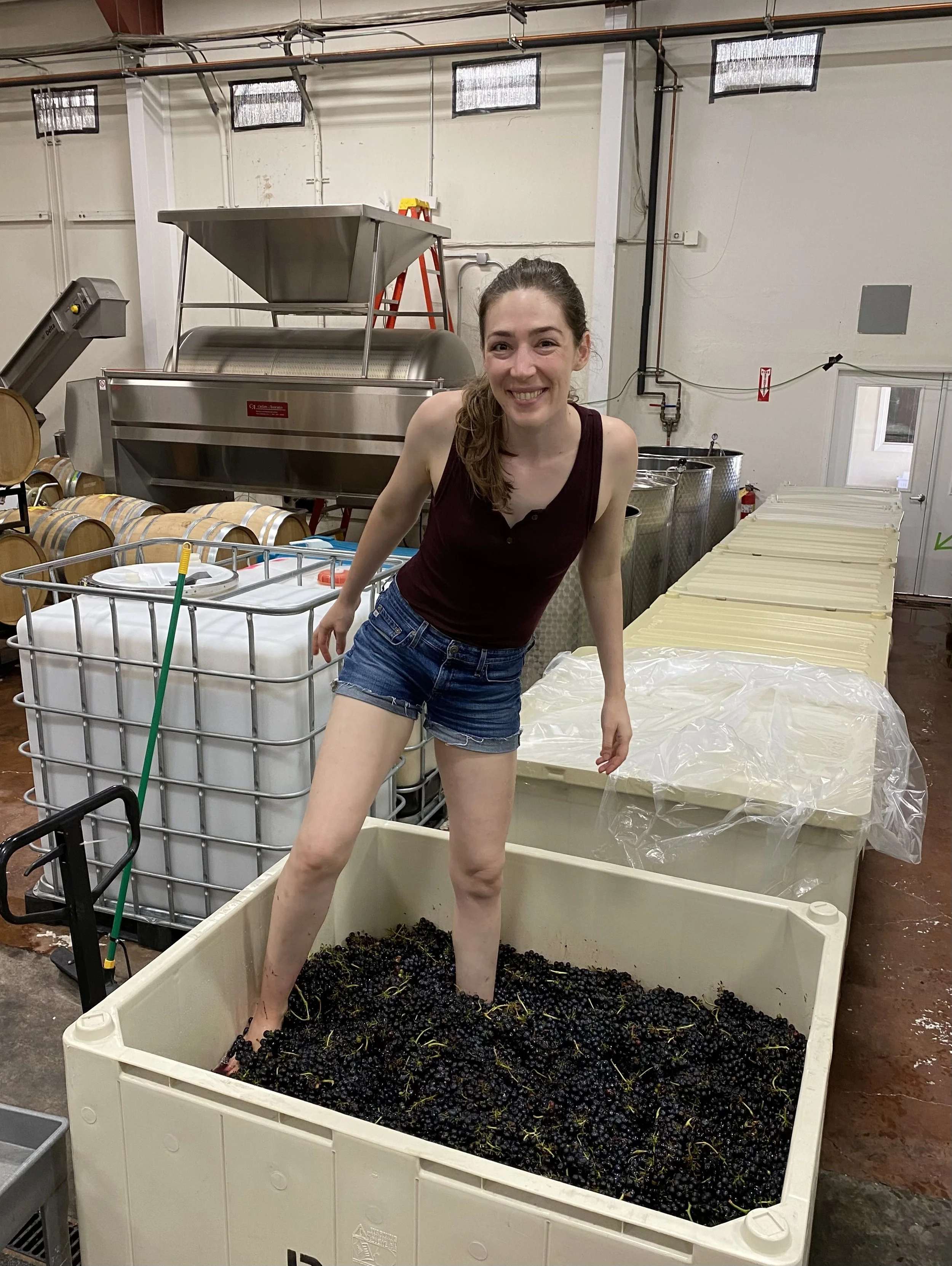
After whole cluster pressing, building slowly up to 1.2 bar of pressure, the must is left to settle overnight to allow the largest solids in suspension to drop out (the bourbes). These solids are usually comprised of things like dust, small bits of stem, pectins, and other dense particles. The following day, I move the cleaner juice suspended above the bourbes into (mostly) neutral French oak barrels (more on that below!).
After several days, native fermentation begins. Once primary fermentation has peaked and begins to slow down, I consolidate the wine into fewer barrels to minimize the amount of barrel headspace and oxygen exposure. One of the barrels goes to stainless steel, and this barrel is then used to keep the others topped throughout aging. In 2023, for the very first time, I was able to purchase a light toast Meursault Damy barrel. One-quarter of the Chardonnay was in new oak for 2 months before being transferred to stainless steel for the remainder of élévage. All told, the 2023 vintage remained on its fine lees for 11 months before bottling.

2022 GRIST VINEYARD SYRAH
$45 → $33.75
black tea, hibiscus flower, pomegranate
Sitting high above the Dry Creek Valley atop Bradford Mountain (1,000 feet elevation), this Syrah has more in common with the Sonoma Coast than with Dry Creek Valley. Only 15 miles from the ocean as the crow flies and perched up above the fogline, Grist Vineyard has a long, temperate growing season that allows for complex and developed flavors at lower potential alcohol. There’s a fantastic natural acidity to the grapes from here that brings freshness and verve. The soils here are Boomer loam, a red volcanic rock that gives low yields and concentrated fruit. The vines are trained in double cordon.
This organically farmed Syrah block was planted in 1983, unusually old for California Syrah. The oldest Syrah vines in the state are found in heritage mixed vineyards where they are interplanted with Grenache, Mission, and Alicante, but the oldest modern plantings began in 1975 with Gary Eberle’s cuttings from Chapoutier in Tain l’Hermitage. In 1977, Joseph Phelps released the first varietal bottling of Syrah in the 20th century (Patrick Comiskey’s book ‘American Rhône’ presents an excellent history of Syrah in California). In 1980, Jim Clendenen, Adam Tolmach, and Bob Lindquist convinced a grower to graft a block of Petite Sirah to Syrah (Black Bear Block). Bill Hambrecht and his neighbor Fred Peterson, both Rhône lovers, decided to plant Syrah on Bradford Mountain soon after using Gary Eberle’s cuttings by way of Ray Teldeschi.
These are the oldest vines at Grist, as prior plantings were on the ill-advised AXR rootstock that succumbed to phylloxera in the early 80s. The old vine Syrah block is Estrella clone planted on St George rootstock. St George is known for being drought tolerant, vigorous, and for producing looser elongated clusters. Looser clusters result in less disease pressure, and fewer interventions required to keep the fruit quality pristine. Though St George felt out of favor for many years for being overly vigorous (with drought sensitive 101-14 gaining precedence), with old vines on thin topsoil over volcanic rock this added vigor manages to keep the yields reasonable. As climate change accelerates, viticulturists like Steve Matthiasson turn back to St George for its drought tolerance.
Just adjacent to the old vine Syrah block are a few rows of Viognier planted in 1996. The intention had been to plant more Syrah, but a nursery misidentification resulted in Viognier being planted. Given the kismet of it all, the Hambrechts decided to keep the Viognier for co-fermenting with the Syrah. The yields on the Viognier vary wildly each year, but in 2022 about 2% Viognier was co-fermented with the Syrah. Beyond counterintuitively giving more color to the wine, I find that co-fermenting with Viognier brings out the lifted, pretty aromatics of Syrah.
Vintage Notes
2022 was an unusual vintage. Winemakers throughout Sonoma and Mendocino found that phenolic maturity and acid dropping lagged behind sugar development. Alcohols were generally higher, but so was acidity. I chose to pick Grist Syrah at a slightly higher alcohol than normal (13.8%) to avoid the green and underripe flavors I found at 13% potential alcohol. This wine has stronger tannins that in years past, a bit more acid, and a profile that lends itself to 4 or more years’ aging in bottle. If 2021 has tannins reminiscent of pomegranate seeds, then 2022 has Cornas tannins. The fruit leans towards fresh blackberry, like biting into one that still has a zing of acid.
Grist Vineyard is named for the old grist mill on the property from when the mountaintop was first planted to Zinfandel in the late 1800s by Dry Creek’s early Italian immigrants. The Hambrecht family has farmed Grist Vineyard for 4 generations.
One-third whole cluster fermentation with about 2% destemmed Viognier co-fermented. Aged for 11 months in 6th use French oak barrels.
CASA VINEYARD, SANTA CRUZ MOUNTAINS 2021 SOLD OUT
$48 → $36
Planted in 2001, this dry-farmed Syrah vineyard is situated on a steep slope at 2,100 feet elevation. The vineyard’s terraces wrap around the face of the slope giving it expositions from the south to the east. Situated above the fog line, the eastern side of the vineyard gets some of the morning sun that lower elevations don’t see until later in the morning once the fog has burned off for the day. True to its native Rhône, there is a pétanque court and olive trees between the terraces of Syrah.
This Syrah has the signature Santa Cruz Mountains cocoa nib smell layered over the variety’s classic bacon fat and olive structure. I make this wine in much the same way I made Syrah at Rhys and with Éric Texier, but pulled back on the whole cluster to half to capture more of the delicate high-toned aromatics. The whole clusters go on top of the destemmed grapes and are then spritzed with grape spirit (“gnolle” in France) to prevent kloeckera growth (and volatile acidity) in the lead up to fermentation. The other half of the fruit is destemmed and goes below the whole clusters to have more thermal insulation as it kicks off fermentation. After 2 weeks of maceration, the dry wine is sent to used French oak barrel where it rests on fine lees for 11 months before bottling
This wine was bottled in August 2022 but will benefit from several more years of aging or a gentle decanting before serving. It has the acid and tannin structure one would expect of a wine from the Santa Cruz Mountains, and the ageability that comes with it.
Farming is organic, though uncertified given the site’s small size. With the high disease pressure of the Santa Cruz Mountains, farming clean fruit organically is a constant battle. This vineyard is sprayed with stylet oil (a highly purified form of mineral oil) and a kitchen sink’s worth of beneficial bacteria to biologically control mildew. Those include Regalia, Triathlon BA, Actinovate, Sonata and Serenade.
This vineyard was the passion project of a French immigrant named Gilles. He sadly passed away in March of 2022, and so this is the last vintage of this wine.
What Does Immigration Have to Do With Wine?
Grist Vineyard was first planted by Italian immigrants in the late 1800s, just like Del Barba Vineyard (none available this vintage, but back next year!). The Lolonis family immigrated from Greece around 1901 and the same family has that vineyard today. Today, immigrants from Mexico are the backbone of California’s wine industry.
California’s vineyards are farmed mostly by Mexican immigrants. Grist’s vineyards have been managed by a gentleman named Agustín for nearly 40 years. His colleague Javier has been there for 35 years. Together, they hold the institutional knowledge of this incredible site, helping it to produce exceptional fruit year over year.
In 2015 and 2016, I learned to prune at Mount Eden working alongside Jeffrey Patterson and his year-round crew of mostly Mexican vineyard workers. Listening to what seemed to be the same 5 Norteño ballads on repeat, alongside men who had been with Mount Eden for as long as 25 years by that point, I gained an appreciation for what it means to carry the knowledge of a place in one’s work.
If great wine is made in the vineyard, then vineyard workers need to know the vineyard they work year over year, through the seasons. They need to know how to prune (and old vines can be particularly finicky), how to pick the best clusters without damaging them, how to do spring canopy work to get optimal phenolic ripeness, how to recognize signs of impending disease pressure and spray accordingly. For better or for worse, almost all of that labor is done by the immigrant community.
If California loses more of these skilled workers, the wine industry will have to rely on machine harvested fruit over hand picked, VSP trellising over head trained old vines. While there are programs in place for hiring temporary seasonal workers for agricultural jobs, this loses the institutional knowledge gained by having the same crew work the same vineyards for decades, year round.
A bit about me and my winemaking
I have been making wine for 10 years now. After starting in a UCSF yeast lab as a research assistant in microbiology, then pivoting to a degree in art history, I unsurprisingly found myself working in restaurants trying to figure out what on earth I wanted to do with my life. Early on in my tenure at Commonwealth (RIP), Eric Texier’s Saint-Julien-en-Saint-Alban Syrah was brought on BTG. After tasting it at lineup, I fell in love. I’d known wine could be interesting, but I hadn’t realized that it could be beautiful. From there, I went off and worked my first harvest in Sonoma and began an ultimately successful 3 year campaign to Eric Texier to let me come learn from him for a year.
I’ve worked in the vineyards of Mount Eden and Eric Texier, and in the cellars of Rhys and Unti. For 4 magical years, I worked for a California importer (Farm Wine Imports) and sold the wines of greats like Jean-Louis Chave, Pierre Overnoy, and Alice and Olivier De Moor, all of whom I have been able to have rich conversations with about winemaking and vineyard work. It was an extraordinary education for a young winemaker to be able to have in depth conversations about press cycles with Olivier of Ulysse Collin, or farming in drought prone areas with Arianna Occhipinti.
I don’t make a lot of wine, only a few hundred cases per year, choosing to focus on just a few extraordinary sites. I use sulfur judiciously, wanting to both allow delicate native yeasts to make their magic while also protecting the wine from oxidation and microbial spoilage. I am an obsessive when it comes to winery sanitation and topping up my barrels, labors of paramount importance to let the vineyard express itself most eloquently. Stylistically, my winemaking focuses on capturing delicate aromatics and playing with texture to find balance.
 Shipping
As things are still quite cold across the US and packages are backed up at sorting centers, I’ll hold off on shipping orders until they can safely travel via UPS Ground, likely in March or April for most. If you want to hold shipping until a particular date, you have the option to set that during the checkout process.
I can ship to all of the below states. If I’m unable to ship to your state, I can ship to a UPS Store close to the border where you can pick up.
Alaska, Arizona, California, Colorado, DC, Florida, Georgia, Hawaii, Iowa, Idaho, Illinois, Indiana, Kansas, Kentucky, Louisiana, Maine, Maryland, Massachusetts, Minnesota, Missouri, Nebraska, Nevada, New Hampshire, New Mexico, New York, North Carolina, North Dakota, Ohio, Oklahoma, Oregon, Pennsylvania, South Carolina, Tennessee, Texas, Vermont, Virginia, Washington, Washington DC, Wisconsin, Wyoming