the fourth japanese restaurant is about to open in my little town. to my knowledge, there is not a single japanese person working in any of them. there is also only one chinese restaurant left out of many.
is this shift prominent in other parts of the country? i suppose there are many factors which attribute to this, which has to include the healthy perception of sushi but what do i know?
Many of the sushi restaurants in Chicago are run by Koreans (and some by Chinese as well). I think that there are a few factors in play the most important of which are (1) there aren’t very many people of Japanese ancestry in Chicago (many more Koreans and Chinese) and (2) the largest fish supplier is tied in with the Unitarian church (Rev. Moon).
I’ll add that many of the sushi chefs are Mexican.
At BeniHana many of the chefs certainly are Mexican.
Unification Church? I know the church is involved in sushi, but which Chicago supplier?
You’re right – Unification Church. Mea culpa. I should know better as I dated a girl whose folks belonged.
The church owns True World Group:
Adhering to a plan Moon spelled out more than three decades ago in a series of sermons, members of his movement managed to integrate virtually every facet of the highly competitive seafood industry. The Moon followers’ seafood operation is driven by a commercial powerhouse, known as True World Group. It builds fleets of boats, runs dozens of distribution centers and, each day, supplies most of the nation’s estimated 9,000 sushi restaurants.
Although few seafood lovers may consider they’re indirectly supporting Moon’s religious movement, they do just that when they eat a buttery slice of tuna or munch on a morsel of eel in many restaurants. True World is so ubiquitous that 14 of 17 prominent Chicago sushi restaurants surveyed by the Tribune said they were supplied by the company.
http://www.chicagotribune.com/news/watchdog/chi-0604sushi-1-story,0,656681.story
Mark - I don’t know if this is typical, but I do know that what I consider to be the best Sushi place on Long Island, is located near me and the owner is Chinese.
Mark. Where I live there is a decent amount of high end chinese owned japanese restaurants. At least in my area it caters to the large upper middle class chinese population. Typically chinese families and older chinese do not frequent traditional high end japanese restaurants.
These ones focus on what most (not all) chinese people like. Which is copious amounts of spot prawns, all types toro, Japanese wagyu, Uni, white fish and a louder less serene environment. But the service level I think is much higher in the sense that they are willing to bend for you while the higher end japanese restaurants in la are very stiff in accommodating requests.
I’m not sure that’s what you are seeing in regards to the level of sushi restaurant. But that’s what’s happening in la.
I guess it’s better than this:
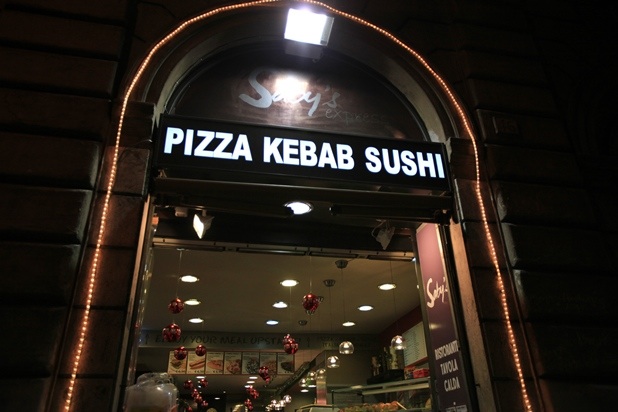
In the SF Bay Area, most of the japanese restaurants are owned and run by non-Japanese.
shrug
Truthfully, if they are able to source and purchase good seafood, and the sushi chef is able to make good sushi rice, cut and mold good nigiri sushi, I don’t care where he/she is from.
Most japanese-run places suck at making sushi too. That being said, the top joints here are all Japanese owned and run. There are a couple of American and Korean joints though that are up there.
In my town two of the three Japanese restaurants are Chinese owned (and managed, no Japanese is spoken within).
I spoke to one of the owners about it. I had already known that the majority of “fast food” Chinese restaurants are run by Fujian-province Chinese, who have made up the majority of immigrants to the US in the last couple of decades (as opposed to southern Chinese and HK Cantonese speakers who were the majority immigrants 20-30 years ago). The Fujian language is very different from Mandarin or Cantonese. Anyway, the owner said that most Japanese restaurants are run by Fujianese.
In the FWIW category…
I used to go to a Japanese restaurant owned by Koreans called Midori on the NW side of the city (Bryn Mawr between Kimball and Kedzie). They used to make two versions of chirashi – traditional, which they did very well; and Korean stye, basically lettuce, loads of imperfectly formed fish bits, tobiko and Korean hot sauce. Both were quite tasty, depending on one’s mood.
As mentioned above, many many “Japanese” places in the SF Bay area are owned and operated by non-Japanese, usually Korean and sometimes Chinese. As a longtime sushi eater, working for a Japanese company, often traveling to Japan, much more often dining locally with Japanese friends/colleagues, and married to a Chinese woman, here is my personal take, which you may take or leave: There is a huge difference in sushi and sashimi prepared and served in a real and traditional Japanese sushi-master’s restaurant and that served in the numerous non-Japanese places.
This, in general, is because of the years of training that the chefs in the former endured and the chefs in the latter were able to avoid. While of course there are exceptions, in my opinion, the non-Japanese chefs do not cut as well, prepare the rice as well, understand the balance as well, obtain as high quality fish and rice, and simply do not put as much effort and pride into what is served. So, when I want to enjoy as close to a Japanese experience as reasonably possible, I go to a genuine Japanese place. That being said, there are not that many real and traditional Japanese sushi-master’s restaurants, and we often will go to a local and very popular Korean owned and operated “Japanese” restaurant, or to a local and very popular Chinese owned and operated “Japanese” restaurant, and we will enjoy ourselves immensely, especially with the numerous, unusual, and very creative rolls, which you would never, ever see in Japan. However, I do not order sushi and sashimi in either place because it will not compare to what we get when we go genuine.
So, to my way of thinking, as perhaps a bit more of an obsessed purist than others, each has its place depending on what we want to eat, and each can provide a great, albeit different, dining experience.
Kampai!
Andrew
Andrew, I agree 100% on the rice issue. I have yet to go to a “high end” chinese sushi restaurant that has the rice of a comparable Japanese restaurant. Sure you get rarer, more expensive fish at the chinese places, but technique definitely does come into play.
Rice at Mori Sushi in West LA is heavenly.
Charlie, if that’s the place on Gateway, it was around the corner from my former office and I ate there a bunch when I still lived down there. Good stuff!
Andrew
What, you don’t like Todai’s nigiri rice machine that plops blobs of cold rice on a conveyor belt?  yuk
yuk
Oy, I think Makoto could also chime in here as a resident expert on Bay area sushi.
Sushi rice, shari, can be incredibly subtle. I must admit, I’m not super picky. As long as it’s not too cold, not too sweet, and not too vinegary. Is that too hard to ask? (apparently so…)
like you said, as long as it meets those criteria I have no complaints. I’m more thinking along the lines when I taste the rice that is so perfect it makes me go “omg”, it only happens at the high end omakase joints run by Japanese.
My go-to sushi place in SF is Aka Tombo in Japantown. Japanese owned and run. It rocks!
Went there tonight on your recommendation. Not bad, but there are two nearby places with much better sushi. Let’s talk when you’re done with crush and can get away.