Count me as a wine lover who likes to compare wine to art, when appropriate. A top performance by Thelonius Monk if you like jazz? A great neo-classical painting by Jacques Louis David? This past Wednesday night was a masterpiece. Certainly transcending point scores, there is nothing better than excellent food served with excellent wine, a fact which reminds us that great wines are not really “blockbusters” which impress you on their own, whether in a blind competitive tasting with lab coats or in informal gatherings to test wines.
No, truly great wines shine best when they shine with great food, as they did this past Wednesday at the Jefferson Hotel’s Plume Restaurant in Washington D.C.
Fifteen Washington D.C.-based tasters including wine writers (Ellen Kirsh of i-winereview.com and Ben Giliberti who used to write for the Washington Post), ITB (Mark Wessels from Bassins) and wine geeks including active members of this board such as Darryl Priest and Faryan Amir-Ghassemi gathered about 6 pm with Delamotte Blanc de Blanc 1999 Champagne, which was very refreshing and toasty and nicely wound together, tasting more youthful than its years. Its fresh richness, and its smooth character complimented our initial surroundings: a lovely area called the Book Room with a warm fire. Named after Thomas Jefferson’s library at Monticello, the space had a 19th century Gentleman’s Lounge feel: books along the wooden walls, plush seating, dim lights. Could have been perfect with cigars after the dinner…
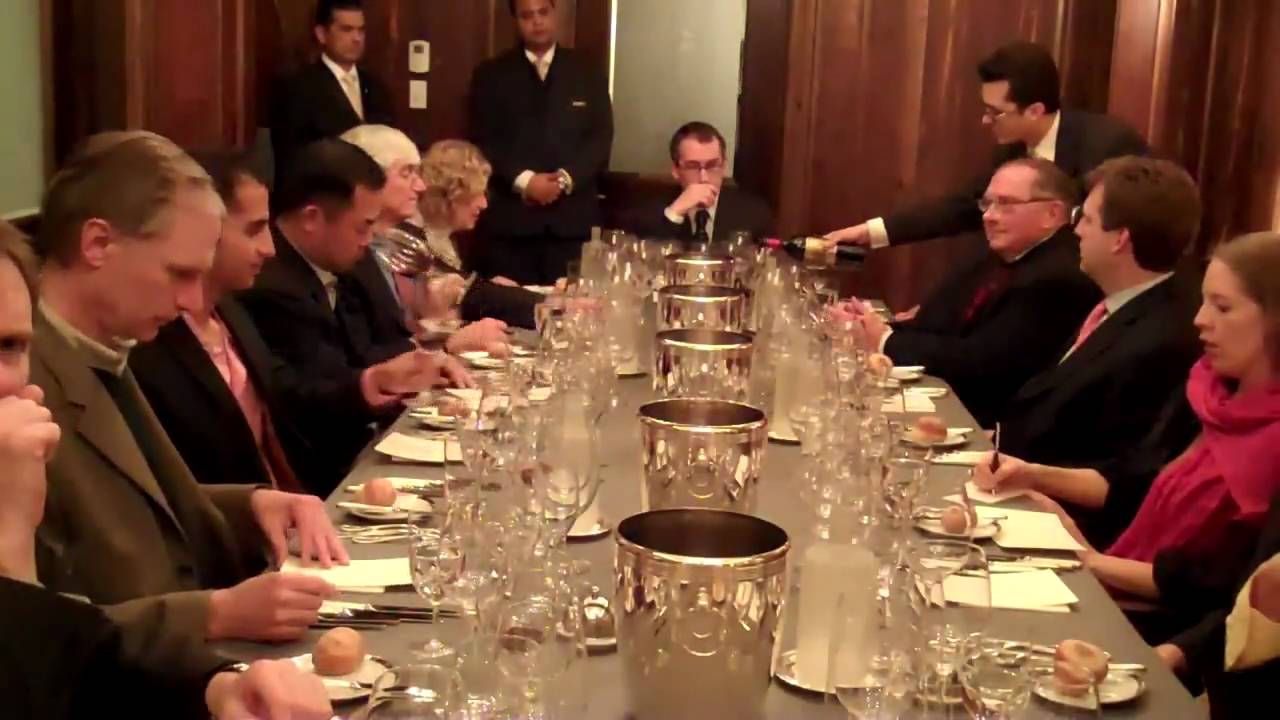
When all participants arrived, we moved into the Cellar, the so named private dining room at Plume, and it was beautiful: lined with glass enclosures featuring the restaurant cellar, from great Bordeaux such as Petrus and Latour, by way of DRC in Burgundy and excellent Cote Roties and Hermitages in the northern Rhone, to multiple vintages of Krug Champagne and cult California wines. They also have a few vintages of Chateau Palmer, but enormous thanks indeed to Chateau Palmer’s Bernard de Laage de Meux and Thomas and Jean Louis for the delivery of the 17 wines (and the Champagne)… which we had double decanted at 5 pm that day, with the help of Frank, our server. Frank and his crew orchestrated impeccable service, catering to our every need at the table in a professional and courteous manner that moved like clockwork. The wines were served perfectly so that we all had enough from the single bottles. Not since I dined at La Mirande in Avignon have I encountered such seamless service.
A long wooden table impeccably set by a professional and courteous staff. The temperature was 65 F, perfect for the wine service and because we were 15 in the room.
Terroir and methodology
As most of us know, Chateau Palmer may officially be a 3rd Growth, but it is justifiably considered perhaps a ‘super’ 2nd in quality, if not a 1st … Certainly the terroir is there: some 45 hectares just south of Chateau Margaux. It “sees the river”, as Thomas Duroux said, noting the nearby river’s positive influence in extreme weather conditions, such as in 1991. We had an interesting discussion about the amount of Merlot planted – due to historical planting more than anything else, Thomas explained. According to the vintage, of course, the proportion of Merlot and Cabernet Sauvignon (and Petit Verdot) vary, but what struck me about the wine was its consistently suave and elegant aspect, in a vintage like 1978 and found again in a vintage like 2000. Polished, but with substance. Even the exceptional 2005 (exceptional in every sense of the word) seemed to overshadow the 2000 with a larger scaled profile (rather atypical largeness) but it was not a really a modern über-concentrated blockbuster, thank goodness.
Thomas spent a lot of time explaining the estate and the philosophy of the wine. He said for example that press wines are always used in both the Palmer and Alter Ego blends. The press wines are of course more concentrated than the free run wines so they are used to perfect concentration in final blending. Other estates eschew press wines and prefer to extract more from the free run wines, which can sometimes result in an over extracted aspect, or even ‘huge concentration’, but that is one aspect happily missing from all the Palmers, including the 2005.
The major nuance here is that if the extraction is pushed to the limit, the press wines will not be of very good quality because the majority of the tannins will already be in the free run wine. But if the extraction is softer, one can obtain excellent press wines which could then be used judiciously for the final blend, Thomas explained. The latter method has always been advocated by the father of modern French winemaking Emile Peynaud and its benefit allows for precision: in the case of a full blown extraction, there would be no possibility for later adjustment to perfect final blending…
Choice of vintages
While in Bordeaux for the harvest last year, I had spoken to Palmer development director Bernard de Laage de Meux, and we made a plan for such a tasting, especially since Thomas was going to be in the US anyway this month. The bottles were already in the NYC, so not flown over from Bordeaux. The idea was not only to mix older with more recent vintages but also less celebrated vintages (1991, 1981) with stars (1983, 2005) and more or less everything in between. With the possible exception of the 2003 and the odd man out XIXth Century blend, all the wines, spanning some 30 years, conveyed elegance, freshness, perfume and palate substance: the mark of great Bordeaux. After the tasting, I am hard pressed to imagine a better and more consistent mix of Cabernet and Merlot, sometimes in equal measure. The word masterpiece does come to mind.
FLIGHT 1
Alter Ego 2006: A lovely, fresh red-fruit driven (raspberry, cassis and fresh plum), and ‘disciplined’ nose with a relatively tight and youthful palate that felt more Cabernet than Merlot, although the blend was roughly equal parts of both with about 8-10 percent Petit Verdot, which supposedly adds more spice, but I got more structure. I have the feeling that the 2006 will develop more slowly than the 2004…
Alter Ego 2004: Warmer, more giving plum and blackberry aromas, somewhat more Merlot-driven and somewhat deeper as well both on the nose and palate – with soft yet present tannin.
The roasted squab, set atop a large ravioli, filled with foie gras, braised lentils and green cabbage, was utterly delicious and probably paired best with the 2004.
FLIGHT 2
Palmer 2004: Well what do you know? There is indeed a fine continuity between the second and first wines here, but a more focused profile with greater perfume of blackberry and floral aromas (violets). The palate is fresh and displays a tonic finish that keeps you coming back for more.
Palmer 2003: At first whiff, I was thinking ‘I have had worse 2003s’ but there it was. Pushing the raisin-like-baked-fruit aroma envelope. It certainly had body and substance, not morning marmalade by any stretch of the imagination, but it suffered in comparison to the others. Thomas jokingly referred to this as the ‘black sheep’ of the flight, and I think we all got a laugh from that remark.
Palmer 2001: The later harvest of 2001 allowed the grapes to ripen slowly (the total opposite of 2003) so we have a wine that is fresh and pure in both its aromatics and on the palate. For me, very much mineral, with that lovely creosote aspect related to the cigar box, but not quite there. The palate also had excellent depth, but not nearly as good as the 2000, IMHO.
Palmer 1999: The wine was like the others double decanted two hours before the dinner began. It was a rainy September – a challenging vintage – and Palmer pulled off an excellent wine in the 1999, showing off bright red berry aromas and a dense if tight palate. The finish is refined and certainly feminine, but there is underlying and even coy power, on a seemingly slower development track than the 1998.
Palmer 1998: I had tried this in Germany in 2008 and got essentially the same feel. Much more Merlot than Cabernet, given the vintage’s favoring the Right Bank variety. A lovely, spicy plum nose, with succulence and richness. A lingering finish keeps that pleasure going. Most people would have chosen this wine to order from a menu among the five options in this flight. I agree. WOTF.
I loved the noisette of Berkshire pork and the confit pork belly and especially delectable boudin noir. The best pairing was indeed the rather opulent 1998.
FLIGHT 3
Palmer 1995: I loved the nose of this wine, certainly getting perfume. Thomas described it as the ‘Mediterranean Palmer’, setting aside of course the 2003, and it did have warmth – on the nose – but the palate was more disciplined with structure. Add to this a certain brooding power, and you do get a long term wine here. A rather typical 1995, but certainly one of the more successful on the Left Bank.
Palmer 1991: Lovely nose that seemed at first to show just a hint of roasted bell pepper, at least to me. The April frosts challenged vintners but Palmer’s terroir handled that challenge very well. Small quantities of wine, but very good. It seemed to improve in the glass and displayed a real smoothness on the palate. Surprisingly good.
Palmer 1990: Evidently larger scaled than the 1991, and I found this wine to be more subtle and less exciting perhaps than some tasters, with complex aromas of spice, mineral, cedar bordering on tobacco and dark fruit. As it sat in the glass, it became more expressive and expansive on the palate, with, again, a compelling subtlety overall, perhaps in contrast to the 1989.
Palmer 1981: I was not as enthusiastic about the 1981 as some posters; comparisons to Burgundy escape me as I sensed a bit more of dying leaf than aged Pinot. Solid on the palate and providing some pleasure; it did indeed draw me in as I sipped … and to its credit did not get thinner or weaken as it sat in the glass. but that’s just me. Still, it was thoroughly overshadowed in vibrancy, and in presence, by the following wine…
Palmer 1978: I made a comment referring to this wine as ‘robust’ and Mark Wessels quickly said it was not so. Of course, but in comparison to the 1981… this was downright lively. Smooth, not cigar box, but mineral elegance with indeed a forest freshness that transcended its age. The word, yes, ‘suave’ comes to mind, with a lingering palate presence finishing with minty lift that makes you come back for more. WOTF
No question an almost spiritual dialogue was created between the 1978’s sheer elegance and the medallion of prime dry aged beef in a (lightly) licorice-infused sauce.
FLIGHT FOUR
Palmer 1989: Almost roasted secondary notes on the nose combine with bright strawberry and cherry freshness, the palate showing both vibrancy and substance. Favorably compared to the 1990, which is perhaps more subtle at this stage but lacks the oomph of the 1989.
Palmer 1983: Has to be among my top three. It has the subtle refinement of the 1990 but with greater exuberance, as Ben Giliberti pointed out, and underlying power. A complete wine, with tobacco and cedar notes giving way to an energetic orange rind like finish that beguiles your senses; at least they did mine. WOTF
Hard to choose which was better with the black truffle studded loin of lamb with seasonal mushrooms. The 1983 in particular echoed the finesse of the food, while the 1989 matched more its rich substance. If I had to choose, the 1983 would have probably been the better wine for this delicious serving, but both were lovely.
FINAL FLIGHT
19th Century Blend (2006): Certainly dominated by the Syrah in spite of the 10 percent component. I got quite a bit of pepper and that Syrah like texture and sweetness. This wine was introduced in 2004 by the estate. On the palate, it is smooth and pleasurable, but perhaps not really reflective of Palmer elegance.
Palmer 2005: The nose is crystal clear, precise and very fresh and rather bursting with blackberries, blueberries and plums but with a literally enchanting floral lift. There is a buttery aspect, perhaps coming from the influence of the oak aging. Thomas said that he does not like too much new oak, and employs maximum 60% of it for the first wine. Very large scaled on the palate but not tiring or excessive yet plenty of tannin. The thing is, we drank it two nights ago in 2010: it is a baby. Give this baby time. Will it turn out to be the modern version of the 1961, as some people who had tasted the 1961 en primeur apparently claim? I have not a clue, but something special is in the glass, for certain.
Palmer 2000: I may just call this my WOTN, although in close competition with the 1983 and 1978 (and 2005 no doubt). Ostentatious but in a more feminine manner. Subtle and complex. While the 2005 wows you with fireworks, the 2000 draws you in with genuine sex appeal. There is something about the 2000 that transcends the sum of its parts better than almost all the other wines from the dinner. Yes, you have the balance among fruit, acidity, tannin, but you do not notice them nearly as much as you do in, say, the 2005. Or even in the 1989. What you have is a spherical wine that combines primary and secondary elements at a still very youthful phase in a manner that might be described literally as a great wine in the making…
Thomas is perhaps right to say that he does not really like matching cheese with red wine. The initial choice of a rich and creamy Brillat-Savarin was vetoed so we went for Gouda and Cheddar as well as for the St. Nectaire. To be honest, I was not paying as much attention to the pairings, focusing more on the wine, especially since the 19th Century blend was served before the cheese arrived. I suppose that the 2005 may have paired best with the cheese, since it had the most pronounced character to match…
A splendid evening with photos and a video coming shortly!