Book Review:
The New California Wine
Written by Jon Bonne
Photos by Eric Castro
2013 publication, 297 pages
I had actually read this book approximately around release, but have very little memory of it. Maybe I only skimmed it, or was just less into the grapes/producers, so little stuck. Our library has reopened, and as I was reconnecting with that old (now essential) friend, I saw this on one of the shelves, checked it out and read it over three nights. Lots of pictures, and maps (at the very end), along with breezy producer profiles. Given the years that have gone by, there has been changes, and many of Bonne’s champions are either defunct now, or have had enough happen to them that the original prose doesn’t seem accurate any more.
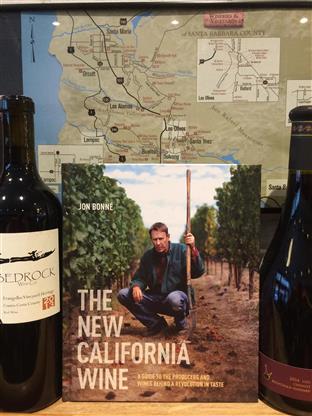
The book is organized differently than conventional regional guides to wine. It begins with the first part: Searching for the New California which includes sections on New Winemakers, A history of the Ups and Downs, New Farming Techniques, Grapes, discussion of Estates/Vineyards/Wineries, and the Dilemma of Table Wines. Producers like Abe Schoener of Scholium get deep profiles, even if Bonne notes the wines are unusual. Then California’s commercial path from jug wines to fighting varietals to high end trophies are discussed, along with the innovations along the way, and drawbacks - in the authors perspective. Some of that is news to me as I had not realized the evolution of the industry. Then in the chapter on New Farming viticulturists like Ted Lemon are interviewed and they present some of the differentiated techniques used to improve their output. For a writer like Bonne, who is concerned about over ripeness, many growers discuss how to control, even scale back, the sugar levels. When it comes to grapes, the dangers of clones are presented and ‘disease free’ Davis plantings are denounced. Bonne talks about how vineyards can live with viruses – it can be a way to control high yields. A discussion on rootstocks is then included, but the fine points of AxR1 vs St. George is beyond me. The next section covers the struggle over land costs for young vintners and how Prop 13 plus agricultural use laws in Napa et al. have made it impossible for the non monied to gain a foothold in the prestige regions. So the young and hungry are forced to ‘frontier’ AVA like Mendocino, the Foothills, Paso etc. I’m not sure this complaint is any different than other parts of the fine wine world - it’s expensive to buy into Pauillac or Chambolle too. The final section of the first part covers the category of Table Wines - the everyday wines that make up the output by volume. Complaints are raised about how the Whole Foods kinds of merchants (and customers) are concerned about the conditions of the meat/vegetables raised, but not about the wine farming. Two Buck Chuck is blamed for an overall consumer belief that wine should not cost more than $2, thus harming the whole industry while industrial KJ is also singled out for ire. Bottlings like Marietta’s NV Old Vine Red are presented as the solution for everyday drinkers - non varietal blends, with consistency coming from blending multiple years together. That seems reasonable, but given their production size (20k lot sizes per bottling run?) I don’t see it that often on Sacramento physical shelves, and doesn’t make sense to ship. There is also an exploration of bags/kegs, which really ought to be used more for better wines, especially for on premises sales. If wine BTG could be priced like craft brew (due to savings from less spoilage/no bottles etc.) it would be even more popular in bars when the world reopens. Overall the first part of the book gives a heavy dose of Bonne’s philosophy combined with vignettes of his champions in each concept.
The next major part of the book is The New Terroir: A California Road Trip. They touch upon Contra Costa, Sonoma, Sierra Foothills, Santa Cruz Mountains, Lodi, Anderson Valley, Santa Rita Hills, Paso Robles, and (!) Ventucapa. The astute will note that (overwrought in authors words) Napa is not covered directly. David Hirsch gets a nice profile for a lifetime of effort and there is some exploration of how vast the ‘Sonoma Coast’ AVA really is. Russian Rivers AVA expansion is also mentioned, which I had not realized. When it comes to the Foothills, Ron Mansfield is profiled for his work, esp with Rhone grapes. In SCM, Mount Eden and Ridge sites are touched upon, with in depth exploration of Rhys terroir too. Then comes Lodi and her old zin vineyards, with pictures that just exude the heat of the area. Anderson Valley gets lots of love - for its cool temps and cutting edge vintners. The Lompoc wine ‘ghetto’ in Santa Rita is also touched upon, although Bonne notes that Loring’s full throttle wines aren’t to his taste. High ripeness is blamed for ‘obliterating the sense of place’; Sea Smoke is called out for losing the ability to ‘telegraph anything more than Big Flavor’. In Paso Robles some limestone rich sites - James Berry Vyd - are touched upon, along with producers making Italianate wines. At least Tablas Creek - and their efforts to find Rhone Valley like terroir - are recognized. The final terroir profiled - Ventucopa - I’d never heard of but there is a Rayas styled grenache being produced there.
The final section is on varietals, and the most favored producers for each: Pinot, Chard, Cabernet, Rhones, New Whites, and Zinfandel. Tensions between Adam Lee and Rajat Parr’s camps are explored in the PN profiles. Some of his favorite producers don’t seem to be around any more, although others have exploded in popularity e.g. Kutch. In the chardonnay section, there is a sidebar on steel vs. oak along with the tricks mega producers use to get ‘buttery’ flavors. At least in the cabernet section, there is some acknowledgement of the Napa strengths, where restrained producers like Dominus and Corison get a little acknowledgement, as well as the newer modern Inglenooks. Rhone varietal champions like Denner, Copain, Lagier Meredith, Wind Gap are also profiled, even if I might know them better for other grapes. When it comes to other whites, the benefits of blends are noted, but the profiled producers seem really esoteric to me, and hardly available for normal consumers. I’m not sure that most of them are even still operating. The Zinfandel section seems well composed with Turley, Dashe, Bedrock, Limerick Lane complex, Ridge and other stalwarts all detailed. The various bottlings described in 2013 may not be all around today though.
The maps are well detailed, but might have been better positioned in each area. Unusually not only are the vineyards demarcated, but the varietals each is composed of is included by colors, so one can see that high profile ones like Hyde or Inglenook have lots of plantings.
Pictures are high quality and illustrative of the prose, paper stock is thick, and its well bound. The book is medium sized and takes maybe 4-6 hours of reading time. Despite its age, and the fact that some material is now outdated, I still recommend it, even if one is not in the AFWE camp like the author. I liked it, and if I found a really cheap copy, would buy it for reference material; second hard examples are running about $10 shipped.
Thanks for making it to end!