I just picked up 18, 50L rubber clad, kegs form our local Mad River brewery, and am wondering how you guys convert them into topping kegs and or store wine in them. Right now I use varable capacity tanks for topping wine, but am wanting to move towards pressuerized topping kegs, as well as be able to store smaller amounts than a barrel in them. Do you put silicone bungs in the openings when storing wine in them. I’ve seem a few companies sell a N2/Co2 inlet that acts like a bull dog pup for topping. I’m assuming the inert gas keeps half full topping kegs from going off or getting oxidized? Just curious about the ins and outs of these, as I’ve seen them in many wineries, but never used them.
I shopped around a bit and ended up buying the bulldog-like setup from St Pat’s in TX for topping.
The inside of the lip on the kegs has a notch that makes it a difficult seal with bungs. It’s much better to order the gaskets from St. Pat’s that mate up the flat top of the keg lip to 2" triclover and close them with a triclover cap and clamp.
I have a question on this topic. What kind of hose do you use for topping that doesn’t screw up the wine that sits in it between toppings? I’ve tried a couple different food grade hoses, and I always have to toss out the liter of wine that had sat in the hose.
Hi John,
Yep, we use them with silicone bungs. In our experience, if there is a partial, gas helps, but for a limited time. I can’t say how often you’d need to re-gas, but I don’t like partial kegs as a long term (more than a few days) solution. We have a few 5 and 6 gallon glass bottles which are a PIA, but that is how it works out. We are in no position to pour out good wine, just because it is not in keg or bbl amounts. We have very few tanks, so we use wood, and both vertical and horizontal SS bbls, along with the kegs and bottles.
Hope that helps.
I use a set up like this. I had the top of the keg (the valve part) cut off and a triclover fitting welded on. I bought a bulldog like device, hose and the topping gun from Bergstaller’s (spelling) in St Helena. Much better/easier/faster way to top up.
I don’t leave the wine in the hose tho. I detach it and clean it out each time, cuz I agree that leaving the wine sitting in the hose doesn’t seem like a great idea (plus, storing the hose where the kegs sit isn’t convenient for me).
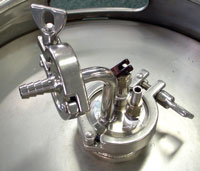
You can use a 2" TC gasket thats flat on one side, either the St. Pat’s special gasket for beer kegs or taking a standard gasket and shaving one side flat. Then use either a 2" TC end cap for full kegs or something like this for topping kegs:
http://www.stpats.com/images2007/ModifiedEndCapnew.jpg" onclick="window.open(this.href);return false;
Its basically a cover with 2 fittings, one a gas connection and one with a dip tube for wine out. I terminate the wine out pipe with a valve then only connect a hose when in use. That way wine doesn’t stay in the hose. I haven’t bothered with a topping gun just use the valve on the tank and move it around with a hand truck. Of course the topping gun would be nice for higher racks. St. Pats, TCW, and Bergstahler Machine all make the hardware. Or if you are setting up quite a few as toppers, you have a local welder build them using end caps and stainless pipe. This solution is a lot more sanitary than VCT’s in my opinion.
As long as the wine in the tube is finished with secondary why would anyone throw it away? just bottle it and have it with dinner!!!
… hell, doesn’t even need to be done with secondary … or primary, for that matter. ![[drinkers.gif]](/uploads/db3686/original/2X/8/82916bed5ad74ac8470bc04089d9758b0c80c9fa.gif "drinkers")
John,
I like having the tops cut off and a 2" triclover welded on. I have a very simple topping setup that is 50’ of food grade hose 1/2" attached to a stainless tube, bent at the top, inserted into a 2" triclover cap that has been drilled out. There’s a gas inlet with quick release next to it. The gun on the end is the expensive part. You can get away with a little plastic guy for a while, but you’ll wan the full on stainless with the trigger eventually. I top every two to three weeks, using argon to pressurize the keg and removing the topping setup and sterilizing it every time (I keep one keg empty for this purpose, and a compressor so as not to waste the gas). With a cap on the keg, I have kept the same topping keg going for two or three months without any negative effect on the wine, although its worthwhile to note I tend to use fairly high acid wine to top and keep the sulfurs on my topping wine in the 30+ free range.
If you like, I can send you a picture of the rig. It’s a pretty straightforward thing that you can probably buy from st pats. Get the full triclover welded on, though. Much better seal. And use the argon on the keg if you plan on keeping the wine.
Ian
John,
Have you thought about using 5 gallon Corny kegs for this purpose? Sounds like it would be a much cheaper solution than what is being talked about here.
I don’t see why it makes sense to weld on the triclover. The adapter gaskets that enable you to use triclover with all your unmodified kegs cost pennies. I’ve found the seal to be perfectly sound.
Assuming you start with a full keg, why do you prefer argon to nitrogen?
I already have the hose and topping gun for my VCT’s, so the gas/valve set up is the only thing I’ll need. The shaving off of one side of the gaskets is great, that with a cap and clamp will work great. Assuming all the air in the keg is inert gas, why would argon be needed vs. nitrogen or Co2?
I only use the larger kegs for storage and I’m not really fond of them. If they are less than full I top them up with Argon on my regular topping schedule. Seal with a bung and duct tape to keep the bung from getting knocked off. I use 5 gallon kegs to do all my topping. Transferring from the big kegs via gravity as needed.
The 5 gallons kegs are easy for me to move around as I top and I have a long line from the nitrogen tank to give me some flexibility. I use a short hose with a tap to do the actual topping. This way the 5g keg is depleted in no more than 2 topping runs on most lots. I keep one 5g keg filled with water that has a SO2/Citric mixture. When I’m done topping I rinse the hose until it runs clear from that keg so there is never any wine sitting in it. I repeat that when starting topping - hooking up to the water mixture and running it through. Then I hook up to the wine and run until its red.
Doesn’t really answer the question but that’s what I do. If I had more room I’d store in floating 200 liter and fill the 5g’s as needed, but I don’t have room for that many tanks in my space.
If you take the endcap/topping device out of the keg in between toppings, you’ll get a bit of air in there…so argon might be a bit better in that case…maybe (this depends on the theory that argon ‘blankets’, which I don’t believe is the case).
If you leave the endcap/topping device in the keg then I agree that there’s no difference between nitrogen and argon…both are inert gasses. Assuming it’s really sealed, you’re in good shape (I remove the topping hose and clean it every time tho). I wouldn’t use co2 tho, cuz that will carbonate your topping wine.
If you’re going to do this (leave the end cap in), I’d have a triclover fitting welded on the keg…Ian’s right that you get a much better seal that way. The gasket will have an indent on both sides when there’s a triclover fitting on both sides…the gasket for the sanke is flat on one side (with an indent on the other). Perhaps it’s not enough of a difference to worry about…but the difference in price isn’t that great.
Also, you get a much better seal when you have a bung in a 2’’ triclover fitting than you do with a bung in a sanke. I’ve found using a breather bung in a 2’’ triclover to seal a keg works well…no need to worry about the bung popping out (due to air pressure changes, or the last bit of ml finishing), and if the breather bung will keep a good vacuum if it’s in good shape (I’m quick to rotate breather bungs out if they aren’t keeping a good seal). Makes it easy/quick to gas them as well (just stick the gas nozzle in one of the breather bung holes and fire away).
Will co2 in solution (carbonic acid) lower the ph of wine by any appreciable amount? If so, then using beer gas (75-80% nitrogen and 20-25% co2) might be interesting way of lowering the ph of the topping wine (always a good thing), without overly carbonating it. Means you’ll have more co2 to sparge at bottling tho, so might not be worth it.
I use argon because it works. I don’t use nitrogen or co2 because they didn’t work. Theoretically they should. I don’t like the shaved off gaskets because I don’t feel like I get a very good seal. For a nominal cost, it keeps my topping wine is better condition.
We mainly use argon for gassing, and nitrogen for rolling. CO2 is WAY more soluble than either of the others, with nitrogen being a bit more soluble than argon. You can use CO2, but I certainly wouldn’t use it near bottling, unless you want to lift the perception of acidity and possibly add spritiness. Some people intentionally do this in whites.
That’s my routine too. Argon to gas, Nitrogen to push. Never thought of pushing with Argon.
I use Argon for gassing head space only. Seems like a waste to use it to pressurize a keg for topping. Nitrogen works in kegs just fine. But it you keep breaking the seal then I guess Argon would be better. I have a individual pressure cap for each topping wine then just move the hose around. I have a gas bottle with a manifold and leave all the topping kegs under about 5 psi all the time. If any leaked it would be obvious. They don’t, neither the full tri-clamp or flat-one-side gaskets. The special gaskets are silicon material and never had one leak. I would like to have all 2" TC fittings, its just doesn’t seem worth the conversion cost to me.
I use regular kegs for storing wine, blanketed with argon and bunged up tightly. For topping, I use kegs with tri-clamp tops, with a topping plumbing assembly from TCW. You can cut the top off of the keg and have a tri-clamp top welded on, but you need to be sure you have the right depth for the plumbing assembly, or the plumbing assembly might not get out all the wine, or worse, the plumbing assembly won’t seat correctly.
The length of the tubing holds just a bit more than needed for topping one barrel, so while the topping system is connected, I top up all but one barrel, and use the wine in the line to top the last barrel.