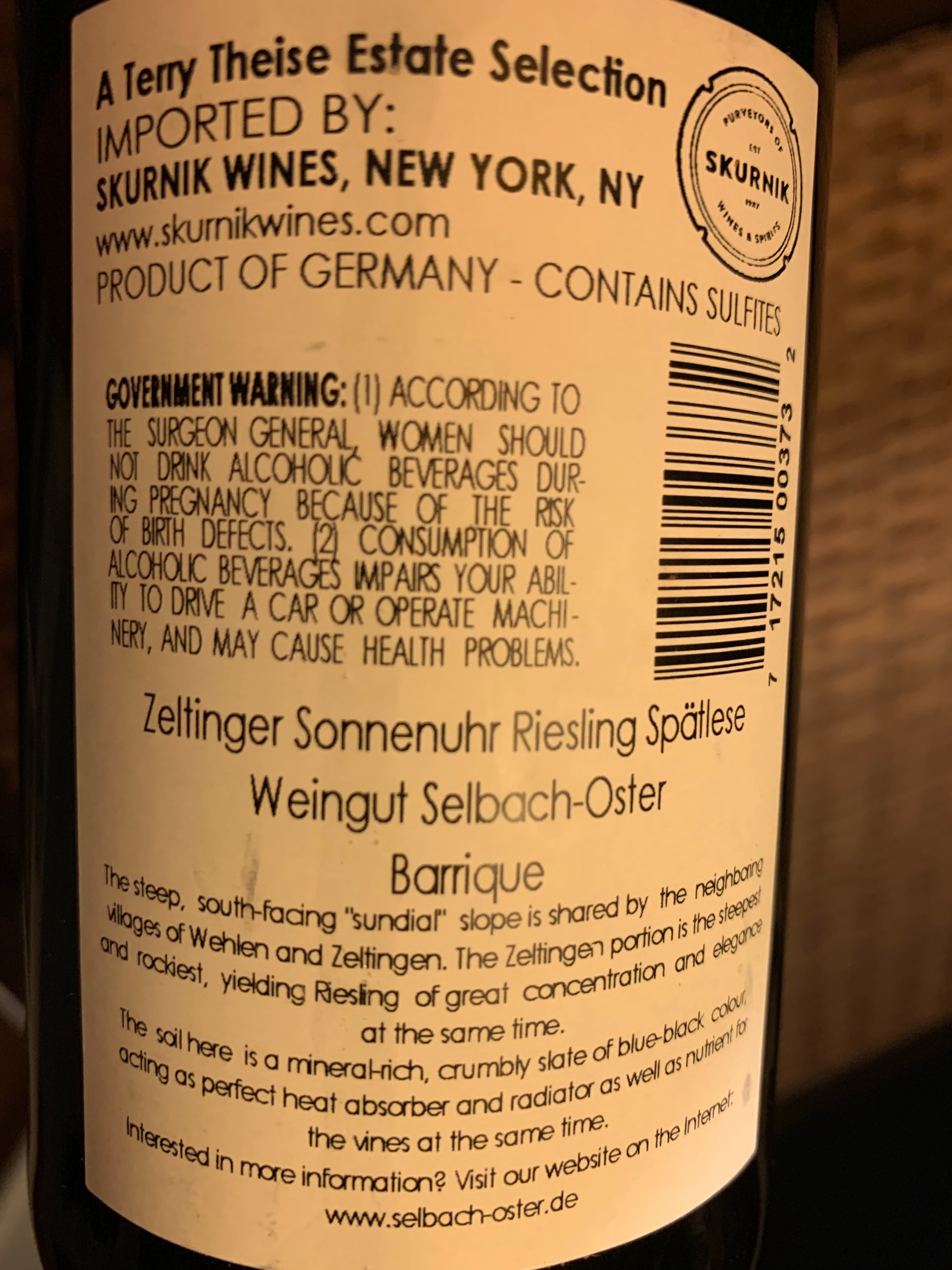
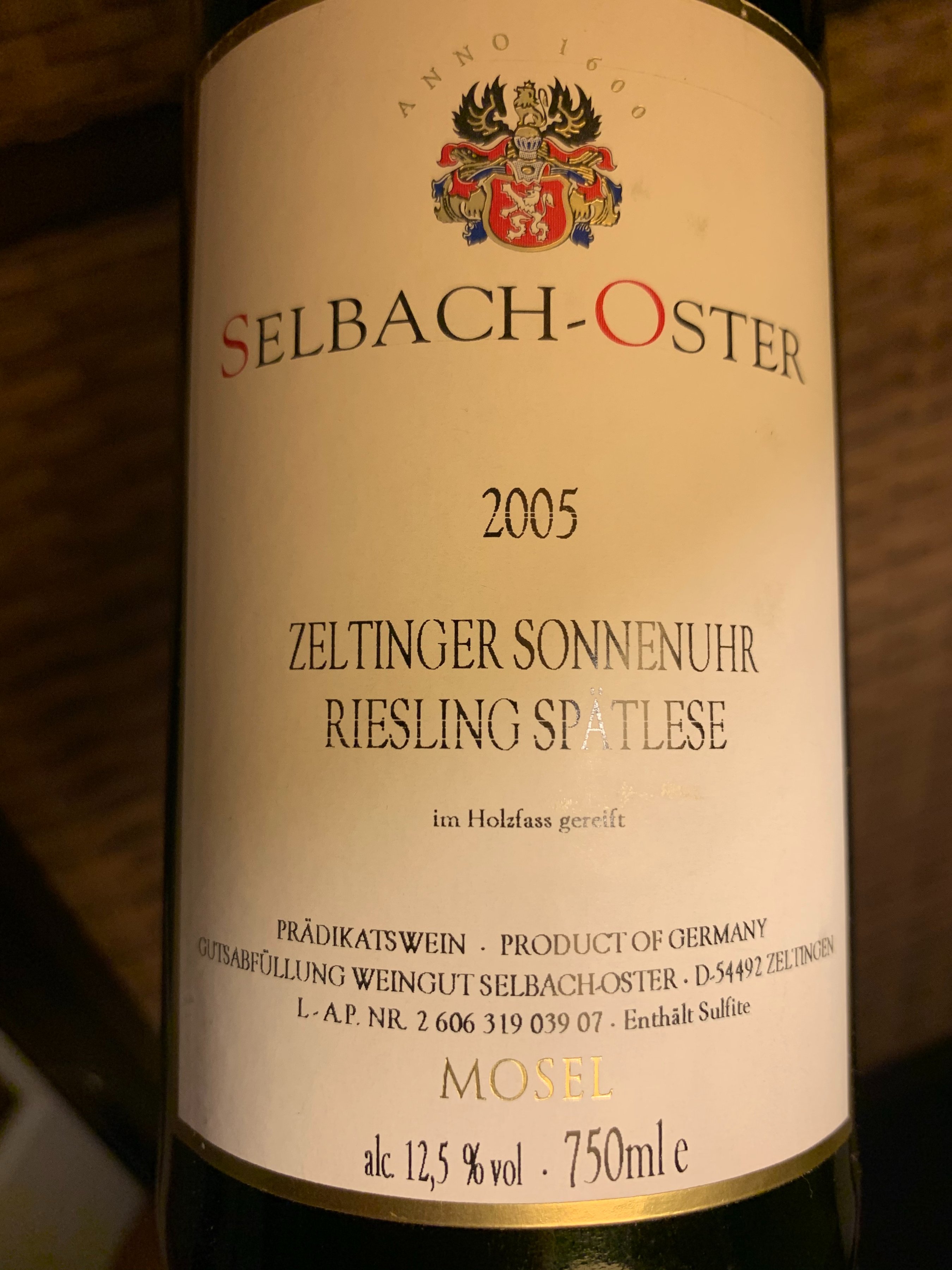
I grabbed a bottle of riesling tonight, and it wasn’t until further examination that I realized something was afoot.
The 2005 Selbach-Oster Zeltinger Sonnenuhr Spatlese I opened was rounder than expected, had an odd note I originally attributed to possible premature advancement, and wasn’t nearly as sweet as I would have anticipated.
A closer examination of the label revealed two surprises. Alcohol labeled at 12.5% and in very small font the german, “im Holzfass gereift” – aged in wooden barrels.
The back label includes the very unusual notation ‘barrique’.
So, this is a spatlese, made in a halbtrocken style (but no where labled as such), and aged in barrique.
Anyone else had one of these? Know much about the wine? Have the old Terry T catalogue for some answers?
The wood has a clear impact on the nose and the palate, but it doesn’t taste wooden, per se. Which is to say, it doesnt taste like oak, but it adds some heaviness to the usual riesling lightness. Probably overshadows the fruit somewhat. Frankly i think it deadens or depresses the vitality of the wine. Those are heavy words, but directionally conveys my sense.
It’s interesting as a novelty, but stylistically its not how I would want my riesling handled with any regularity.
I know nothing about this wine, but Terry Theise has his old catalogs online at www.terrytheise.com, under “portfolio.” The 2006 lists two Zeltinger Sonnenuhr. Spätlesen:
“2005 Zeltinger Sonnenuhr Riesling Spätlese + This is a genial aristocrat, a guy who has to wear a suit but would much rather not. There’s a chewy intensity here — old vines, small berries — and a real ancient-tasting wild “heirloom” apple fruit. I’m trying to stay nice and calm; we haven’t even started with the Ausleses yet . . .
2005 Zeltinger Sonnenuhr Riesling Spätlese* +++ Uh-oh; here it comes. Though less mealy and seamless than the Badstube 1-star, this has even more delineation and digital precision, and a back-palate apple-lavender- slate-ROCK that seems to never stop melting; all the while the wine is in ceaseless manic motion - and this from a sample bottled last week! An apotheosis of sweet balsam and aloe and a lime crème-brulée.”
Nothing there that seems to indicate barrique. Perhaps this was released later?
I like Selbach’s wines. I think of them as a very easy to drink style of German wines. To me, aristocrat was a good word for his Sonnenuhr while his Schlossberg is zippier. But, his wines are pretty solid and really easy to like. They may not hit the heights of the very top producers, but I often do not care.
2005 is a vintage in the Mosel with pretty good acidity. So, the wine probably does not qualify as halbtrocken even if it gives a drier impression. Frankly, wines that are not finished dry but are not supersweet and that have good acidity is the way German wines used to be made and it is a great style that I wish more people would make today. The best wines are wines of balance, not extremes either way IMHO.
Lots of German wines are made in oak barrels. Even though it is from oak, I would be surprised if it is new oak and so I am not surprised you detect no oak flavors. But, you get more interaction with air than you would with stainless steel. So, the wines tend to be less reductive than ones from stainless steel, IMHO. I am surprised that this would be from barriques (unless the Germans have a different definition of this than I normally think of) as I think of this as a smaller oak barrel and I am used to seeing German wines in oak in fuders, larger oak barrels.
I think that the key word here is exactly that “barrique”. Germans mean a 225-liter barrel when they use the term “barrique” (as opposed to, say, Spanish, who might use “barrica” with a wine aged in any kind of smaller barrel). The Rieslings aged in (normally 1000-liter) fuders are quite commonplace, but I, too, am surprised to see that this wine is aged in barrique. It is definitely not commonplace and very rare indeed in Mosel. I can count the Mosel Rieslings aged in barriques probably with the fingers of one hand (the only one I can think of right off the bat is Stein St. Aldegunder Klosterkammer Riesling Im Barrique Gereift **** 2011).
The halbtrocken note was more in reference to the fact that the ABV is 12.5%. This is more than a wine thats perceptually drier than the actual RS. And as Otto noted, this is about barrique particularly. Its an odd duck.
This was an odd, outlier wine that Skurnik brought in as a novelty. Terry did not select it, despite the label showing it as a Theise selection. That used to happen every once in a while. There are some 2006 Austrian wines that Skurnik decided to import that Terry did not select.