Thank you, Brad and William for your detailed comments. This thread has been quite instructive.
Wow Brad! This is the kind of stuff I’m looking for and some of it is coming together and making some sense. I also appreciate knowing how certain producers make their wines and the outcomes after tracking them over time. I may not be drinking a lot of “older” champagnes, but I’m eating this dialogue up.
Blake’s Summer of Champagne Discourse is having a crescendo in August  . This is fun.
I’ve always thought that cristal has the most dramatic (and graceful) transformation with age. Would Brad or anyone else know if there is anything particularly distinctive about the dosage regimen (or otherwise) that might cause this?
In regards to the regular release Cristal (and most of the other Roederer wines), the wine used for the liquer d’expedition/dosage is what I would call ‘Super Cristal’. Each year, the best of the best wine from the Cristal plots is blended and aged in large oak foudres. If the wine doesn’t reach expectations, it is declassified and becomes a reserve wine. This means that the best wine that Roederer makes actually is used as the base for the dosage. Roederer has a large selection of years to choose from when selecting the constituents for the dosage wine. For the Vinotheque Cristal releases, the dosage wine is Cristal from the original release of that particular vintage - so Cristal 1996 Vintotheque’s dosage wine comes from the origianl release of 1996 Cristal.
For a long time, my main complaint with Cristal was that it was released too young and usually didn’t get appropriate aging on the lees to have it reach its full potential. It has started to see more lees aging lately and I think that has made it a better wine and one that will gain even more complexity and quality with age.
2 Likes
Thanks!
Fantastic add on Brad. Keep it coming. This is truly inspirational information that encourages me to explore more into the depths of champagne making by individual producers and then understand the changes reflected in the character of the wines as they age.
So, Brad, Willian and any others, how do you explain the findings I got on the 85` Cristal Rose? From what I’m understanding from input in this thread, there’s much more than just the Maillard Reaction going on, but what else if it is possible to identify? Here’s an excerpt from the notes:
“medium amber color; the fill was mid neck, there was no sign of leakage nor damage to the label, no cork push and even it came out with a little effort and in perfect condition; once poured, it showed minimal bubbles; the nose confirmed this was oxidized, but only a taste would verify as to what extent; first came some maple and at the end came some honey; in between was caramel, butterscotch, apricot and almonds with a heavy dose of sweetness.”
And then on to the 86` Taittinger Comtes de Champagne Rose where it had “very unusual speckles of sediment/ particles dispersed in the glass”. They never settled out. What is this attribute to?
Blake,
Both your bottles to me sound like they were not stored properly and had heat damage. The wines probably sat somewhere where the temperature was too warm for parts of many years. I have had numerous old Champagnes like this - even when they looked perfect before opening the bottle, they didn’t perform.
As for what was going on to cause these Champagnes to taste this way - The effects of lees aging and the Maillard Reaction are there plus a lot of other ones that involve oxygen and heat. Essentially, your Champagne was likely stored under conditions that were favorable to encouraging reactions that resulted in undesirable compounds. You probably had all of the good reactions that result in positive development too; it is just that you had way more of the negative ones and they dominated the wine.
I have had sediment in a lot of bottles that saw poor storage and were exposed to high temperatures. I have also had sediment in older bottles that were fine, but usually when there is a lot of sediment dispersed in a bottle and the color is darker than expected or the fill lower than expected, it is not a good sign.
1 Like
Thanks Brad for the evaluation. This is all making more sense to me now.
I was actually somewhat optimistic when i found all of the bottles that I could view were devoid of a cork push, signs of leakage, and with the Cristal Rose, decent color although it’s more difficult with a 35 year old rose to detect red flags as per color alone unless it’s brown or worse. Even the fill was a surprisingly high neck. I always thought a wine that is severely oxidized would have more air space for more oxygen to advance it, but evidently, that’s not the case.
The sediment was a first time ever experience for me when it remained suspended in the glass and did not fall out. Also, the Taittinger had way acceptable mid neck fill.
There’s a lot s going on inside these bottles that we can only hope is favorable especially when the provenance is not known.
I had hoped that Francois Audouze would chime in here, but no response so far. He did post on Instagram about 4 champagnes from 1973 and raved about these 2:
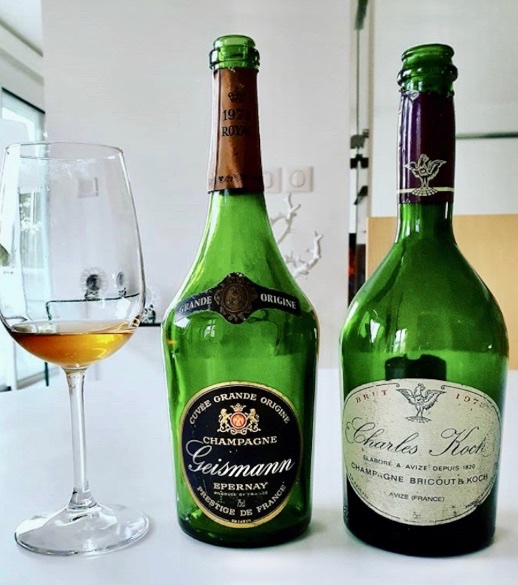
Looking at the color of that Champagne in the glass, his expectations and priorities are clearly different from my own.
I had the same thought Michael, in fact, over all of the years he has posted about champagnes that were 50-100 years old, I concluded I had different preferences.
I’ve had very limited experience with older Champagnes (or older sparkling wines). I think one of the best showings I’ve had was from a '96 Comtes BdB last September. There was a hint of oxidation, I think that might make sense with a 23 year old bottle of Champagne. The few I’ve had from the 80’s were all quite oxidative, but in a pleasurable way. It would be very nice to have some older bottles directly from the caves…and I expect that’s why people are paying top dollar for the P2’s & P3’s from Dom P.
Good point on the P2 and 3s although they have not stood up to the test of time yet. I some 95` Dom Oenotheque I’m going to open in the next couple of years or so and get a read.
Count us among those who prefer younger Champagne compared to aged, and we drink a lot of Champagne (it’s about 50% of our cellar). The only “aged” Champagne we’ve had good luck with is stuff that has been aged and recently disgorged directly by the domaine. As far as stuff that has been aged by individual collectors, our experience is about the same as yours; 99/100 we won’t like it. Our sweet spot is ~15 years, give or take, depending on when it was released/disgorged.
1 Like
While I have a lot less experience with this comparison than you do this has always been my preference as well.
What an excellent thread. A real joy to read. I have been slowly increasing my stock of Champagne the last 2 years (just in time for 2008) as I realised I have collected too little. Not much vintage champagnes left, and by Brads remarks, I will let my DP 02 rest for quite some time…
I have not been as fortunate to taste much aged Champagne (oldest so far is 88 DP around 2015 I guess), but I found the writings of Brad to be very inspirational in lack of a better word. Brad, if you don’t mind, besides Vilmart CC that you mentioned above, what other producers and bottlings would you suggest buying (i.e buy yourself)? As a side note I do like the style of Roederer, Egly, Charles Heidsieck and Bollinger to mention some. DP do need some age to be properly appreciated by me.
I am currently planning to try to get ahold of the Taittinger 08 CdC.
Thanks
Emil,
Everyone has there preferences, but the first 25 favorite producers that come to my mind are below. I purchase all of these with the intent to age them as I believe they improve tremendously over time. This is not to say these are my favorite 25 producers or wines, just those that are favorites and I feel really benefit from aging. In no particular order they are:
- Krug
- Dom Perignon
- Franck Bonville
- Vilmart
- Pierre Peters
- Louis Roederer
- Veuve Clicquot
- Ruinart (for Vintage and Dom Ruinart)
- Moet (for Grand Vintage)
- Lilbert
- Taittinger (for Comtes de Champagne)
- Charles Hedisieck
- Diebolt-Vallois (for Prestige and Fleur de Passion)
- Laurent-Perrier (for Grand Siecle)
- Philipponnat (for 1522 and Clos des Goisses)
- Delamotte (for Vintage)
- Pierre Gimonnet (for Special Clubs)
- Deutz
- Drappier (for Grande Sendree)
- Billecart-Salmon (for Nicolas Francois, Elisabeth Salmon, and Cuvee Loius)
- Marc Hebrart (for vitnaged wines and the Special Club)
- Pol Roger (though they have shown more variability of late)
- Alfred Gratien
- Bonnaire (for vintaged wines)
- Vazart-Coquart (for vintaged wines and the Special Club)
6 Likes
and the wealth of information just keeps on coming Brad- again, thanks so much.