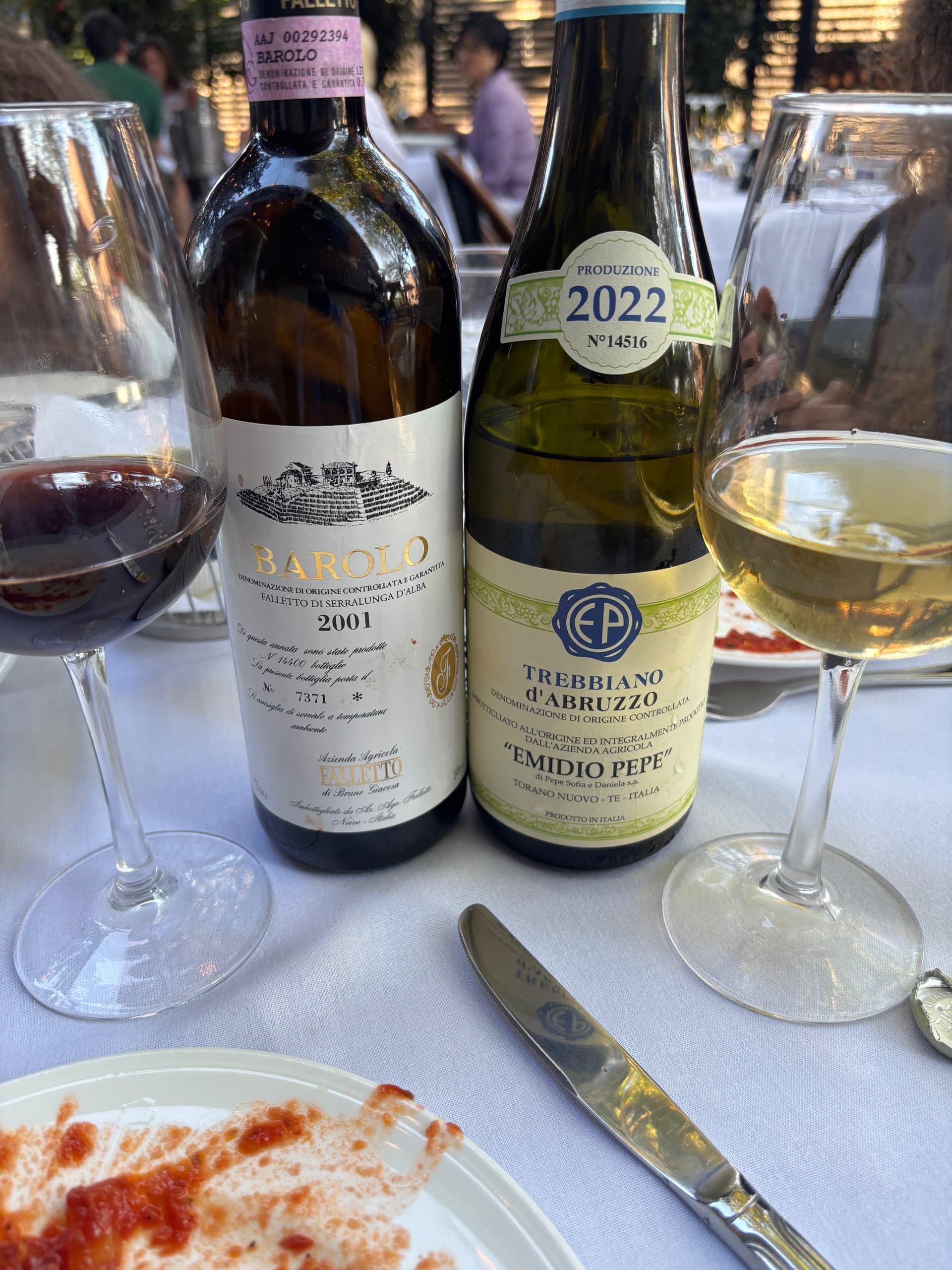
I have consistently had negative experiences with Barolo from auction that is more than 10 years old. Even with 2013 and 2010 they taste and smell oxidized.
Last night, I opened a 2001 Bruno Giacosa Falletto di Serralunga purchased from Zachys auction and was disappointed - it was thin and the fruit tasted stewed, with slight hints of oxidation. I could see tiny pieces of sediment in the glass.
Is it poor storage? Do others have this experience? Or is it my bad luck?
Eric, did you stand the bottle up for a couple of weeks and then decant off of the sediment before serving? Did you follow it over the course of time to see if it improved with air? The fact that you mentioned pieces of sediment in the wine, makes me wonder if you prepare the bottle correctly. If not, that could be playing a part in your bad experiences. Perhaps not so much of an issue for a 2013, but I would definitely want to decant a 2001 off of the sediment.
Color looks ok to me. I suspect a lot of older Barolo sat on shelves at room temp for a while but not sure about that one.
Nebbiolo has very fine sediment, so when they are more than 20yrs old I generally stand upright for a week or so ahead of time. Double decant if traveling. I know it’s a pain. Can use a pouring basket otherwise if no time to stand up.
If no oxidative aromatics (brown sugar) and color looks good then maybe just needs more air. There a lot of threads on decanting Barolo/barbaresco. The fine sediment can definitely lead to a thin shrill or bitter wine. Much more so than Bordeaux varietals.
I completely agree with Michael on this bottle - there’s a shock
FIne sediment in your glass should not be considered a flaw in the wine, only a flaw in your preparation. Nebbiolo is known for having fine and sometimes copious sediment after a number of years - this is totally normal. At very, very least you should stand bottles up for a day, and even longer can be much better, especially if the bottle has been shaken up, or is very old. Bottles that have been unmoved for years in the cellar tend to have a line of sediment down one side. Be very careful when removing from your racks, being sure to keep the downside down, then carefully stand it up, leaving it at an angle if possible, to allow the sediment to slide down into a corner and settle there (I have a friend who mispronounces sediment as “settlement” and I don’t correct him because, well, it’s cute, but also because it’s a viable metaphor.) Then carefully decant off sediment all at once, either long before or just before serving (see below), so that you don’t ruin all our hard work by tipping the bottle repeatedly.
Air is also the friend of older nebbiolo, though it becomes challening to know at what age “older” begins. Very rough rule of thumb for me is the older the nebbiolo, the more air it needs. For a classically made barolo like this one, I would open it several hours early and probably decant immediately. Oxidation often completely vanishes with a few hours air, color improves, and the wine comes together. You can’t apply rules of other regions across the board to older nebbiolo, as it is the exception to many rules.
Apologies if you know all of that and are already doing it. I think it’s unlikely you have had all bad bottles across different producers, ages, and auction houses, so my suspicion is that treatment is the culprit. It’s also possible you don’t LIKE old barolo, which is fine!
I also have to agree with what has already been said - the color, the sediment, being unfriendly upon opening - these seem all completely normal to me for a 24 year old Barolo. I have seen that color in Nebbiolo half that age, standing up for decanting off the sediment is must, and I usually decant anything old 4-8 hours prior to serving.
I will add that I have had excellent results buying Nebbiolo from auction. I have not opened anything from 2010/2013 as I personally think these are too young. However, in the last year, I opened Barolo/Barbaresco/Boca/Bramaterra from 1989, 1999, 2001, 2004, 2006, and 2008 that have all be just as I hoped for.
Careful double decanting should not cause diffusion of properly settled sediment. My guess is that the fine sediment was gathered in the bottom until you moved it around. Sorry to say this, but even if you kept it standing upright during the drive, after transporting dozens and dozens of bottles even short distances, I know that fine sediment can get stirred up during a car ride. So I don’t think the fine sediment would have been an issue if you had double decanted at home. Ideally, I only move an old nebbiolo enough to remove the cork and oh-so gently and carefully decant off sediment in one go. I’ve never had issues with remaining fine sediment in a well prepared bottle, over I’d guess well over 100 bottles of old to ancient nebbiolo.
If you are really worried, some people do use a coffee filter, but I never have.
Nebbiolo has a finer sediment than any other wine. As others have said, this needs to be decanted and left in the decanter for a while. Giacosa’s wines in particular always have a brownish tint when first poured. They need lots of air. This wine should have been terrific. 2001 was a great vintage for Giacosa.
Yes, I’ve had several 01s, as well as 98 and 99 white labels over the past 6-7 years and all are in very fine shape, basically little changed. 98 probably being the most open but that’s another story. All were very good.
Klapp was pretty adamant about his willingness, or insistence, that it’s worth it to sacrifice a decent portion- maybe 1/8 of a bottle- on the decant in order to make sure the least amount of the dregs will make it to the glass. Sometimes after a nice clean decant, I am surprised at how much sediment will end up in the bottom of the freshly rinsed bottle after the wine has been returned to it and had a chance to sit a number of hours. With that said, I don’t really stress too much about a decant of Barolo under 20 years. I just poured the 98s, 99s, and 01s straight from the bottle although gently and I do leave them upright for months if not years before pouring.
If you are very careful, no, at least not to the extent you imagine.
I routinely stand bottles for six months to a year to let the sediment really settle and cake to the bottom (having already cut the capsules or removed wax, etc.). It is then a very short, very careful walk to the counter and prep area. I am very careful, very deliberate and gentle when removing the cork so as to make as little motion as possible, giving me the best chance of getting just the wine. I always decant over a flashlight as well, and do so very slowly so that the airflow in does not create bubbles that disturb the wine more than necessary. Once I see sediment moving to the neck, I stop, and I will then pour what’s left- usually not more than a half to an ounce- into a tasting glass that I have standing by. This allows me to check for TCA, but after a while I can usually get a little more wine off the sediment.
Once the wine is in the decanter, I pour a couple of ounces of distilled water into the now empty bottle and shake vigorously to dislodge any sediment and what I am left with is a perfectly clean, sediment-free bottle and the wine goes back in, I pop in the cork, and then we can head out to the restaurant or tasting.
It’s all about being as gentle and careful as you can possibly be. It can be a tedious process, yes, but I have consistently excellent results and I know I have given the wine its best opportunity to show well.
Nebbiolo is especially fussy. I brought some 1970s Sobreros from England and even after a five week rest, they still had a fine sediment.
John Gilman’s note on the 1979
|Ironically, after I told a friend of mine who had introduced me originally to the wines from Filipo Sobrero about how brilliantly the 1971 had shown at a tasting I hosted, he suggested we get together for another tasting with a couple more vintages of Sobrero Barolo included in the lineup. We happily did so, but also proved that standing up bottles for five weeks is still not sufficient to get all the sediment in an old Barolo to settle perfectly to the bottom! As a result, this bottle of 1979 was still just a touch affected by sediment in solution. However, it was easy enough to work around and it is clear that this is a great bottle of Barolo at its apogee today. The bouquet is deep, complex and precise, wafting from the glass in a beautiful blend of dark berries, black cherries, anise, spit-roasted pigeon, camphor, bonfire, a beautiful base of soil tones and a lovely array of brown spices in the upper register. On the palate the sediment stole a bit of precision away from the wine, but the wine was still easy to read. It is full-bodied, complex and tangy, with a superb core of fruit, lovely soil undertow and grip, still a bit of buried tannin and excellent balance on the very, very long, classical finish. The next bottle of the ’79 Sobrero I drink will be treated so as to ensure the sediment is completely settled, so that we can catch the wine as beautifully transparent on the palate as it is aromatically! But, there is little doubt that this is a brilliant wine at the peak of its powers today. (Drink between 2025-2050) 94+ points|
Decanting solves the problem because the fine sediment after standing for a long time, as I said earlier and as @Chris_W described quite well, is in the bottom along with everything else, it isn’t suspeded in the wine. A wine that has been standing up for a long time will not have fine sediment suspended throughout it - it may be fine, but it’s heavy enough to obey the laws of physics and settle to the bottom. Your fine sediment was only throughout the wine because, I am pretty sure, it was shaken up and suffused throughout during your travel. If you had just left it standing, then barely moved it to decant, the fine sediment would remain at the bottom in the last couple of inches of the wine. The coffee filter is really to get a little extra out of the bottom of the bottle. Most of the wine will be totally clean without a filter if you handle it correctly.
Edited to add - you are, however, correct that once the fine sediment is suffused throughout, double decanting without a filter won’t help. Like after you arrived at the restaurant. That’s why we go to such trouble standing them up way in advance.
Might just be a bad bottle. I had a 1999 of this Giacosa bottling just a week ago and it was gorgeous. Double decanted off the sediment about 6 hours before serving after I had it standing at cellar temp for 4 weeks (probably could’ve benefited from more than that, as I had a good 3-4 oz full of sediment at the bottom). Even after opening for service, it really didn’t hit its stride until a couple hours into the tasting.
Saying this as respectfully as possible, and I mentioned in another thread, that it might just be Eric doesn’t really care for aged or even slightly aged Nebbiolo. That’s OK. I say this because Eric has repeatedly mentioned the same issues. The color of trad Neb often looks a little rusty brown as if it would be cooked or overly aged if it were any number or other grapes. Trad examples often have a nice whiff of VA. The classic descriptors are tar and roses, not anything fruity. It can be very floral and pretty when young, but it’s not really fruity, or at least the examples I like. It’s got an element of bitterness to it. Hard to say with any conclusiveness as to the soundness of the bottles but you’re going on maybe 10+(?) examples that I assume came from different auctions or lots, and Zachy’s is reasonably reputable, so I have to think somewhere in these samples you would have come across at least some sound bottles. Really, they all look and sound pretty good to me, it might just be your preferences lie elsewhere.
I’m out of the NY loop for some years but I believe Jamie is still involved with Chambers. He has great Neb knowledge. Maybe consult with him on a bottle, do the whole decant rigmarole discussed here, then if it still seems off to you, bring the bottle back to Jamie and have him try it. If it’s bad, I am sure he will credit. He’s an honest guy, if he says it is normal, trust him.