Going to agree with this. Excellent wines @Keith_Levenberg
1 Like
Honestly Roy, I think your heart is 100% in the right place for your own wines and your musings on other people’s wines.
I think you should come up and visit again. I think you would see a remarkable array of really lovely wines being made in a wide array of styles. I doubt mine would really appeal to you, but I think you would be hard pressed to believe that we are too warm. The mid-summer days are indeed warmer than Cali, but the nights are just as cool, and the shift in seasons gives our vines very clear messages, even if it’s warm. The side seasons cool rapidly and, for now at least, we’re in a great spot for winemaking.
And while Goodfellow red wines may not be in your wheelhouse, I think you would enjoy the bubbles and Chardonnay.
4 Likes
I mean, I don’t generally take my clue on how our vineyard are doing based on the climate data from valley floor airport weather stations….. but if you really want to break it down that way, for apples to apples (or specifically: only tangentially related nearby micro-climate to likely only tangentially related nearby micro-climate) here are the average highs and lows for McMinnville and Lompoc:

McMinnville, definitely warmer average daytime temps than we used to get in July and August…. but then, even in the hottest valley floor areas, the wind kicks in about 5:00 and temps drop.
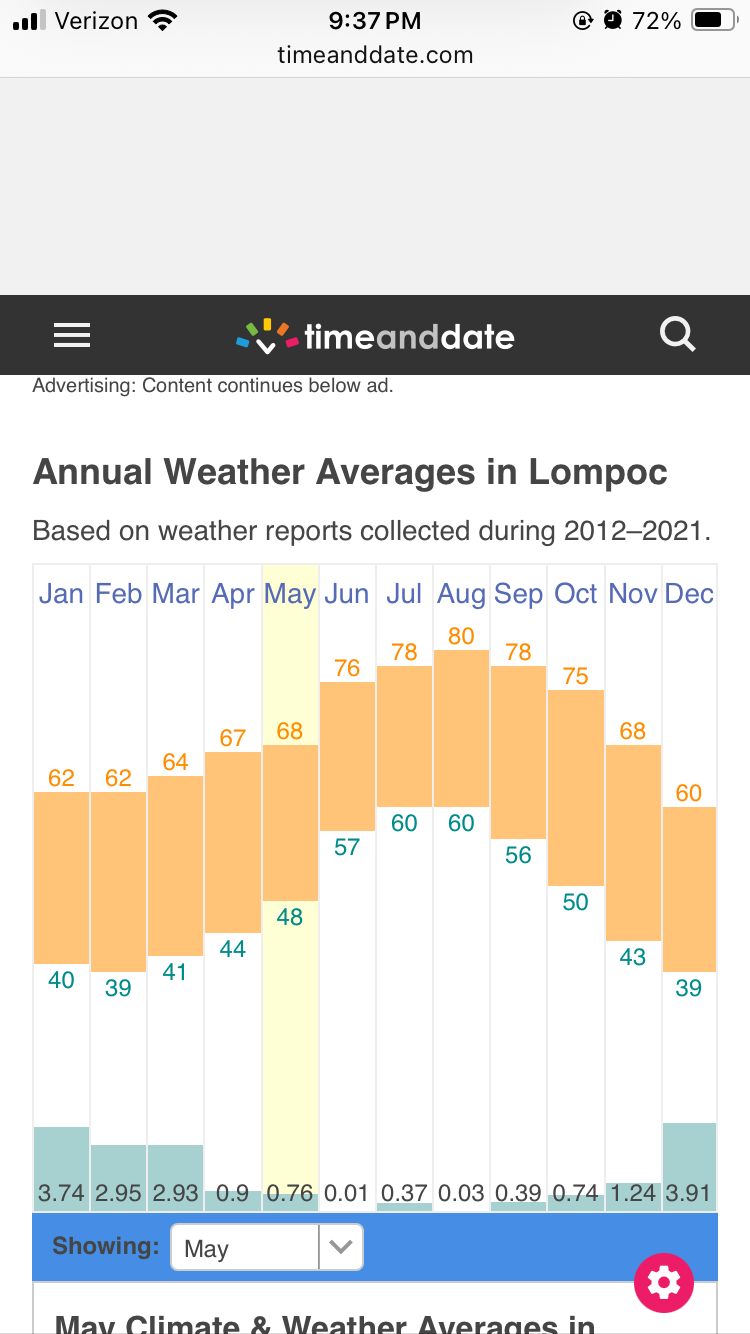
Looks like our airport temps are similar in May, cooler before then, warmer highs by a few degrees in the meat of summer (but again, lows dropping quite a bit more than “yours”)and then we start dropping lower again come September.
I really am not sure what you are trying to get at, either with your article, or your post. One of the fascinating and beautiful aspects to Pinot Noir is its diversity of expression even in two different slopes of the same vineyard, and I cannot imagine it is any different in the regions that you actually spend your life in. Being “concerned” for the Willamette Valley based on the airport temps in the hottest part of the valley seems a bit… performative, at best.
We are both (apparently) incredibly lucky to be in regions that are highly affected by the cool air of the Pacific Ocean. I have no idea how it works where you are, and I am not enough of an ass to pretend that I do. For us, days are hotter than they used to be, but then the hot air rises, and the cold air from the coast is sucked in. Either through the narrow Van Duzer Corridor, or the much wider mouth of the
Columbia River, where the winds then lick down into the valley from the north(as is the case for Whistling Ridge, in the Ribbon Ridge AVA), which I don’t have to guess from a far away weather station as to its weather patterns.
I don’t think anyone is claiming that temperatures in Oregon are the same as they were 20 years ago, much to the chagrin of C&H. The last truly marginal vintage in the Willamette Valley was 2019….. but the cool nights, and adjustments in farming that we have made have led to a really fantastic set of balanced and elegant vintages. Oregon State is definitely just as concerned (likely more
concerned) wi th valley floor crops of grass seed, hazelnuts and berries. For the grapes, we don’t need canopies 8ft tall, and the choice vineyard sites are often not the same as they used to be (as, I would imagine in California) but our nighttime (and even daytime) temps are much cooler than the valley floor, and we’re doing just fine.
Happy to hear you all are also doing well.
Cheers.
13 Likes
Marcus,
I am sorry my column upset you so much. Full stop. I mean that.
My experience actively making wine in Oregon stretched from 1995 to 2021. I’d spend time walking vineyards every month and up until 2015 I brought the grapes down to California and made the wines there - doing punchdowns, deciding on whole cluster percentages, etc. There were no corporate meetings with Sam and Gary - just meet walking Archery Summit and tasting grapes. I’m not the corporate type. I was just very fortunate to be allowed to taste many of the samples they brought in. After I sold Siduri to Jackson Family I was able to get fruit from Zena Crown, Willakenzie, Gran Moraine, and Maple Grove and walked those vineyards extensively ever year. Having said that, my experience is not and has never been as complete as someone who lives there. It cannot compare. Also, full stop.
I recently took 20 of my wine club members to the Willamette and we visited and tasted with 3-4 producers a day. One of the highlights was a tasting at the Pearlstaad Vineyard with virtually all of the producers that source Chardonnay from that site. That was amazing. I continue to visit the area, and I’d love to come and taste with you, Marcus. You can tell me to fuck off both before and afterwards if you’d like. 
The emphasis in my article was on the future. I think Willamette Pinots are superb - as you could see from my cellar (you also are welcome to come and visit). But the changes I’ve seen over the last 25 years are dramatic. And more dramatic there than what I’ve seen in California grape growing areas that open directly to the California Coast. Twenty years ago, we were told by some that California would rapidly warm to the point that we’d have to abandon Pinot Noir grape growing and move to Oregon. That hasn’t proven to be true right along the coast. Which is why I said I would bet right now on areas that open directly to the coast (I also say that I wouldn’t bet on the upper Napa Valley for Cabernet going forward).
If the WW2100 study proves to be true, then the changes in Oregon will continue and that is concerning. Climate change should be concerning to all of us in the wine community. But, if we are reaching the end of a Pacific Oscillation Decadal cycle then I might very well be wrong and things will change back dramatically in Oregon.
I didn’t post my column here. I didn’t say that the Willamette isn’t making great wines – most assuredly more producers there are making great wines now than ever before. I didn’t say that the wines are too lean or even leaner than I like (my Clarice Pinots are leaner than what I made at Siduri – picked early with lots of whole cluster). I talked about the future and trends as to how things have changed in my time there and what I’d bet on if those trends continue. That’s it.
Adam Lee
14 Likes
Megan,
I couldn’t agree more than to say that diversity of expression in Pinot Noir is wonderful. That’s why, for many years, I made Pinot Noir from the northern end of the Willamette Valley (I sourced from several areas near Sherwood) south to Zena Crown and all the way down to Maple Grove and then in the Sonoma Coast, Petaluma Gap, Sonoma Mountain, Santa Lucia Highlands, Santa Maria Valley, and Sta. Rita Hills. I hope that we always have a diversity of Pinot Noir available to people, and I’ll continue to buy them all.
I picked the McMinnville weather station because, from what I’ve been able to find, they’ve operated continuously in the same location, since 2000. If you have data from Whistling Ridge or any other vineyard for that long, I’d love to see it. I went through and entered high and low and average temperatures for every vintage from May through October from 2000 through 2025. In a column limited to about 800 words, I obviously wasn’t able to post that.
The point of my column was that, if the trends continue, areas that open directly to the Pacific Ocean will be more favored - especially the California coast. If the Pacific Oscillation Decadal shifts, then that may not be true.
Cheers,
Adam Lee
2 Likes
More thought, less care. BTW, his name is Vincent.
Chris Crutchfields real name is Vincent?
3 Likes
Hi Adam,
My apologies for losing my cool. Full stop.
We bottled 2024s yesterday, after having the spring open house over the weekend. It’s simply been a grind the past 3 months.
I appreciate your clarification. I agree 100% that we have be concerned with the effects of climate change. I wish I had more time to comment now on what we’re seeing up here, and I’ll try to comment this evening if possible. But I did want to let you know that I appeciate your measured and adult response to my frustration. It is appreciated.
I’ve seen some excellent California Pinot Noirs over the past few years, and some good Oregon wines as well. But the choices are very different than the were 25 years ago.
And if you do get up here, please do come say hello.
16 Likes
I think this is an interesting discussion which sort of brings up some of the things we talked about on the zoom session with Marcus and Megan a few weeks ago in so far as Burgundy itself has had even more significant temperature increases than both coastal California and Oregon, and in many cases, the wines have only improved, although there have been some changes in canopy management and other viticulture/winemaking.
5 Likes
Would you agree that this is somewhat unique in the WV? I buy a decent amount of Oregon chard, and don’t have any bottles from any other producer with a listed abv below like 12.7% or higher. At least not to my knowledge.
@MChang I also thought of that conversation.
@Adam_Lee I don’t have annual data, and though I sympathize with trying to write an article and not having the information that you need, my point about microclimates within the Willamette Valley and utilizing valley floor airport data is that you are severely limiting your understanding (and your reader’s understanding) of what is going on. Especially in a region where wind patterns are so fundamental to diurnal shifts in temperature for individual terroirs. The Van Duzer Corridor is impressive, and certainly the most publicized of the points where wind comes in from the coast, but again, it is not the only point. The idea that any vineyard not in its path is SOL for cooling from the Pacific is flat out wrong, the “windscape” of the valley is maybe not something you could have fully covered, but is probably something you should at least look into.
@Roy_Piper There have always been producers (and consumers) who have chased 14.5% Pinots, it’s easier for folks to do, if that’s what you’re into, but if you got there without trying you just missed your pick call. I am not sure where you are getting the idea that watering back is now widespread, it is not my experience. If anything I would say that the current trend of steadily warmer vintages has made it easier to make fundamental shifts in farming, so that warmth does not have the same effect as it did when there were the random “hot” vintages in the middle of a run of cold years.
Again, there is no doubt that Oregon’s Willamette Valley is warmer than it was, and climate change is both real and has some very scary implications for our future, but as @PeterH pointed out, how exactly that pans out is a bit harder to predict than a straight line temp graph.
10 Likes
Like I said, I like some of those wines, but they don’t meet the criteria here. I don’t think I’ve ever had a CA pinot noir - even the ones I like! - that pull off that effortless lightness of being that used to be the exclusive province of Burgundy, but in more recent years can be seen across Oregon from producers who cracked the code.
4 Likes
Keith I don’t disagree that California generally produces bigger wines than Oregon and certainly Burgundy. But I think there are smaller wineries out there producing some of the wines you might like such as Lady of the Sunshine/Scar of the Sea, Whitcraft, Domaine de la Cote as well as others. That being said, I have yet to have an Oregon pinot that I have confused with Burgundy, but still hoping to have that experience.
It is somewhat unique, but there is a good bit of WV Chardonnay from 12-12.9%.
Our sub 12% numbers are also an exploration enhanced by making sparkling wines. The goal of the sparkling program was always to get the fruit flavors ripe at very low Brix, and to get malics down to more modest numbers before picking. We’ve managed that goal, and had a couple of vintages where flavors were nicely developed (for my palate), so the 2023 and 2024 have low abvs. They also have very bright acids, and reflect the body of Chardonnays that are sub-12%. So YMMV on whether they to a person’s taste. As Megan and I taste base wines more frequently, the appeal of those wines has grown on us. These 11.2-11.7% Chardonnays remind me more of 80s and 90s vintages of Chablis, or Rully as well. And with climate change, those types of wines have mostly disappeared.
But I also feel that 11.8%-12.7% is where I would like to see our Chardonnays. The 2023 Durant is wonderfully pretty, but I know the textural change at 12% is meaningful for that vineyard. Whistling Ridge carries 11.5% very well but is equally good a degree higher.
With the 2025 vintage, we saw acidity maturing very early. It’s my opinion that producers could pick for sugars or acidity last year. While we put a few more days between the sparkling picks and the still Chardonnay picks in 2025, the 2025 Richard’s Cuvee will be at 12.0-12.2%, and we have an absolutely smashing puncheon of Temperance Hill at 11.5%.
6 Likes
Good list of California producers, I love the Whitcraft wines. DDLC does nice wines as well, though I am a sucker for the whole cluster.
The shift in latitude is a big impact in separating the regions, in a terroir sense rather than a quality sense.
And there’s no shortage of big Willamette Valley wines. At a technical tasting many years ago with California and Willamette Valley Pinot Noirs, all of us Oregon producers called the big wines Californian and then ate our words as the bags came off. I thnk there is more diversity in both California and Oregon wines now, so picking producers is really important.
The warmth we have, for the moment, is giving us the choice of making such a range of wines from elegant to massive.
3 Likes
No, the winemaker you mentioned multiple times in your post as Vince is named Vincent, a bit ironic in the context of that post.
1 Like

That 05 PG Notorious was pretty Burgundian but it was also like the 25th wine we had that day so I’m not sure we were on our blind tasting game.
1 Like
Have we without a shadow of a doubt shown that a grape that reaches 23brix/3.3pH in Aug is worse than one that reaches 23brix/3.3pH in October? What if hang time has no effect whatsoever on flavor?
Never forget that it’s in the self-interest of almost all estate wineries to push terroir, climate and place. That’s how you retain the value of your real estate, brand and legacy. If it was tied to winemaking, the real estate would be valueless each generational/corporate shift.
4 Likes
The winemakers I was talking to in Napa think they may harvest in July this year. And less hangtime has often proven an advantage when fickle weather comes along and you’re already in the barn and the other guy’s grapes get ruined.
1 Like