A Century of Burgundy in One Night (with squab, morels, and a little patience)
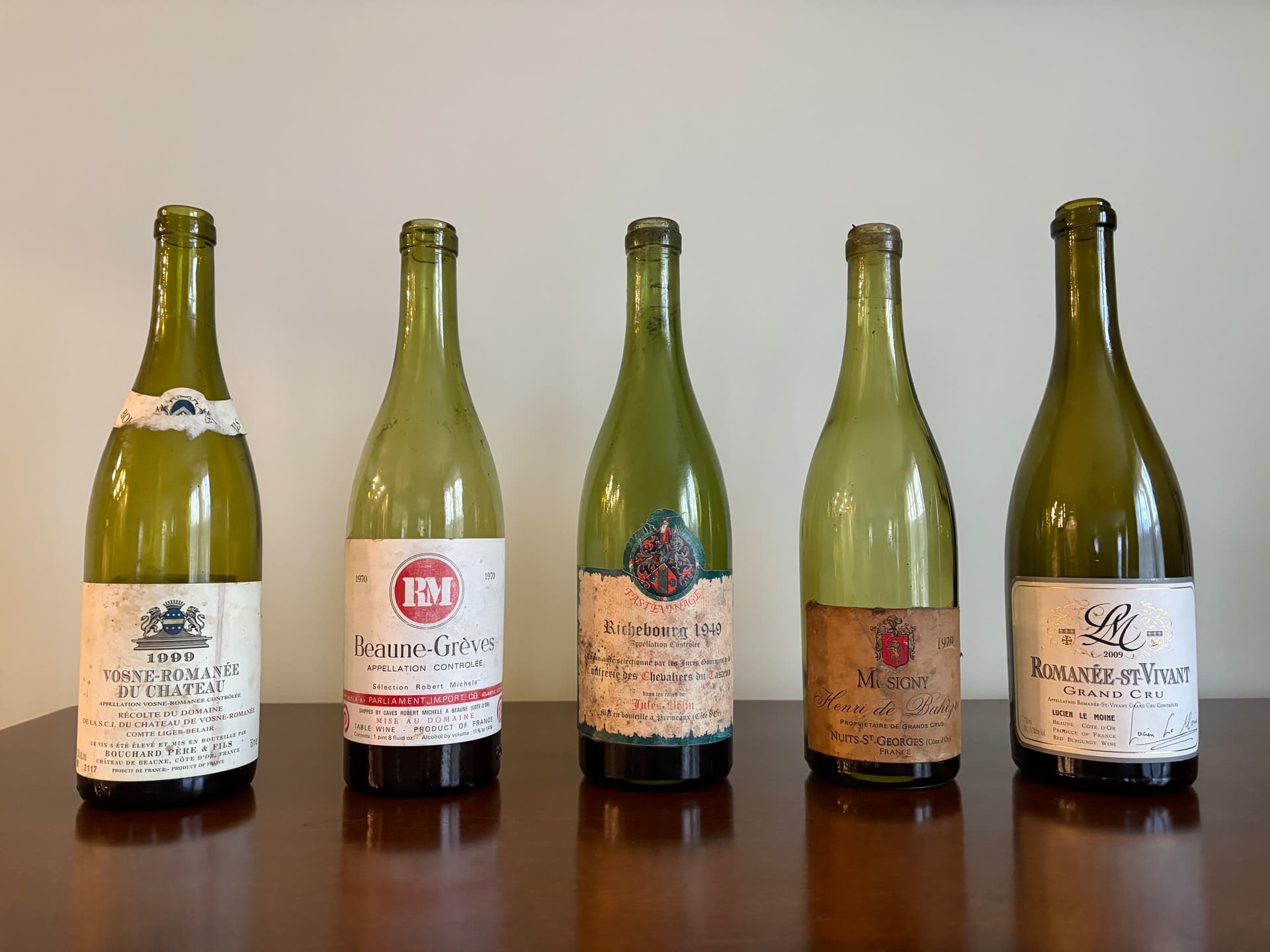
Our small “Burgundy company of six” finally gathered last night to open two bottles that had been waiting for the right moment: 1929 Musigny (Henri de Bahèzre) and 1949 Richebourg (Jules Belin). All transferred from Dijon’s cellar into the US, covered in wax seal.
Both bottles had about 5 cm ullage, healthy color, and corks that looked frankly terrifying: almost black, extremely fragile, and completely blank (no markings at all). Extraction would have been impossible without an ah-so/Durand, but both came out cleanly.
For preparation, all bottles were stood upright for about 4 weeks at 16°C to allow sediment to settle. I opened them gently and decanted to remove the sediments. Serving temperature was around 16°C, which seemed logical for wines of this age.
Glassware was large Burgundy stems (Riedel Sommelier).
Because wines like these deserve proper support, I spent quite a bit of time thinking about the food. The idea was to create something Burgundian in spirit that would highlight the tertiary complexity of the wines without overwhelming them.
The centerpiece of the dinner became a squab dish built in several layers: squab leg confit + crisply fried squab breasts (medium rare) with French pilaf and a classic morel sauce.
Originally, I considered placing lightly seared foie gras under the roasted bird breasts, but I ultimately decided against it. Between the richness of the sauce and the age of the wines it felt unnecessary - and in retrospect that was absolutely the right call.
The sauce was based on shallots, stock, and cream (and morels, of course), finished with the pan juices from the birds. The goal was to bring out the earthy, forest-floor elements that mature Burgundy loves while keeping the dish balanced and elegant.
We started with these 2 wines:
1970 Robert Michel Beaune Grèves
Alive (!), but clearly the weakest wine of the lineup. Quite earthy with what I would describe as “dungeon / zombie” elements. Interesting (one could still feel Greves) but not especially charming.
1999 Bouchard (Liger-Belair) Vosne-Romanée Clos du Château
This surprised everyone. Extremely focused and precise, with textbook Vosne spice and beautiful acidity. Remarkable clarity for a village wine and easily held its place at this table. Amasing nose (VR spices/strawberry) + simple but not obtrusive palate.
1949 Richebourg (Jules Belin)
A marvelous wine. Fully alive for about 30 minutes, during which it showed everything one hopes from Richebourg: depth, velvety texture, dark spice, and wonderful tertiary complexity. The squab and morels worked beautifully with it.
1929 Musigny (Henri de Bahèzre)
This wine stole the night completely.
It opened slowly and then kept expanding for nearly an hour (!), revealing more and more layers of aroma and structure (initial tertiary, followed by fresh strawberry, followed by a symphony of strawberries/other fresh red berries, wrapped in silky tannins). The perfume was extraordinary - haunting and incredibly complex. One of those wines that reminds you what Burgundy can be at its absolute peak.
If these two wines had been served at separate dinners, we would have declared them all great. But tasted side-by-side, the 1929 Musigny clearly rose above the 1949 Richebourg.
To close the evening, we opened:
2009 Lucien Le Moine Romanée-Saint-Vivant,
partly to bridge the century gap and partly to remind ourselves that modern Burgundy, in the right hands, may one day reach similar heights. An absolutely gorgeous wine now, though. Classical RSV (silky tannins, rosewater, a bit of blackcurrant and VR spices, of course).
It showed beautifully and felt like the right way to end a night that spanned nearly 100 years of Burgundy history.