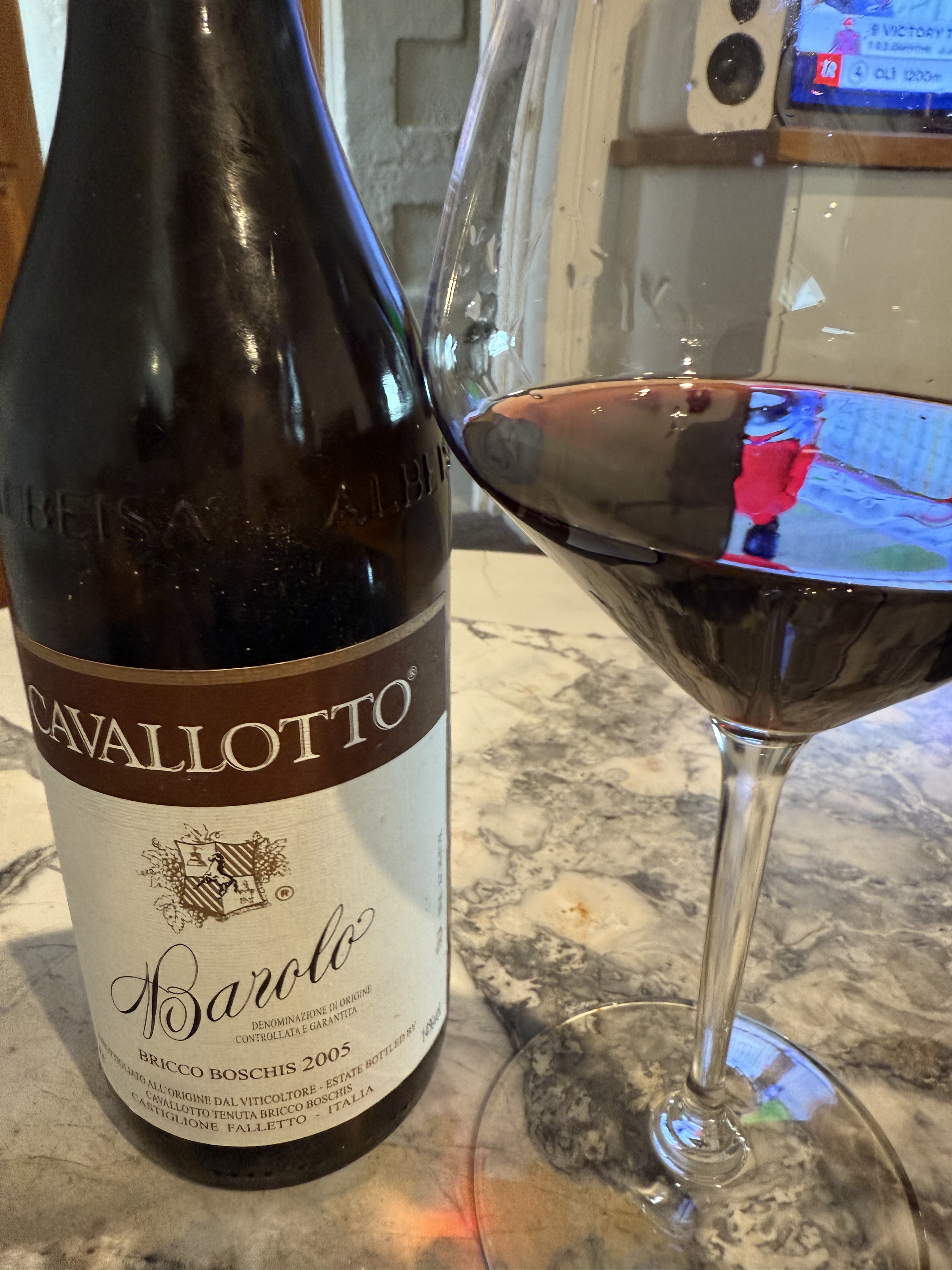
Actually aging decently. Tannins were still pronounced. There was cedar but not too unruly. I find some of the Italian modernist wines age better than I expect. Lively fruit left; not an undifferentiated mush. I think another few years left in this one.
1 Like
Hi Michele and I wish you all the success with vinifying the wines yourself.
Barrique? Definitely a contentious subject, not just here, but also in the Langhe as well.
It’s more complex than we at times consider.
- At the extreme end, of new, high toast French oak barrel, it imparts flavours to nebbiolo that will overpower the subtlety of nebbiolo that I love. Oak tannins can also be the very last thing that tannic nebbiolo needs.
- However wines made with older, more neutral wooden barrique (be they French, Slavonian oak, chestnut) can make it very hard to tell apart from wines aged in large botti. Likewise a mix of barrique and botti (and/or tonneux) as a few do around Ghemme, Gattinara etc. can also work well, and with enough subtlety that few of us could spot the barrique influence.
I recall tasting at the Barbaresco festival in the Commune building many years ago. That included the wines of La Spinetta. They were impressive (and expensive) and interesting wines for sure, but they were nothing like the rest of the Barbaresco wines there. Bigger, richer, bolder, but without the subtle elegance I seek. I accept the wines were interesting and in their way, well-made. Bigger & bolder is something I rarely seek (dessert wines an obvious exception as long as they retain matching acidity).
Your expected production doesn’t leave you many choices - I don’t believe 500L (butt) or 600L (demi-mued) are common, at least not in Italy. A Tonneau at 900L is too big. So it’s got to be barrique to qualify for Barbaresco (INOX steel would not).
Used makes sense, but even then the level of toast can be significant (and how it’s cleaned from memory).
It’s then your choice - to seek subtlety (or oak influence) in the barrels you choose. For me subtlety is a massive preference, as it is for many here, but it’s your wine to make as you want to. Perhaps it might be worth experimenting with 3 different used barrels, each subtly different in age, level of toast, informing your choices in future years.
1 Like
Ciao Michele! welcome to the forum. generally speaking i dont love “barricato” wine, especially for nebbiolo, where the barrique has a noticeable effect on the flavour of the wine. in your situation (and i have seen similar situation with some producers in carema) barrique would work given the small amout of wine produced, as long it is well used… in bocca al lupo!
1 Like
I had the great honor of meeting the legendary Bartolo Mascarello not long before he died. He was also a skilled artist and made a lot of hand-drawn labels, including one that said: "No Barrique, No Berlusconi" I would say the same thing, but substitute a different national leader. Another funny quote from him: “As the time came to change oak casks I made sure that every corner of the cellar was filled, so that when I die there would be no room for barriques”
4 Likes
Ciao Michele. I personally loathe what barrique does to Nebbiolo, and I am not alone here in that. Some are more agnostic on the issue, but I don’t know many who actually love it. Barrique, in my opinion, strips away all of the acid and tannic cut of Nebbiolo, strips away all of its energy in the process, leaving a smoother, rounder wine which could as easily be any international variety. And that is even when there is no overt oak notes on the wine, which is even worse. I don’t think Nebbiolo character holds up well to a heavy oak. The rose and red cherry notes are easily swallowed up by any toast or wood scents, even if this is secondary to my concerns about what it does to the texture and energy of the wines. One can get an oaked wine from anywhere. Why ruin something as unique as Barbaresco with this technique.
There are many producers making excellent wine in the Langhe with a modern vision but not modern techniques aiming for a certain Burgundian transparency without barrique or short macerations. If you want to set yourself apart, it might be worth looking to this avant garde approach rather than the modernist trend of the '90s.
Like others say, with small production there may be no other choice. I can’t really say whether a very well used, very neutral barrique would still cause problems for my tastes. I’m sure some are using small vessels in this manner for small amounts of wine so possibly no problem, but I don’t know.
5 Likes
Opened a 2006 P Scavino Carobric yesterday evening. Sort of regretting my decision. Decanted for 5 hours after filtering out a mess of cork residue (not TCA). It took one taste to know that it needed much more time.
Just tasted again to check development (about 18 hours after opening). Odd acid spike. Little fruit — makes me think it’s still closed. Of course, tannic. But, lovely long finish with forest floor.
I don’t think the bottle is flawed, more likely that I opened it too soon. Will give it more time and update here.
That is a producer who heavily uses barrique. What to add to the above discussion?
Yeah, I know. I know how polarizing it can be. I tend toward the traditional style but recently acquired some back vintage modern/spectrum style Barolos to see how they age. A recent 2006 Conterno Fantino, for example, drank quite nicely.
1 Like
Interesting. I have often heard the argument with new oak in wines (any wine) that it “just needs to integrate.” I have not bought into that. Integrate doesn’t mean “goes away.” It will always be there, even after the fruit is long gone. So if new oak in Nebbiolo isn’t your thing, I don’t hold any hope for it.
3 Likes
The wine equivalent of “it’ll ride up with wear”? Picture for the younger ones amongst us

3 Likes
Welcome Michele and great that you joined in here, keep up posting! Nothing better than boots on the ground and even better someone living and breathing Langhe.
I stayed away from barrique Nebbiolo after a few attempts. Either they have showed very glossy, or most often the tannins gets a certain not so pleasant grainy quality to them. It’s not such a good explanation but this is kind of the direction of how I detect if tasting blind.
Accomasso had a very interesting remark in his interview with Levi Dalton. IIRC he mentioned that old barrique might be even worse. If you didn’t listen to the interview I really recommend it and for you as a local many of the interviews by Levi will probably be even more interesting.
2 Likes
There’s more to it than the use of new oak for me. Fermentation vessel and conditions, aging time in each vessel seem to make a difference. Other things too? Both Conterno Fantina and Scavino use multiple vessels to age, including new oak. With the former, I find that the oak notes balance well with fruit, tertiary notes. Just tried my open bottle of the latter again. No change and I’m getting impatient subjecting myself to periodic tongue shellacking. 
1 Like
Everybody likes something different. I like my Nebbiolo without barrique, new or old. Scavino and his ilk criminally ruin Nebbiolo, in my opinion, because they should know better.
Liking modern/barrique Nebbiolo is not a crime. Often.
3 Likes
Echoing what people said above, I do find a lot of Riserva wines that are aged in smaller oak barrels do tend to leave an unpleasant oaky gloss that can obscure the Nebbiolo character of the wine. But, I also think many Riservas tend to be a little too over-worked and over-extracted as well, which may be a product of overly interventionist winemaking than elevage choices. I do think folks get a little too caught up with the whole barrique vs. botte thing, and don’t take into account a whole host of other winemaking interventions that made the modernist Barolos and Barbarescos of the 90s and 2000s unpleasant.
However, don’t let all of the above to dissuade you from trying, especially since you have such a low volume to work with and finding a small enough tonneau barrel will be difficult for you. I guess the onus will be trying to find two or three used barrique that are as neutral as possible. Good luck!
4 Likes
‘Your expected production doesn’t leave you many choices - I don’t believe 500L (butt) or 600L (demi-mued) are common, at least not in Italy.’
This isn’t true, I’ve seen quite a few of the 600L size; the Austrian cooperages like Stockinger and Pauscha sell them. That plus a used barrique would be about right. Gamba is offering 700L too.
5 Likes
Michele, this is the most important!
Just out of curiosity, are there some Barbaresco and Barolo wines from specific producers that you really like?
I understand.
It will be easy to fine and depending on where you listen I think it will be there, here’s a link to the podcast:
It’s a fantastic source and there’s a lot about Piemonte with winemakers, writers and people in the wine business.
Many man of the most well know and sometimes lesser know wineries are covered (both Barbaresco and Barolo). Some interviews are more historical while other ventures to winemaking. I think you will find it very interesting in general and also perhaps for your “research”.
1 Like
