They’re just not as competitive.
1 Like
NV Champagne Suenen Champagne Grand Cru Oiry Blanc de Blancs Extra Brut - France, Champagne, Champagne Grand Cru (1/25/2024)
– popped and poured –
– tasted non-blind over a couple hours –
– disgorged: Jan. 2021 –
– dosage: 3 g/L –
– Base: 2017 –
NOSE: lemony, with a touch of fresh baguette; light chalk, too.
BODY: light yellow color; active, medium-bubbled bead; light bodied.
TASTE: super dry; largely in-line with my previous notes, but for perhaps having just a weeee bit less energy than the bottle I had about a year ago — this is an excellent, bright and crisp Champagne that aligns with my preferences quite well. Paired excellently with sushi rolls.
3 Likes
Not to pig pile onto Benjamin’s comment, but I was a bit surprised by him referring to “Oregon Pinot funk.” I too have quite a bit of OR PN and have never found funk to be a characteristic of any AVA there. On the contrary, I think it is a characteristic of producers who specifically make reductive reds (Cameron being being the poster boy). Kelley Fox makes only Dundee Hills and Eola Amity PN and I don’t find even a hint of funk or nattiness in her reds.
I’m a big fan of the Suenen Oiry BdB. Even though I don’t have a champagne ‘type’ I seek this one out a lot. Your note about less energy rings true to me in the context of the 2019 base vs 2017. The 19s I have had just don’t have the same punch and excitement as the 17s do. I’m hopeful the 19s will improve a bit with a little more cellar time to be as pleasurable as the 17s are.
1 Like
Good to know about the '19 base. I haven’t seen any such bottles at my local retailers yet, but I’m not sure I’m going to be willing to swallow the price increases, anyways … we’ll see.
Totally fair question, and I’ve assumed it’s a signature of reductive practices in the farming and winemaking specific to Pinot Noir, but the honest truth is that I don’t know if that’s it or not.
I’d love other’s thoughts here too. The scent I sometimes (and it is sometimes, because it’s not every producer, just some) is a bit of a wild, dirty fruit if that makes any sense (or not). Hard to put into words, but it’s not the extreme side of reduction (eg garlic, onion, rubber, etc).
The only reason I bring it up here is knowing that the Perkins Harter sparkling wine is 100% Pinot Noir, and it’s where my brain went. Now I really need to pop one of these and stop speculating 
That is pretty much what I said above, but these practices are limited to neither Oregon nor Pinot Noir. Without ever having had the producer’s wine in question, I am still incline to speculate that any funky or natty flavors are likely the result of production methods rather than region or grape variety.
1 Like
I think that’s a fair point, and my statement was overly general, for sure. A product of my own experiences, which are by no means exhaustive.
I tossed the Perkins Harter sparkling in the wine fridge to open tonight. Notes coming soon.
1 Like
And to add another data point, I’ve recently tasted two Goodfellow BdN (Tsai and Whistling Ridge). There is nothing funky or natty about either one! 
2 Likes
For sure. I’ve never gotten these aromas from any of Marcus’ wines. Nor Kelley’s, Will’s, Vincent’s… the list goes on.
A few recent bottles where I did get this include Day Wines, and a couple bottles from Evening Land. I don’t mean to suggest these are negatives, as I really enjoyed all the wines in these more recent examples.
Anyway, we’re drifting… back to champagne. 
Oh the joys of an inquisitive mind and the happy peer pressure of this specific thread!
Thanks you guys. FWIW, I am finally finishing off the 2009 and 2013 Coeur de Cuvee bottles tonight. Man, the 2009 is just about still and remains gorgeous, The 2013? Still reflecting the fresh sliced green apple in honey, with a kicking lime zest for energy and accentuating the structure. To have these both yet again side by side is just a joyride!
2 Likes
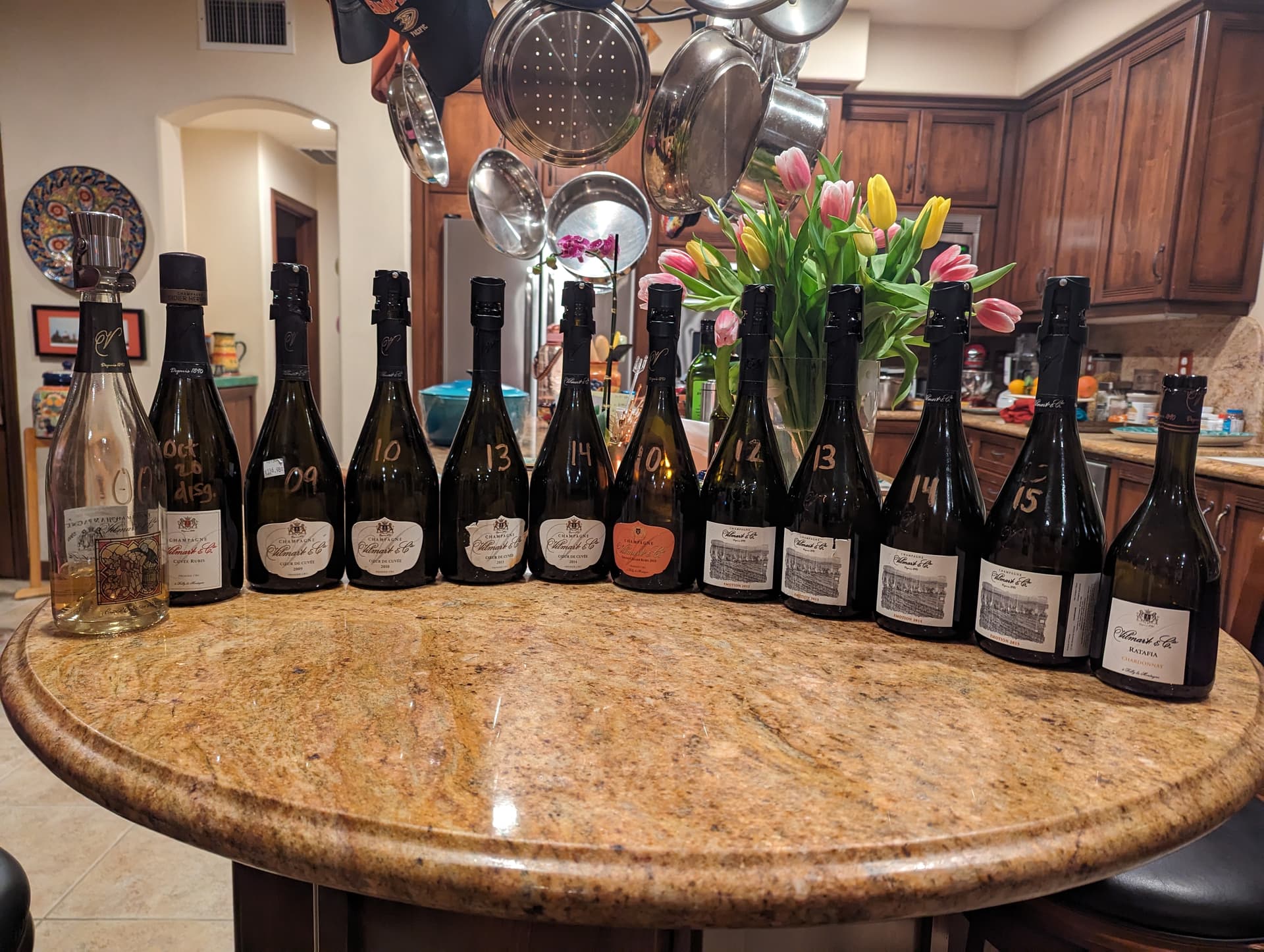
Frank’s notes are awesome. I didn’t take contemporaneous notes during the event (heresy!), so I’m summarizing my memories &impressions briefly… well, it seemed brief when I started 
Overall: WOTN: 2000 Création. Runners up: 2009 CdC, 2012 & 2014 Émotion, Ratafia; Dud: 2015 Émotion.
2000 Vilmart & Cie Champagne Cuvée Creation was a standout. Golden in color. Aloka and I wondered whether there was a hint of salmon in the color. Surprisingly fresh & deep. Yellow apple, hay, and an intriguing nutty note (without the accompanying nut bitterness). Long finish. These words fail completely at describing the wine. By far the WOTN for me.
Coeur de Cuvée line-up:
- 2009 was the stand-out. Definitely some tangerine & some tropical fruit I couldn’t place. The intensity of flavor was striking. My favorite of the CdC.
- 2010 was an outlier in the CdC. It was very rich and had fruit cocktail vibes. The acidity took a backseat, and it almost seemed like there were some botrytis-like notes. 2010 was a wet year in champagne and a substantial portion of PN was affected with botrytis. I am not saying that there was botrytized PN in the 2010 CdC – likely this was just an off bottle - it’s more like I can’t come up with a better descriptor of the impression it was giving.
- 2013 & 2014: both excellent. I thought the 2013 & 2014 were pretty similar, though the 2013 was a bit richer.
Émotion & Rubis line-up
- NV Rubis: disg 2020. perfectly delicious in a ripe strawberry, orange, more “in-your-face,” bold style than the Émotion line. It tastes like it has just a tad more dosage than the Émotion line. (If memory is correct, 9-10 g/L dosage for the Rubis)
- 2010 Grand Cellier Rubis. Oh yum. No signs of the difficult vintage in this rubis. Red berries, and something like cardamom? Perhaps the least acidity of the vintage rosé lineup.
- 2012: the most powerful of the Emotions in the line-up. Concentration of raspberry, nectarine. Great balance with the acidity.
- 2013: I remember this being similar to the 2012, but slightly less intensity.
- 2014: (brought this home so have extra notes). This was one of my favorite rosés from 2023. Luminescent, glow from within salmon-pink color. Yellow apple, raspberry and Valencia orange zest. Words fail me – it’s like an amalgamation of raspberry, sour cherry, boysenberry, yellow raspberry and blackberry and maybe some stone fruit like nectarine. Everything in its place.
- 2015: (brought this home so have extra notes) In terms of color, it’s neck-and-neck with the 2014, but the similarities end there. On the evening of the meal, I kept thinking “this smells of nothing and doesn’t have much flavor.” It was outclassed by everything on the table.
The next evening, fresh palate, no food, by myself. 45* degrees to start. On the nose, something pine-y, no detectable fruit. On the palate, vegetal and stemmy. If I concentrate, some sour cherry comes through, but maybe I am manifesting it because I keep thinking there has to be some fruit. Acid finish, not in balance. Oddly, as it warms and gets more air, the nose fades to nearly nothing and it becomes pretty flavorless, reflecting the prior evening. I have another bottle, so we’ll see if this is an off bottle, it’s going through a dumb phase, or this is it… Disappointing and confusing bottle.
Vilmart Ratafia: oh goodness, what a delicious ratafia. Dried apricot and honey on the nose. On the palate, it reminds me a little bit of apricot and orange “pâte de fruits” and honey. This smells so incredible - if Vilmart made a perfume like this, I would douse myself in it.
3 Likes
LOVE the Creation! 97 one of my all time bubbles. Wish they still made it.
Great tasting you guys!
1 Like
Been looking forward to opening this one
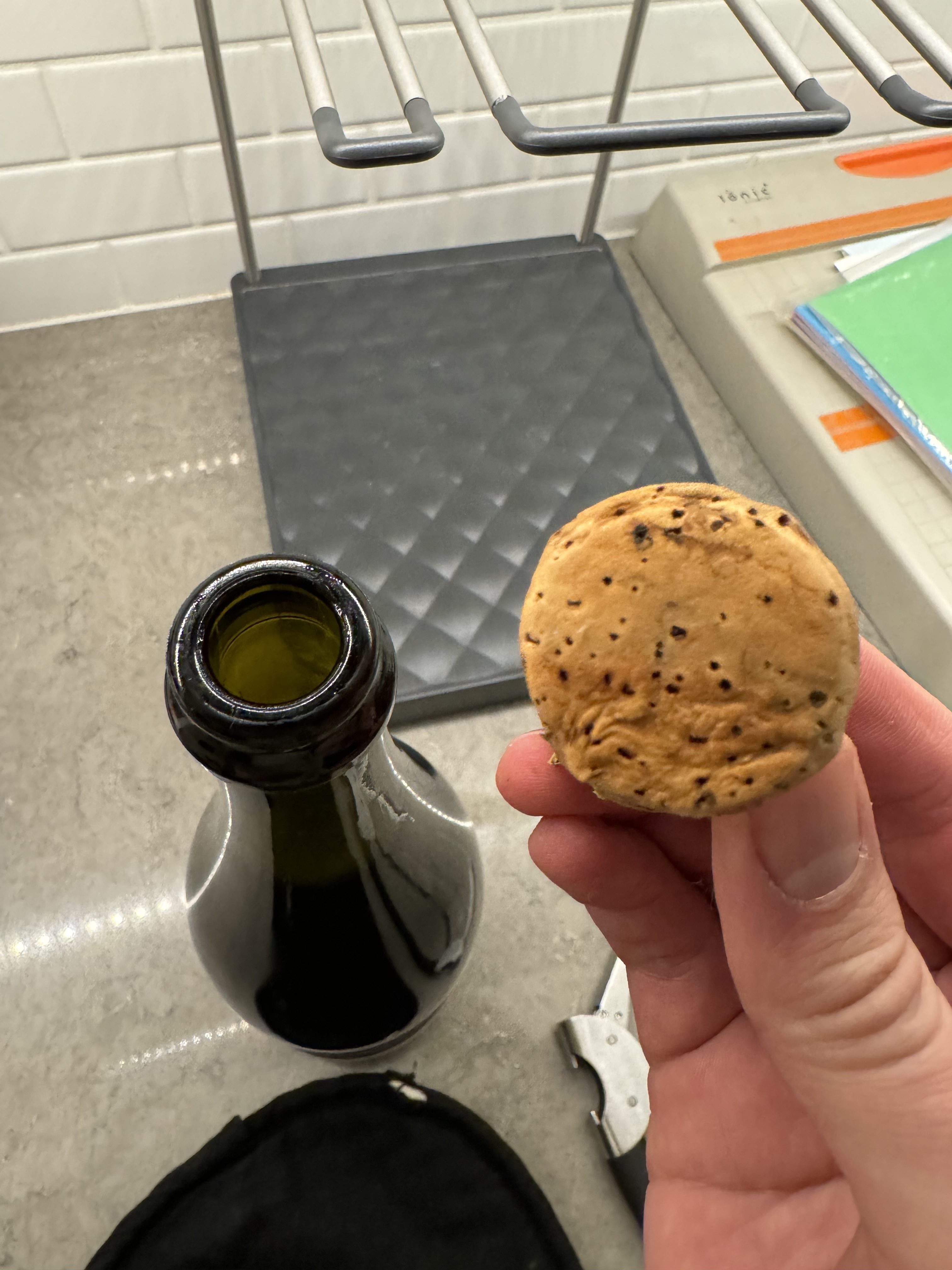
A few fun things to note… the cage is wound backwards (must rotate clockwise to remove). Never seen that before, found it interesting.
The cork…oh my. This thing is HUGE and I gave myself a decent arm/wrist workout trying to remove it. Eventually, I resorted to a dual-lever corkscrew which did the trick.
Onto the wine…
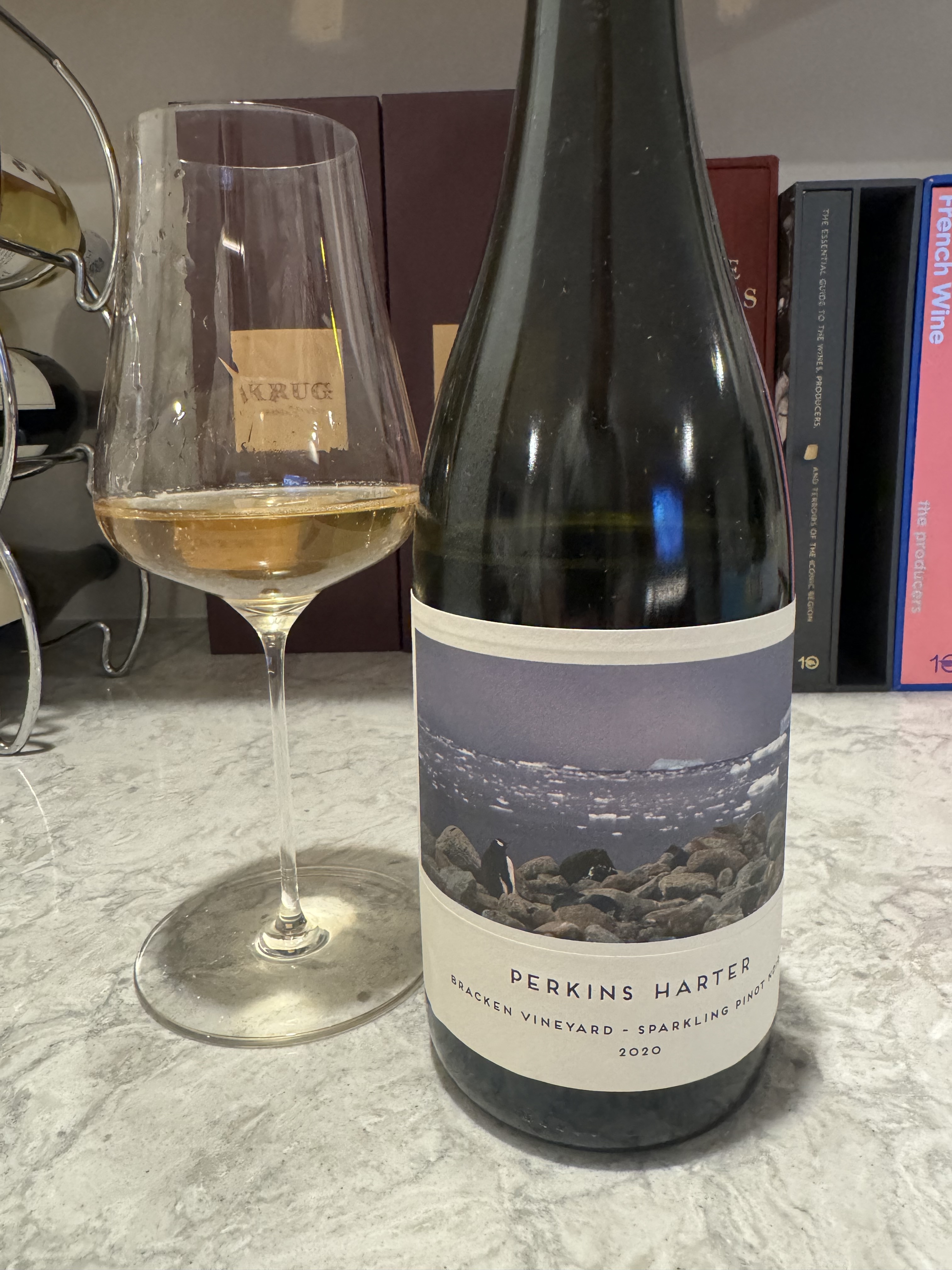
2020 Perkins Harter Sparkling Pinot Noir Bracken Vineyard (BdN) (BerserkerDay Special)
Pours a light gold, with good effervescence.
On the nose, I’m getting red fruits, particularly raspberry, but it has a touch of that petrol quality you find in many Rieslings (wondering if that’s what @K_John_Joseph picked up as the natty element). It is a unique element to the wine, and I can’t exactly put my finger on what it exactly is…there’s also this crushed sweet tart aspect to it, which sounds very different, I realize, so clearly I’m having a hard time describing this one. It is rather unique.
Anyways, as the temp rises slightly, the wood reveals itself (albeit not overtly) and I can see where @K_John_Joseph would say banana, but I don’t find it to be nearly that tropical. To me, it’s more of a light toast note from time in oak. The kefir lime was a great call as there’s a definite citrus note and I can sense those lime leaves slightly in the nose too. Vanilla wafer is also a great call, I get that too.
On the palette I’d call this medium body, there’s good concentration of underripe raspberry, freshly squeezed lemon and lime (plenty of acid here). I get some minerally character in there as well, showing off Eola-Amity Hills terroir. The oak is present, never overpowering. That wafer note hides out in the background proving a nice base layer to end on. Medium length, finishes very clean. If there’s dosage here, it’s minimal and will appeal to the extra brut crowd.
Overall, it’s a nicely made wine. That nose I’m having a hard time putting words to may be polarizing to some, but for what it’s worth, my wife and I are really enjoying the wine. I can see a through line to a recent bottle of Marcus’ 2021 Temperance Hill Chardonnay here (albeit with bubbles, and Pinot, of course) so I’d say there’s a clear sense of place, and nice balance.
5 Likes
You do pretty well on just recall, that’s a good skill. Besides, and with your humility I love about you, there was also a dinner for you to execute alongside all of this, one that you took a large part in curating, cooking and serving.
Of note earlier tonight I sent to Laurent at Vilmart some of the photos, along with the link to my post/notes (yours were not yet present or I would have linked your post, too), and I flagged a comment to him about the 2015. I said a lot of well-deserved (as did you too) positive things about the wines from this past weekend, but I also want him to have some feedback about the 2015.
1 Like
Looks like a great night Frank, glad you did a Vilmart evening.
I love seeing these tasting notes but I wanted to add some much-needed context in regards to the 2020 Bracken BdN
At the outset let me admit that the 2020 is a beautifully-flawed wine and I personally have a love/hate/love/hate/love relationship with it. Ultimately, it is its own beast, I submit to it and enjoy its imperfection as a cardinal point on my sparkling journey - and the journey of sparkling wines from the Eola Hills in general.
Let’s slow down and consider that this is only the second sparkling wine I have ever made and also doubles as only the second sparkling wine that’s ever been made from our part of the Eola Bench. Right now I am currently 10 sparkling bottlings deep after only five vintages of experimentation in a vineyard planted in 2016 - and I am working methodology as fast as possible to figure out what works and what does not. So this is a conversation probably best had outside of the context of “Champagne” section since they’ve had a few hundred years to work on their terroir and pass on their skills.
The 2019 and 2020 were definitely stories of reduction from shallow soils. These grapes come from the shallowest soils at Bracken - so shallow that my replants require a jackhammer, not a shovel. These shallow soils do not contain much water, so the fruit ripens faster under stress - and therefore I pick it as soon as possible so as to not attract birds. However, these shallow soils also result in low nutrition for yeasts in the base wine, which in turn leads to stressed yeast and reduction. The reduction could have been from the quantity of yeast populations at tirage - but I eliminated this as a possibility by adjusting my methodology in the 2020. So, this tendency to be reductive appears to be from the site - not farming methods or processing methods. I could have adjusted the nutrition in the base wine with powdered nutrients like many would do…but how would I responsibly learn the limits my site - am I doing the work or not? I could have added copper to suppress the reduction like many would do…but how would I find out how the reduction would evolve? Will the reduction remain with bottle aging or will it dissipate like a Dom? I have no idea but I’m really excited to find out! Do note that the 2020 has 5 g dosage and the base wines were sulfured so the funk one might perceive is not microbial.
With the 2019 I suspected that reduction would be a constant issue so I began reserving wines for a solera with the 2020 vintage. By giving the base wines more oxygen during elevage, the reduction potential during tirage seems to be constrained. And - what happens with the Solera version is also something that seems to eradicate the “wet dog” funk - which I find in the Pommard clone in a reductive state. So, I suggest any perception of funk in the 2020 is a Pommard/reduction love child. In the Solera the essence of the terroir is left to shine a bit more brightly - especially the mineral of Eola-Amity. So, I think solera is the right move for my site for the time being. To consider vintage wines again might mean experimentation with vines in deeper soils of the vineyard and areas with other clone concentrations than Pommard.
I am building a Chardonnay Solera as well and will disgorge my first vintage Chardonnay bottling in a few weeks - and I’m dying to see how reductive it appears in comparison.
For the past 15 vintages I’ve been focused on still wines - so that is my primary skill set. I could have sent these base wines out to another house for the tirage, remuage, dosage work…but then where is the actual learning of it when control and handling opportunities are lost? Learning still wine making is more of learning to read the green for a hole in one on a long putt. Sparkling is more of a 36 hole mini-golf course, complete with anthill, windmill loop de loop and other squeaky little skills one needs to master. Otherwise stated - sparkling winemaking has a deceptive number of moveable parts - the decision tree is quite large.
The end point is a laundry list of learning - Diam champagne corks are a nightmare, crown capper must be top notch, caps must need the correct lining, press cuts, disgorgement skills, cork diameter choices for differing pressures so they don’t slip or get stuck…and, yes, my husband has been retrained to twist the muselet in the correct direction. Sparkling wine has loads of pitfalls, that’s why not everyone is doing it.
But…I see it as my responsibility to capture the lessons from the biggest mistakes and wins so that the major course corrections can be made as this site and slope evolves. And I think these twists and turns make some of the most interesting and unique wines. From a market perspective, Oregonians don’t seem to like the wine, New Yorkers rave about it. But then, I had a few bottles for sale at a sparkling event the other week back in Oregon and I got cleaned out - even a couple of bottles that had been chilling for pouring were sold out from underneath me. So I have no idea. I suspect the wine is relevant because it is an honest representation of where this grower-producer is on her journey. In this country we get to be fearless, make mistakes, create our own methods, contexts, and make new wines that we might not yet understand…no, it’s definitely not Champagne…but I hope you enjoy them all the same.
10 Likes
Base wine was sulfured. “Natty” aroma you perceive is probably the reductive aspects of Pommard per my longer response below.
1 Like
@ShelbyPerkins Thank you for the notes. I really appreciate the interaction and your openness about the process. I’ll give my other bottles some time and see how things play. This is a goofy aside, but I absolutely love the label art. I’m reading Endurance, the novel about Earnest Shackleton’s transantarctic voyage, and the label hit home. What was the catalyst for choosing the Antarctic motif?
1 Like