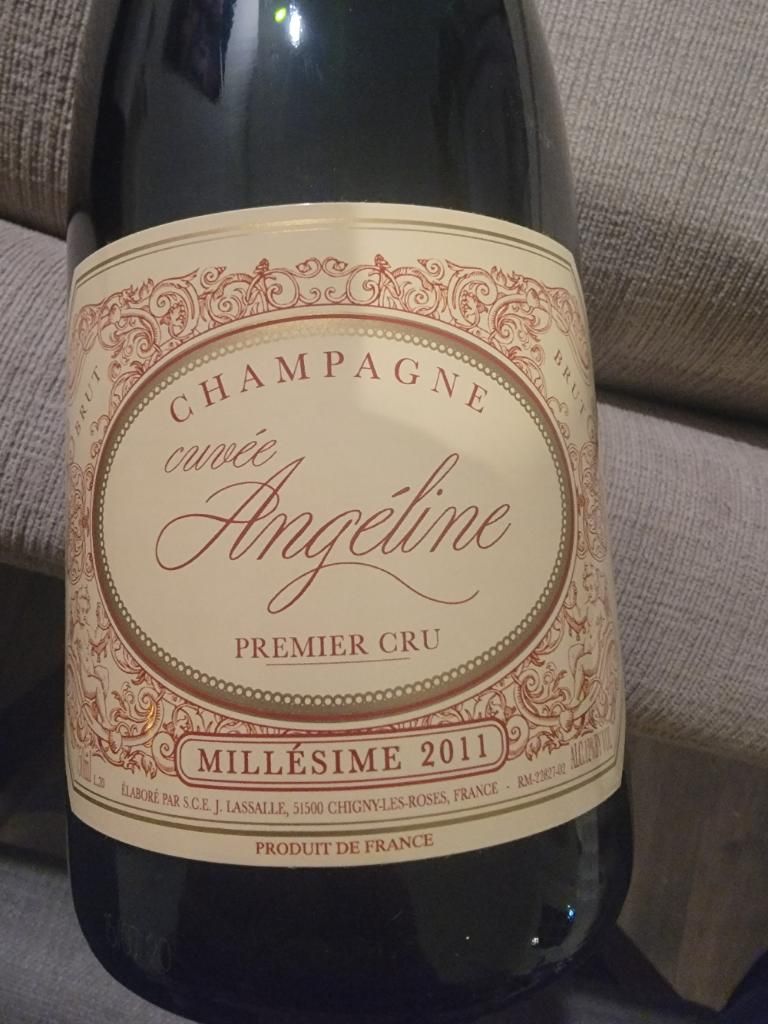
NOSE: strong yellow apple aspect; a bit bready; smells like it’s going to be boldly-flavored; slightly oxidative.
BODY: very active bead; brassy / golden yellow color; medium-light body.
TASTE: brimming with flavor — apple-y — oxidative; rich, but quite dry and not sweet; sherried edge, which I find pleasant (or tawny port, with a longer stretch). Enjoyed this one, and would rebuy. {ignore 2011 vintage in the CT picture; my TN is for the 2012}
We had a bottle of Andre Clouet 1911 NV last night. This was our third bottle and our least favorite of the bunch. The first two were extremely enjoyable and hoped for more of the same. This one had a slightly gasoline/kerosene type of note in the middle that really threw everything off. Our first two times around it had a very nice, soft, delicate flavor at the end that we really liked and this time it was notably more “harsh” I guess I would call it. What I just wrote may give it an overall negative impression but in reality we still liked it well enough and happily finished the whole bottle but it was interesting that this particular bottle wasn’t as successful as before. We hope our next one will bounce back strong.
Nice, organized notes. This release was one of our house bubblys back in the 90s, early 2000s. I’ve only had a few since and am not encouraged to seek any out after your 2012 experience. .
Similar experience with two bottles, the second was a fairly unique, simultaneous combination of youngish-fresh and mature; the first was angular and all about the acid. The seller of the first acknowledged consistency issues.
Yeah, if one doesn’t like the oxidative style, particularly when married to low dosage, then this one should be avoided. Curiously, this wine represents a departure from my usual preference for a more non-oxidative style. I have one of two bottles remaining, so I’ll be curious to see if bottle two is in-line with number one. Sounds like the style used to be something different back when you were tasting it on the regular, Blake?
It was different, but bordered on being advanced. I had to be careful as to how long they had been stored as some came from WTSO. I noticed a change about 20 years ago to what you experienced.
I prefer champagnes that do not have oxidative notes as they tend to be more monochromatic.
One of the most fascinating aspects of selling champagne is witnessing the evolution of new producers. A standout example for me has been Delphine Laborde Costheur’s development with Saint-Pierre les Dames. Laborde Costheur is a unique figure in the grower-producer scene, a trained enologist with experience at Bollinger under Matthieu Kauffman, and later at Veuve Clicquot, before she took over her family’s vineyards in Nogent L’Abbesse.
A particularly notable aspect of her Pur, a 100% Chardonnay from Noblesse L’Abbesse, is the consistency of its aromatics over the years, maintaining its distinctive character. Yet, with each new release, a new level of refinement is achieved. The oxidative elements, once more prominent, have been toned down and are now seamlessly integrated into the champagne’s profile. This change has allowed the brioche element, a signature note of this champagne, to become more pronounced, adding depth and complexity.
Furthermore, the dosage has been drastically reduced, leading to a significant increase in precision. This refinement has enhanced not only the champagne’s overall balance but also brought a new level of sophistication. The latest release is the best so far, showcasing the unique apple/pear aromatics and a distinctive grapefruit aroma, typical of Noblesse L’Abbesse, complemented by a complex nutty/viennoiseries aroma.
So after all the chatter about it here I’ve now got a bottle of Un jour de 1911… in stock (at a cost of ~US$82, which is nearly twice what I normally pay for fizz that I find perfectly acceptable). It came with all the paraphenalia (which I guess is $5-10 of the price): straw, wooden case, leaflet.
From which I learn that what I have is bottle 1089/1911 of Tourbillon no. 127, disgorged in January 2023.
I see some TNs etc identifying the base vintage for their bottles. How would I determine that for mine?
Last night we had a 2012 and 2014 Delamotte side-by-side. Both outstanding wines. Interesting comparison. The 2012 was richer, the 2014 had better acidity. Both will continue to improve for a while.
@alan_weinberg Certainly could be a different lot/disgorgement. Unfortunately I don’t have notes about that from the previous bottles, otherwise I’d try to compare
@Stan_Y I guess I’m glad I’m not the only one but also not the best news to hear it’s a somewhat common occurrence. C’est la vie. I’ve got a few vintage Andre Clouet bottles in storage and one more 1911 so here’s hoping those all turn out to be their best
2013 POL ROGER BRUT- blind; it had a light yellow color denoting youthfulness, but after tasting it, I was leaning more toward the 2008 vintage as it had lots of richness and energy; the nose was full of fresh, with an emphasis on fresh, lemon and lime notes which received a coat of honey and an accent of ginger in the taste profile; it was delicious and nicely balanced, holding steady for over an hour in the glass; IMHO, it ranked in the higher echelon with some of the Grand Marques; in retrospect, it really did not have the power of most 2008s and the fruit was super fresh and ripe suggestive of a younger vintage.
Brian,
I’m happy to read this. I just took delivery on two. I haven’t opened a Lassalle in 14 years, but bought them after reading this:
“Montagne de Reims, 60% Pinot Noir 40% Chardonnay… 8 years on the lees and limited production. Always the most charming and elegant wine from Lassalle, soft pinot contours that are about as inviting as it gets.”
Cheers,
Warren
I’ve recommended this cuvée and have opened a bunch of bottles over the years. I would have argued they’ve been completely consistent… until my last bottle. Now, I’d say there’s an occasional dud. Given the price and typical quality, worth the risk for me.
2005 DOM PERIGNON BRUT- the color was a youthful light yellow, but the nose had caramel and stone fruit notes that suggested an older wine or at least one that was advanced; this dance continued on over the course of the evening and I struggled to get the vintage, assuming it was; subtle aromas of pepper and licorice that I find in Piper Heidsieck Rare swayed me in that direction, but then other notes of spicy citrus and honeysuckle that came in later said otherwise; there was enough acid to actually cause a bit of a sting on the tip of my tongue; bottom line after an hour or so, this was delicious, refreshing and absolutely fabulous; it just took a while for it to get it together. My list of possible suspects also included Charles Heidsieck, Laurent Perrier, Launois or even Duval Leroy, but I never considered DP and wondered if the initial citrus dominate profile had given way to peach, tangerine and apricot via oxidation.
A decent quaff for $29.99, with lemon yogurt, peach, apple, and licorice notes. I feel like the lack of a minimal dosage was a missed opportunity, however. It’s not at all severe, just lacking a little generosity. I feel like two or three grams of dosage would have made the flavors pop and given it a bit of opulence. Still, for the price, I can’t complain. Perfect for those weeknights, like tonight, when I am feeling run down and am resorting to the drive through for dinner. Paired quite nicely with Little Caesar’s. Not loving the finish, however, which resembles Peach LaCroix.
Not sure what the story is with this cuvee. There are no reviews online, nothing on cellartracker or vivino, and no mention on Moutard’s website nor the importer’s.