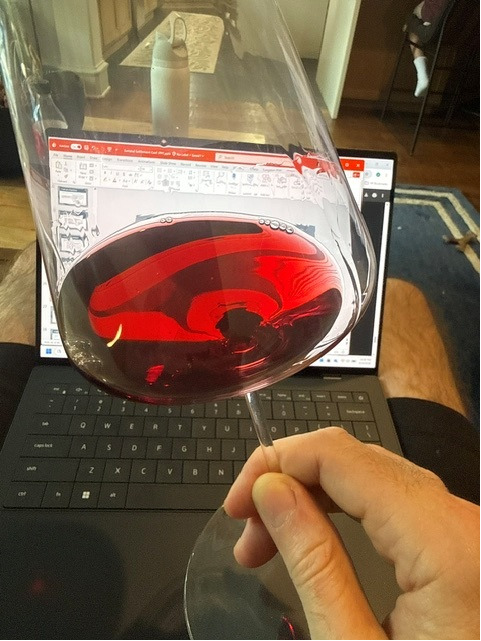
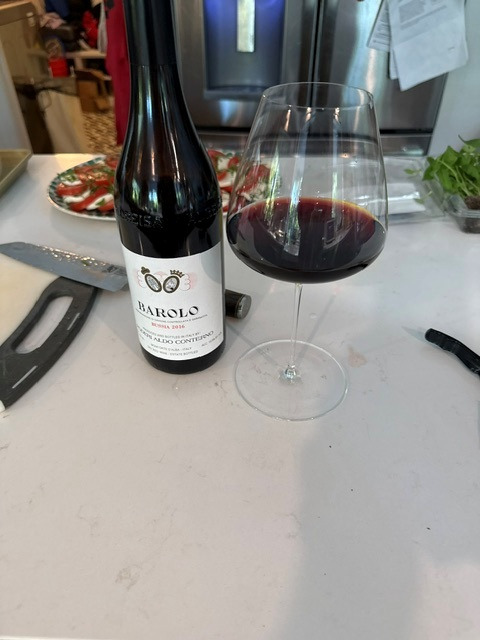
2022 Kelley Fox Wines Weber Vineyard - Beautiful vibrant red berry aromatics, with cranberry cocktail, pomegranate, rhubarb, transitioning to a faint aroma of blood orange and baking spice. The wine is clear and bright in the glass, with a lightness of color that belies the wine’s wonderful complexity. An absolute delight to drink, with enough structure to carry a decade and more.
I know there is some chatter above about vintages, but for me Kelley’s 2022s are absolutely spectacular. This wine is no exception, and delivered everything I was hoping for. A triumph.
Thanks for the note John! I think this is an interesting observation. When I think of this wine, and Kelley’s Pinot more broadly, I personally think of it slightly differently, as below, so I wonder if this makes sense to you.
“The wine is clear and bright in the glass, with a brightness of colour (and flavour) that belies the wine’s wonderful complexity.”
It’s a likely artefact of my WSET training, but I tend to think about a wine’s colour first in terms of its intensity (pale / medium / deep), and then the nature of the colour itself. Using that framework, there are various wines with pale intensity (is this analogous to your use of “lightness”?) that create an expectation of complexity - many Barolos and Burgundies, for example.
For me, though, it’s the bright nature of the colour that can create the expectation of a simple, fruit-forward wine..I know the two can be independent, but the expectation tends to carry through. I think this extends to the flavour profile too. The bright fruit flavours work in combination with a much broader array of aromas and flavours to create complexity. That combination of brightness and depth is actually a big part of what I love about these wines. Does that distinction make sense to you?
I’d also be curious what you particularly love about the ’22s vs. other vintages.
Purity of fruit, brightness of acidity, wonderful balance between the two, adequate but not intrusive structure. Call it an issue of personal preference, but I’ve preferred the 22s over 21s in almost every instance, and over 23s. I like 2019s as well, I’ve just not been drinking them side by side. And I drink too sporadically to pontificate on how 22s compare to older vintages of Oregon pinot, though I’ve had them from probably every vintage going back to 2004 when I began my foray into the region in earnest and began visiting.
I appreciate your comments on color. I’m not entirely sure I follow the distinction your making. I think most people get handed a glass of wine that is a clear light ruby color and they think it’s not going to be a particularly complex wine. Maybe they think it will be thin, or simple as you suggest. Not really the brightness, to me, which often just suggests it’s really young. And I don’t think I’ve had many youngish Baroli that I would describe as “pale intensity” for color. And really the same is true for most burgundies. For instance, there is no color comparison between the Kelley Fox wine I described above, and the same vintage of Denis Mortet’s gevrey Mes Cinq Terroirs.
The uniquely pale but clear and bright color of some of Kelley’s wines reminds me a bit of RAEN’s wines where you pour them and you’re like, holy smokes that’s pale, but the aromatic intensity is wild and the wines complex. I’m guessing it has much to do with use of whole cluster, but there are plenty of folks making more deeply colored and still relatively low abv wines that show much greater pigment extraction.
Thanks for the vintage comments — it helps me to build a picture of Oregon vintages.
I think you’re right about most people. There’s quite a lot of research on colour and expectation. It seems a little more mixed for experienced tasters.
This is probably a calibration mismatch. By WSET standards a lot of them would be (although not your Mortet for example). This makes me think I need to stop relying only on that scale, which serves a specific purpose, and be a bit more nuanced..
Following the discussion I’d now think about it on three axes:
1/ how pale or deep it is
2/ the hue (purple/ruby/garnet)
3/ how vivid or muted it is at whatever paleness it happens to be
The third axis is what I was getting at. WSET certainly doesn’t cover this and Interestingly neither does CMS really in my understanding. I believe their " brightness" line is more an extension of clarity.
The reason vivid (or bright) can say “simple” to me is a bit unglamorous - I taste a fair amount of very cheap wine, and often it can be pale, ruby, vivid (and also aggressively fruity in an artificial way). Completely opposite wines made in completely opposite ways, obviously, but Kelley Fox, at least superficially, lands in the same corner of that colour grid, which is probably why the contrast is striking. Your RAEN example is a great one in the same mould.
Frankly, rather than colour, the flavour part of the equation is the most fascinating to me as that mix of brightness and depth is a lot of what I like about these wines. Does that make more sense? Rather more than you asked for from a tasting note, but it’s helped me straighten out my own thinking if nothing else!
I don’t think the 2024 Carter has been released yet. 2023 is the current version for now. Some other 2024 single vineyard Pinot Noir wines were released earlier this year.
Turn the dial on Burgundy back 25 years and you will see wines the same hue as Kelley’s (or ours) on a regular basis.
Domaine de l’Arlot
Ghislaine Barthod
De Montille
Dujac (whose wines are quite dark these days)
Robert Arnoux
To name a few, but therr were tons. Global warming and modern techniques have altered the presentation of most of the Burgundy I see these days about 4 steps darker.
I know that now Burgundy is the Burgundy that sets the bar. But back in the day I had two different Burgundian producers tell me that, “if you can’t read the newspaper through it, it isnt Pinot Noir”.
I’ve requoted that well over a thousand times in tasting appointments but these days it just doesn’t apply anymore. That said, I happy Kelley rolls the way she does.
Of the people that ACTUALLY deserve to be called legends Josh Reynolds sits comfortably within the inner confines. I have 1,000 stories about him and they’re all magic. Dude was one of a kind.
We used to punch down 2x/day every day. That was the program. We don’t punch down ever now (pump over and pigeage). Some fermenters see maybe an every other day intervention of some sort. At most a fermenter has a daily intervention but that is rare at this point. We do WAY less because that’s what is warranted.
Funny, we added pumpovers the first week of fermentation because it’s more extractive than punchdowns in the whole cluster ferments. The early “punchdowns” are a waste of time with high whole cluster.
I should clarify, we pump over the first week it’s in the fermenter, that’s mostly pre-ferment plus maybe 1-2 days of early fermentation.
Though I still prefer old school switching to two a day punchdowns until we get to around 3-4 brix (the first and then we drop to one per day for 2 days or so and then every other day. We’re in fermenter a long time, so I don’t want to move it too much once the CO2 production begins to drop.
The concept of aggressive punchdowns is a destemmed issue. The Rock couldn’t beat up one of our 100% whole cluster ferments.