Lucky you! That’s the only JG vintage I haven’t tried - I look forward to reading what you think of it.
Looks like I had the 1995 about 3 1/2 years ago, and that it showed better on the second night.
Given that I think I’ll try to hold on for a couple years before I pop my last one.
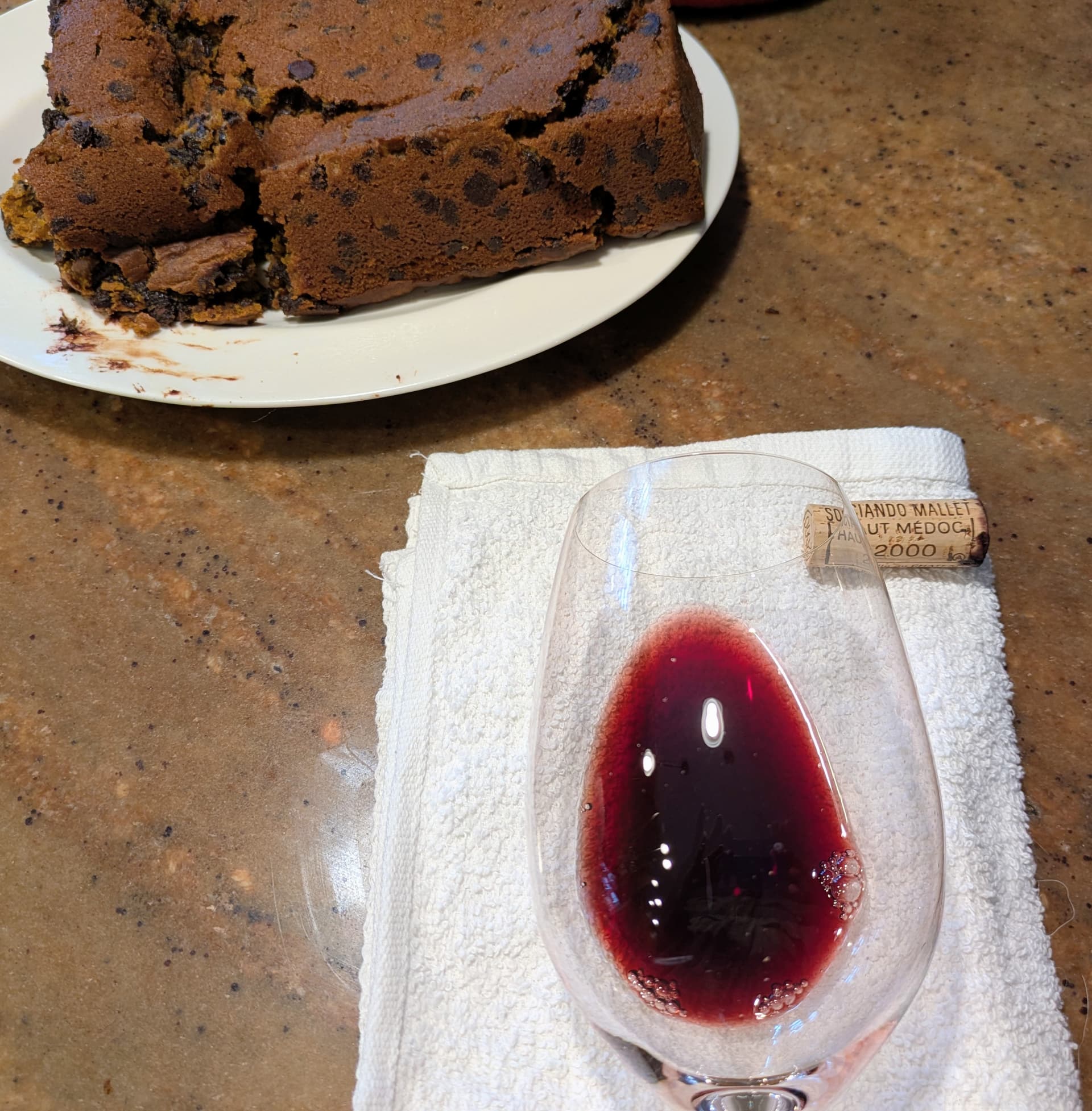
This motivated me to open a 2000 S-M tonight to go with a roast spatchcocked chicken, and I thought the color comparison might be interesting. I know it’s not a ‘grapes to grapes’ fair comparison, but the Gatreau bottling seems darker.
What other Bordelais are making JG type analogs? It seems rare in the region
2 Likes
Sounds fantastic, though given your and Julian’s advice I think I’ll focus on finding the '01 in both normal and JG cuvees (already got a few of the '01 regular wine coming) over the '00. Still wish I had more of those '04s, but looking forward to the '04 JGs I picked up.
I think that the Cuvée JG is indeed darker, but perhaps that’s my imagination. It’s certainly glossier and more concentrated.
At Sociando-Mallet, they’re very wary of pushing the Cuvée Jean Gautreau, in order to protect the core brand, which makes sense since it represents such a small percentage of the overall production. Indeed, they’re at pains to refute the idea that it’s a “premium cuvée” at all, rather “another expression” of SM.
I think the whole idea of “premium cuvées” is anathema in Bordeaux, at least on the Left Bank, because brands cannot be seen to have diminished the quality of the main product. So instead they have increased selection, with more going into second and now third wines, and sometimes talk of only certain plots like the Grand Clos at LLC, or “Terrace 3” (or 4, or whatever) elsewhere going into the main wines. Likewise, when a Cru Bourgeois is bought by a Cru Classé, it is with the aim of incorporating the wine from the best plots into the CC, the remainder of the former CB’s production going into the CC’s second (or third) wine (because unlike in Burgundy in Bordeaux the brand is classified, not the vineyards). Thus the quality and prices of the main product rise.
I’m struggling to think of any equivalents to the Cuvée JG. A wine like Haut Condissas, belonging to the owner of Rollan de By, was thought by some to be a premium wine but is in fact a separate property. There are wines on the Right Bank like Fleur de Gay and Péby Faugères, which sound as if they are premium wines, but which are I believe also separate estates. There are one of two “Cuvée Excellence” type wines, but they’re only from pretty obscure properties.
Sadly, the Cuvée JG 01 is hard to find! I’ve only tried the JG 04 once. I didn’t take notes, which was stupid of me, but I do remember really enjoying it. The only JG I’ve been indifferent about is the 2003, but that was several years ago and it’s probably better now.
2 Likes
In the case of Angelus, I take you are thinking of Cuvee Elisabeth Bouchet as a separate assemblage more than a premium selection, correct?
Definitely premium at $1200+! Hommage à Elisabeth Bouchet Is an old vine Cab Franc wine.
Trotevielle makes a Cab Franc Cuvee that is pretty unicorn: Les Vieilles Vignes du Chateau Trottevieille. Very old vine CF, some allegedly pre-phylloxera.
1 Like
Agree about the premiumness, but @Julian_Marshall was making a point that “premium cuvees” are something chateaux tend to want to avoid in order to protect the main bottling’s image.
I was interested in understanding whether Angelus tries to (over-proportionately) push the “the assemblage is different, and therefore it is not a wine that is quite similar but more premium” message vs. “it’s a similar wine from the same terroir, but with the best grapes”, which would be closer to Chave’s Cathelin.
The grapes come from the same vineyard but from a premium area of old vine CF, some around 100 years old. So we can call it a premium cuvee, and it is, but it is a different wine compared to the base Angelus. I think the JG is still more similar to the base Sociando. Still a blend, perhaps more Cab, and perhaps more new oak, but ultimately similar, structurally.
2 Likes
I’m surprised you know so much about your friend Hube’s business! Actually joking aside I think Fred and yourself know a lot more than I do about those wines- I’d never even heard of the Angélus cuvée, nor the Trottevieille one. I’m sure there are others on the RB I don’t know about. Isn’t there a premium version of La Fleur de Bouard too? Anyway it does sound as if the JG is a different case. And a lot more affordable!
I think there are some good wines being made at top Château that may not fit in with the first wine, and are relegated to being second wines.
I was always skeptical of Alter Ego from château Palmer, but it is always has always had a unique signature very different from the Grand Vin. It is a $50 bottle and I think comparable to many first wines at the same price.
Yes, Le Plus, which is 100% Merlot, old vine, compared to the base Cuvee which I think is around 85% Merlot. It is just more of more, not a fan. But I guess in some respect this would be the analog to JG Cuvee and similarly priced. If you’re a fan of modern and ripe Bordeaux, this would be the one to get, I guess.
And yes, I should not know these things!
Being even remotely associated with Robert’s wine knowledge is a compliment I’ll take any day 
1 Like
Good observations on the Fleur de Gay and Peby Faugeres - I had forgotten about them - but I do think they are separate plots/vineyards. And a shout out to @Michel_Abood for pouring us the 89 and 90 Fleur de Gay years ago for a side by side comparison too; that was truly memorable for a blurry night.
I guess it’s interesting/cool that some of these properties are bottling up special sites, and offering enthusiasts an introduction to their magic, but part of the glory of Bordeaux is the healthy production/distribution. I like being able to talk about an estate with enthusiasts here, or pull together (now rare!) mini verticals.
PS: I’m having the rest of the 2000 Sociando tonight, and despite being a pyrazine influenced bottle, it is much better on day 2.
2 Likes
The Fleur de Gay is a separate parcel to La Croix. Its proximity to Petrus was the main reason to create it. We were in Bordeaux in 1985, when the owner Alain Raynaud was showing off the first commercial vintage, the 1983. Still have a signed bottle somewhere.
Raynaud BTW was the consultant behind the only Pavie under Perse that I would buy, the 1998. Soon after, he was set aside, and Michel Rolland took over.
1 Like
Had the 2020 SM last weekend. Pretty boring, un-Sociando, international style. Meh
3 Likes
I took advantage of a brief lull between heatwaves to open another JG 2000 last night:
The nose is very brambly at first, quite deep, but later with more floral notes and yes, a little red pepper (rather than green), all very mouth-watering and enticing. The attack is rich, quite powerful, but not overpowering, full of blackberries and black cherries, before a cooler wave of blackcurrant and a salty streak - then (roll of drums…) - the finish: this is glorious stuff - all the fruit flavours come back together, with wafts of red fruits sidling up to the tastebuds, the whole thing rising swiftly to the top of the palate where it bursts like a firework display, before lingering long afterwards. All very impressive and obviously CC standard. My only “but” would be that for all the fireworks, I still prefer the JG 01. Anyway, a great wine which would be a match for any 00 I’ve tried so far. 94 pts
2 Likes
Wonderful notes, Julian. I think I have one of each left. I agree with you, the 2001 edges the 2000, and frankly is the greatest JG I think that has ever been made, since it’s start in 1995. I love the 95, I have one bottle of that left.
1 Like
Thanks Robert! Yes, we agree - the JG 01 is the best I’ve tried so far. It’ll be interesting to see if any of the younger vintages end up challenging it. It would be fun also to put the JG 00 in a horizontal with other 00s -now there’s an idea…!
1 Like
I have not tasted the Gautreau, but I had real problems with the basic Sociando. I like a bit of herb, but this was so dominant, it obscured the fruit and anything else in its path.